
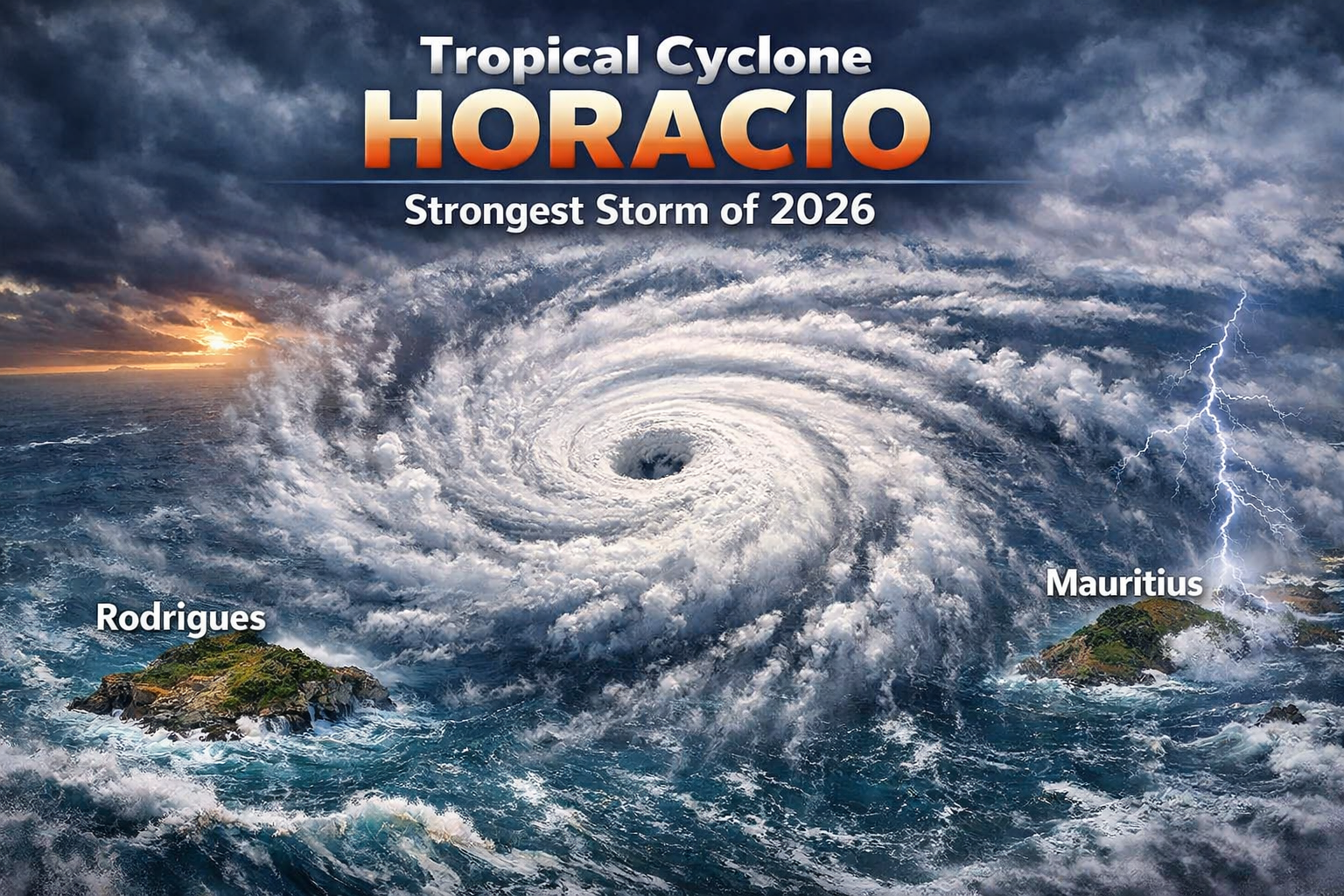
Tropical Cyclone Horacio has rapidly emerged as the standout tropical cyclone of 2026 to date, intensifying in the southwest Indian Ocean east of Mauritius and near Rodrigues before beginning a weakening trend over open water. Based on Joint Typhoon Warning Center (JTWC)-based reporting summarized by the Pacific Disaster Center (PDC), Horacio reached 140 knots in warning number 9 (about 160 mph / 260 km/h on a 1-minute sustained basis), which places it in Category 5-equivalent territory on the Saffir-Simpson scale.
By the morning of February 24, 2026 (UTC), the storm was already showing signs of weakening, but it remained a very powerful system. A JTWC advisory mirror showed Horacio at 120 knots with gusts to 145 knots at 06:00 UTC on February 24, positioned near 22.5°S, 64.3°E and tracking south-southwest. The same advisory noted a minimum central pressure of 941 mb and forecast continued weakening over the next 48 hours.
Mauritius Meteorological Services (MMS) also described Horacio as an “Intense Tropical Cyclone” on its current storm page on February 24, listing the center at 22.4°S, 64.3°E at 10:00 a.m. local time, about 315 km southeast of Rodrigues and 745 km east-southeast of Mauritius, with an estimated central pressure of 955 hPa and movement toward the south-southwest at 19 km/h. MMS explicitly stated the cyclone was “showing signs of weakening while moving away.”
That combination of extreme peak intensity and relatively limited land impact is what makes Horacio such a significant meteorological story: it became a high-end cyclone over water, threatened nearby islands with dangerous seas and strong gusts, then started to decay as environmental conditions deteriorated before a direct catastrophic landfall. Official bulletins and tracking pages show both the dramatic intensification phase and the equally sharp weakening phase within roughly a 24–48 hour window.
Why Horacio Is Being Called the Strongest Storm of 2026
The “strongest storm of 2026” label is tied mainly to peak wind estimates during Horacio’s rapid intensification period. PDC’s February 23 update, citing JTWC warning number 9, reported sustained winds of 140 knots and gusts to 170 knots. That is a Category 5-equivalent intensity by 1-minute wind standards and notably higher than the wind values typically seen in most storms earlier in the year.
A Zoom Earth storm tracking page (which compiles warning information and forecast summaries) also listed Horacio’s maximum wind at 260 km/h and showed a peak entry of 260 km/h at 18:00 UTC on February 23, with a listed pressure of 920 hPa at that timestamp. On the same page, Horacio’s current status on February 24 was already lower (220 km/h at 06:00 UTC), reinforcing how brief the peak may have been.
Some media and weather-focused outlets have gone further and described Horacio as the strongest tropical cyclone globally so far in 2026. For example, The Watchers explicitly used that framing and reported peak winds near 260 km/h (160 mph), while also noting JTWC’s Category 5-equivalent assessment. Because agencies use different averaging periods (1-minute vs. 10-minute sustained winds), exact rankings can vary depending on the metric used, but Horacio’s peak intensity clearly places it among the year’s top systems to date and, by many trackers’ framing, at the top.
That distinction matters because tropical cyclone “strength” can be measured in several ways: maximum sustained wind, central pressure, peak gusts, storm size, rainfall footprint, storm surge, or accumulated energy over time. Horacio’s headline-making status is specifically about peak wind intensity during its brief but explosive strengthening phase, not necessarily overall impact or duration.
The Rapid Intensification Phase
Horacio’s most striking feature was the speed and efficiency of its intensification. PDC’s summary of JTWC warning number 9 described the storm as undergoing rapid intensification under highly favorable environmental conditions, with low vertical wind shear, warm sea surface temperatures, and vigorous radial outflow. The update also described fast eye development and clearing, which are classic signatures of a cyclone strengthening quickly.
According to that same PDC/JTWC-based summary, animated multispectral satellite imagery showed a consolidating storm at 22:21 UTC on February 22, followed by eye formation by 23:00 UTC and a rapidly clearing, warming eye over the next two hours. The report also characterized the wind field as extremely compact, with the maximum extent of gale-force winds confined within 100 nautical miles, another feature often seen in storms capable of sharp intensity swings.
Compact cyclones can intensify very rapidly when the inner core becomes vertically aligned and the environment supports deep convection around the eyewall. In Horacio’s case, the PDC summary specifically noted a “finite window of opportunity” for further rapid intensification before conditions would begin deteriorating. That kind of wording is consistent with storms that peak quickly and then weaken abruptly once wind shear or dry air increases.
Zoom Earth’s timeline also reflects this acceleration in intensity. The page shows Horacio strengthening from much lower values on February 21 to 175 km/h by 06:00 UTC on February 23, then climbing further to 215 km/h at 12:00 UTC and peaking at 260 km/h by 18:00 UTC the same day. Even allowing for differences in source methodology and update timing, the progression indicates a dramatic intensification burst over a short period.
Why Horacio Started Weakening So Quickly
As dramatic as Horacio’s strengthening was, the weakening phase was almost as notable. By JTWC warning number 10 (24 February), the advisory mirror showed the storm down to 120 knots, and the forecast projected a drop to 100 knots at 12 hours, 80 knots at 24 hours, and 60 knots at 36 hours, with extratropical transition beginning later in the forecast window.
The JTWC prognostic reasoning (as mirrored on HurricaneZone) explained why. It said environmental conditions had shifted rapidly toward unfavorable, driven primarily by significant dry mid-level air intrusion and increasing vertical wind shear. While sea surface temperatures remained warm enough initially and poleward outflow was still strong, the advisory emphasized that the hostile influences were beginning to overwhelm the storm’s structure.
The same reasoning described Horacio as “rapidly weakening” while rounding the axis of a subtropical ridge to the east. It also noted that the eye, while still identifiable, was filling and the deep convection had been reduced. Forecasters assessed the environment as unfavorable, with wind shear in the 15–20 knot range at that time and expected to increase substantially afterward.
Zoom Earth’s forecast summary echoed these factors, highlighting increasing dry air intrusion, rapidly increasing wind shear, and cooling sea surface temperatures as the key reasons for a rapid weakening trend over the next two days. It also stated that the system was expected to begin extratropical transition within a few days as it moved into cooler waters and interacted with upper-level features.
This is a common pattern for intense tropical cyclones that develop in a favorable pocket but then move into a less supportive environment. Horacio appears to have reached its peak during a narrow meteorological window, then weakened as the surrounding atmosphere and ocean conditions changed quickly.
Track and Location: East of Mauritius, Near Rodrigues
Horacio’s track placed it over open waters of the southwest Indian Ocean, east of Mauritius and near Rodrigues, which is why the storm generated serious concern even without making a direct hit on a large population center. MMS’s current storm page on February 24 located the system about 315 km southeast of Rodrigues and 745 km east-southeast of Mauritius, still intense but moving away.
JTWC warning number 10, as mirrored by HurricaneZone, placed Horacio approximately 417 nautical miles east-southeast of Port Louis, Mauritius, at 24/0600Z and moving south-southwestward at 10 knots. That position and motion are broadly consistent with other trackers and MMS data, though slight differences are expected because agencies use different analysis times and methods.
The Rodrigues-focused cyclone warning bulletin from Mauritius Meteorological Services gives a more local view of the closest approach. In its seventh and final bulletin issued at 22:10 on Monday, February 23, MMS said Horacio passed at its closest distance at about 190 km east-southeast of Rodrigues around 21:00 local time, then moved away toward the southwest at an accelerated speed of about 20 km/h.
That distance was close enough to produce dangerous marine conditions and strong winds in showers, but far enough that Rodrigues avoided the worst inner-core conditions. MMS said the risk of cyclonic conditions had “considerably decreased” by late evening February 23 and waived the cyclone warning based on the recommendation of the Rodrigues Crisis Committee.
In practical terms, Horacio was a near-miss for Rodrigues rather than a direct strike. The storm’s center remained offshore, and the most severe winds likely stayed concentrated in a compact core around the eye, while the island mainly experienced outer-band effects and hazardous seas. That distinction is critical when explaining why a storm can be exceptionally strong on paper while producing a more limited onshore damage footprint.
What Rodrigues and Nearby Areas Experienced
Even without a direct eyewall impact, Rodrigues still faced dangerous weather and sea-state conditions. The final Rodrigues cyclone bulletin warned that cloud bands associated with Horacio would continue to influence the island with passing showers, some moderate at times, and forecast southwesterly winds around 40 km/h with gusts of the order of 90 km/h in showers before gradually weakening.
Sea conditions were a major concern. In that same bulletin, MMS warned that the sea would remain high with swells of around 7 meters and strongly advised the public not to venture out at sea or along beaches. This is consistent with the kind of prolonged marine hazard that can continue after the center has moved away, especially around islands and reefs.
MMS also maintained a separate heavy swell warning for Rodrigues. On the bulletin available via the MMS site on February 24, the agency warned of swells of the order of 4 meters, potentially higher at times, with wave breaks expected in lagoons and near low-lying coastal areas during high tide, and advised the public to avoid beaches and not go out to sea. The warning was listed as valid until 10:00 a.m. on Wednesday, February 25, 2026.
The existence of both the cyclone warning bulletin and the swell warning bulletin underscores an important public-safety point: the cyclone threat and the marine threat are not always synchronized. A cyclone warning can be lifted once the risk of cyclonic winds falls, while dangerous surf and coastal wave action continue for many hours afterward.
Public messaging from MMS consistently emphasized marine safety rather than post-landfall damage response, which aligns with the fact that Horacio stayed offshore. As of the available bulletins and summaries cited here, the focus remained on hazardous sea conditions, strong gusts in showers, and precautionary restrictions for the public and seafarers rather than widespread structural destruction.
A Closer Look at the Forecast Path Ahead
Forecast guidance on February 24 indicated Horacio would continue moving generally poleward (southward) and then begin transitioning away from a purely tropical system as it entered less favorable waters. JTWC warning number 10 projected continued weakening at each forecast interval and explicitly indicated the system would be “BECOMING EXTRATROPICAL” by 72 hours and “EXTRATROPICAL” by 96 hours.
The JTWC prognostic reasoning also described the steering pattern in more detail, noting influence from a subtropical ridge to the east and later interaction with a passing upper-level trough. It anticipated structural degradation from increasing shear and dry air, followed by the onset of extratropical transition as baroclinic forcing increased and sea surface temperatures cooled into the low 20s Celsius later in the forecast period.
Zoom Earth’s forecast summary was broadly aligned with that evolution, also pointing to a poleward/eastward turn under the ridge influence, rapid weakening, cooler waters, and eventual extratropical transition. When independent trackers and official forecast discussions converge on the same pathway, confidence generally increases in the broad scenario even if precise positions and timing still shift somewhat.
For residents and mariners in the Mascarenes region, the key operational takeaway is that Horacio’s highest-risk phase for direct cyclonic conditions appears to have passed by the time of the latest Rodrigues bulletin, but residual ocean hazards may continue as the system pulls away and its swell field propagates through the region.
Why This Storm Matters Beyond the Headlines
Horacio is a useful case study in modern cyclone monitoring because it highlights how quickly storm intensity can change, how compact systems can produce major swings in wind speed, and how local impacts depend heavily on track and storm structure, not just peak category labels. A Category 5-equivalent storm offshore can still be a serious threat due to waves, surf, and outer-band winds, but it may produce far less devastation than a weaker storm making a direct landfall over a populated coastline.
It also shows the importance of understanding agency differences. In the southwest Indian Ocean, Météo-France’s RSMC La Réunion and Mauritius Meteorological Services use regional classifications and warning systems, while JTWC uses 1-minute sustained wind estimates often translated by media into Saffir-Simpson “Category-equivalent” labels. These are useful for public communication, but they are not always directly interchangeable without context.
Another reason Horacio matters is timing. The cyclone developed during the climatologically active Southern Hemisphere season and intensified rapidly in a basin where sea-surface temperatures and atmospheric patterns can support sudden strengthening episodes. Weather outlets covering the event have noted that Horacio intensified during a period of favorable upper-level outflow and warm waters before running into increasing shear and dry air.
For forecasters and emergency planners, Horacio reinforces the need for fast update cycles and layered hazard messaging. The sequence seen in the bulletins—cyclone warnings, then warning removal, while marine hazards remained elevated—demonstrates why “storm is moving away” does not automatically mean “danger is over.”
Final Assessment
As of February 24, 2026, Tropical Cyclone Horacio stands out as the most intense tropical cyclone of the year so far by widely cited peak wind estimates, reaching Category 5-equivalent strength on the JTWC 1-minute scale before weakening over open waters east of Mauritius. PDC’s JTWC-based summary cited 140-knot sustained winds in warning number 9, while later advisories and trackers showed the storm already declining as shear and dry air increased.
Rodrigues experienced a near-passage rather than a direct hit, with strong gusts in showers, dangerous swells, and continued marine hazards even after the cyclone warning was lifted. Official Mauritius Meteorological Services bulletins documented both the closest approach (about 190 km east-southeast of Rodrigues) and the lingering swell threat that extended into February 25.
The biggest lesson from Horacio is not only that it became exceptionally strong, but that it did so quickly and then weakened quickly once the environment turned hostile. That full lifecycle—from rapid intensification to rapid decay—makes Horacio one of the most important tropical cyclone events of early 2026 for meteorologists, forecasters, and anyone tracking severe weather risk in the southwest Indian Ocean.