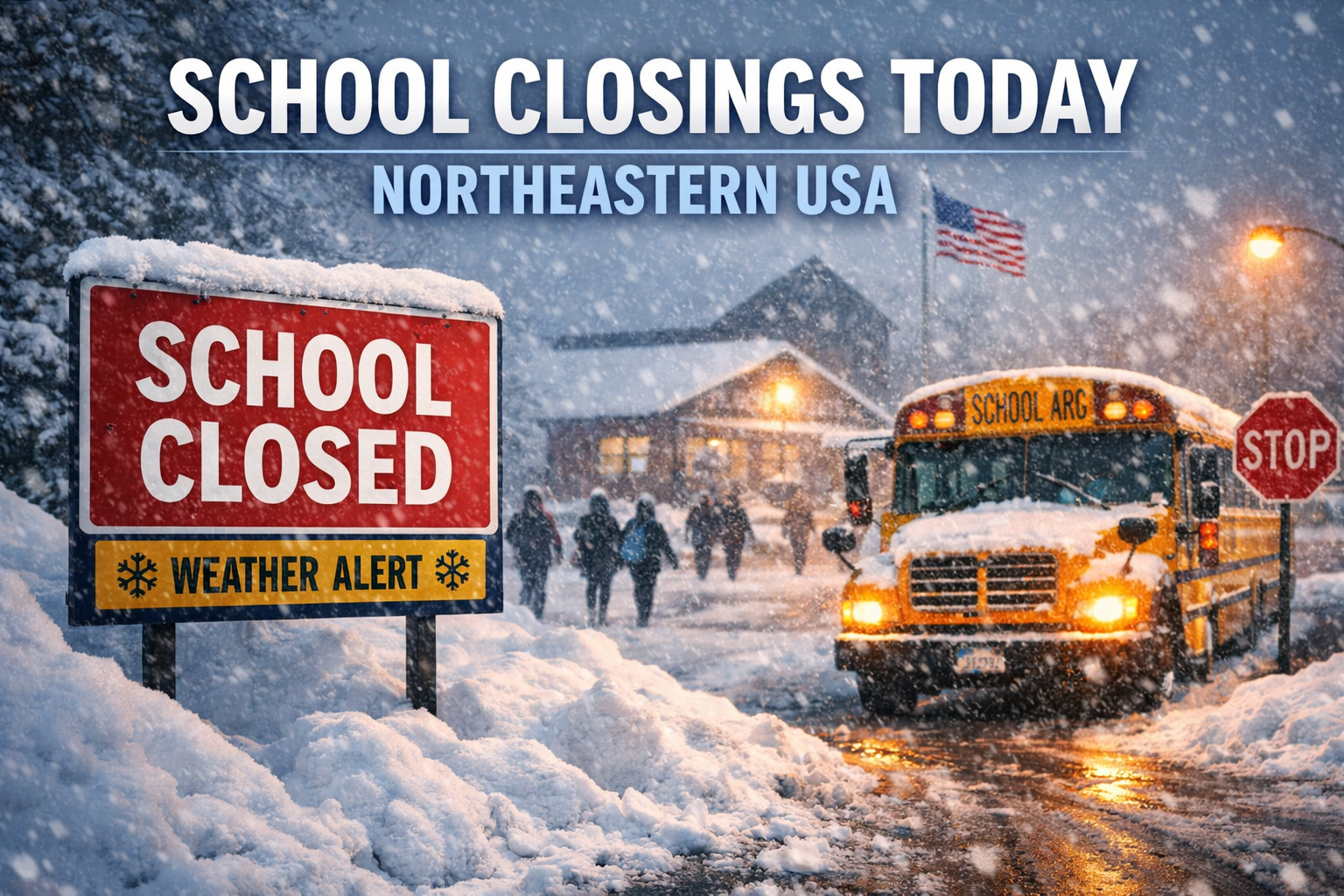
As of Wednesday, February 25, 2026, many schools across the Northeastern United States still face closures or delays after a historic blizzard, while a smaller follow-up storm adds fresh snow and icy roads in some areas. This article gives a regional overview of what is driving closings today, where disruptions remain strongest, and what families should expect through the rest of the day.
The short version is this: the worst issue in many places is no longer heavy snowfall. It is cleanup. Snowbanks, icy sidewalks, blocked bus stops, and local road conditions now drive many district decisions. A midweek clipper system also brought a fresh burst of snow to parts of the region, especially Connecticut, which created new morning hazards on top of existing snowpack.
Why schools are still closing today
A major storm earlier this week buried parts of the Northeast from Maryland to Maine. The Associated Press reported widespread disruptions, including canceled flights, transit problems, power outages, and school closures. It also noted that some areas in Rhode Island topped 3 feet of snow.
Even after the heaviest snow ended, communities still had to clear streets, sidewalks, and access points around schools. That cleanup takes time. It also varies block by block. A district may have clear main roads but unsafe side streets or bus routes. That gap explains why neighboring districts can make different decisions on the same morning.
On Wednesday, a weaker clipper system added another layer of risk. The AP said a Great Lakes storm would move into the Northeast on Wednesday, with a mix of rain and snow and slick conditions from freezing temperatures. AP also reported New York City emergency officials warned commuters about black ice and slippery roads and sidewalks.
This pattern matters for schools. Superintendents do not only weigh snowfall totals. They weigh timing. A light snow event during the morning commute can cause more school disruptions than a bigger storm that arrives overnight and ends early enough for crews to work. Connecticut’s Wednesday clipper hit right in that risky window.
Massachusetts remains one of the hardest-hit areas
Massachusetts still shows major disruption today. Local outlets reported continuing closures and delays as communities dig out from the earlier blizzard. NBC Boston said many schools remained closed, and it highlighted ongoing cleanup and power outages in the state.
NBC Boston also noted that Monday’s storm dropped more than 2 feet of snow in many parts of Massachusetts and Connecticut, while Rhode Island saw more than 3 feet. The same report cited more than 172,000 Massachusetts customers without power around early Wednesday. Power restoration progress helps, but outages still complicate operations for districts and families.
WCVB reported that several Massachusetts districts canceled classes for Wednesday as the state continued cleanup. Its report also said a ban on nonessential travel remained in place for southeastern Massachusetts, while officials asked motorists to stay off roads across the commonwealth to help road crews.
Boston.com reported that some Massachusetts districts would remain closed for a third straight day. It said many Wednesday closures clustered on the South Coast and South Shore, where snowfall was heaviest. That local concentration fits the broader pattern seen after major coastal storms. Areas with the deepest snow and slowest clearing often keep closures longer than inland districts.
In practical terms, families in Massachusetts should expect uneven reopening schedules. One district may reopen with delays. Another nearby district may close again. This does not always reflect caution levels. It often reflects local plowing progress, sidewalk conditions, staffing, and bus route access.
Connecticut faces a fresh morning commute problem
Connecticut saw a different challenge on Wednesday. The state already dealt with major snow from the earlier blizzard. Then a clipper system arrived during the morning commute and added fresh snow and black ice risk. CT Insider reported the snow would move west to east between roughly 5 a.m. and 8 a.m., with some areas seeing snow linger until about noon.
CT Insider also reported expected snowfall amounts of roughly 1.5 to 2 inches for most of the state, with up to about 3 inches in the Northwest Hills. Those totals look modest. Still, timing and temperature made them disruptive. The report cited weather service warnings about snow-covered roads, reduced visibility, and black ice while temperatures stayed below freezing through mid-to-late morning.
That combination pushed districts to close or delay again. CT Insider’s reporting said dozens of schools across Connecticut closed or delayed openings, with notable impacts in southeastern Connecticut and in places including New Haven, Hamden, and West Haven. Another CT Insider report also said several schools announced closures and delayed openings as the state braced for an additional 1 to 3 inches.
The Connecticut situation shows why “today’s school closings” often reflect both storm recovery and new weather at the same time. Families may hear “only a couple inches” in the forecast and still wake up to a delay. The road surface and leftover snowpack can matter more than the headline total.
New York City reopened, but the region still has delays
New York City took a different approach than some nearby districts. AP reported that New York City’s public school system resumed regular in-person classes Tuesday, while many large districts, including Boston and Hartford, remained closed. AP also reported that more than 900,000 NYC students had a regular school day and that many families still had to navigate large snowbanks during drop-off.
AP further reported a sharp attendance drop in New York City on that return day. Preliminary attendance came in at 63% of roughly 900,000 students, compared with an average near 90% the prior school year, according to city data cited by AP. AP also said nearly 1 in 6 teachers called out and officials brought in more than 5,000 substitutes.
That NYC decision does not mean the broader metro region returned to normal. FOX 5 New York published a Wednesday, Feb. 25 tracking page for school closings and delays in New York, New Jersey, and Connecticut. The page listed multiple delays in New York and New Jersey and said Connecticut had none at the moment on that specific tracker snapshot, while also directing readers to real-time updates.
FOX 5’s examples included delays in districts such as East Islip, Marlboro Central, and Riverhead in New York, along with several New Jersey districts with 90-minute or 2-hour delays. That list may change throughout the morning, but it shows that many communities still face transportation and road-condition issues even when major city systems reopen.
This creates a common Northeast pattern after big storms. A large city district may reopen for service reasons, staffing plans, and system-wide policy. Meanwhile, suburban or smaller districts may choose delays because local road conditions remain uneven. Both choices can make sense in context.
Philadelphia and parts of the Mid-Atlantic move toward reopening
The Philadelphia area also illustrates how quickly conditions can shift day to day. NBC10 Philadelphia reported that schools across the region announced closures or virtual learning for Tuesday, Feb. 24, due to the Nor’easter, including the School District of Philadelphia moving to remote learning that day.
By Wednesday, AP reported that some large districts returned to in-person classes, including Philadelphia, which had used online learning during the first two days of the week. That move suggests stronger progress on cleanup and transportation compared with the worst-hit parts of southern New England.
Still, “reopen” does not always mean normal operations. Families may still see bus delays, slippery sidewalks, canceled activities, or changed pickup routines. After a storm of this scale, schools often restore instruction first and then phase back athletics, events, and full building operations.
Rhode Island shows how deep snow keeps disruptions going
Rhode Island took some of the most extreme snowfall in this event. AP reported that more than 3 feet fell in parts of the state, surpassing totals from the Blizzard of 1978, and another AP update described the storm as record-breaking in Rhode Island.
That level of snow creates a longer recovery cycle. Even if highways improve, side streets, sidewalks, parking areas, and school entrances can stay blocked. AP also described ongoing accessibility concerns in the region, especially for people with disabilities, because packed snow and snowbanks narrowed or blocked routes. Those same conditions affect school arrivals and dismissals.
Rhode Island’s closure networks reflected broad disruption on Wednesday. The Rhode Island Broadcasters Association closings page listed many public schools, private schools, Catholic schools, colleges, childcare centers, and community organizations as closed, delayed, or operating remotely. The same page also included cross-border entries from southeastern Massachusetts and a few eastern Connecticut schools, which shows how regional media closure systems can capture the real geography of a storm’s impact.
Providence Public Schools’ closings and dismissals page explains how the district communicates emergency schedule changes, including media partners and parent messaging systems. That framework matters during storms like this because updates can change early in the morning as crews assess local conditions.
What families should expect through the day
The biggest risk this morning was slick travel, not extreme snowfall rates. AP and local reports repeatedly flagged freezing temperatures, black ice, and lingering cleanup as key hazards. That means even places with only delays may still see a rough commute and slower buses.
Conditions should improve in some areas later today as temperatures rise. CT Insider reported Connecticut temperatures should move into the upper 30s to around 40 by the afternoon, with road conditions improving after the morning burst. That said, shaded roads, packed snow, and slush can still refreeze later.
Families should also expect uneven decisions for after-school programs. Districts often reopen classes but cancel sports or evening events to reduce late-day travel risk and allow more cleanup time. Local closure pages often update those activity decisions separately from school-day status.
Why “school closings today” changes so fast online
People often search “school closings today northeast USA” and expect one complete list. In reality, no single page covers every district in the region in real time. The Northeast has thousands of districts and private schools across multiple states, with separate policies and local media partners. Today’s results show that clearly.
Regional newsrooms publish useful trackers, but they usually cover a metro area, not the entire Northeast. For example, FOX 5 focused on NY/NJ/CT, NBC Boston focused on Massachusetts, and NBC10 Philadelphia focused on the Philly region. Rhode Island broadcasters maintain a broad local closings network that also catches some nearby Massachusetts and Connecticut entries.
That means families get the best answer from a layered approach:
- district alerts first
- local TV/radio closings tracker second
- weather updates third
- regional news for context
Providence Public Schools’ page, for example, explicitly describes its communication channels for weather closures and schedule changes.
Bottom line for today in the Northeastern USA
School closings across the Northeastern U.S. on Wednesday, February 25, 2026 reflect a mix of storm recovery and fresh weather. Southern New England, especially parts of Massachusetts, Rhode Island, and Connecticut, continues to see the most disruption from deep snow, outages, and difficult cleanup.
Some major systems have resumed in-person learning, including New York City earlier in the week and Philadelphia by Wednesday, but many communities still report closures or delays based on local road and sidewalk conditions. The regional picture remains uneven, and updates can shift quickly.