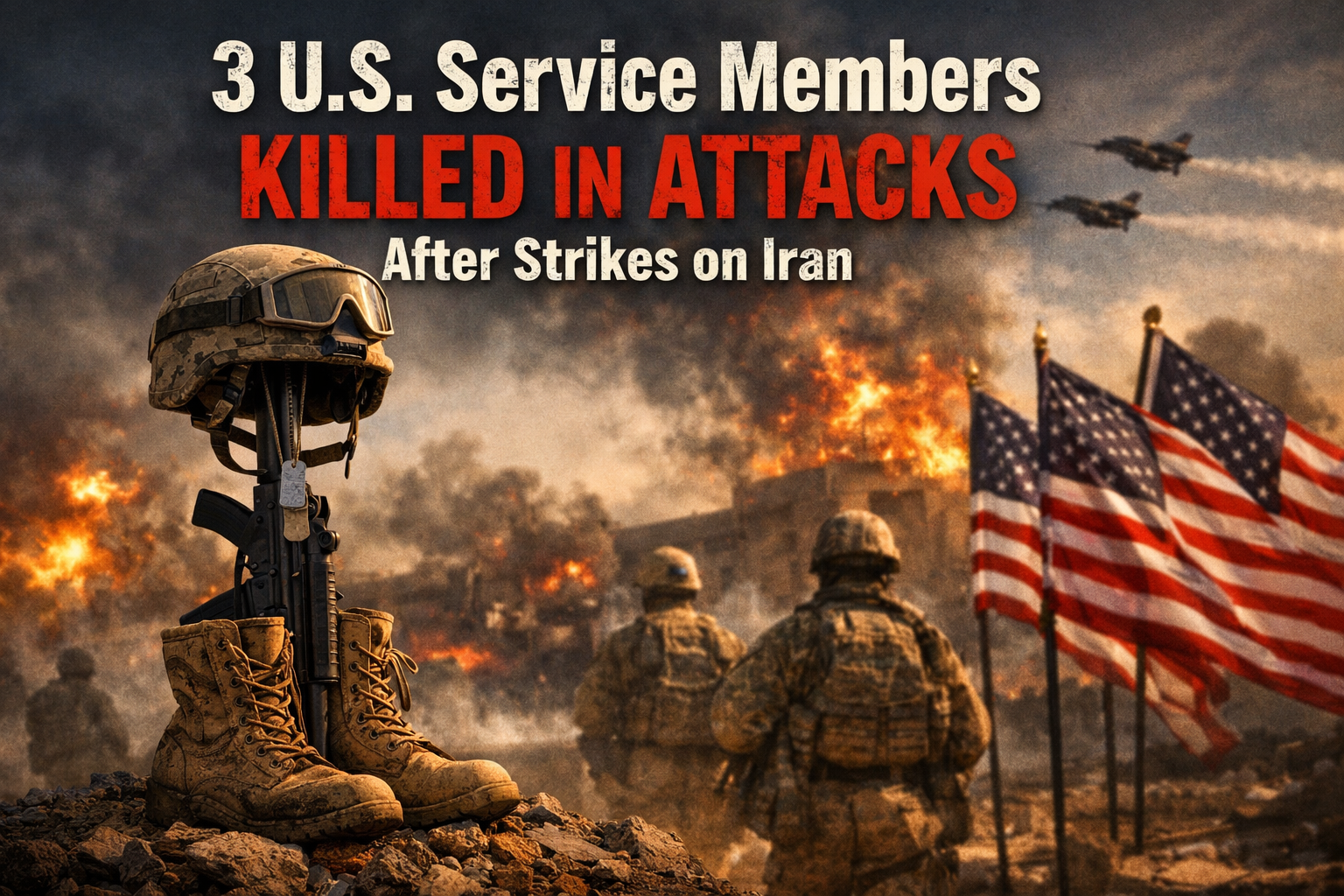
The U.S. military says three American service members have died since the United States and Israel launched strikes against Iran, marking the first publicly confirmed U.S. combat deaths tied to the new phase of fighting. U.S. Central Command (CENTCOM) reported on Sunday, March 1, 2026, that the deaths occurred during “Operation Epic Fury,” and that five additional service members suffered serious wounds. CENTCOM also said other troops suffered minor shrapnel injuries and concussions and have begun returning to duty.
The announcement lands as the conflict widens across the region, with Iran launching retaliatory missile and drone attacks at Israel and at U.S.-linked military sites in several Gulf countries, while Israel continues strikes inside Iran.
What the U.S. actually announced
CENTCOM’s update focused on casualty totals and avoided operational specifics. The command said three service members “died in action” and five remain “seriously wounded” as part of Operation Epic Fury. The statement did not identify where the incident happened, which unit the troops served in, or what type of attack caused the deaths and injuries.
U.S. military practice often delays releasing names until officials notify families. Early reporting on the CENTCOM statement indicates the military plans to withhold identities until the next of kin receive notification.
CENTCOM also signaled that the campaign continues. In its public messaging, the command framed the casualties as part of ongoing combat operations rather than an isolated incident that concluded with the initial strikes.
What remains unclear about how the troops died
Because CENTCOM did not release a location or circumstances, outside observers cannot independently verify where and how the deaths occurred. The region now includes multiple possible theaters: air and missile defense engagements around U.S. sites in Gulf countries, strikes and counterstrikes involving Israel, and activity around key maritime corridors.
In the first hours after Iran’s initial retaliation, some reports said U.S. forces had not recorded casualties. Later updates changed that picture as CENTCOM confirmed deaths and serious injuries. That shift often reflects the reality of combat reporting: commanders sometimes receive incomplete information during fast-moving attacks, especially when units operate across several countries and domains at once.
Online claims also circulated about attacks on U.S. naval assets. CENTCOM-linked reporting pushed back on at least one major rumor, with outlets reporting that the aircraft carrier USS Abraham Lincoln did not take a hit.
How the conflict reached this point
The U.S. casualty announcement follows a dramatic escalation that began with coordinated U.S.-Israeli strikes on Saturday, Feb. 28, 2026. Reporting describes the joint operation as a broad campaign that hit Iranian government and military sites and that U.S. officials labeled Operation Epic Fury.
Iranian state media confirmed early Sunday that Iran’s Supreme Leader, Ayatollah Ali Khamenei, died in the strikes, a development that dramatically raised the stakes for the region and introduced uncertainty about Iran’s leadership transition.
In parallel, Israel said it would continue operations against Iranian military and leadership targets, while Iran vowed retaliation. Those public positions, combined with the speed of the strikes and counterstrikes, set the conditions for rapid escalation and higher risk to forces stationed across the Middle East.
Iran’s retaliation and the risk to U.S. forces across the Gulf
Iran responded to the initial strikes with missile and drone attacks aimed at a widening set of targets, including Israel and several Gulf countries that host U.S. military assets. Government-linked reporting and regional coverage indicate Iran targeted or sought to target sites in Bahrain, Kuwait, Qatar, and the United Arab Emirates, among others.
Bahrain’s government said a missile attack targeted the headquarters of the U.S. Navy’s 5th Fleet in Manama, and officials also described impacts affecting residential areas. These details matter because they show how quickly a military exchange can spill into civilian zones in dense urban areas.
Kuwait’s Defense Ministry said attacks targeted Ali al-Salem Air Base, and Kuwait’s civil aviation authority reported a drone incident involving Kuwait International Airport that caused injuries and damage. Qatar’s Defense Ministry said it intercepted incoming missiles under a “pre-approved security plan,” and reporting referenced a strike or attempted strike tied to early warning infrastructure in the country.
The United Arab Emirates also reported effects from the exchange, including a death in Abu Dhabi tied to intercepted missiles, and officials reported a fire incident in Dubai’s Palm Jumeirah area after blasts echoed across the city.
Taken together, those accounts describe a region where U.S. forces operate inside a patchwork of host-nation bases and shared facilities, often close to civilian infrastructure. In that environment, even “intercepted” attacks can still produce injuries, infrastructure damage, and escalation pressure—especially if debris falls in populated areas or strikes land near sensitive military sites.
What “Operation Epic Fury” suggests about the military campaign
Public reporting links Operation Epic Fury to a multi-domain campaign involving U.S. operations against Iranian targets alongside Israeli strikes. The available official information still leaves major questions unanswered, including the campaign’s intended duration, the rules of engagement for U.S. forces responding to Iran’s regional attacks, and whether Washington seeks limited military objectives or broader political outcomes.
That uncertainty matters because it shapes the risk profile for U.S. personnel. A short operation that focuses on a narrow set of targets can still produce high exposure if Iran chooses to retaliate widely. A longer campaign typically increases the chances of casualties through repeated barrages, miscalculation, and the logistical strain of sustaining air defense, maritime patrols, and base protection across multiple countries.
CENTCOM’s own wording—“major combat operations continue,” as reflected in related coverage—signals that commanders expect more contact rather than a quick return to a steady-state posture.
International diplomacy moved into emergency mode
As the military exchange intensified, the United Nations Security Council convened an emergency meeting where the U.N. Secretary-General warned of wider war and urged de-escalation. The Secretary-General condemned both the U.S.-Israeli strikes and Iran’s retaliatory attacks, and he argued that the actions violated international legal principles tied to sovereignty and the U.N. Charter.
At the same meeting, U.S. and Israeli representatives defended the strikes as necessary to address threats tied to Iran’s nuclear and missile programs, while Iran’s ambassador condemned the strikes and highlighted civilian harm. Russia called for the United States and Israel to stop military action immediately, and China voiced concern over the rapid escalation and backed calls to return to negotiations.
Those diplomatic exchanges illustrate a familiar pattern in major regional crises: international bodies quickly become arenas for competing legal narratives and strategic messaging, even as combat realities on the ground shape leaders’ next steps.
Why these casualties carry outsized significance
U.S. casualties often change how policymakers and the public interpret overseas military operations. The United States maintains a large military footprint across the Middle East, and Iran has a long history of signaling that it can threaten U.S. assets indirectly or through strikes that raise the cost of intervention. When U.S. troops die, American leaders often face intensified pressure to clarify objectives, explain the end state, and justify the risks to service members.
These deaths also arrive at an early stage of the campaign, when both sides still maneuver for leverage. Iran’s leadership transition after Khamenei’s death adds another variable: internal decision-making can shift rapidly during succession moments, especially if different factions disagree about retaliation, restraint, or bargaining channels.
For U.S. commanders, the immediate operational concern likely centers on force protection: strengthening air defenses, dispersing high-value assets, hardening bases, and coordinating more tightly with host nations that now face direct attack pressure.
The spillover effects: airspace closures, travel disruption, and energy risk
The strikes and counterstrikes have already disrupted air travel across the Middle East, with multiple countries temporarily closing airspace as they tracked incoming projectiles or launched interceptions. Airlines and travelers often see immediate impacts during periods of missile activity because aviation authorities prioritize safety and struggle to guarantee secure corridors.
Energy markets also watch this conflict closely, largely because of the Strait of Hormuz and surrounding maritime routes. Reporting notes that roughly a fifth of the world’s traded oil moves through the Strait, and the perception of risk alone can push prices higher, reroute shipping, and increase insurance costs—even before a full disruption occurs.
If the conflict continues, those economic pressures can feed back into political decisions. Gulf states that host U.S. forces must balance their security partnerships with domestic concerns, economic stability, and fear of further attacks on infrastructure or cities.
What to watch next
Several near-term developments should shape the next news cycle:
U.S. identification of the fallen service members. The military typically releases names after family notification, and those announcements often generate follow-up reporting about units, missions, and circumstances.
Additional details about where the incident occurred. CENTCOM’s initial statement left key questions open; reporters will likely press for location, timeline, and whether the casualties resulted from Iranian strikes on regional installations or from direct combat operations linked to the broader campaign.
Iran’s next moves and host-nation responses. Bahrain, Kuwait, Qatar, and the UAE have already reported attacks or attempted attacks; further barrages could shift the political calculus for governments that try to avoid deeper involvement while hosting U.S. assets.
Diplomatic channels and de-escalation proposals. The emergency U.N. session showed how quickly major powers diverged on legality and blame. Any workable off-ramp likely needs a combination of military pause signals, backchannel diplomacy, and commitments tied to broader security issues in the region.
For now, the U.S. military’s confirmation of three deaths underscores a central reality: once large-scale strikes begin, they create conditions where retaliatory fire and rapid escalation can put service members in immediate danger, even far from the original target set.