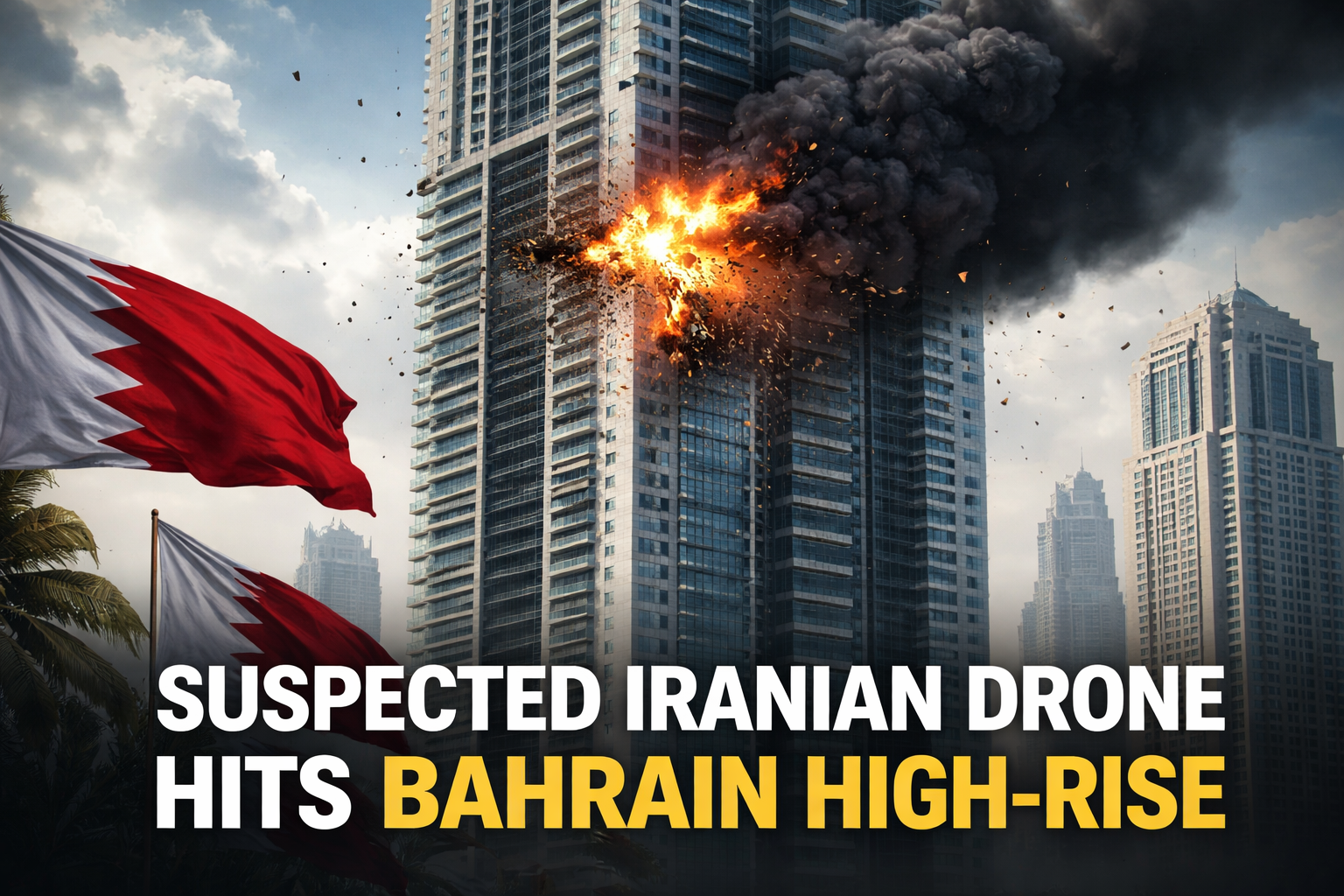
A drone strike hit a high-rise building in Bahrain on February 28, 2026, as wider missile-and-drone activity shook parts of the Gulf region. Video shared by major outlets showed a one-way aircraft slamming into an upper section of a tower, followed by a flash and a plume of smoke. Early reporting described the drone as “suspected Iranian,” and investigators had not publicly confirmed the drone’s exact origin or flight path at the time of publication. Officials also had not released a verified casualty figure tied specifically to the high-rise incident.
The high-rise strike drew intense attention because it appeared to hit civilian housing or mixed-use property rather than a clearly identified military installation. At the same time, Bahrain sits close to key U.S. and allied facilities, so even a mistaken impact can carry major political and security consequences. The question of intent matters: a strike aimed at military infrastructure that misses and hits a residential tower points to targeting error, interception debris, guidance failure, or a deliberate attempt to spread fear by hitting urban centers. Officials in Bahrain signaled that emergency services had moved quickly to contain fires and assist residents.
What we know about the high-rise strike
Footage circulating on February 28 showed a drone impacting a tall building in Manama, with smoke pouring from upper floors shortly afterward. Some reporting placed the damage in or near Manama’s Seef district, a dense area known for high-rises, commercial centers, and heavy traffic. Photo documentation also showed smoke rising over the skyline from a building that editors described as hit by a drone strike. Those images helped confirm that a significant fire followed the impact, even as officials kept details limited while first responders worked the scene.
Reporting also referenced other neighborhoods that include high-rise residential towers, and some accounts described damage near the top floors of a tower rather than a ground-level blast. That detail matters because one-way attack drones typically dive into a target on final approach, so impacts often cluster where a drone meets a façade rather than where gravity pulls debris after an interception. Still, investigators must separate direct impacts from secondary effects, such as fragments from an air-defense interception or falling debris from a nearby strike. Until Bahrain releases technical findings, the public record cannot fully answer whether the drone aimed for the building, drifted off course, or struck after a defense engagement.
Bahrain’s official response and emergency operations
Bahrain’s Interior Ministry said attackers targeted multiple residential buildings in Manama and confirmed that Civil Defence teams carried out firefighting and rescue operations at affected sites. The ministry signaled that it would share additional details later, which often means officials still verify damage reports and account for residents. Civil Defence activity typically includes evacuations, triage support, securing elevators and stairwells, and checking for secondary fires caused by fuel, electrical damage, or falling debris. The official statement did not publicly identify the specific tower shown in widely shared footage.
In situations like this, authorities often balance transparency with operational security. Clear details can help residents make safe choices, but specifics can also expose vulnerabilities, reveal response patterns, or inflame panic during ongoing threats. That tension can slow public updates, especially if officials expect additional incoming drones or missiles. Residents in nearby high-rises often receive instructions to move away from windows, avoid elevators, and relocate to lower floors or sheltered areas until authorities declare the immediate risk over.
Parallel strikes near U.S. facilities and warnings for residents
The high-rise strike unfolded amid reports of missile and drone activity that targeted or threatened sites linked to U.S. forces in Bahrain. Reporting described repeated blasts and smoke rising near areas associated with U.S. naval operations, with warnings that urged people in certain locations to move to safer ground. Updates also described guidance telling people to leave high-rise apartments and relocate lower, a rare instruction that reflects the particular risk that towers face from blast overpressure, shrapnel, and façade failures. Officials on the U.S. side reported no U.S. casualties at one point during the day, though the situation remained fluid and subject to change.
This overlap helps explain why early coverage used cautious language like “suspected Iranian.” In fast-moving exchanges, attribution can lag behind impact footage, especially when several actors operate drones in the region and when air defenses intercept threats mid-flight. Governments also sometimes wait for forensic confirmation—such as engine fragments, guidance components, warhead remnants, or launch signatures—before issuing a definitive attribution. That approach can reduce misinformation, but it leaves the public with uncertainty in the early hours after an attack.
Why attribution stays difficult in the first 24 hours
Many one-way attack drones share common design cues: delta wings, rear-mounted engines, and a loud, distinctive sound profile that witnesses often describe. Observers also flood social media with clips that compress time and remove context, which makes it hard to determine direction of travel, altitude, or whether an interceptor engaged the drone moments before impact. Even credible footage can’t easily show whether the drone carried a full warhead or struck after damage.
Investigators typically rely on multiple inputs to confirm origin. They examine debris patterns, explosive residue, recovered components, radar tracks, electronic signatures, and sometimes telemetry if defenders capture or jam the system. They also compare fragments to known systems used by regional militaries and proxy forces. When officials use “suspected,” they often signal that they have early indicators but haven’t completed that forensic chain.
Regional backdrop: a wider cycle of strikes and retaliation
The Bahrain incident occurred as the region absorbed news of major strikes on Iran and retaliatory launches toward Israel and U.S. military bases. Live reporting described a rapidly escalating pattern, with cross-border attacks and heightened alerts across several countries. That backdrop raised the risk that civilian infrastructure could suffer either from deliberate targeting, mis-aimed weapons, or collateral effects from defensive interceptions over urban areas. Several governments also moved to restrict air travel and close portions of regional airspace as the threat picture shifted hour by hour.
This broader context matters because it changes how security planners interpret a single impact on a tower. In peacetime, an errant drone can look like a one-off incident. In a multi-theater exchange, the same impact can signal a deliberate expansion of target sets, a probing attempt to overload defenses, or a message aimed at shaping public perception and political decision-making.
Why high-rises create unique risks during drone and missile threats
High-rise buildings concentrate people, utilities, and critical vertical transportation in a small footprint. Even limited façade damage can disrupt power risers, water pressure systems, and fire suppression lines that serve dozens of floors. Smoke movement also behaves differently in towers: stairwells can act like chimneys, and elevator shafts can spread heat and smoke rapidly if building systems fail. That dynamic forces responders to prioritize stairwell control, ventilation decisions, and controlled evacuations that avoid stampedes.
Drones add another layer of complexity because they can approach at low altitude and exploit the clutter of city skylines. Even with warning systems, residents may only have seconds to react when a drone clears nearby buildings. Authorities often advise people to move away from windows, shelter behind structural walls, and avoid rooftops and balconies where falling debris can cause injuries. In dense districts, responders must also manage traffic so fire units can reach the scene quickly.
Immediate impacts on daily life in Manama
Even without a confirmed casualty number, a high-rise strike can disrupt tens of thousands of lives in surrounding blocks. Authorities often close roads, divert traffic, and restrict access to affected neighborhoods to keep routes open for emergency services. Businesses in nearby towers may shut down temporarily due to smoke infiltration, safety inspections, and power disruptions. Schools and offices can also pause operations if officials anticipate further threats or if transportation networks grind to a halt.
Residents frequently face a second wave of problems after the flames go out. Building managers may need structural assessments, electrical inspections, and smoke remediation before they allow reentry. People can lose access to medication, important documents, or pets left behind during an urgent evacuation. If the incident links to an ongoing exchange, families may also struggle to find reliable updates as rumors spread faster than official statements.
Diplomatic and security implications for Bahrain and the Gulf
Bahrain occupies an important strategic position, and heightened conflict pressure can put governments in difficult positions. Officials must protect residents, maintain internal stability, and coordinate with partners that operate military assets nearby. A strike that hits civilian housing can intensify public anxiety and raise demands for stronger defenses, faster alerts, and clearer public communication. It can also complicate diplomatic messaging, since leaders must condemn harm to civilians while managing the realities of regional alliances and security commitments.
Security services may also reassess air-defense posture around urban districts, not only around bases. That shift can involve more radar coverage, additional short-range interceptors, electronic warfare systems to disrupt drone navigation, and expanded civil-defense drills for high-rise residents. These steps can reduce risk, but they cost money and can strain daily life through checkpoints, alerts, and restrictions.
What to watch next
Over the next several days, several developments should clarify what happened in Manama:
Officials may release a fuller damage assessment, including whether the drone struck one tower or multiple buildings across different neighborhoods.
Investigators may identify the drone type or publish evidence that supports attribution, such as recovered components or launch indicators.
Hospitals and emergency agencies may confirm injury counts linked to the high-rise strike, which can differ from broader regional casualty figures.
Authorities may announce new public safety measures, including changes to evacuation guidance for high-rise residents during incoming-threat alerts.
Air travel and maritime advisories may shift as governments adjust to the evolving threat environment.
Until those updates arrive, the safest framing remains careful: video and photos show a drone impact and a serious fire in a Manama high-rise area, while officials confirm attacks on residential buildings and ongoing rescue operations, and analysts continue to assess origin and intent.