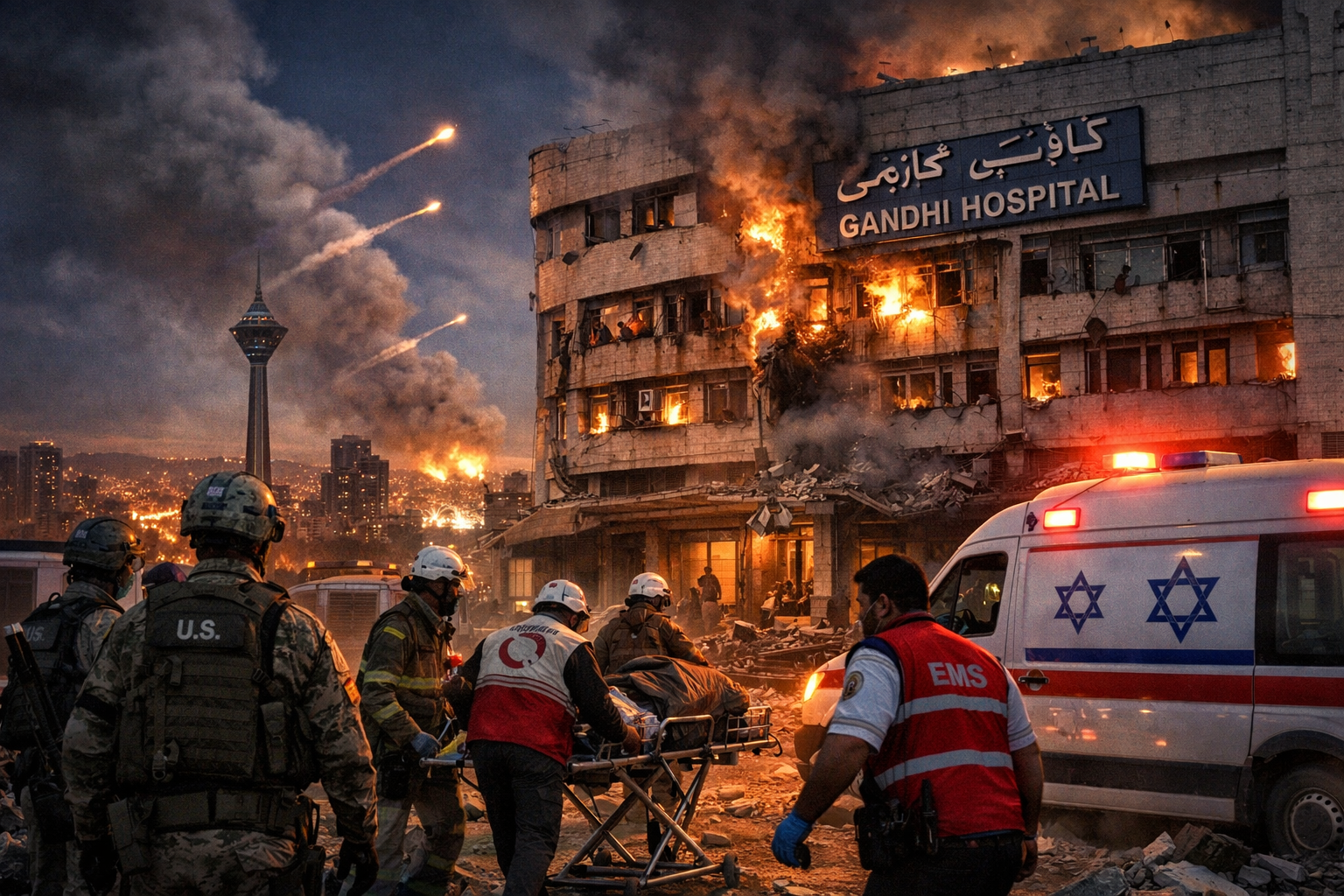
Reports from Tehran on March 1, 2026, indicated that a major hospital complex on Gandhi Street was struck as the wider U.S.-Israeli air campaign against Iran continued to push further into the capital city. Other sources reported hospital sites of the same name near the location had been hit, and two eyewitnesses described a hospital in the area that had been heavily damaged and was evacuating patients. Iranian sources described the site as Gandhi Hospital in northern Tehran and attributed the damage to “Zionist-American” strikes, posting video appearing to show debris in hospital corridors and emergency equipment within the building. The hospital itself has a posting indicating its public address is on South Gandhi Street, self-identifying as located in that neighborhood, matching the district reported in initial sources.
What’s unclear is if the hospital was the intended target, or struck inadvertently during strikes against nearby sites, or if the damage came from secondary effects—like blast overpressure, fragmentation, or debris—falling directly on it. There were no casualty counts associated with the hospital in the early reporting, and neither the U.S. nor Israel publicly released a detailed incident-specific explanation in the earliest wave of coverage.
Where Gandhi Hospital is and why it matters.
Gandhi Hospital—described variously as a large private “hotel-hospital” style complex—is located in a dense urban part of the city. In “big city” strike campaigns, when cities are large enough, density matters. Civilian infrastructure, government offices, and security-oriented facilities sit close to each other. Even when commands sites or communications nodes are the aim, attacks may damage nearest residential and medical buildings. That doesn’t answer whether Gandhi Hospital was struck, but it does highlight why hospitals become particularly exposed in cities under continued air operations. Once a major facility has been heavily struck, it can alter how a city broadly experiences the war: emergency care becomes harder to deliver, patients are moved around the system, etc, and fear of “secondary strikes” can stop people from getting treated at all.
What early reporting says actually happened at the hospital
The clearest externally sourced detail to this point is the witness-based claim of a hospital in Tehran’s Gandhi Street being heavily damaged and evacuation being in progress. The fact Irani state media published Gandhi Hospital and also footage filmed inside broadly aligns with that picture, but again nothing in terms of video alone can emerge to establish cause, direction, or destination.
War reporting in Iran in general tends to be tricky to verify quickly. International journalists don’t have easy access (sometimes work is impossible to get into the country), comms are often out of action, information operations are at their height, the stakes are high – the responsible framing at this stage is contingent: there are strong reports of Gandhi Hospital or adjacent hospital(s) being heavily damaged, and evacuation of patients, but the munition, destination, and extent to patients/staff is unestablished.
Why attribution matters and why is it contested
Above I spoke of the language of those contemporary accounts and the (potential) implications of why it matters. This is why – witness-based reporting a/hospital in the Gandhi Street area “Israeli strikes” Iranian media, by contrast, credit Israel and the U.S. with responsibility, reflecting Tehran’s view that Washington is a co-belligerent in the wider operation.
In combined campaigns, who “does the hitting” can be unbundled—one partner flies most sorties over a city while another provides targeting intelligence or refueling or command-and-control. Rhetoric may be deliberately vague, especially while fighting is ongoing. The practical takeaway is that direct claims to the perpetrators in strikes currently preferred to Israeli strikes impacting the hospital area, while allegations broadly of U.S. involvement are being asserted primarily through Iranian messaging about the joint campaign.
The information environment: why hospital incidents move quickly and verify slowly
Damaged hospitals lend themselves to spreading swiftly because they are compelling and often easy to misinterpret. A short clip can be breathtaking without being comprehensive, and in a conflict where communications or movement are broken off, a day or two may go by before an audience sees follow-on context.
Verification usually happens by at least a few repeatable approaches. One is geolocation—look at a video and compare what you see in it to what you know about the layout or landmarks. Another is corroboration—eyewitness accounts of forty ambulances during the same time window, or of a flag OR via different emergency service movements, or word from the hospital that such and such location is hit. A third area is imagery analysis—satellite pictures may show blast patterns and building damage consistent with either an artillery hit or one further afield. Even these tools, of course, have their limits. A “hospital complex” consists of multiple towers, often connected, and a “minor” in one wing may look particularly remarkable in camera footage. By contrast even a near miss can shatter windows, knock out ceilings, and incapacitate critical equipment. That is why early “hard numbers” and confident claims about intent often evaporate, and why the most credible reporting tends to stick to what can be verified: location, observable damage and confirmed evacuation.
The law: hospitals are off-limits, with limited exceptions
Civilians and civilian objects have protections under international humanitarian law, and hospitals and medical units have even more. They must be respected and protected. Medical personnel should be able to carry out their work safely. Again the law does not say always, but in narrow situations where the protection is lost. If a medical facility is being used to commit “acts harmful to the enemy” in connection with its humanitarian function, it can lose its protection in certain circumstances, usually including warning and time to comply—but the core rules of distinction, proportionality and feasible precautions still apply.
That is why a strike on a hospital always attracts immediate scrutiny. Investigative eyes look for a military objective at or near the site, the intelligence underlying the decision to strike, whether alternative times, aimpoints, or weapons could have reduced risk to patients and staff. The burden of showing that legal compliance is taking place is not purely legal; it is also political, because credibility with allies and with neutral states can be contingent on acceptance of how seriously those protections are being taken.
How a hospital can be hit in a dense capital
Without confirmed strike details, the following mechanisms are considered common when hospitals are struck in air campaigns. One is incidental damage after a nearby impact whose blast effects or fragmentation reach the surrounding/periphery buildings. Another is misidenitification/being misled by intelligence — thinking it’s some kind of other building, misunderstanding what is done in the structure, or relying on old data about what is where. A third is indirect damage associated with activity by air defenses — debris from interception or follow-on explosions damaging civilian sites. The most serious is direct and deliberate targetting, for which exceptionally strong evidence is required to justify a claim that a given hospital has lost protected status — but nothing seen so far supports that hypothesis for these reports — but it frames what questions are called for in follow up reporting of what target was intended, how close was the next claimed military objective, what precautions proved impracticable, and where was there potential to do better?
Implications of humanitarian impact: what evacuation indicates
Evacuation is itself a screaming indicator of disruption, to be followed by something else for more severe patients. Critical care patients can require ventilators, dialysing, continuous medication, operating environment, sterile environment, secure route, trained staff, stable power, and ambulances. It may no longer be possible to get them safely.
If a major complex loses its operating rooms, its imaging, systems that provide oxygen and a steady stream of electricity. Or next doors hospitals can be overwhelmed. Or, having to delay surgery, and intensive care, prevents them from making their skilled medical personnel save preventable deaths from what would have been survivable injuries. Even when casualties ar first-order ones at the site, damage to a major facility that then ripples outward to a longer-order chronic-care issue—delayed cancer treatment, missed dialysis, insulin and antibiotics that can’t be provided—is a problematic feature if supply lines are strained out and staff too.
There is a behavioral effect as well: in many conflicts, people stop going to hospitals after they’ve read and been warned that healthcare is under strike threat, afraid they will be part of a mass casualty situation if hospitals are hit in a sequence of follow-on attacks. That can delay routine care and see injuries and infections becoming much more serious before people see it to become time to find help.
How the reported strike on the hospital fits into the wider campaign context as US officials and Israel frame it
The reported hit on the hospital occurred as part of a broader campaign against Tehran and inside Iran. US officials framed the campaign in these terms: ““On the broad question of Iranian nuclear ambitions … the clear objective is to prevent Iran from obtaining a nuclear weapon and as a byproduct of that preventing the deterioration or the growth of their [missile] capabilities, and that’s succeded,” a senior official told reporters….Israel for it’s part described hitting security and command [and] control infrastructure inside Tehran and declared it had achieved air superiority over the city.” Separately, Iranian state media also acknowledged that other medical-related sites in Tehran have been under danger or apparent effects of strikes. And it’s this that becomes the more relevant practical part of this for civilians: moves toward this model of fighting have -every- attack attempt to overlay in actual life the visual language it demands, and hits like this take them deeper into what happens when fighting moves into cities. It’s less about what the messaging means, and more what about how you, if you’re trapped in that, try to shield your city from being the next mass casualty of an asymmetric conflict: Can relevant hospitals stay running? Can ambulances get safely get to the scene of need? Can supply chains find a way to keep it’s Musans and Syntharize ons from defecting too many license plate number styles for essential medicine?
Diplomatic and accountability consequences
Strikes that hit medical facilities can appear on UN and regional diplomatic agendas because they touch on core humanitarian principles. The UN Security Council has held unscheduled discussions about the wider conflict out of fears over escalation and civilian harm.
Humanitarian organisations stressed that civilian infrastructure such as hospitals must be spared and that medical staff must be able to do their work safely. If there is clearer evidence that Gandhi Hospital was struck expressly and without lawful justification, that incident could drive calls for formal investigations. If evidence indicates incidental damage, the scrutiny can centre around whether all feasible precautions were taken, and whether expected civilian harm was proportionate in the balance of military advantage.
International reaction to the wider conflict has included calls for de-escalation and concern about protection of civilians, with some governments stressing military action must be proportionate, etc. When hospitals are reported hit, those concerns can sharpen because attacks on health care are deemed a red line—even among states that may be sympathetic to openly stated military aims.
In the Ukraine conflict, war documentation is done by a local health authority, humanitarian actors and open-source investigators. That’s with observers and international investigators on site, but such inquiries can take weeks. They also tend to produce the most resilient record: when dates and times of impacts, assessments of damage, and transfers of patients from hospitals all corroborate with imagery, it makes it a lot easier for actors outside of the immediate conflict to come down on which side they think is negligent, unintentionally damaging, or actively targeting.
Beyond inquiries, there’s a strategic effect: such incidents visually harden opinion, lead to a collapse of diplomatic offramps, and heighten pressure on governments to retaliate. When photos of a sacked hospital are widely distributed, it also complicates the question of in what coalition third-party states should cast their lot—is there easy political bandwidth to go all-in backing Ankara’s position or should we neutral ourselves? Are there off-ramps where the parties talk again about doing the diplomatic dance for a ceasefire?
What to watch next
We might hope for better information in coming days: confirmation from the hospital about which provides were damaged, whether wards were disrupted, and whether services can continue. And now we look for geolocated images—is it confirmed that the strike hit the hospital itself or did it land nearby?
If Tel Aviv or Washington confirm that Gandhi Hospital was indeed struck and justify that designation we will have further information. And finally we’ve been monitoring whether America eases access to medicine out of the belly of the beast or are there restrictions and strikes to drive a saturation at Tehran’s hospital network.
Bottom line
At this time, I think the best estimate is that a hospital in Gandhi Street near the obour city in Tehran—confirmed by Iranian reporters as Gandhi Hospital—was hit in significant fashion during the March 1 wave of strikes. Patients evacuated. Main question is whether it was the target and liability of the wider us-involved campaign. As more evidence surfaces, I think this incident becomes a key test of how the belligerents frame targeting, what international actors do when protective medical facilities are impacted, and more broadly, is there any humanity left in the norms for Berliners when people-charting breaking-system-destroying proliferating new set behaviors, this time grafted into Sinai-Urania air war.