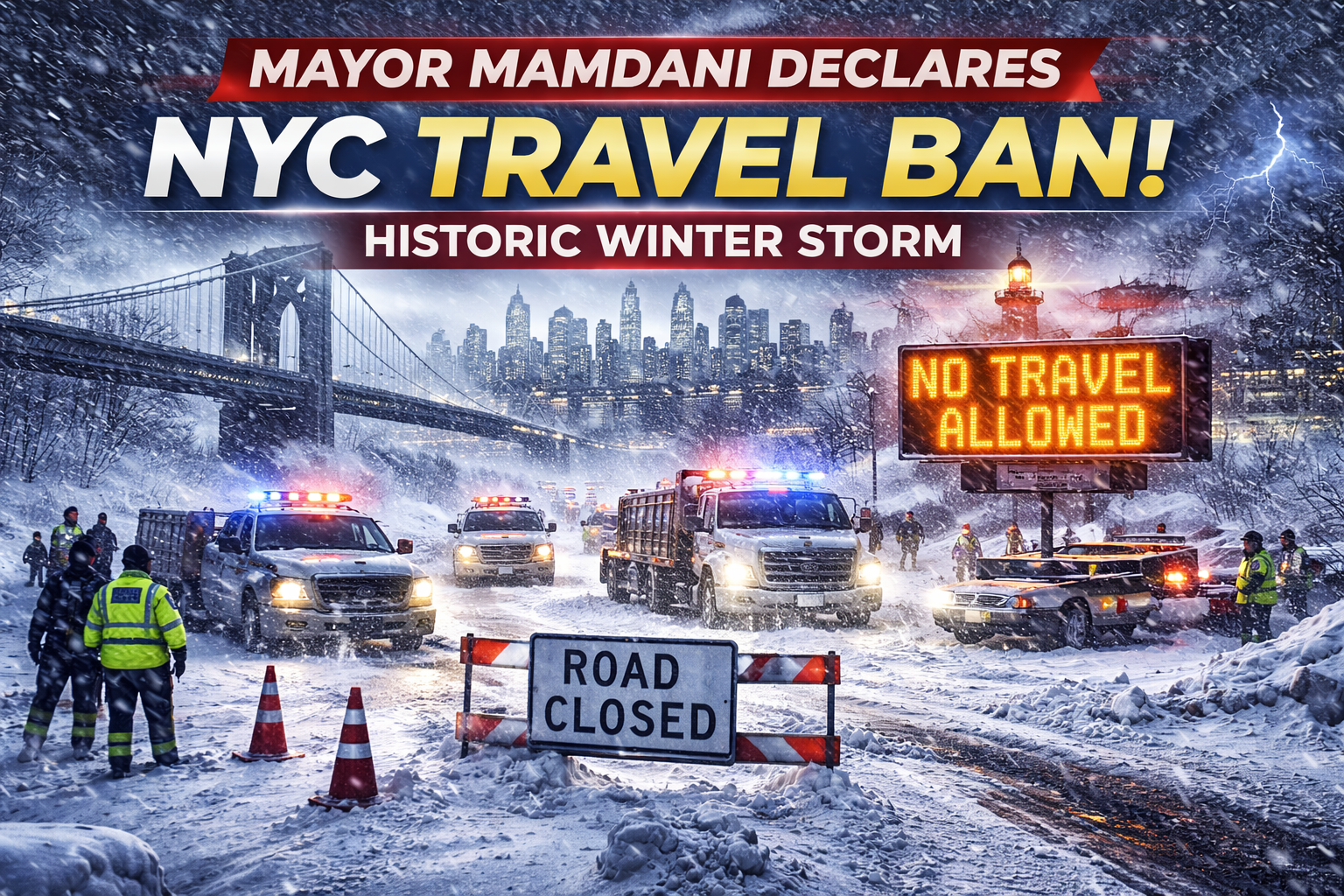
On February 22, 2026, New York City Mayor Zohran Mamdani declared a local state of emergency and ordered a temporary, citywide restriction on most vehicular movement as a powerful nor’easter approached the region. The move, widely described as an NYC travel ban, was designed to reduce crashes, keep routes clear for plows and emergency responders, and limit the number of people who could become stranded as blizzard conditions intensified.
The declaration arrived alongside blizzard warnings and forecasts of heavy snow, strong wind gusts, and possible coastal impacts. While the exact snow totals could still vary by neighborhood, city officials emphasized that the combination of wind and snow could produce rapidly deteriorating visibility and dangerous road conditions, especially overnight into February 23.
This article explains what the order did, how the NYC travel ban was structured, why city leaders use these tools, and what the potential trade-offs look like for residents, workers, and businesses during a high-impact storm.
What the NYC travel ban required
The mayor’s emergency declaration established a temporary citywide travel restriction from 9:00 p.m. on February 22 until 12:00 p.m. on February 23, closing city streets, highways, bridges, and tunnels to most vehicle traffic during that window.
A key detail in the order was its breadth: it covered not only private cars and commercial trucks, but also categories such as electric bicycles, scooters, and mopeds, unless they fell under authorized exceptions.
The city also stated that violations of the travel restriction were punishable as a Class B misdemeanor.
Who was exempt
The declaration listed multiple exemptions aimed at keeping essential services functioning. Exempt vehicles included, among others:
- Government and emergency response vehicles
- Public transit vehicles (including MTA buses and Access-A-Ride)
- Vehicles delivering food, fuel, and medical supplies
- Utility vehicles performing emergency repairs
- Transportation for essential workers traveling to certain workplaces (examples listed in the order)
- Transportation to hospitals and court facilities
- Nonprofit and private organizations providing emergency relief
In other words, the policy goal was not “no movement,” but “only movement that is critical.” That distinction matters for understanding both the intent and the likely real-world enforcement patterns.
Why the mayor paired the travel ban with a state of emergency
A travel restriction of this scope is easier to implement when paired with an emergency declaration, which expands the city’s operational flexibility.
In the same emergency announcement, the city listed additional steps, including:
- Suspending alternate side parking for February 23
- Directing city consumer protection officials to monitor and enforce against price gouging
- Instructing multiple city agencies (including emergency management, police, fire, sanitation, and transportation) to take steps necessary to protect public safety
The order also noted it took effect immediately and would remain in effect for five days, unless otherwise limited, extended, or revoked. That broader window matters because emergency declarations are often used not only for the peak storm period, but also for recovery actions such as clearing streets, coordinating repairs, and running warming and shelter operations.
The storm context behind the decision
Forecast risk, not just snow totals
On February 22, the National Weather Service and national forecasters warned of a major winter storm affecting a wide stretch of the Northeast. Reporting based on forecaster guidance described the potential for:
- 1 to 2 feet of snow in many areas
- Periods of very heavy snowfall, potentially around 2 inches per hour in stronger bands
- Wind gusts up to around 55 mph, creating whiteouts and dangerous travel
- The possibility of localized flooding in certain spots
The “historic” framing used in some coverage can be misunderstood. In many cases, it is not a claim that the storm will set a single definitive record everywhere. Instead, it reflects a risk profile where the combination of impacts—snow rates, wind, visibility, and geographic scope—raises the chance of severe disruption.
In New York City’s case, the AP reported Mamdani described the storm as blizzard conditions and said the city had not faced a storm of that scale in the last decade.
Blizzard warning criteria helps explain the urgency
One reason officials emphasize travel risk is that blizzard warnings are driven by visibility and wind, not only accumulation.
NBC New York summarized the standard criteria as:
- Sustained winds around 35 mph
- Visibility reduced to about 1/4 mile or less from blowing snow
- Those conditions persisting for at least three hours
This matters because even if a street has been plowed, high winds can quickly blow snow back across lanes and create near-zero visibility. When that happens at scale, a city can see a rapid spike in crashes, stranded vehicles, and blocked routes—exactly the conditions that slow emergency response and plowing operations.
NYCEM messaging: “avoid unnecessary travel”
The mayor’s order did not emerge in isolation. In the days and hours leading into the storm’s peak, the city’s emergency management apparatus was already pushing a clear theme: limit travel and prepare for difficult conditions.
A New York City Emergency Management press release dated February 21, 2026 described a hazardous travel advisory for February 22 through February 23 and cited an NWS forecast of 12–20 inches of snow citywide, with the possibility of higher localized totals. It also described the city preparing for snow levels “not seen since 2016” and warned that heavy snow, strong winds, and coastal flooding could make travel dangerous.
When a city issues a hazardous travel advisory and then imposes an NYC travel ban the next day, it usually reflects a stepwise escalation: advisory first, restriction next, with decisions updated as forecast confidence and risk increase.
How travel bans are intended to work in a city like New York
A citywide travel restriction is blunt by design. New York has millions of residents, a dense road network, and complex dependencies between streets, transit, utilities, and emergency services. Officials generally try to accomplish several goals at the same time:
1) Reduce “avoidable” crashes
During intense winter storms, the highest-risk scenarios often come from discretionary trips: short drives that become longer as roads clog, visibility drops, and minor collisions snowball into gridlock. A travel ban reduces the number of vehicles exposed to those conditions.
2) Keep routes usable for plows and responders
Plows need room to operate. If too many vehicles are on the road, plows can’t clear efficiently, and emergency vehicles can’t reach urgent calls. This is a central justification for restricting non-essential traffic.
3) Prevent stranded motorists from becoming a rescue problem
In whiteout conditions, even a short breakdown can become dangerous if help can’t reach the vehicle quickly. Cities try to reduce the number of people who might become stuck in that position.
4) Support continuity of critical services
By carving out exemptions—utility repairs, deliveries of food and medical supplies, public transit vehicles, and essential work travel—the city attempts to keep critical functions running while shrinking overall road volume.
The trade-offs and points of tension
A neutral analysis has to acknowledge that restrictions like the NYC travel ban can be simultaneously protective and disruptive.
Essential work is not evenly distributed
Some workers can stay home. Others—healthcare staff, utility workers, certain retail and logistics roles—are asked to keep moving. Even with exemptions, reaching workplaces can still be difficult, and enforcement uncertainty can add stress.
Economic impacts are immediate
When roads and in-person services are restricted, the costs show up quickly:
- Lost shifts in hourly work
- Reduced customer traffic for small businesses
- Higher operational costs for delivery, maintenance, and emergency staffing
- Cascading delays for regional supply chains
Officials generally weigh these costs against the possibility of worse outcomes: mass crashes, prolonged gridlock, slower medical response, and delayed restoration if power and infrastructure are hit.
Enforcement can be complicated
The order states violations are punishable as a Class B misdemeanor.
In practice, enforcement typically depends on conditions, staffing, and operational priorities. During severe weather, cities often focus on compliance and safety rather than maximizing citations, but the presence of a legal penalty is intended to reinforce that the restriction is not merely advisory.
Communication is a vulnerability
Even well-designed restrictions can fail if residents don’t understand:
- When the restriction starts and ends
- What roads are covered (streets vs. highways vs. bridges/tunnels)
- Which vehicles are included (cars only vs. cars plus e-bikes/scooters/mopeds)
- What qualifies as “essential” travel
The city’s own materials attempted to address those questions by listing both the scope and exemptions.
Transit and aviation impacts: what changed beyond the roads
City transit: not automatically “shut down”
The travel restriction targeted vehicular traffic, but public transit vehicles were explicitly included among exemptions in the city’s list.
That does not guarantee normal service—wind, visibility, and staffing can still force changes—but it clarifies that the travel ban’s primary focus was roads, not a blanket halt of all movement.
Flights: storm impacts ripple nationally
Major Northeast storms tend to disrupt air travel far beyond the region because so many routes connect through a handful of airports.
Reuters reported that by early afternoon on February 22, 15,247 flights were delayed and 3,509 were canceled, with the largest share of cancellations at JFK, LaGuardia, and Newark.
The AP separately reported more than 3,500 cancellations across the U.S. as of Sunday afternoon, citing FlightAware.
While those numbers can shift as airlines update schedules, they underline why a local city decision like an NYC travel ban is often paired with broader regional transportation disruption: when the Northeast corridor is hit, the national system feels it.
Why the storm was described as “historic” in some coverage
“Historic” is sometimes used too casually in weather headlines. A careful approach is to unpack what the word is actually referencing.
In the February 22 coverage cycle, several factors supported the “unusual severity” framing:
- Forecasters described a large, high-impact nor’easter affecting a broad corridor and warned of conditions that could be “potentially life-threatening” for travel due to whiteouts and strong winds.
- NYCEM messaging referenced preparations for snow levels “not seen since 2016,” implying the city was treating the event as a high-end scenario within recent history.
- Local reporting emphasized that blizzard warnings for NYC are rare, noting the last such warning to go into effect was in 2017.
None of these statements prove a record will be broken in every part of the city. They do support why officials treated the event as exceptional enough to justify strict measures.
School closures and the broader city “slowdown”
The mayor’s emergency declaration also closed public school buildings on February 23, 2026, except those operating as warming centers, describing it as a traditional snow day with no remote instruction.
The logic here is similar to the travel ban:
- Fewer people commuting during peak storm intensity
- Reduced burden on roads, transit, and emergency services
- Lower risk for students, staff, and families during the worst conditions
In parallel, the order indicated that city offices would be closed for in-person services on February 23, while essential employees would report and nonessential employees could telework.
Warming centers, shelter access, and risk to vulnerable residents
A storm response is not only about plows. The city’s announcement also referenced warming and shelter support, including:
- Deployment of warming buses
- Additional warming spaces at health facilities and school locations
- Guidance to use 311 or LinkNYC kiosks to find nearby sites
NYCEM messaging also emphasized checking on neighbors and avoiding unnecessary travel during the storm window.
These elements highlight a common pattern in urban winter emergencies: the most serious harms are often indirect—exposure, outages, and delayed medical response—rather than snowfall totals alone.
What happens after the restriction ends
Travel bans do not “solve” a storm. They are designed to stabilize the worst window, after which recovery becomes the priority.
Once a restriction ends, cities typically shift toward:
Clearing and widening plowed routes
Initial plowing often focuses on passability. Later passes widen lanes, clear intersections, and address drifting.
Handling stranded vehicles and minor emergencies
Even with restrictions, some vehicles may remain on streets, and officials must restore normal circulation without triggering new congestion.
Utility restoration and infrastructure repairs
If wind and snow damage lines or equipment, repair crews rely on cleared routes and coordinated access.
Managing the return of commercial activity
Businesses reopen in stages, depending on staffing, deliveries, and neighborhood conditions.
The five-day emergency declaration window gives the city a framework to manage that broader recovery process beyond the strict NYC travel ban timeframe.
A neutral bottom line
On February 22, 2026, Mayor Mamdani’s decision to impose an NYC travel ban reflected a risk-management choice under conditions forecast to produce blizzard-level wind and visibility hazards. The policy aimed to reduce preventable crashes, keep routes workable for plows and responders, and preserve movement for essential services through explicit exemptions.
At the same time, the restriction carried real costs: disruptions to work and commerce, uncertainty for people who still needed to move, and the practical challenge of communicating and enforcing a citywide rule during fast-changing weather.
Whether the decision is viewed as proportionate tends to depend on what happens next: how severe conditions become, how many outages or emergencies occur, and how quickly roads and services return. In that sense, the NYC travel ban is less a statement about certainty and more a statement about consequences—an attempt to reduce the likelihood of worst-case outcomes when the margin for error is thin.