
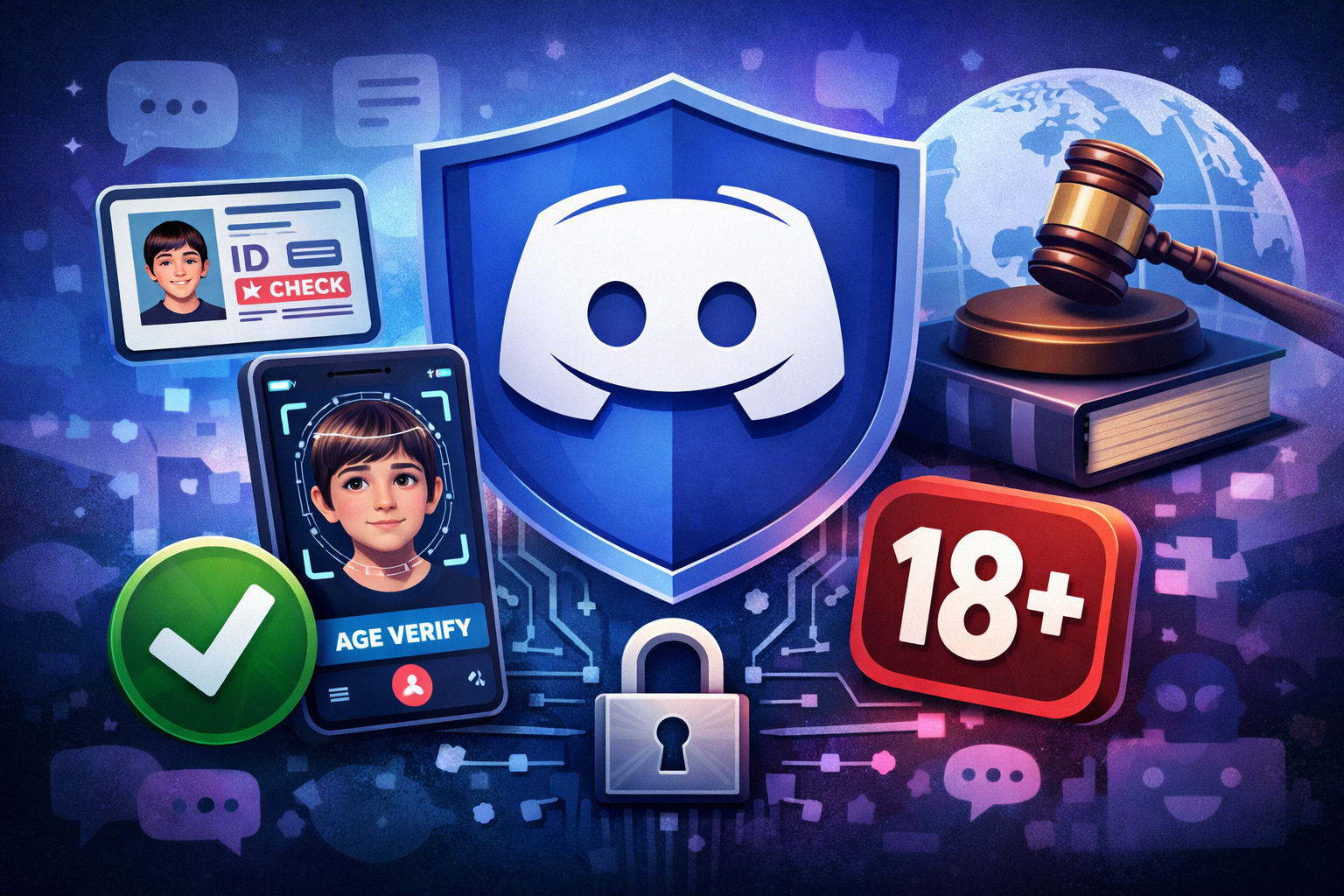
Discord age verification has become a major topic in 2026 because it now sits at the center of three big issues: teen safety, privacy, and new online regulation.
Discord announced a broader “teen-appropriate” experience with age assurance features in early February 2026. The company said most users would not need to upload ID or complete a face scan, but some users could be asked to verify their age to access age-restricted content or change certain safety settings. Later, on February 24, 2026, Discord said it would delay the global rollout to the second half of 2026 after backlash and confusion, while still continuing in places where legal obligations already apply.
This article explains what Discord age verification is, how it works, why Discord is doing it, what users can expect, and where the biggest concerns still remain.
What Discord Means by “Age Verification” and “Age Assurance”
Discord often uses the term age assurance, not just age verification.
That wording matters. “Age assurance” covers more than one method. It can include direct checks, like scanning an ID, and estimation methods, like a short video selfie processed on-device. Discord also describes an internal age inference model that can sometimes determine an age group without asking the user to complete a separate check.
In simple terms, Discord’s approach has three layers:
- Automatic age determination (inference model) for many users
- Facial age estimation (video selfie)
- ID scan (government-issued ID)
Discord says it uses the automatic model first when it has high confidence. If Discord cannot confirm a user’s age group that way, and the user tries to access age-restricted spaces or settings, it may prompt the user for an age assurance flow.
Discord also says this is not a universal “show ID to use the app” rule. In its February 2026 press release and clarification, Discord stated that the vast majority of people can continue using Discord without confirming age through a face scan or ID upload.
Why Discord Is Introducing Age Verification
Discord frames the change as part of a broader teen safety push.
In its February 9, 2026 announcement, Discord said all users would receive a teen-appropriate default experience, including stronger content filters and restrictions around age-gated spaces. Discord tied that move to its safety architecture and teen protections.
Discord also points to regulation. In a February 24, 2026 blog post, Discord said age assurance design and compliance requirements are being shaped by laws already in effect in the UK and Australia, with Brazil “quick to follow,” and more rules likely elsewhere. Discord said some laws require approved methods like facial age estimation or ID checks and do not allow platforms to rely only on internal non-identifying systems.
That explanation matches a wider policy trend.
In the UK, Ofcom has said robust age checks are a cornerstone of the Online Safety Act and that age assurance methods can include age verification, age estimation, or a combination, provided they are “highly effective.” Ofcom also published guidance and enforcement timelines around children’s protections and age assurance.
In Australia, eSafety says social media age restrictions are now in effect and that, as of December 10, 2025, age-restricted social media platforms must take reasonable steps to prevent under-16s from creating or keeping accounts. The eSafety page also notes that the platform list can change and that excluded categories include some online gaming and standalone messaging services.
So Discord’s move does not happen in a vacuum. It reflects a broader shift in platform safety rules.
Where Discord Age Verification Applies Right Now
This part caused a lot of confusion, so it helps to split it into two buckets.
1) UK and Australia rollout
Discord’s support pages say age assurance is available for UK and Australian users and is a one-time process. Once completed, Discord says users will not need to verify again. Discord also says some users outside those regions may still see prompts during experiments.
For UK and Australian users, Discord says age assurance can be triggered when a user tries to:
- Unblur sensitive content
- Change sensitive content filter settings to show content
- Turn off Message Requests
- Access age-restricted (18+) channels
Discord presents these changes as part of a privacy-forward age assurance system tied to default safety settings.
2) Global rollout plans (now delayed)
Discord’s February 9 announcement described a phased global rollout beginning in early March 2026. It said users might need age assurance to access sensitive content, age-restricted spaces, or modify certain settings.
But on February 24, Discord said it would delay the global rollout to the second half of 2026. Discord said it still plans to meet legal obligations in regions where age verification laws already apply, but it will wait before expanding globally.
That means Discord age verification is real and active in some contexts, but the broader worldwide rollout timeline changed.
How Discord Age Verification Works in Practice
Discord’s support documentation gives a clear step-by-step flow.
When Discord prompts a user, the user sees a “verify age group” style window. Then Discord offers two primary methods:
- Face Scan (video selfie)
- Scan ID (government-issued ID via mobile scan)
Discord’s support article explains the user flow, including camera access for the video selfie or using a phone to scan a QR code for the ID process.
Discord also says some users may need to complete both methods if facial age estimation alone does not provide enough confidence.
After verification, Discord says users receive system messages and a direct message from Discord’s official profile confirming the verified age group. Discord also says the assigned age group can be viewed in account settings, and users can retry to appeal an assigned age group.
Discord also warns that if a user is verified as under the minimum required age in their country, the account will be banned. If the result is wrong, Discord points users to an appeal flow using ID verification.
Discord’s Privacy Claims and Data Handling
Privacy drives most of the debate.
Discord describes its system as “privacy-forward” and makes several specific claims across its support pages, press release, and blog posts.
What Discord says about facial age estimation
Discord says the video selfie for facial age estimation runs entirely on the user’s device in real time. Discord says facial scans do not leave the device, and neither Discord nor vendors receive the facial scan itself. Discord says it only receives an age group or estimated age range.
What Discord says about ID scans
Discord says IDs are used to confirm age, then deleted quickly, in many cases immediately after age confirmation. Discord also says identity documents and matching selfies are not permanently stored by Discord and k-ID.
What Discord says it receives
Discord says it only receives age or age-group information, not the user’s identity tied to the account. Discord also says the age group status is private and other users cannot see it.
What Discord says about ads and data use
Discord says it uses age assurance information for safety and age-appropriate experiences. It also says it will not use age assurance information to target ads and does not sell that data.
These claims address many common fears. Still, public trust depends on execution, not only policy language.
Why People Pushed Back
The backlash came from both privacy concerns and messaging problems.
Many users believed Discord planned to force every user to submit a face scan or ID just to keep using the app. Discord later acknowledged that users walked away with that impression and said the company failed to explain the plan clearly.
Discord also faced scrutiny over vendors.
In its February 24 blog post, Discord said it had run a limited Persona test in the UK in January, then decided not to continue with Persona and deleted data after verification. Discord also said Persona did not meet a new requirement that facial age estimation must happen entirely on-device.
Discord further said community skepticism increased because of a prior security incident involving a third-party customer service provider, though Discord stated that vendor was not used for age assurance and that Discord no longer works with it.
These factors combined into a trust problem.
Even users who support teen safety often want more proof about data minimization, vendor controls, retention, and error handling.
What Discord Changed After the Backlash
Discord did not cancel age assurance. It changed the rollout plan and promised more transparency.
In its February 24, 2026 post, Discord said it would delay global rollout to the second half of 2026 and make several changes first:
- Add more verification options, including credit card verification
- Publish clearer vendor documentation and practices
- Show vendor information in-product
- Require on-device facial age estimation from partners
- Add a “spoiler channel” option so communities do not need age gates for non-adult topics
- Publish a technical blog post about automatic age determination
- Include age assurance stats in transparency reports
Discord also said legal-obligation regions would continue.
This response matters because it shows Discord heard two separate complaints:
- Users wanted more privacy and choice
- Users wanted better communication and fewer surprises
The delay gives Discord time to address both.
What Discord’s “Age Inference” Model Means
This is one of the most important parts of the system.
Discord says it uses an internal machine learning model to predict whether a user falls into an age group based on account signals and user behavior patterns on Discord. Discord says it only uses the model when confidence is high, and users go through the age assurance flow when confidence is not high enough.
Discord also says it does not use message content in this model. The Verge reported Discord’s description that the system uses account-level signals such as account age, payment method on file, server types, and general activity patterns, not message text.
This approach has benefits.
It can reduce the number of users who need to upload ID or complete a face-based check.
It also creates new questions.
Users may want to know which signals matter most, how errors get corrected, and whether certain user behaviors trigger more false prompts. Discord said it plans to publish a technical post about methodology and privacy constraints before the global launch.
That future documentation will likely shape how much trust the system earns.
What This Means for Everyday Discord Users
For most users, the main takeaway stays simple: you probably will not see a prompt unless you try to access adult-only spaces or change certain protected settings.
Discord repeated that point multiple times in official materials. It says the vast majority of users can continue using Discord as they do today without a face scan or ID upload.
Still, users should prepare for a few practical changes.
If you are in the UK or Australia
You may see age assurance prompts in the scenarios Discord lists, such as unblurring sensitive content or entering age-restricted channels. Discord says the process is one-time and private.
If you are outside those regions
Discord says some users may see prompts in experiments. Discord also said the global rollout is delayed, so timelines may shift again as the company updates methods and policy messaging.
If you get a wrong result
Discord says users can retry and appeal age-group assignments. If a user gets flagged under the minimum age by mistake, Discord directs them to an appeal process tied to ID verification.
If you receive an email or text about age verification
Discord says it prompts users to age-assure within Discord and currently does not send emails or text messages about the process or results. That detail can help users avoid phishing attempts.
What This Means for Server Owners and Moderators
Server admins and moderators should also pay attention to these changes.
Discord’s teen safety settings tie adult verification to access for:
- Age-restricted channels and servers
- Certain app commands
- Some safety setting changes
- Stage speaking permissions for adults in some contexts
Discord also routes unknown DMs into a message request inbox by default and limits modification of that setting to age-assured adults.
This can affect community management.
Some servers use age-gated channels for reasons beyond explicit content. Discord acknowledged that and said it plans a new “spoiler channel” option so communities can separate topics like spoilers or heavier discussions without relying on age gates.
Moderators should expect more support questions from users who suddenly cannot access channels or settings. Clear server rules and pinned guidance will help.
The Benefits and the Risks
Discord age verification is not a simple “good” or “bad” change. It solves some problems while creating others.
Potential benefits
- Better protection for teens in age-restricted spaces
- Stronger defaults for sensitive content and messaging settings
- Lower friction for many adults if age inference works well
- More privacy than traditional centralized ID checks, if on-device and deletion claims hold in practice
- Better regulatory compliance in regions with stricter rules
Discord’s official materials emphasize this balance: age-appropriate protections plus privacy protections and user choice.
Main concerns
- Trust in vendors and third-party processing
- False positives and false negatives in age estimation
- Accessibility and usability barriers
- Regional inconsistency in rules and triggers
- Fear of broader expansion over time
- Confusion caused by changing timelines and announcements
Discord’s decision to delay the global rollout shows those concerns had real impact. The company publicly admitted communication mistakes and changed the rollout schedule.
What to Watch Next
Discord age verification will likely remain a moving target through 2026.
The biggest next signals to watch include:
- Discord’s promised technical post on age determination
- Vendor documentation and in-product transparency
- New verification options, including credit card checks
- Transparency report metrics on prompts, methods, and automated handling
- How Discord handles appeal accuracy and support volume
- Whether Brazil and other regions trigger broader compliance changes
Discord has already said it plans to publish more detail before a global launch. That documentation should make it easier to judge the actual privacy and accuracy trade-offs, not just the marketing language.
Final Takeaway
Discord age verification is really a larger age-assurance system.
It mixes policy, machine learning, safety defaults, and third-party verification methods.
Discord says most users will never need to upload ID or complete a face scan. It also says age assurance helps protect teens and meet legal requirements. At the same time, user backlash forced Discord to delay its global rollout and promise better transparency, more options, and stricter vendor standards.
That combination tells the full story.
This is not just a product feature. It is a test of whether a large platform can enforce age-based safety rules while preserving privacy and trust.
Discord now has more time to prove it can do both.