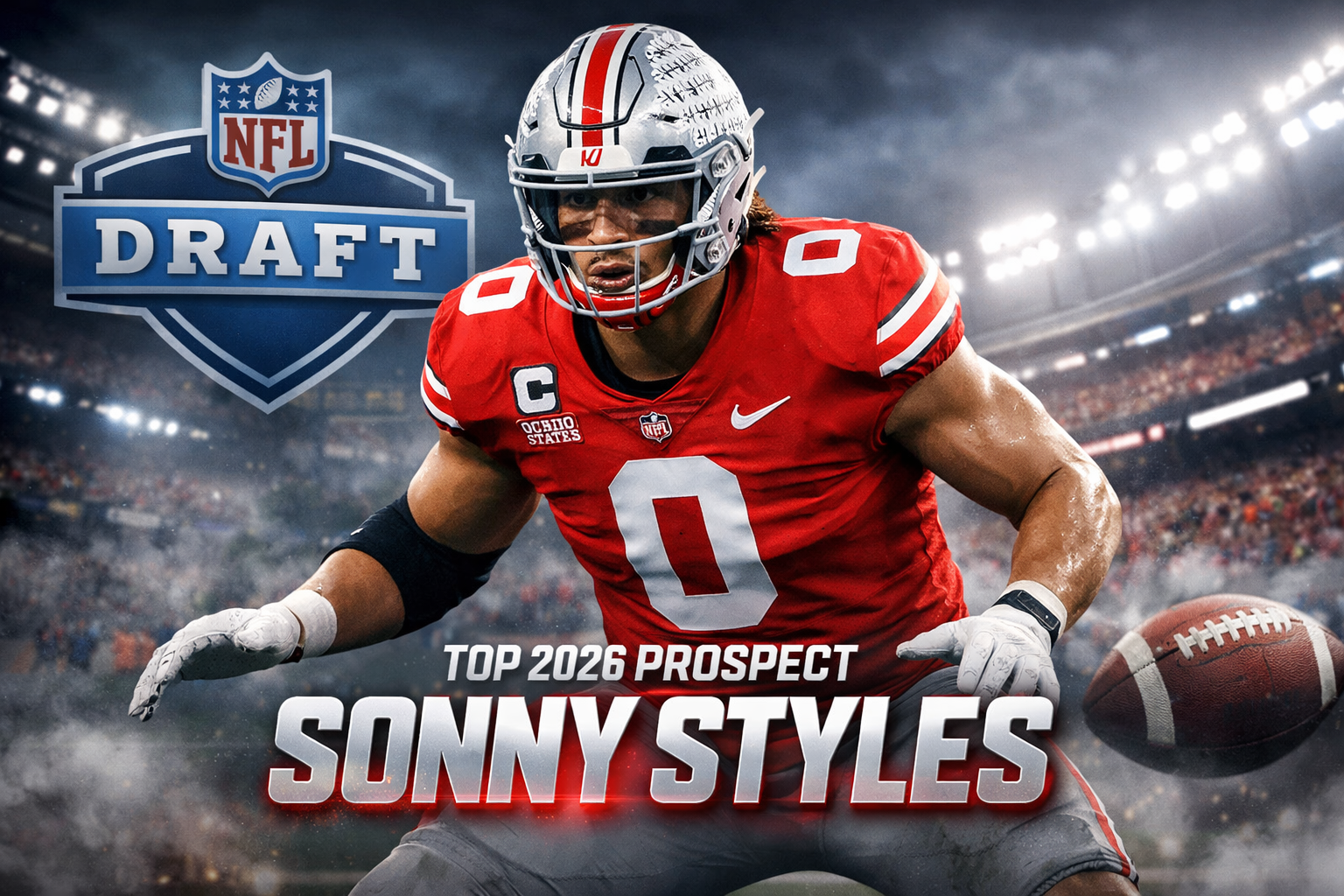
As the 2026 NFL Draft cycle moves into combine week and the final stretch before April, evaluators keep circling back to one name at linebacker: Ohio State’s Sonny Styles. Draft analysts describe him as a modern, every-down second-level defender—one who can cover, tackle in space, and add value as a pressure piece without coming off the field.
Styles built that profile over two seasons at linebacker after he entered college as a highly rated safety. Ohio State leaned into his size, movement skills, and competitive temperament, then turned him into a centerpiece of a national-title defense in 2024 and a high-volume producer in 2025.
What follows breaks down Styles’ background, production, traits, and projection—plus the questions that teams will try to answer through testing, interviews, and film.
Sonny Styles at a glance
Styles played at Ohio State and comes from Pickerington, Ohio. Major listings put him around the 6-foot-4 to 6-foot-5 range and in the low-to-mid 240s. ESPN lists him at 6’4″ and 243 pounds entering the pre-draft process.
Ohio State leadership also recognized him as a tone-setter. The program awarded him the Block “O” and the No. 0 jersey, a team honor that Ohio State ties to toughness, accountability, and character.
Recruiting background and the early runway to Columbus
Recruiting services tagged Styles as a top national prospect while he played at Pickerington Central. ESPN’s recruiting coverage described him as a five-star safety and a top-10 overall recruit in the 2023 class at the time of his commitment, before he later reclassified to enroll earlier.
That reclassification mattered for his development curve. By enrolling ahead of the 2022 season, Styles reached major-college strength and scheme demands earlier than most players in his cohort, and he stacked game reps across four seasons in the program.
The position switch that shaped his pro projection
NFL teams rarely find true “coverage linebackers” who also bring plus size and play strength potential. Styles’ path explains why teams see that combination in him.
Ohio State moved him from safety to WILL linebacker during spring practice in 2024, and local coverage framed the move as official at the time.
Analysts around the draft space viewed the shift as a natural fit: his safety background gave him experience with spacing, route distribution, and open-field tackling, while his frame gave him room to add functional mass for life in the box.
2024 breakout: production plus postseason moments
Styles’ first season in a linebacker-heavy role produced “edge-adjacent” disruption and steady tackling volume across 16 games.
CFB Stats credits him with 100 total tackles, 10.5 tackles for loss, and 6.0 sacks in 2024.
Ohio State’s own write-up about his Block “O” honor highlighted how his play escalated in the postseason: it cited 24 tackles, four tackles for loss, two sacks, and a forced fumble across the playoff run that ended in a national championship.
That combination—base-down consistency plus “big stage” disruption—often drives linebacker grades more than raw tackle totals. Teams want plays that end drives: negative plays on early downs, pressures that alter throws, and coverage snaps that erase outlets. His 2024 tape gave evaluators plenty of those moments to catalog.
2025 season: steadier box role, consistent impact
In 2025, Styles played 14 games and again produced across categories, even if the sack totals fell from his 2024 spike.
CFB Stats lists 82 total tackles (46 solo), 6.5 tackles for loss, 1.0 sack, and 1 interception for five yards.
ESPN’s season line matches the core production markers (solo tackles, sack, forced fumble, interception), reinforcing the overall picture of a three-down defender who touched multiple parts of the stat sheet.
If you want a clean summary of his two-year linebacker profile, you can stack it like this:
- 2024: 100 tackles, 10.5 TFL, 6.0 sacks (16 games)
- 2025: 82 tackles, 6.5 TFL, 1.0 sack, 1 INT (14 games)
That arc often signals “role clarity.” In 2024, Ohio State used him aggressively and let him hunt. In 2025, the defense asked him to anchor more snaps, fit the run with discipline, and still contribute on passing downs.
Athletic profile: why scouts expect a big combine week
The combine matters more for some positions than others. For off-ball linebackers, teams watch testing as a confirmation tool: they want lower-body explosion, change of direction, and long speed that show up on tape.
ESPN’s combine preview singled Styles out as a potential workout standout. Jordan Reid wrote that scouts expect him to run in the mid-to-high 4.5 range in the 40 and potentially exceed 40 inches in the vertical, with strong broad-jump numbers as well.
That same ESPN section also noted that teams already view him as a potential top-10 pick, which frames how decision-makers currently value his ceiling relative to positional trends.
Some draft databases list a faster 40 time (for example, NFL Draft Buzz lists 4.48), but teams will rely on verified combine numbers once they land.
Film-driven strengths that translate on Sundays
You can summarize Styles’ NFL appeal in one sentence: he offers linebacker size with a defensive back’s comfort in space.
Athlon’s scouting report emphasizes his range, wingspan, and ability to affect both run and pass, and it frames him as a top linebacker prospect in the class.
Here’s how those traits tend to show up on film, and why pro teams care.
Coverage feel from a safety background
Modern defenses ask linebackers to do more than “spot drop.” They must match routes, carry seams, overlap crossers, and close windows for quarterbacks who attack the middle of the field.
Styles’ early career at safety created a foundation for those responsibilities. Draft coverage repeatedly notes the transition from safety to linebacker and ties that background to his three-down projection.
That background doesn’t guarantee elite man coverage against slot receivers, but it often improves zone spacing, route recognition, and the ability to play with vision while staying connected to threats behind him.
Tackle production that aligns with real defensive workload
Tackles can mislead when a defense funnels plays to a player, but Styles’ tackle totals pair with disruptive production (TFLs, sacks, picks), which usually signals more than “clean-up duty.”
His 2024 line (10.5 TFL, 6.0 sacks) points to timing and acceleration on pressures and run fits.
His 2025 line (6.5 TFL, 1 INT) shows that he continued to impact plays behind the line and in coverage even with different weekly usage.
Run defense and leverage tools that teams want to refine
At linebacker, teams evaluate run defense through three questions:
- Can he see it?
- Can he get there?
- Can he finish it?
Styles consistently answers the second and third questions with his size and burst, and evaluators often focus their critique on the first question’s details—eye discipline, fits, and processing versus misdirection.
Athlon’s report specifically calls out his aggressiveness as a strength, while noting that over-pursuit and play-action influence can create occasional problems.
That profile fits a common linebacker development track: teams coach the “slow feet, fast eyes” component harder than the athletic component, because NFL offenses attack linebacker eyes with layered route concepts and run-pass conflict.
Blitz and pressure utility
Styles’ 2024 sack total (6.0) stands out for an off-ball linebacker and suggests that Ohio State found ways to weaponize him as a blitzer and edge-adjacent rusher.
Even if his NFL coordinator doesn’t chase sack totals from him, defenses value a linebacker who can mug gaps, threaten pressure, then drop into coverage without tipping the call.
Strengths and areas teams will probe
No prospect enters the league without questions. Styles’ evaluation comes down to a relatively clean set of strengths with a manageable list of growth points.
Projectable strengths
- Every-down size/speed blend: Analysts repeatedly cite a rare combination of length and range for an off-ball linebacker.
- Production across categories: Two seasons of impact tackles, TFLs, and splash plays (sacks/INT) support a three-down projection.
- Big-game résumé: Ohio State’s postseason recap highlights high-impact production during the championship run.
- Role versatility: Draft coverage consistently frames him as a defender who can align in multiple spots, including pressure looks.
Development areas that could influence draft slot
- Pad level and leverage vs blocks: Athlon notes that his height can work against him when he needs to stay low and finish in space or stack blockers.
- Man-coverage stiffness on longer routes: Evaluators sometimes flag limitations when he carries complex routes for extended time.
- Eye discipline vs misdirection: Aggressive play can invite over-pursuit or false steps on play-action.
- Continued refinement at linebacker: He moved to linebacker in 2024, so teams still project some learning curve on run fits, block deconstruction, and communication.
None of these concerns look unusual for a converted safety. Teams will decide how quickly he can close the gap between “high-end tools” and “week-to-week precision.”
Ideal NFL usage and scheme fits
Linebacker value often depends on usage. A defense that asks a linebacker to take on guards every snap will grade prospects differently than a defense that lives in nickel and asks its second-level defenders to cover and rally.
Styles’ profile fits best in systems that:
- Live in nickel as a base, then treat the WILL as a coverage-plus pursuit player
- Use simulated pressures and creepers that let the linebacker threaten gaps
- Ask linebackers to match tight ends and running backs, not just sit in short zones
That list matches how many NFL teams play now, which helps explain why analysts attach first-round or near-first-round language to him.
A 4-3 defense can use him as a WILL who runs, covers, and blitzes. A 3-4 defense can use him as an inside linebacker who stays on the field in sub packages, especially if he pairs with a heavier “thumper” who absorbs more downhill collisions.
Where draft analysts place him right now
Draft projections fluctuate through March and April, and linebacker positional value can push even strong prospects down boards in some years. Still, multiple outlets place Styles in the early-round conversation.
- ESPN’s combine preview states that scouts already view him as a potential top-10 pick.
- Athlon projects a first-round outcome and calls him the top linebacker prospect in the class.
- Other draft commentary frames him as a high-end coverage linebacker who should come off the board early, even if team needs and positional economics create variance.
If you want the simplest “range” summary: evaluators often talk about him in the Round 1 tier, and combine testing can either cement that tier or open the door for a slight slide if the numbers come in lower than expected.
What to watch during combine week and pro day
Testing alone never replaces film, but it can confirm whether an athlete sits at the top end of the class.
For Styles, keep an eye on:
40-yard dash and 10-yard split
He wins with closing burst and range. Scouts expect strong speed for his size.
Vertical and broad jumps
Explosion metrics can support the “trigger and close” style that shows up on tape.
Coverage drills (particularly transitions)
Teams will watch his hip transitions and route anticipation. Athlon notes some stiffness in extended man reps, so smooth transitions can help answer that concern.
Interviews and playbook recall
Converted safeties often need to prove they can quarterback a defense from the box. Ohio State’s leadership honors suggest coaches trusted him, and teams will press for details on calls, adjustments, and weekly preparation.
Bottom line: why Sonny Styles stays near the top of 2026 boards
Sonny Styles offers a mix that teams keep chasing: linebacker size, defensive-back movement skills, and a résumé that includes championship-level play and multi-category production. His 2024 breakout validated the position switch, and his 2025 season reinforced a steady every-down floor with continued splash potential.
Scouts will still test the details—pad level, eye discipline, and man-coverage flexibility—but the league’s current defensive trends reward players exactly like him: versatile second-level defenders who erase space and stay on the field in high-leverage passing situations.