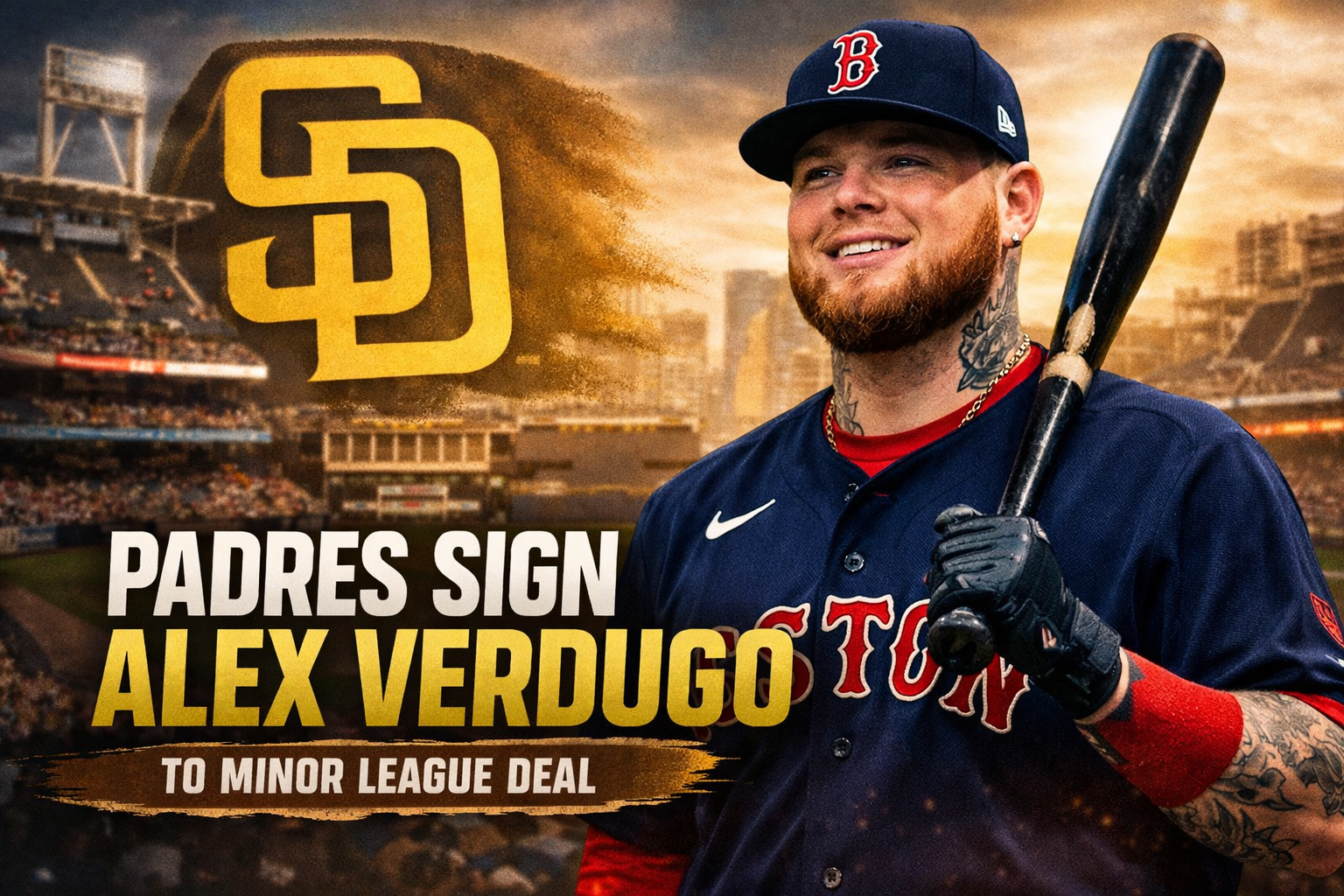
On Sunday, the Padres added a familiar face — veteran outfielder Alex Verdugo, being on a minor-league deal that will send him to minor-league camp with no invitation to big-league spring training. Kevin Acee from The San Diego Union-Tribune was first with the news.
San Diego has done well this spring to bolster deeper organizational options without a crowded big-league roster, which can also benefit staying flexible with the other 25 players. The deal with Verdugo is similar to their tendency: bring in proven big-leaguers to dig further into camp, get game reps, and see if it can be reactivated in time for a long major-league season. But this is much more than just another signing for the Padres. For Verdugo, who turned 30 in June, it’s a fork in the road from which he can pivot his career after two seasons of production in declining power numbers and much of the last 18 months without a big-league job.
The details of what it means
Going on the minor-league deal means Verdugo needs to grow further out of that picture. It doesn’t guarantee him a spot on the Padres’ Opening Day club. If they desire him to be in the majors later, San Diego would need to add him to the 40-man roster and select his contract. The structure gives the front office maximum flexibility: evaluate the player, keep roster spots open, and make a decision only if performance (or need) dictates.
The detail that stands out is the level he’ll report to. TheScore was first reporting that Verdugo will forgo a big-league spring training. That doesn’t necessarily preclude a call-up later in spring, but it’s a good signal that the early spring roster is not being built around him—and that he’ll play his way into consideration rather than have his performance tracked as a near-term roster lock.
Minor-league deals for veteran players also generally include a few practical guardrails: language that allows the player to request a release if he isn’t promoted by a certain date, or clauses that give the club discretion to move him between affiliates as roster needs change. Not every contract has the same features, and the specific terms here haven’t been publicly detailed, but the general idea is prevalent throughout the league. The player gets a bona fide chance to be seen, and the team keeps the flexibility to promote only if that fit feels right.
Why the Padres took the flier
Over 162 games, outfield depth gets stress tested by injuries, slumps, and matchup’s needs. Even clubs with a clear starting trio typically need extra plate appearances from their fourth and fifth outfielders. An experienced veteran on a minor league deal can be useful insurance, especially if he’s left-handed, can handle a corner outfield spot, and has a track record of at least being an average everyday bat. San Diego also has been going about building competition around the edges intentionally. MLB Trade Rumors notes that the Padres have been stockpiling experienced MLB players on minor league deals while “testing out a plethora of unused bench options”—noted in the piece are Ty France and Franchy Cordero. The club has matched that with short commitments to … established names; Reuters reported the Padres signed Miguel Andujar to a one-year deal in February and later agreed to a one-year arrangement with Nick Castellanos after his release from Philadelphia. Verdugo fits that same template: add depth, keep flexibility, see what sticks.
There’s also an organizational rationale to late-camp signings. Players who are out of options, coming back from a minor injury, or not quite fitting into another team can become available after most teams have established their main camp priorities. A team that’s comfortable offering a defined runway in the minors can discover a player whose value wasn’t present on February 1 — if it believes the floor is a useable depth rather than replacement-level placeholder.
That’s Verdugo’s career arc: from premium prospect to depth option
Verdugo’s name still has cache because of how his career started. He came up with the Dodgers and looked for a time like a permanent everyday corner outfielder. When the Red Sox took him on in the Mookie Betts trade, he was a big part of that return. In Boston, the production was “okay but unspectacular” according to MLB Trade Rumors, and he posted a .281/.338/.424 line and 43 homers across 2,071 plate appearances (a 105 wRC+). That’s the version of Verdugo teams would like to rediscover: not a lineup-carrying star, but a playable everyday bat who doesn’t vanish for months at a time.
Across his career, he’s also piled up enough playing time to give him a meaningful baseline. TheScore noted that Verdugo “has appeared in 856 major-league games and owns a .732 OPS (99 OPS+) for his career, with his best year in 2020, when he finished 12th in AL MVP voting.” That’s not a profile of a fringe player; it’s the profile of someone who has been a genuine big-league regular. The downturn, however, has been real and recent: since Opening Day 2024, of which MLB Trade Rumors noted that Verdugo “has hit .234/.292/.339 with 13 home runs in 834 plate appearances (80 wRC+) since” that date. Reuters’ reporting from the period also captured the larger context: full season in 2024 with the Yankees—where he notched 51 runs batted in, 13 home runs and hit .233 on the season—but late sign with Atlanta for 2025 and struggled enough to be off the roster by the All-Star break.
How Atlanta shaped this winter
The Braves stint is the easiest explanation for how it was that Verdugo was looking at a minor-league deal back in March. “He acknowledged that he was not desirable at the end of last season. MLBTR originally noted that he didn’t receive his 2025 contract No 1 (one year, $1.5 million guaranteed) until a week before Opening Day. On the field, the results didn’t stabilize: theScore reported he posted a .585 OPS in 56 games for Atlanta’s major-league club, while MLB Trade Rumors added that he mustered a .239/.296/.289 credibility once he hit the majors after an odd early-season ramp-up. His departure was also a matter of roster math—Reuters reported the Braves outrighted him in July 2025 to create space for Jurickson Profar after Profar’s 80-game suspension, and MLB Trade Rumors said that Verdugo was released and didn’t find a new team afterward.
The net result: Verdugo left the majors at the end of 2025 and came into this offseason without much momentum.
San Diego’s outfield picture and where Verdugo fits
San Diego’s depth chart in the outfield seems the biggest obstacle to a quick return. MLB Trade Rumors reported that Fernando Tatis Jr., Jackson Merrill, and Ramón Laureano are “set” as the Padres’ starting outfield, with other names—like Andújar—being used for some corner outfield work, and theScore reported that trio as projected starters while describing Bryce Johnson as more of a fourth-outfielder type. That particular framing matters because it describes the hurdle in front of Verdugo fairly clearly: if those players are healthy, his clearest path is through bench work as a left-handed complement or injury insurance.
He’s also joining a roster that appears to be built around role flexibility. MLB Trade Rumors noted Gavin Sheets and Nick Castellanos are “technically also outfield options” but will more likely be deployed at first base and DH. That sort of roster construction can lead to occasional outfield spots at the end of days when the Padres are rotating rest and matchups, but it also means that the last spots on the bench reward players who can offer something different (speed, multi-position defense, platoon leverage), rather than a redundant corner profile.
What San Diego would be looking for if he gets a look
Since the initial assignment is to minor-league camp, the first evaluation is going to be readiness: Verdugo’s last year included a strange ramp-up, and the Padres will want to see that his timing/conditioning/mobility is where it needs to be before they even consider the next step.
From there, the questions about him are baseball-specific:
• Is he driving the ball enough that pitchers have to respect him in the zone, rather than challenging him as a low-impact contact hitter?
• Is he getting on base at rates that fit a bench role, where each PA is magnified?
• Can he put up solid corner defense without the club having to protect him with late-game substitutions?
None of those are lofty goals, and on a roster filled with established everyday bats “not giving away at-bats” is a pretty good contribution, and a version of Verdugo that sits around league-average offense could have value over the length of a season. What has to bounce back at the plate
The reporting on Verdugo the last two years points to the same root issue: the bat has slipped. His OBP and SLG the last two years aren’t bad but they aren’t up to scratch for someone who had been an everyday regular; now he’s just a depth option, and both MLBTR and theScore found that decline in wRC+ and OPS.
The issue is that the decline typically isn’t about one conspicuous flaw that can be fixed by one tidy adjustment. When a hitter’s line moves from a tidy .281/.338/.424 (that’s how MLBTR summed up his Boston stretch) to the .234/.292/.339 range, it usually means several smaller things haven’t gone right, combining into something worse. There’s a little less hard contact, a few more weak balls in play, fewer extra-base hits, fewer walks to cover the down stretches.
Again, for Verdugo to turn this deal into a major-league role, he probably needs to look like someone who can add on-base value and drive the ball with authority enough he can punish mistakes. The more he resembles the steady version of himself that Boston had before—league-average offense, competent corner defender—the more likely San Diego is to see him as a usable piece when this season’s inevitable bumps come along. As simple as that sounds, the other issue is just competition. MLB Trade Rumors listed a long set of veterans in camp on minor-league deals—France, Pablo Reyes, Jose Miranda, Nick Solak, and others—battling for those final spots, too. If the Padres want to carry a bench bat who also doesn’t cover other infield positions, that player generally has to win that roster spot outright with performance or offer that very specific skill (e.g. a clear platoon edge or late-game defense). The challenge for Verdugo is that he’s not just up against players; he’s up against the overall geometry of the roster: how many infield backups the club wants to carry, how frequently it will turn over DH and first base, and how much it’s willing to lean into speed/defensive range at the back of the depth chart. This is the difficult part of baseball management—sometimes it’s not about who the best player is, but what the team’s needs are on other levels.
Why it’s low risk for San Diego
From a club perspective, minor-league deals are some of the safest bets available in roster construction. They don’t require a 40-man spot at the outset, they don’t block a prospect, and the club can cut bait quickly if the player fails to produce.
MLB Trade Rumors outlined the genesis of this style of deal fairly bluntly: there is, relative to the dollars spent, “no risk” which means teams can see what Verdugo can do while giving him that chance.
The Padres also have an information advantage. If Verdugo looks like he’s close to being the version of him they’d need in order to call up and use, they can promote him. If he isn’t, they can let him slip into depth or move on or pivot to another internal option, but they’re out-sourcing the question of “who is ready if we need help?” into the early weeks of the minor-league season, a time when real at-bats and real decisions tend to yield clearer answers than theory tends to. The bottom line: 162 games is a long haul, and while star power wins games in April for sure, depth wins them in June and July just as surely.