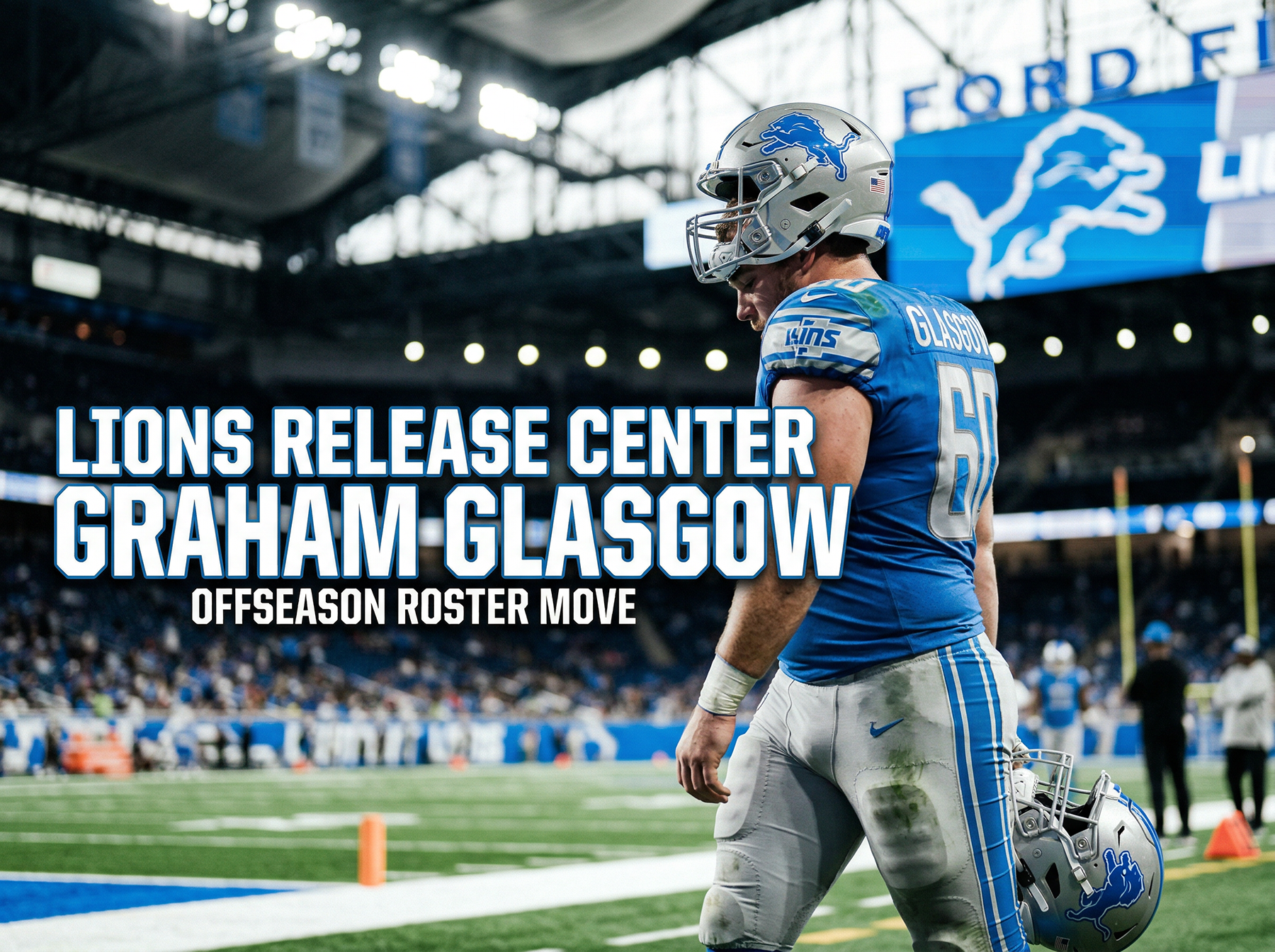
Detroit’s offensive line has been one of the team’s biggest strength in recent seasons, as well as one of the most costly parts of the roster. On Monday, March 2, 2026, Detroit announced that it released veteran inside lineman Graham Glasgow. The release closed out Glasgow’s second stint with the Lions, and opened up a new chapter for the Lions’ offensive line which is still adjusting after a year of rotation, injury, and performance inconsistency. The decision also indicated that the front office was prepared to live with some temporary instability at center in order to add roster and salary cap flexibility heading into free agency.
What Happened
On Monday, March 2, 2026, Detroit announced it released Glasgow, creating approximately $5.56 million in 2026 cap space, while absorbing roughly $2.88 million in dead money. Glasgow started 14 games for the Lions in 2025, and had one year left on his contract with no guaranteed money remaining.
On its own, that appears to be a standard “cap casualty” type move. However, the timing, as well as the position, indicate that the release was larger than just a routine cut. Center is the focal point of all line protections, and it is one of the quickest ways to disrupt an entire offense if the center is not a good fit. Instead of carrying the contract through the spring and hope things settled, Detroit chose to resolve the problem now.
Why the Lions Did It Now: Cap Pressure and Roster Flexibility
Detroit has had a salary cap puzzle to solve this offseason. At the end of February, team coverage on Detroit’s official site stated that the Lions were “around $9 million over the cap” (according to OverTheCap), and would need to create cap space before the new league year began. There are several ways to achieve this goal – restructuring, extension, smaller releases, etc., but releasing a veteran starter is one of the easiest methods to increase roster flexibility immediately and reduce the amount of cap dollars that the team would need to allocate to future seasons. This is important, since free agency tends to be fast-paced during the opening days of free agency, and the Lions cannot realistically shop for players until they are under the cap.
It is possible that the Lions will not be “big spenders.” Sometimes a move like this is merely the first step in a process to allow for targeted additions and depth signings. Other times, it is part of a larger reallocation of resources, where a team determines that it can replace a veteran’s production for less money while maintaining its core.
Quick Review: Glasgow’s Tenure with the Lions and Why He Ended Up at Center.
Glasgow’s value to the NFL has always been based on his versatility. Glasgow was originally drafted by Detroit in 2016, spent the next three seasons in Denver, and then returned to the Lions in 2023. Following that return, the Lions signed Glasgow to a three-year, $20 million contract in 2024, which placed him firmly within the team’s roster planning, rather than a short-term fix.
So why did he become the center?
As a result of the sudden change in the Lions’ center plan. In June 2025, longtime Lions center Frank Ragnow retired from football due to health issues, and a desire to focus on his family’s future. As a result, the loss of an elite center during the latter stages of the offseason forced the Lions to make a practical solution to the problem, rather than a perfect solution, and the Lions decided to rely on a veteran who could handle the mental aspects of the position.
While moving Glasgow to center from guard seemed logical. Center is just as much about processing information as it is about raw power. Identifying defensive fronts, managing line calls, communicating with teammates regarding adjustments, and remaining calm when the defense makes a last-second adjustment to confuse the offense, are all critical elements of the position. Coaches frequently favor experienced players at the center position, particularly if the alternative is placing an untested player at the helm of the offensive line.
However, “logical,” does not mean “optimal.” Guard and center are two completely different positions. The timing of the snap-to-step is different. The leverage points are different. And, the cost of a mistake is often greater at center, since it can disrupt the protection scheme prior to the actual snap.
Role Changes and Performance
Another factor that explains the reasonableness of Detroit’s decision is that Glasgow was not simply tasked with learning a new position and playing it for a full season. Glasgow transitioned from guard to center in back-to-back seasons.
Most offensive linemen need to adapt to a new position, learning how opponents attack that position, and developing the footwork and angles necessary to perform naturally in the new position. While adapting to a new position is challenging enough, transitioning to a second new position increases the length of time it takes to develop comfort with the new role.
Additionally, offensive line play is interdependent. If the center collapses the A-gaps too quickly, the quarterback loses his platform prior to the receivers fully developing their routes. Similarly, if the guard is unable to secure the B-gap, the center is likely to struggle with quick interior pressure. Additionally, the presence of injuries can lead to backup linemen entering a role they are unprepared to play. Finally, defenses excel at exploiting mismatches, and if they believe your center is susceptible to either power or speed, they will design their game plans accordingly.
When teams choose to reset an interior line, it is generally to eliminate the weekly “weak link” game plans that defenses construct. Conversely, resetting an interior line can be part of a larger effort to reclaim a team’s identity, returning to the type of consistent run game and clean pockets that fuels everything else on offense.
What Does the Move Indicate About Detroit’s Priorities for 2026
Based upon the decision to release Glasgow, there are several reasonable conclusions that can be drawn, and these conclusions can overlap.
First, Detroit may wish to obtain a “true” center, rather than a conversion. While converting a guard to a center can work, a long-term roster plan will generally seek to place a player at the center position who has developed his mechanics and instincts at center for multiple years.
Secondly, Detroit may wish to obtain better value for the money spent on the center. While veteran linemen provide a solid base line of production, they rarely provide “growth.”
Thirdly, Detroit may wish to use the cap space saved by releasing Glasgow to build the roster elsewhere. Salary cap space spent at one position cannot be spent at another. If the Lions believe that they can produce “good enough” play at center for less money, then that tradeoff may be acceptable.
Ultimately, the key takeaway from the decision to release Glasgow is that it provides the Lions with options. The decision to release Glasgow does not, by itself, define the ultimate plan for the Lions’ center position.
Who Will Play Center Now?
At this point, the release of Glasgow is clearly a football issue, rather than a purely accounting-based issue.
In the immediate term, the Lions can view the center position as an open competition. Based upon reporting related to the transaction, it appears that the Lions see Tate Ratledge, the Lions’ 2025 second round selection, as an option at center. Reporting also references Juice Scruggs, an offensive lineman acquired by the Lions from Houston in a separate deal that will become official at the start of the new league year.
That indicates a layered approach.
Competition First.
If a younger player wins the center position in training camp, the Lions will receive a cost-controlled starter and the flexibility to spend on other positions.
Veteran Insurance.
Whether a young player is viewed as the leader, the Lions can sign a veteran center in free agency to prevent the team from being “one injury away” from a crisis.
Leverage in the Draft.
Signing a veteran center does not eliminate the possibility of drafting a center. It allows the Lions to draft the best center available, regardless of whether he is ready to start immediately.
Why Center Stability Matters So Much to the Lions
Center defines what types of calls the offense can reliably make.
Interior pressure develops quicker than edge pressure. If the A-gaps collapse, the quarterback loses his platform before the receiver routes fully develop. An experienced center will help to maintain the pocket integrity and minimize the potential for the type of instant disruption that destroys drives.
Additionally, small discrepancies in leverage and timing can determine whether a running play results in a short gain, or a significant chain-mover. Most common concepts require the center to establish contact with the nose tackle for sufficient time to allow the guards to reach the second level of the defense.
If Detroit’s offense relies on rhythm, play action, and maintaining a lead, the team cannot afford to suffer multiple interior breakdowns. Therefore, finding a center to stabilize the position is imperative once a veteran starter is released.
What Will Happen Next for Graham Glasgow
Glasgow’s release re-enters the veteran interior line market at a time when teams are actively seeking interior line help. Players such as Glasgow, who possess multi-position value, tend to attract attention from teams due to the frequency of injuries throughout the season that require teams to utilize backup linemen.
A player like Glasgow is attractive to teams for three primary reasons.
He can serve as a guard or center in an emergency situation.
He possesses extensive experience competing against NFL defensive lines, stunts, and pressure schemes.
He adds a baseline level of quality to an offensive line, regardless of whether he is the foundation of the unit.
Glasgow must now consider whether he desires to attempt to secure a starting role, compete for a spot as a veteran option in a strong system, or retire after a lengthy professional career.
Bigger Picture
Releasing Graham Glasgow is a move that may appear straightforward, but it carries genuine football implications. Detroit is clearing salary cap space and beginning anew at a position that affects nearly every snap. Detroit is wagering that the Lions can replace Glasgow’s stability — via a younger player, a specific free agent signing, or a rookie draft choice — and ultimately enhance the performance of the unit and preserve financial flexibility.
Sacrificing a veteran starter is not a zero-risk proposition for a team with playoff aspirations. However, the NFL is fundamentally built on calculated risk-taking, and the Lions are taking a calculated gamble that finding a suitable center in 2026 is worth the uncertainty of change.