
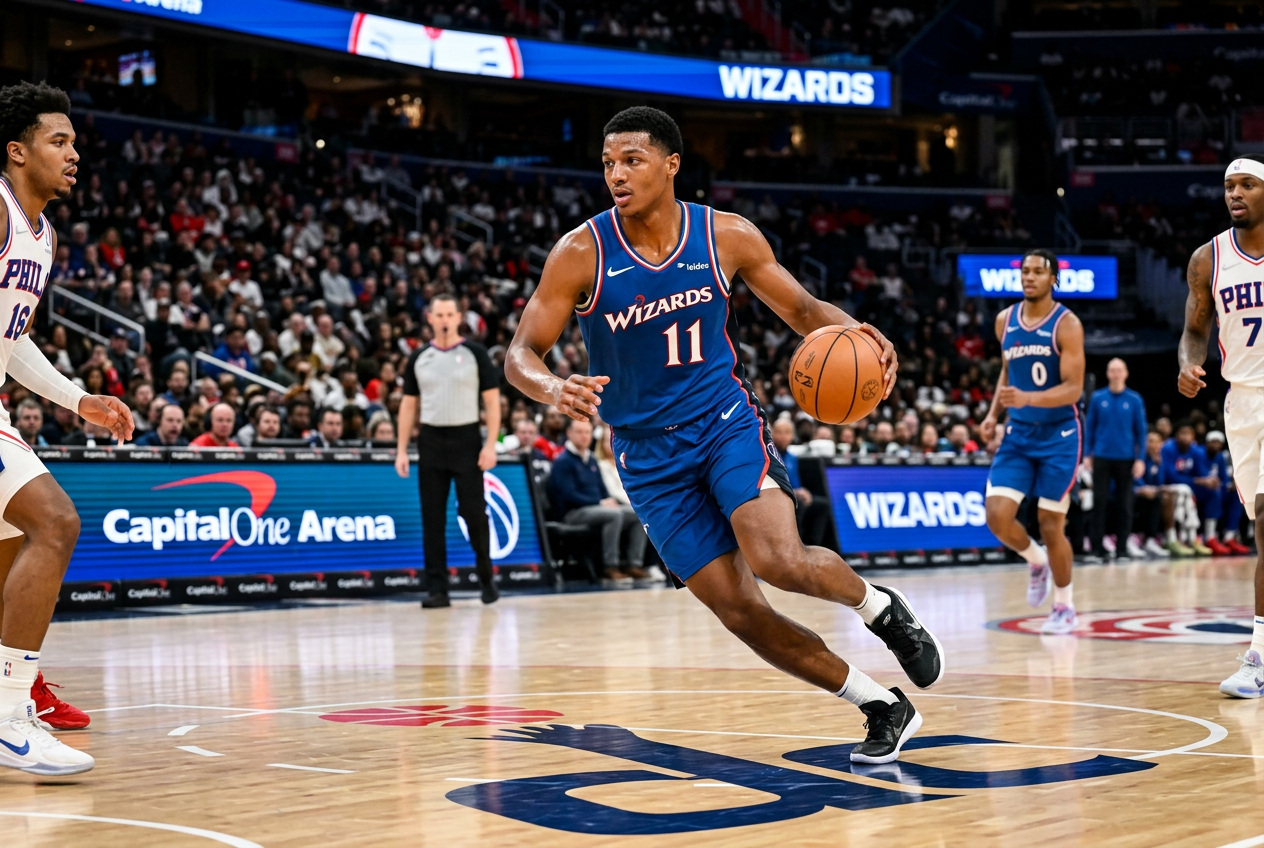
Julian Reese is headed to the Washington Wizards on a two-way contract, a move that gives the former Maryland standout a clear NBA development runway and gives Washington another young frontcourt piece to evaluate down the stretch.
The NBA G League’s transaction release confirmed the signing on Feb. 28, 2026, and the move also shows up on the Wizards’ official transaction log for the same date.
For Reese, it’s a “local” NBA landing spot. He’s a Baltimore native who built his profile in the DMV at the University of Maryland, then spent this season in the Toronto Raptors’ developmental pipeline with Raptors 905 before getting his call-up opportunity.
Julian Reese’s two-way deal with the Wizards: what’s confirmed
Washington signed Julian Reese to a two-way contract on Feb. 28, 2026.
Reese entered the season with Raptors 905 and logged meaningful minutes as a high-efficiency finisher and rebounder.
In the NBA G League’s release, he’s listed at 6-foot-10 and 240 pounds, and the same release notes he appeared in 38 total games (including the Tip-Off Tournament and regular season) while averaging 7.9 points and 7.2 rebounds in 17.2 minutes per night, shooting 62.8% from the field.
That production profile matters because two-way signings are often about one or two translatable skills.
Reese’s current strengths are the kind teams typically like to test at the NBA level: finishing plays cleanly, running the floor and consistently winning possessions with rebounds and physicality.
The box-score efficiency is real, but the question is how quickly he can show he fits into NBA spacing and NBA defensive schemes when everything speeds up and defenders have to make split-second decisions.
From a Wizards perspective, it is also just a low-stakes roster move during a season the team has already been busy on the transaction wire.
Washington’s public transaction list shows several signings during February, including Reese’s signing as a two-way player.
Who is Julian Reese?
If you have followed along in Big Ten basketball the last several seasons, Reese is not an unfamiliar name.
He was a multi-year player for Maryland, picking up a reputation as a strong two-way presence who rebounded well, guarded the paint and slowly expanded into more offensive comfort.
The G League release describes him as a Maryland player for four years (2021–25) and averaging 11.1 points, 7.6 rebounds, 1.3 assists and 1.3 blocks across 134 career games (102 starts).
Maryland’s athletics release provides more perspective on the résumé: he finished his Terps career with 1,488 points and 1,015 rebounds, one of just two players in program history (alongside Len Elmore) to reach 1,000 points and 1,000 rebounds.
The Maryland release also shows just how full the stat line was over four years: 179 career blocks (eighth all-time at Maryland), and the assists and steals totals indicating he wasn’t just a stationary giant.
He also had 37 career double-doubles (fifth all-time at Maryland), and a career field-goal percentage that ranks among the program’s very best.
Those types of achievements don’t automatically qualify players to find a role in an NBA rotation, but they do mean that the teams see the foundation they want in a young big: reliable effort, durable production, and at least one bankable calling card (in his case, rebounding and interior efficiency).
Here’s the “why him?” skill set teams like to take a risk on
Two-way contracts usually go out to players who are either:
specialists, that the team thinks the player can fill a niche NBA need for short stretches, or;
developmental bets where the team believes the player is a bet in part because, one improvement allows for a larger role.
Reese fits both boxes.
He’s already generating elite efficiency on shots near the rim in the G League, doing it while keeping his game simple.
He also picked up a steady diet of double-figure rebounding games and double-doubles during the season, with the league release noting nine games of 10+ rebounds and five double-doubles.
This is the “NBA entry point” for a lot of bigs: defend, rebound, finish.
How Reese got here: Maryland to Raptors 905 to Washington
After college, Reese took a modern path: find a place to be a pro.
Get in and produce in the G League, force a team to take a longer look.
Sportsnet reports that Reese first got into the Raptors organization on a reported Exhibit 10 arrangement that was connected to a training camp, working out to the Raptors 905 team.
Maryland’s release ads another piece of the timeline: he was part of a Summer League deal with the Los Angeles Lakers, before signing with Toronto at the start of the NBA season.
Once he was with Raptors 905, it was simple: play hard minutes, be physical, rebound and score efficiently.
The NBA G League transaction write-up has a couple examples of peak-game impact — “high-end outcomes,” on his assessment — when the matchup and rhythm are right: 20 points with a career-high 17 rebounds on Feb. 8, and a career-best 24 points with 13 rebounds on Feb. 12.
“For players like me, that’s what matters,” Reese said. “Not only I scored, but I could dictate how the game played out. Control these areas of the game and also do so efficiently to the point where I’m okay in a primary position.”
What does a two-way mean in practical terms?
NBA G League teams have a closer relationship with the NBA, and two-way contracts resemble NBA contracts.
“Injuries can reshape a roster, but usually — usual sort of preparation moving into a training camp, as an example, is to have maximum of 50 NBA games,” NBA G League president Shareef Abdur-Rahim explained.
Under NBA rules described in more detail here, teams can sign three players who spend the bulk of their time in the G League and are permitted to be active for two through December.
For a player signed later, it becomes a prorated number based on the days left in the regular season.
That pro-rating matters because it impacts how a team chooses to use a two-way player in March and April.
If Washington wants Reese available for certain matchups — or wants him to spend the most nights playing heavy minutes in the G League — they can manipulate the “NBA active list” appearances.
It’s a development contract, but it’s also an NBA tryout
Two-way deals are frequently the cleanest way to test whether a player’s strengths can hold up against NBA athletes.
For Reese, the ideal early NBA pattern of use is spot minutes in specific roles:
energy big off the bench
physical rebounder in short stints
rim finisher who doesn’t need plays called for him
If he shows he can defend within the team scheme without fouling and can stay playable against NBA spacing, that’s when the opportunity can grow.
There’s a calendar component
The NBA G League overview notes that two-way contracts may not be signed after March 4.
Reese signing on Feb. 28 keeps Washington comfortably inside that window.
Why the Wizards did this
The simplest explanation is often the right one: Washington is taking advantage of the two-way system as it’s designed.
The Wizards’ transaction log gives the impression of a team actively cycling through options at the end of the season.
(Reese’s) signing fits that pattern, and it fits a broader “evaluate young talent in real games” approach that rebuilding or retooling teams often take.
The team context [also] matters.
ESPN’s team page snapshot at the time of the transaction list shows Washington sitting at 16-43, which is typically the type of record that encourages more experimentation with younger players and different lineup looks.
That doesn’t guarantee Reese plays meaningful NBA minutes immediately, but it does suggest Washington has incentives to give developmental players real opportunities—especially if they believe there’s a chance the player can be part of the next roster iteration.
How Julian Reese could fit on the floor
Projecting G League production to the NBA is tricky.
Pace is faster, spacing is wider, scouting is deeper, and every mistake gets punished more quickly.
Still, Reese’s current profile provides a clear starting point
Rebounding translates—if you can win position
Reese has been a strong rebounder across every level referenced in public releases.
In the G League sample, he’s producing 7+ rebounds per game in limited minutes.
At Maryland, he finished second all-time in program rebounds and piled up over 1,000 boards.
NBA rebounding is more about reading the bounce and carving out space than height or leaping ability alone.
Reese’s college track record suggests his instincts and physicality are real.
The question is whether he can hold those advantages against NBA centers who are stronger, longer, and smarter about leverage.
Interior efficiency is useful—for all its other elements, if you can create enough rim chances
Hitting over 60% from the floor in the G League—on fewer shots—probably indicates good finish and shot choice at the basket.
If Reese’s offense is mostly screens, rolls, cuts and putbacks, he can provide offense without siphoning flow or consumption from an above-the-rim offense: there’s real value there, particularly for a role player vying for minutes.
Defense is everything
The difference for most young bigs.
The Maryland release also lists Reese’s blocks and steals—179 career blocks, plus 113 steals—but NBA defense is about coverage and reliability more than highlight reel plays.
Is Reese pointing to the right places, getting back to shooters, and avoiding dumb fouls?
If so, he can stay on the floor long enough for his rebounding and finishing to pay off.
What happens next: realistic ideas about the rest of a season
A two-way signing means a couple likely next steps.
Expect a ton of Capital City Go-Go time
Two-way players tend to spend a bulk of their time with the G League affiliate, where they can play through mistakes and stack high-quality reps.
The NBA G League’s own explainer on two-way roles emphasizes that players drafted into two-ways spend the majority of the season in the G League.
If Reese gets real time with Capital City, Washington can just focus on hitting specific markers and goals (defensive coverage, screen setting, free throw shooting, short-roll reads) while also keeping him available for NBA nights.
NBA minutes may come in short windows
Sometimes, if he’s on the list, even “active” doesn’t mean he gets real time.
Coaches often bring players along slowly, especially bigs, who need to pick up matchups and prey-specific game plans for pick-and-roll defense.
If Reese gets NBA minutes, they may first come as:
a handful of short first-half stints to check matches
second-half minutes of victories
situationally, depending on the other team’s frontcourt size
Then, the big picture: can he turn his two-way into one for a standard contract?
Two-way is like a bridge.
The goal is either:
to convert to a standard NBA contract, or
to signal enough that another team would sign him to a standard contract in the summer.
For Reese, the route to conversion should be pretty clear: defend, repeat on the glass and finish well in the low end of usage.
If those keys are hit, it’s just roster math from there for Washington.
Bottom line
Signing Julian Reese to a two-way contract with the Wizards is the kind of move the G League and two-way system exists to facilitate: a talented young player with a high-quality college history and translatable skill-set gets an NBA platform for development, and the team gets a low-risk chance for upside evaluation.