
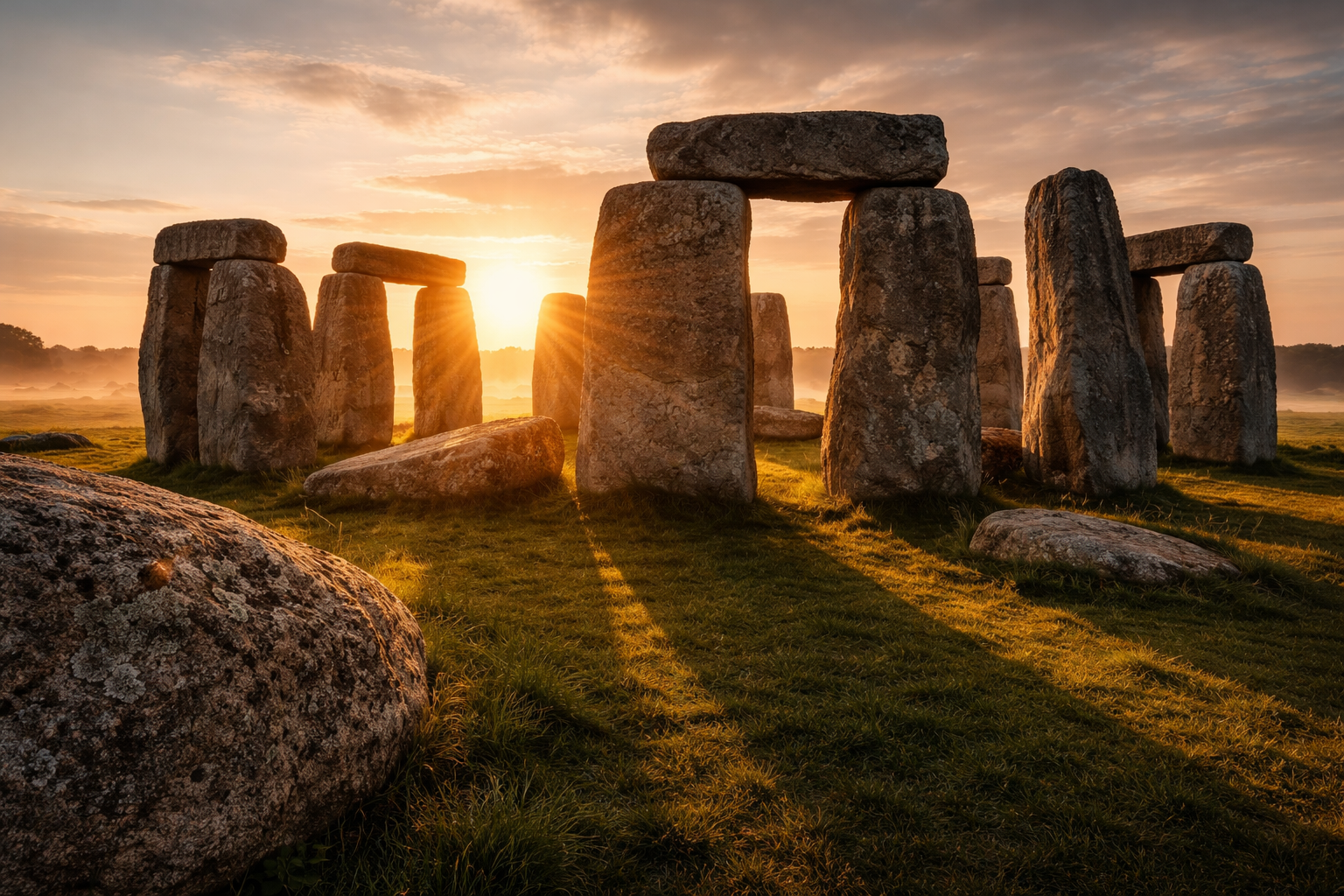
Stonehenge’s “moving stones” mystery has not been solved in the sense of a step-by-step reconstruction with a proven route, exact tools, and precise workforce counts. But a major part of the debate has now been narrowed dramatically: new geological evidence strongly challenges the long-running idea that glaciers delivered Stonehenge’s non-local stones to Salisbury Plain. In practical terms, the latest research shifts the balance further toward deliberate human transport.
That matters because the “glacier vs. people” question is one of the biggest foundations beneath all Stonehenge transport theories. If ice did not bring those stones south, then Neolithic communities almost certainly selected, moved, and assembled them with intention—and across impressive distances. The new study does not tell us exactly how they did it, but it makes the “humans moved them” position much stronger than before.
For readers searching “Stonehenge’s Mysterious Moving Stones Explained at Last,” the most accurate headline-level takeaway is this: the newest evidence appears to explain who moved the stones (people, not glaciers), but not yet exactly how every stone was transported or why each source stone was chosen.
Why This Stonehenge Story Is Back in the Headlines
Stonehenge is already one of the world’s most studied prehistoric monuments, and it remains archaeologically important because of its engineering sophistication, long-distance stone transport, and role within a much larger ceremonial landscape. English Heritage notes that Stonehenge was built in multiple stages, beginning about 5,000 years ago, with the iconic stone circle erected in the late Neolithic around 2500 BC.
UNESCO also describes Stonehenge and Avebury as globally significant prehistoric monument complexes, emphasizing the technological achievement involved in the stones’ shaping, design, and transport. The site was inscribed as a World Heritage property in 1986.
The recent spike in attention is tied to two linked scientific developments:
- A 2024 Nature paper that traced Stonehenge’s Altar Stone to northeast Scotland (Orcadian Basin), implying transport of a six-tonne stone over at least 750 km.
- A 2026 Communications Earth & Environment paper that used mineral fingerprinting of river sediments around Stonehenge to test whether glaciers brought megalith-related material into the area—and found evidence arguing against that scenario.
Together, these studies make a powerful combination: one strengthens the case for extraordinary long-distance sourcing, and the other weakens a major natural-transport explanation.
The Stones of Stonehenge, in Plain English
To understand the “moving stones” mystery, it helps to separate Stonehenge’s stone types.
English Heritage explains that the larger sarsens (the iconic outer uprights and lintels) came from the Marlborough Downs area, specifically West Woods, and average about 25 tons, with the Heel Stone around 30 tons. The smaller bluestones are geologically varied and came from the Preseli Hills in southwest Wales, generally weighing about 2 to 5 tons each.
English Heritage also highlights that some bluestones appear to have had complex histories before their final positions at Stonehenge, including evidence they may have been rearranged or moved between monuments.
A key complication is that some official and educational pages still reflect earlier interpretations of the Altar Stone’s origin, including older Welsh-source assumptions. Meanwhile, the 2024 Nature research argues that the Altar Stone is best matched to the Orcadian Basin in northeast Scotland, not the previously favored Anglo-Welsh sources. This is a good reminder that public-facing heritage pages can lag behind cutting-edge research.
The Old Debate: Did Glaciers Do the Heavy Lifting?
For decades, scholars and enthusiasts have debated whether humans had to move all of Stonehenge’s distant stones—or whether glaciers may have carried some of them south as “erratics” during the Ice Age, leaving prehistoric builders to collect and reuse them.
The 2026 study lays out that this glacial transport hypothesis has relied largely on geomorphological arguments, including questions about how far older Pleistocene ice sheets may have extended and whether isolated boulders in southern England could be explained as glacial deposits. But the authors also note that direct, diagnostic evidence for glacial incursion onto Salisbury Plain has been unclear or disputed.
That ambiguity is exactly why the new paper is important. Instead of arguing from landscape features alone, the researchers tested the hypothesis using microscopic mineral evidence in modern stream sediments around Stonehenge. If glaciers had pushed material from Wales or Scotland toward Salisbury Plain, they reasoned, traces of that transport should show up in local river sands as a recognizable mineral-age signature.
What the New Study Actually Did
The 2026 Communications Earth & Environment paper used grain-scale U–Pb fingerprinting of detrital zircon and apatite from modern stream sediments surrounding Stonehenge. In simple terms, the researchers examined tiny mineral grains and dated them to build a provenance fingerprint—an age-pattern signature that can be compared against known geological source regions.
The study explains that rocks across Britain have distinct age patterns, so zircon and apatite grains can act like geological barcodes. The researchers then compared Salisbury Plain sediment signatures with datasets from multiple regions and formations, including the London Basin/Thanet Formation and other British and Irish geological units.
In the paper’s discussion, the authors report that zircon age spectra from the river sand samples were statistically consistent with each other and combined into a composite dataset of 401 zircon dates. They also report a dominant apatite dataset with a large cluster of analyses (notably 250 analyses in the relevant discussion section describing the U–Pb array).
This is why many science coverage pieces describe the research as analyzing “hundreds” of grains (and some summaries phrase it as more than 700 zircon and apatite grains combined). The key point is not the exact media-summary number but the method: the team used a large mineral dataset to test for glacially imported signatures at the landscape scale around Stonehenge.
The Main Result: No Clear Glacial Fingerprint on Salisbury Plain
The study’s headline conclusion is straightforward: the zircon ages in Salisbury Plain stream sediments match local/southern British recycled sediment sources rather than a glacially delivered input from the regions associated with Stonehenge’s far-traveled stones. The authors specifically state that their data indicate Salisbury Plain remained unglaciated during the Pleistocene, making direct glacial transport of Stonehenge’s megaliths unlikely.
That is a big deal because it does not merely say “we still aren’t sure.” It actively challenges a major natural-transport explanation using geochemical provenance evidence. In archaeological terms, this strengthens the argument that Neolithic people intentionally moved the non-local stones instead of opportunistically using rocks dumped nearby by ice.
The paper also notes that outwash from glaciers can carry fine detrital grains beyond ice margins, which is part of why this method is so useful. Even if giant erratics themselves were absent, a glacial system reaching the region could still have left behind a fine-grained mineral signal. The absence of that expected signal is therefore meaningful.
How This Connects to the 2024 Altar Stone Breakthrough
The 2024 Nature study on the Altar Stone changed the Stonehenge conversation by arguing the stone’s provenance lies in the Orcadian Basin of northeast Scotland. The paper describes the Altar Stone as a central recumbent sandstone megalith weighing about 6 tonnes and concludes that its detrital mineral signatures match northeast Scottish sources rather than southern Britain.
The authors write that such a provenance implies a source at least 750 km from Stonehenge and note that the difficulty of long-distance overland movement suggests a sea route is plausible, reflecting substantial social organization in Neolithic Britain.
Now combine that with the 2026 glacial-transport challenge and the broader narrative becomes much more compelling: one study says a key Stonehenge stone likely came from very far away in Scotland, and the next study says the local geology around Stonehenge does not show the glacial signature expected if ice had delivered such material south. The combined implication is a stronger case for planned human transport networks and sophisticated logistics.
What “Explained at Last” Gets Right—and Wrong
The phrase “Stonehenge’s Mysterious Moving Stones Explained at Last” works as a news hook, but it can be misleading if read too literally.
What it gets right:
The latest research appears to explain the mechanism category of arrival more convincingly than before—favoring human transport over direct glacial delivery to Salisbury Plain. That is a major explanatory advance in a debate that has persisted for generations.
What it gets wrong (or overstates):
We still do not have a complete, verified operational reconstruction of how every stone was quarried, hauled, floated, dragged, lifted, and set in place at Stonehenge. The studies do not provide a final route map, exact transport technology sequence, or definitive labor estimates.
In other words, the mystery is not “finished.” It has been refined. A major natural explanation has been weakened, which elevates human agency and engineering in the story, but plenty of archaeological questions remain open.
Why This Matters for Archaeology and Prehistoric Britain
This is not only a Stonehenge story. It is also a story about prehistoric connectivity, logistics, and social organization across Britain.
If communities in the Neolithic were deliberately moving heavy stones over long distances—from Wales for bluestones and potentially northeast Scotland for the Altar Stone—that implies more than brute force. It suggests planning, coordination, route knowledge, labor mobilization, and cultural reasons strong enough to justify extraordinary effort.
The 2024 Nature paper explicitly frames provenance research as a window into the “culture and connectivity” of prehistoric Britain, especially because these societies left no written records. That is why provenance studies matter so much: they let scientists reconstruct social worlds from stone, sediment, and mineral grains.
UNESCO’s description of the wider Stonehenge-Avebury landscape also fits this interpretation, emphasizing long-term ceremonial and mortuary use, large-scale monument building, and technological achievement over roughly two millennia. The stone transport debate sits inside a much larger picture of organized prehistoric landscape engineering.
What We Still Don’t Know About Stonehenge’s Moving Stones
Even with the new evidence, several major questions remain unresolved.
1) The exact transport routes
Did builders move stones primarily overland, by river, by coastal sea routes, or through mixed systems? Different stones may have followed different paths. The Altar Stone paper suggests sea transport may be more plausible for such a long-distance Scottish source, but it stops short of proving a single route.
2) The exact transport technology used
Common ideas include sledges, rollers, ropes, timber tracks, and watercraft, but no single model has been confirmed for all stone types and distances. The new glacial study addresses whether nature brought the stones, not the exact engineering toolkit humans used.
3) Why these particular stones were chosen
Stonehenge’s stones were not interchangeable building materials. Their source locations, rock types, visual properties, and possible prior use may all have mattered. English Heritage notes some bluestones may have had earlier placements before their final Stonehenge arrangement.
4) The symbolic role of the Altar Stone
The Altar Stone sits at the center of ongoing debate because of its placement, size, and unusual composition relative to other stones. The 2024 study strengthens provenance evidence, but its ritual, symbolic, or practical role remains uncertain.
FAQ: Stonehenge’s Mysterious Moving Stones Explained at Last
Did scientists finally prove how Stonehenge was built?
Not completely. The new research strongly challenges the glacier-delivery theory and supports human transport, but it does not fully reconstruct the exact methods, routes, or sequences used for every stone.
What did the new Stonehenge study test?
It tested whether glaciers left a detectable mineral fingerprint in sediments around Stonehenge. Researchers analyzed zircon and apatite grains in modern stream sands around Salisbury Plain and compared their age signatures to known geological sources.
What did the study find?
The sediment signatures matched local/southern British recycled sources rather than a glacially imported signature from the regions associated with Stonehenge’s distant stones. The paper concludes direct glacial transport of Stonehenge’s megaliths is unlikely.
Where did Stonehenge’s stones come from?
English Heritage identifies the major sarsens as coming from West Woods (Marlborough Downs area) and the bluestones from the Preseli Hills in southwest Wales. A 2024 Nature paper argues the Altar Stone likely came from the Orcadian Basin in northeast Scotland.
Why is this discovery important?
It strengthens the case that Neolithic communities intentionally selected and transported Stonehenge’s non-local stones across long distances, which has major implications for understanding prehistoric engineering, planning, and social networks in Britain.
Final Verdict
“Stonehenge’s Mysterious Moving Stones Explained at Last” is best understood as a partial but meaningful scientific milestone.
The new evidence does not eliminate mystery from Stonehenge. It does, however, significantly clarify one of its biggest transport debates by undermining the idea that glaciers delivered the monument’s distant stones to Salisbury Plain. That pushes the story further toward deliberate human movement—and toward a view of Neolithic Britain as highly organized, connected, and technically capable.
And that may be the most important update of all: Stonehenge looks less like a monument assembled from chance geological leftovers and more like the result of intentional choices on a remarkable scale.