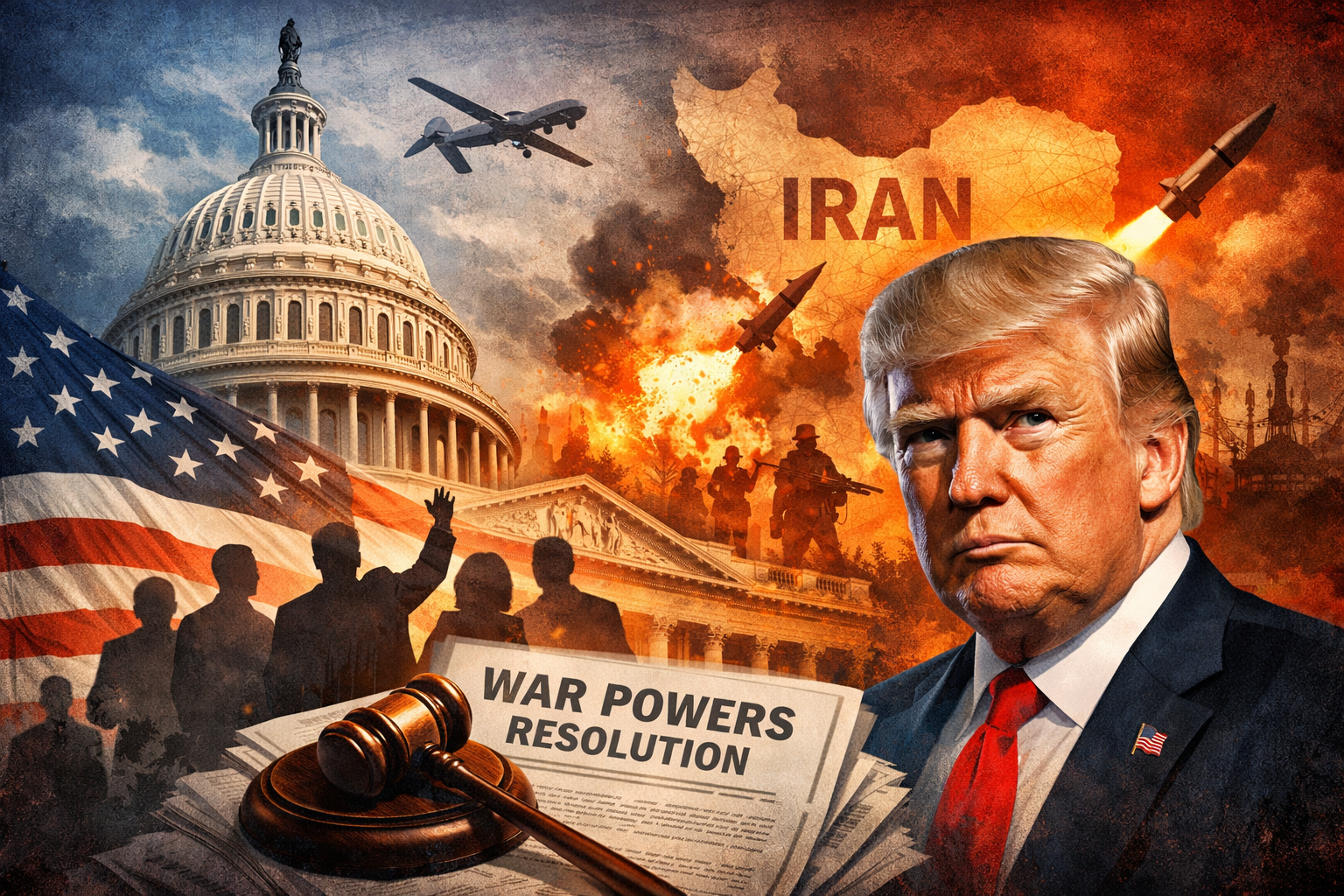
A new push on Capitol Hill aims to put Congress back at the center of any decision to expand U.S. military action against Iran. Democrats, joined by a small group of Republicans, say they will force votes in the House and Senate that would require President Donald Trump to seek explicit congressional authorization before launching or widening hostilities against Iran.
The effort comes as tensions spike after U.S. and Israeli strikes on Iranian targets and as Iran signals it may respond in ways that could raise the risk of a broader regional war. Lawmakers who support the resolutions argue that the Constitution gives Congress—not the president—the power to declare war, and they say recent actions moved the country toward conflict without an open debate or a clear vote.
Republican leaders who back the White House approach frame the situation differently. They argue that the president, as commander in chief, must retain flexibility to respond quickly to threats, protect U.S. forces, and deter further escalation. That divide sets up a high-profile test of the War Powers framework, a law Congress passed after Vietnam to limit unilateral military action by the executive branch.
What Democrats and a Few Republicans Say They’ll Do
In the House, Democratic leadership and key ranking members have announced plans to compel a floor vote on what they call the Khanna–Massie Iran War Powers Resolution, led by Rep. Ro Khanna (D-Calif.) and Rep. Thomas Massie (R-Ky.). They say the measure would force the president to come to Congress to make the case for using military force against Iran, and they want every House member on record.
In the Senate, Sen. Tim Kaine (D-Va.) has teamed up with Sen. Rand Paul (R-Ky.) on a related War Powers effort, and Democratic leaders have amplified calls to hold a vote soon. Supporters say they want a public debate and a clear decision on whether the United States should enter or expand a conflict with Iran.
These moves do not necessarily stop current operations immediately. They aim instead to draw a line around further escalation and to reassert Congress’s role before the next step—additional strikes, a longer campaign, or expanded involvement—turns into an open-ended conflict.
The Core Question: Who Decides on War?
The Constitution splits war powers between Congress and the president. Congress holds the power to declare war, raise and fund the military, and regulate the armed forces. The president serves as commander in chief and can direct military operations, especially when responding to attacks or urgent threats.
That division often creates friction during crises. Modern presidents in both parties have claimed broad authority to conduct strikes without a formal declaration of war. Congress has often tolerated or supported that approach, sometimes by funding operations after the fact, sometimes by passing Authorizations for Use of Military Force (AUMFs), and sometimes by doing nothing.
The current War Powers fight reflects a deeper argument about accountability: Should elected lawmakers vote “yes” or “no” before the country enters sustained hostilities, or should the president act first and ask for support later?
What the War Powers Act Actually Says
People often call it the “War Powers Act,” but the formal name is the War Powers Resolution of 1973. Congress designed it to ensure that “the collective judgment” of Congress and the president governs the introduction of U.S. forces into hostilities.
The law lays out three big requirements that matter in today’s debate:
Congressional consultation
The resolution says the president should consult with Congress “in every possible instance” before introducing U.S. forces into hostilities or situations where hostilities look imminent, and it calls for continued consultation afterward.
Rapid reporting
If the president introduces U.S. forces into hostilities (or certain related situations), the law requires a written report to congressional leaders within 48 hours explaining the circumstances, the legal authority, and the expected scope and duration.
The 60-day clock (plus a short extension)
The War Powers Resolution sets up a framework that generally requires the president to end involvement within 60 days unless Congress declares war or provides specific statutory authorization, with a further period allowed for withdrawal in some circumstances.
In practice, presidents often dispute parts of the War Powers framework, and Congress rarely enforces the strictest interpretations. Still, lawmakers use War Powers votes as a concrete way to challenge the executive branch and shape what happens next.
How “Forcing a Vote” Works
The phrase “force a vote” sounds straightforward, but Congress has multiple procedural paths, and leaders in both chambers often control the floor schedule.
In the House, supporters argue they can use privileged procedures tied to War Powers to bring the resolution up even if leadership resists. House Democrats also frame the vote as a matter of institutional responsibility: if the United States moves toward war, members should not hide behind leadership’s schedule or behind ambiguous claims about authority.
In the Senate, Kaine and Paul’s camp has emphasized that War Powers measures can qualify for expedited consideration, but Senate leadership still shapes timing, especially when members leave Washington or when leaders control when the chamber reconvenes. That dynamic explains why many calls focus on bringing senators back into session to vote.
Even when Congress holds a vote, the endgame remains difficult: a measure must pass both chambers and survive a presidential veto (or override it) to create binding law. That bar almost always requires significant bipartisan support.
Who Supports the Push and Why
Supporters come from two overlapping groups.
Democrats who want Congress to reassert authority
Many Democrats argue that recent Iran-related military actions require clearer legal authorization than the White House has described publicly. They also worry about mission creep: an initial strike can expand into a sustained campaign, especially if Iran retaliates against U.S. forces or if the United States widens objectives beyond narrow deterrence.
A slice of Republicans who distrust open-ended intervention
A handful of Republicans—often libertarian-leaning or anti-interventionist—support War Powers limits on principle. They view the issue as constitutional and procedural rather than partisan: Congress should vote before war, regardless of which party holds the White House. The House effort led by Massie alongside Khanna highlights that cross-ideological alignment.
This coalition does not share a single foreign policy vision. Some supporters want a more restrained U.S. posture in the Middle East. Others might support tough measures against Iran but still demand Congress approve them first.
Who Opposes the Resolution and Why
Opposition also comes in different forms.
Republican leadership and many national-security hawks
Many Republicans argue the president needs room to respond quickly, especially if intelligence points to imminent threats. They also worry that a War Powers vote could signal division to adversaries and weaken deterrence during a crisis.
Some Democrats who support the strikes or prefer a different approach
Not every Democrat lines up behind the effort. Some support the military operation itself, some focus on backing Israel, and others worry that a War Powers vote could constrain future presidents in ways that might matter outside the Iran context. Public comments from some Democrats have signaled support for the administration’s posture even as many colleagues criticize the lack of congressional authorization.
There’s also a more tactical objection: if the resolution is likely to fail, opponents argue it can become symbolic politics instead of meaningful oversight. Supporters reply that symbolism matters when it forces accountability—especially when war decisions sit on the line.
The Political Math: Why the Vote Looks Hard
Even if a bipartisan group forces a vote, passing the measure remains difficult.
The House
House margins often run tight, but leadership still shapes outcomes. A War Powers vote can attract unusual coalitions—some progressives and some libertarian-leaning conservatives—but it can also splinter once members weigh party loyalty, national security arguments, and political risk. Democrats say they want every member on record, which suggests they see value even if the measure falls short.
The Senate
In the Senate, a successful vote typically requires near-unified Democratic support plus multiple Republicans. Recent history suggests that hurdle remains steep, especially when a president’s party controls the chamber or when leadership encourages unity during a conflict.
The veto problem
Even if both chambers pass a War Powers bill, the president can veto it. Overriding a veto requires two-thirds majorities in both chambers, which rarely happens on foreign policy constraints. That reality pushes supporters to treat the vote as both a legal tool and a political marker: it signals where Congress stands and can influence public opinion and future negotiations.
What This Looks Like Compared With Past Iran War Powers Fights
The current push echoes earlier Iran War Powers battles during Trump’s prior term and during the last year of renewed Iran conflict.
A Senate vote in 2025 rejected a Kaine-led effort to restrict further military action against Iran, with the chamber voting 53–47. Reporting at the time described a mostly party-line split, with Sen. Rand Paul supporting the resolution and Sen. John Fetterman opposing it.
Back in 2020, Congress also passed an Iran war powers measure after the killing of Iranian General Qassem Soleimani, but it did not become law after Trump vetoed it and supporters failed to override.
Those episodes shape expectations now. Supporters argue that Congress never should have accepted a norm where major military decisions happen first and debates happen later. Opponents argue that Congress already has tools—funding, hearings, briefings—and that a War Powers cutoff can create more risk than it reduces.
Why This Moment Feels Different to Lawmakers
Several factors explain why the latest push is gaining traction even if it still faces long odds.
The pace of escalation
A crisis that moves quickly can leave Congress feeling sidelined. When lawmakers hear about operations after the fact—or with minimal notice—they often respond by reaching for War Powers tools because they provide a concrete procedural path to a vote.
High risk to U.S. forces in the region
Iran has multiple ways to retaliate—direct missiles, proxy attacks, maritime disruptions—and many lawmakers worry about U.S. troops and diplomats stationed across the Middle East. That concern cuts across ideology: hawks worry about deterrence and force protection, while skeptics of intervention worry about the United States sliding into another prolonged conflict.
A broader institutional anxiety
Even some members who lean pro-defense worry about the long-term erosion of congressional authority. They see War Powers votes as rare moments when Congress can pull back some leverage over the executive branch.
What a War Powers Vote Could Change in the Real World
A War Powers vote can influence events even when it does not become law.
It can force briefings and public justifications
Members often use the pressure of an impending vote to demand classified briefings, legal memos, and clearer explanations of strategy. Those demands can shape public understanding and limit the administration’s flexibility to keep plans opaque.
It can signal limits to allies and adversaries
If Congress shows strong resistance to escalation, foreign governments might adjust their expectations about how far the United States will go. That can cut two ways: it might discourage allies from assuming U.S. backing for a longer war, or it might encourage adversaries to wait out political divisions.
It can shape the next step more than the current step
Even when a vote occurs after initial strikes, it can still matter for what comes next: additional rounds of bombing, deployment increases, cyber operations, maritime actions, or a broader campaign with multiple objectives.
The Central Tension: Law, Politics, and Strategy
At the heart of the debate sits a conflict between three realities.
First, Congress has clear constitutional powers over war and funding, and the War Powers Resolution tries to translate that into deadlines and procedures.
Second, modern crises move fast, and presidents often act first—especially when they claim they need to stop imminent threats or protect U.S. forces.
Third, Congress often lacks the unity and speed to match the executive branch. Even when lawmakers agree on principle, they split on strategy, timing, and whether a vote helps or hurts deterrence.
That tension explains why the War Powers Resolution remains both influential and frustrating. It gives Congress a framework, but it doesn’t guarantee Congress will use it effectively—or that it will win the showdown with the White House.
What to Watch Next
If lawmakers succeed in forcing votes, several details will matter more than the headline.
How leaders schedule the vote
Timing can shape outcomes. A vote held quickly, while news coverage remains intense, can draw more cross-party defections. A delayed vote can lower urgency and give leadership time to line up opposition.
How the resolution defines “hostilities”
War Powers fights often turn on definitions. If the administration argues that certain actions do not qualify as “hostilities” under the law, it can claim the War Powers clock doesn’t apply. Supporters will likely counter that strikes, coordinated attacks, or sustained operations clearly meet the standard.
Whether the coalition expands beyond the usual suspects
Massie, Khanna, Paul, and Kaine represent a recognizable War Powers bloc. The question is whether more Republicans join them, and whether Democrats who support the administration’s actions still support Congress’s right to authorize them.
Whether the administration offers a narrower authorization
Sometimes a War Powers confrontation ends with the White House asking Congress for a targeted AUMF. That path can defuse the constitutional fight while still authorizing action. It can also trigger a new debate over scope, duration, and limits.
Bottom Line
Democrats and a few Republicans want to force Congress to take a clear position on whether President Trump can expand military action against Iran without explicit authorization. The coming votes will test the War Powers Resolution’s practical strength and Congress’s willingness to use it, especially under intense partisan pressure and fast-moving events.