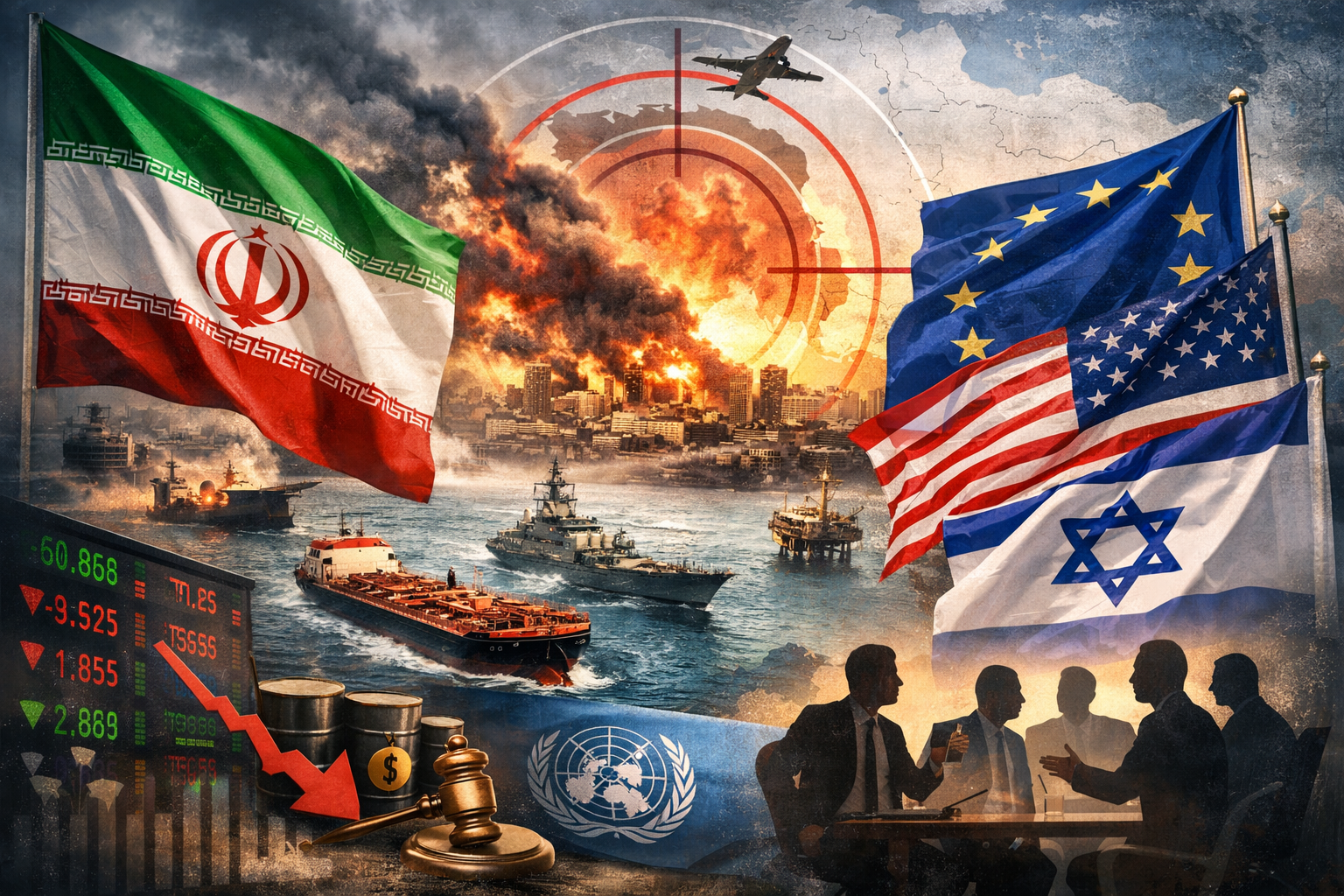
In the aftermath of the attack on Iran, governments around the globe have quickly worked to stake out positions, protect citizens, and prevent spillover. The leaders of some governments supported the strikes as a needed step to deter Tehran’s weapons programs and regional influence. Others condemned the use of force, warned of violations of international law, and pressed for an immediate ceasefire. Many have tried to hold both ideas at once: they criticize Iran’s behavior while also demanding restraint from every side.
This mess of responses reflects a hard reality. Iran sits at the center of multiple global fault lines: energy trade, regional security alliances, nuclear non-proliferation, and great-power rivalry. When major militaries strike Iranian targets, the shock waves, literally and figuratively, travel far beyond the battlefield. Diplomats worry about escalation. Shipping firms worry about chokepoints. Airlines worry about airspace closures. Households worry about fuel prices. Political leaders everywhere worry about what comes next.
Here’s how the world reacted to this particular attack, why those reactions differ, and what the next phase of this crisis might ride on.
Why this attack prompted a global reaction
The attack on Iran quickly grew into more than a bilateral or regional confrontation because it directly implicated multiple systems that the global economy and security order rely on.
Energy and trade exposure
The Persian Gulf and nearby sea lanes connect major oil and gas producers to global markets. Any hint that the supply of oil or the security of trade routes—through seizure, military conflict, or insecurity—may bad consequence markets and raises inflation risks all the way around the world from the Middle East.
Alliance politics
The United States and Israel are at the center of this Western security reorientation. And many countries are asking whether to support partners, recoil from partners, try to convince them to step back from the edge but not abandon their alliance.
International law and precedent
When states begin to make the case for a large-scale strike, for “preventive” or “preemptive” actions, other governments are immediately confronted with what this means for the rules of the road. Even countries that don’t trust Iran are often put off by norms that set a precedent for unilateral projection of force.
Domestic politics
Leaders have domestic audiences that look at the crisis through separate, varied, and competing lenses—security challenge, ideological, humanitarian, or cost-of-living pressure and that often shapes the presentation of their political case externally.
The U.N. emphasizes de-escalation and civilian protection
At the United Nations, other senior diplomats prioritized a “de-escalation” narrative for the crisis. U.N. Secretary-General António Guterres last week “condemned Israel’s military escalation” and emphasized the need lapse of fighting, or risk a broader regional war that could have “grave consequences for civilians and regional stability.”
Human rights leadership are elevating this narrative focusing on the harm to civilians, risks of displacement, and the long term damage that escalation of this nature does to populations even if there is some military precision involved. Governments that prefer diplomacy amplify this offering because it leaves a sharing minimum of undergoing – “find a way to avert a humanitarian disaster, keep the conflict from iscriminalize it, and re-open the question.
European capitals begin to “walk us down the tightrope” of restraint, law, and holding on to security interests.
China made focused comments about ceasefire and the need for the broader implications of the conflict on economic risks.
A joint statement from Germany, France, and the UK reiterated a commitment to regional stability and civilian protection and called for a resumption of negotiations while condemning Iranian attacks. French President Emmanuel Macron said the U.N. should “urgently mobilize” and warned that the flare-up is dangerous for everyone.
At the EU level leaders have played up both non-proliferation and humanitarian risk. European Commission President Ursula von der Leyen and European Council President António Costa called for “maximum restraint,” civil protection, and respect for international law. The EU’s foreign policy chief Kaja Kallas called the situation “perilous” and emphasized the need to keep maritime corridors open through the EU’s Aspides naval mission.
Europe’s balancing act (no pun intended) speaks to geography and vulnerability. European countries sit slightly closer to the conflict than Canada or the U.S. and feel secondary effects sooner—migrant pressure, spikes in energy prices, and concerns about critical infrastructure security. European leaders have a diplomatic legacy in nuclear talks with Iran that provoke risk aversion around steps that close the door to negotiation. Chinese Foreign Minister Wang Yi described them as unacceptable and called for a return to talks, while Chinese state media criticized what it termed coercive “power politics.” Beijing issued travel and evacuation advisories for Chinese citizens in the region, and highlighted cases of canceled flights and risk.
This hits multiple Chinese interests all at once. It keeps China in line with its opposition to political changes imposed from the outside. It casts Beijing as a defender of stability to energy-importing Asian economies, and as a conscientious partner that worries about trade disruptions which can raise energy and shipping costs to a Chinese scientific and consumer base.
Russia condemns “hunting” and goes after energy-market risk
Russia too has condemned targeting of leaders and framing the strike as a dangerous precedent under international law, while stressing in its messaging the risk to oil and gas markets of a severe disruption to those markets, particularly if the corridor of the Strait of Hormuz is closed or significantly destabilized.
Russia’s messaging reflects both principle and strategy. On principle, Moscow will often invoke sovereignty: the sanctity of leaders and retaliatory strikes on their compounds. Strategically the Kremlin is extremely sensitive to energy markets, and both the price of oil it ships out and of the commodities it buys depend on stable markets. It cares what oil and gas do and looks for market distortions that can raise prices and alter bargaining strength in Moscow’s favor. At the same time, Russia worries about dangerous escalation that can affect Moscow’s friends and partners.
Middle East honeypots balancing for containment and sovereignty
Governments immediately exposed live in the Middle East, and they respond with a more focused initial effort on containment. They work on readiness and resilience for air defense, securing critical infrastructure, and shoring up diplomacy to stop a wider regional war from happening. Oman, which has frequently mediated between Washington and Tehran, cautioned that conflict complicates negotiations, urging the United States “not to entrench itself deeper” in the crisis. Leaders in Lebanon were emphatic they wouldn’t let parties drag Beirut into “adventures” that threaten the country’s stability.
Singapore and other Gulf governments focused on tamping down panic and keeping businesses running while preparing for the direst situations. That could involve tighter security at ports and airports, working alongside foreign embassies, and bracing for the potential of strikes on bases, energy facilities or even in urban areas with large populations.
Allies and partners divided over legality and goals
Among partners, similar reactions have sometimes been starkly different, even as officials express common concern over Iran’s weapons development or regional posture. Since the war broke out Canadian Prime Minister Justin Trudeau supported US discussions to assist Tehran in “get[ting] permanent nuclear weapon-free,” indicating general alignment with Western pressure on Iran. Spain called for de-escalation and complete observance of international law, and Norwegian diplomats pushed back on how to define a “preventive strike” as potentially within international legal standards, sans the imminent threat test. None of this is a full rupture, and makes clear domestic politics, historical experience, and level of exposure is varied. Still, it creates a disunified capacity to create a sprawling and formidable platter of yeah.
Markets react quickly: oil, shipping, aviation, insurance
While diplomats debate legality and strategy, the markets are reacting quickly to potential risk. In this crisis investors and logistics firms are particularly focused on chokepoints and avenues in the air. Reports of port blockages and tanker traffic disrupted around the Strait of Hormuz. Certain tanker owners, oil majors and trading houses have stopped shipments of crude, fuel and LNG, while European naval officials reported warnings of no ships passing. Groups representing mariners and navies especially have urged caution, while major carriers have changed routing or suspended Gulf transit.
These disruptions matter because roughly a fifth of global oil flows go through the Strait of Hormuz. Even part disruption raises freight rates, lengthens delivery times and spurs insurers to increase war risk premiums. Higher insurance drives higher consumer prices for fuel and goods.
Lastly finance ministries and central banks believe they have a role fighting inflation. You hold an oil spike for too long, and everything consumer price wise just goes up, up, up, and you have to rework your rate plans, hit emerging markets first as they switch into safer assets.”
Airlines have in some cases rescheduled or rerouted flights to avoid overflying conflict airspace, while some carriers have suspended flying in parts of the Middle East entirely. That general shift can cause knock on delays in global schedules too, because those longhauls crawl the globe using hubs and overflight corridors in the Middle East.
Update: Public opinion and street politics matter
Governments operate in a world too. Protests and rallies move them and what they feel they can say or do. People mapping social networks to predict change. In some countries, communities closer to the region have agitated for their governments to favour protection of civilians and diplomacy. In others, lawmakers and voters have agitated for deterrence and to defend allies. Social media has amplified both accounts at once, drowning each in misinformation that far outruns correction by officials.
These dynamics matter because they cement positions. Leaders afraid of losing domestic opinion will stop using language of compromise. Leaders feeling pain due to the energy price rupture will push more strongly for ceasefire. Leaders feeling threat at home will tighten policing and security around the flashpoints, including around diplomatic missions and events to facilitate members of their communities.
What diplomats will try next
So far international messages have clustered around three goals: stop an escalation, protect civilians, and resume talks. That consensus hides sharp disagreement on the route there.
Expect a wave of shuttle diplomacy. Countries that have channels with multiple parties – Oman, some European states, Asian partners – will push for limited pauses that open space for negotiation.
Expect pressure on rules-in-the-Sea. If there’s ambiguity in the Gulf, governments and navies will seek to clarify what constitutes an official close, what warnings carry legal weight, and in what way commercial shipping interacts with military authorities.
Expect a renewed debate about non-proliferation. Leaders that supported the strikes will argue that Iran’s nuclear and missile programmes thus far meant they have no time for diplomacy. Leaders that opposed the strikes will argue that no verified deal actually constrains those programmes in the long haul.
Expect humanitarian planning. If fighting continues in the Occupied Territories or spreads regionally, international agencies and neighbouring states will need a plan for medical support, housing displaced persons, safe passage for foreign nationals.
What to watch in the next 72 hours
Several indicators will determine whether it escalates or stabilizes.
Signals from Tehran as to command-and-control
If there’s ambiguity as to command-and-control it raises the chance of a miscalculation, and complicates negotiations.
Shipping patterns in and around Hormuz
Vessels and insurance pricing, and official maritime advisories will provide early indications as to whether commercial actors fear that danger is going to persist for awhile yet.
Airspace advisories and airline intentions
If major operators are continuing to delay or divert, that signals a longer-piece of risk beyond simply facing strikes.
Messaging from major powers
Look to whether US, European leaders converge with China and Russia with a concrete proposal – such as a timebound ceasefire, an inspection protocol, or performing a diplomatic conference.
The bottom line
The world’s reaction to the attack on Iran shows no single narrative – leaders have split on legality arguments, security priorities, and the economic fears – yet there’s a thread of consistency in many official statements underlining that they clearly want to prevent wider regional war whilst at the same time protecting civilians – even if they disagree on who bears responsibility and what deterrence should look like.
It’s now on whether they can convert those words to steps to de-escalate – and those steps put a clarity into laws of the sea and aviation, and a diplomatic process that threads the needle of addressing (non)proliferation and regional security without launching an endless conflict.