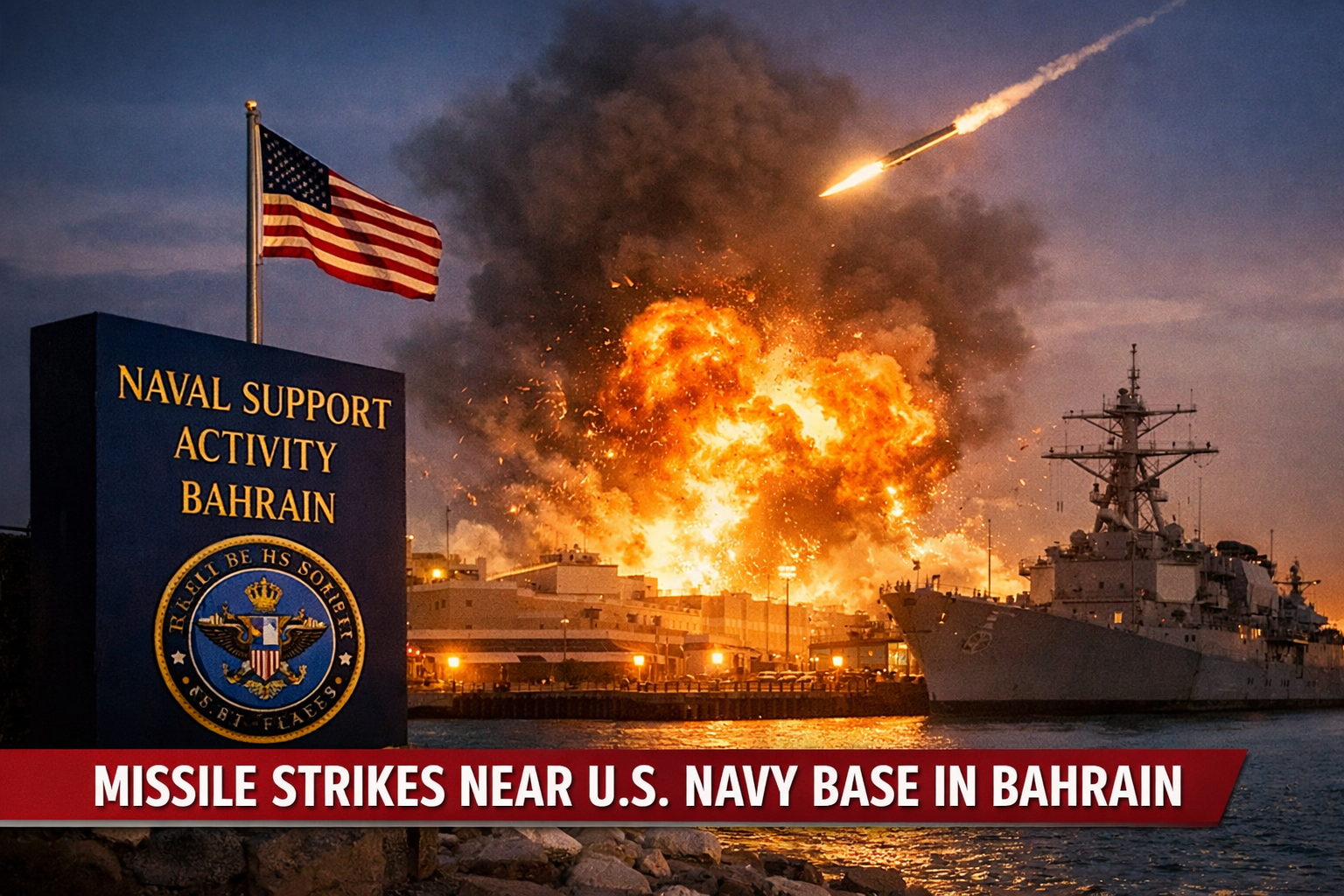
Missile strikes hit areas near the U.S. Navy’s main hub in Bahrain on February 28, 2026, as tensions across the Middle East escalated sharply. Bahrain’s government said a missile struck a service center linked to the headquarters of the U.S. Fifth Fleet, which operates from Naval Support Activity Bahrain in the Juffair area of Manama.
The incident quickly drew global attention because the base anchors U.S. naval operations across critical sea lanes, including routes tied to global energy shipments and commercial trade. At the same time, early information came in unevenly, with official statements offering limited detail while videos and claims spread online. Here’s what credible reporting and official background information support so far, what remains unclear, and why the Bahrain strike matters.
What happened near the Fifth Fleet facilities in Bahrain
Reports described explosions and rising smoke in Manama’s Juffair area, where Naval Support Activity Bahrain sits and where U.S. Navy commands run regional operations. Bahrain’s National Communication Centre publicly acknowledged an attack and said a missile hit a Fifth Fleet service center, while it urged residents to follow official instructions as authorities assessed the situation.
Iranian state-linked outlets and officials also claimed responsibility for strikes on U.S.-linked sites in several Gulf countries that host American forces. Major international reporting connected the Bahrain strike to a wider volley that targeted multiple locations across the region in the same window.
Some news organizations reviewed and verified portions of the circulating footage, which appeared to show explosions in the vicinity of the U.S. naval complex in Bahrain. Verification helped confirm that at least some videos reflected the real location and timeframe, even as many other clips remained unverified.
What we know about damage and casualties
Public details about damage at the Bahrain facility remain limited. Bahrain’s initial statement confirmed the strike on the service center but did not immediately provide a detailed assessment of damage or casualties.
Early reporting also did not confirm U.S. casualty figures from Bahrain in a definitive, official accounting. News coverage emphasized the fluid nature of the situation and the likelihood that governments and militaries would release information in stages, especially while defense forces remained on alert.
At the regional level, reporting indicated at least one fatality in the United Arab Emirates after missile activity there, underscoring that the broader volley produced real-world harm beyond the Bahrain strike zone.
Why the U.S. Navy base in Bahrain matters
Naval Support Activity Bahrain hosts U.S. Naval Forces Central Command (NAVCENT) and the U.S. Fifth Fleet, which together oversee maritime security operations across a vast region. The Fifth Fleet’s area of responsibility covers major waterways such as the Arabian Gulf, Gulf of Oman, Gulf of Aden, parts of the Arabian Sea, and connections toward the Red Sea—areas that include key chokepoints for global shipping.
That footprint makes Bahrain more than just a basing location. It functions as an operational headquarters that supports patrols, partner-nation cooperation, and responses to fast-moving security threats at sea. The posture also places the base and nearby infrastructure in the center of any crisis that touches maritime routes, energy markets, and regional deterrence calculations.
The base also sits near civilian neighborhoods and commercial areas in Manama, which means any strike near the installation can create immediate public safety concerns well beyond military targets. That proximity often drives rapid “shelter in place” messaging, temporary closures, and travel disruption when authorities detect incoming threats.
How Bahrain and partners responded in the first hours
Authorities in and around the Gulf issued urgent safety guidance as the situation unfolded. The UK Foreign Office advised British nationals in Bahrain and several nearby states to shelter in place and follow local instructions amid reports of missile attacks, reflecting the broader regional alert posture rather than a Bahrain-only incident.
U.S.-linked community messaging also reflected heightened caution. Reporting aimed at U.S. military communities indicated officials authorized departures for military dependents in Bahrain and paused some departure flights as conditions evolved, while officials directed personnel to continue sheltering.
These steps fit a common crisis-management pattern: reduce exposure, limit movement, and keep families informed while officials evaluate whether additional strikes could follow. They also signal that decision-makers treated the threat environment as ongoing, not as a one-off incident.
A wider regional volley, not an isolated Bahrain event
Multiple reports tied the Bahrain strike to a regional exchange that included missile activity against several Gulf states and U.S.-linked facilities in the broader area. In that reporting, countries such as Qatar, Kuwait, the UAE, and Jordan appeared in the list of places where missiles aimed at or near military infrastructure, and regional air defenses reportedly engaged incoming projectiles.
This matters because it changes how analysts interpret the Bahrain strike. A single strike might point to signaling or a limited escalation; a multi-country volley points to a coordinated operation designed to raise pressure across several U.S.-partner basing nodes at once. It also increases the chance of spillover effects—flight diversions, temporary airspace restrictions, and heightened security postures at ports and critical infrastructure.
Air travel and commercial disruption risks
When missiles fly across the Gulf, airlines often reroute quickly to avoid risk corridors, and governments sometimes restrict airspace in response to threats or uncertainty. Reporting on the broader escalation described widespread travel disruption and warnings to civilians, including advice to shelter in place across multiple locations in the region.
Even when air defenses intercept threats, aviation planners treat debris risk, navigation uncertainty, and rapid changes in NOTAMs as serious hazards. That reality can ripple into delayed cargo, disrupted passenger itineraries, and tighter insurance or security requirements for carriers operating near the Gulf.
For shipping, the bigger concern centers on perceptions of risk near chokepoints and key ports. The Fifth Fleet’s operating environment includes waterways that handle a large share of global energy and container traffic. Any sustained escalation that threatens maritime routes can affect freight rates, fuel prices, and regional port operations—sometimes even without direct hits on commercial vessels.
Sorting credible information from rumor and viral footage
Fast-moving conflict stories generate a predictable “information fog.” People upload videos without timestamps, mislabel locations, or repurpose older clips to match new narratives. In this case, some outlets said they verified certain videos as showing the vicinity of the Bahrain naval complex during the reported retaliation window, which helped anchor at least part of the online content in reality.
Still, verification of one clip does not validate every claim. Responsible coverage draws a line between what authorities confirm, what multiple credible reporters corroborate, and what social media accounts assert without evidence. Readers should treat early casualty numbers, precise target claims, and dramatic “direct hit” language cautiously until official assessments or consistent independent confirmation appears.
What could happen next
Several paths can follow a strike near a major U.S. facility:
- De-escalation through signaling and backchannels
Leaders sometimes use a limited strike as a message, then pivot to diplomacy once they believe they restored deterrence or saved face. In that scenario, officials emphasize “measured responses,” increase defensive readiness, and push intermediaries to contain further launches. - A cycle of retaliation
A strike near a high-value base can prompt counterstrikes, which then trigger further launches. That loop can accelerate quickly when each side tries to reassert deterrence and avoid appearing weak. - A defensive, containment-heavy phase
Even without immediate counterstrikes, militaries may shift posture by dispersing assets, moving ships, hardening facilities, and tightening force protection. Governments also may raise travel advisories and restrict movement near military zones.
At the time of reporting, public information supported the idea of a heightened alert environment across the Gulf, with governments issuing shelter guidance and militaries adjusting movement for personnel and families.
What residents and travelers in Bahrain typically watch for during alerts
During missile and drone warnings, authorities and embassies usually focus on practical guidance rather than detailed operational updates. People often see advice like:
- Stay indoors and avoid windows if officials warn of incoming threats
- Follow local emergency alerts and verified government channels
- Avoid military facilities and nearby roads during heightened security
- Expect temporary closures, checkpoints, and traffic diversions
In Bahrain, the location of Naval Support Activity Bahrain near populated neighborhoods makes this guidance especially relevant for civilians who live or work in Manama and adjacent districts. Even when air defenses stop an incoming threat, authorities often treat falling debris and secondary hazards as real risks.
Why the Bahrain strike draws outsized attention
A strike near the Fifth Fleet headquarters carries symbolic and operational weight. Symbolically, it signals that an adversary can reach a premier U.S. basing hub in the Gulf. Operationally, it forces force-protection decisions that can affect sortie rates, port operations, and the tempo of maritime patrols.
It also affects political calculations for Gulf partners. Bahrain hosts U.S. forces as part of a long-standing security relationship, and any strike on its territory raises questions about sovereignty, internal security, and how regional governments balance deterrence with domestic stability. That balancing act often shapes how quickly leaders share details, how they frame the incident publicly, and what steps they take to prevent follow-on attacks.
Key uncertainties to watch in the next updates
Several facts will likely evolve as officials publish more information:
- The precise impact location and what infrastructure sustained damage
- Any confirmed injuries or casualties linked to the Bahrain strike
- Whether air defenses intercepted additional threats over Bahrain after the initial impact
- How the U.S. military adjusts posture at sea and across regional bases
- Whether governments announce expanded airspace restrictions or new travel advisories
As with most breaking security incidents, clarity often arrives in layers: initial acknowledgment, then damage summaries, then follow-up reporting on operational impacts.
Bottom line
On February 28, 2026, Bahrain acknowledged a missile strike that hit a Fifth Fleet service center connected to the U.S. Navy’s hub in the Juffair area of Manama, as part of a wider regional escalation that included missile activity against multiple Gulf states. The strategic importance of Naval Support Activity Bahrain and the Fifth Fleet’s role in guarding critical sea lanes explains why the incident triggered immediate shelter guidance, military-family movement decisions, and intense global scrutiny.