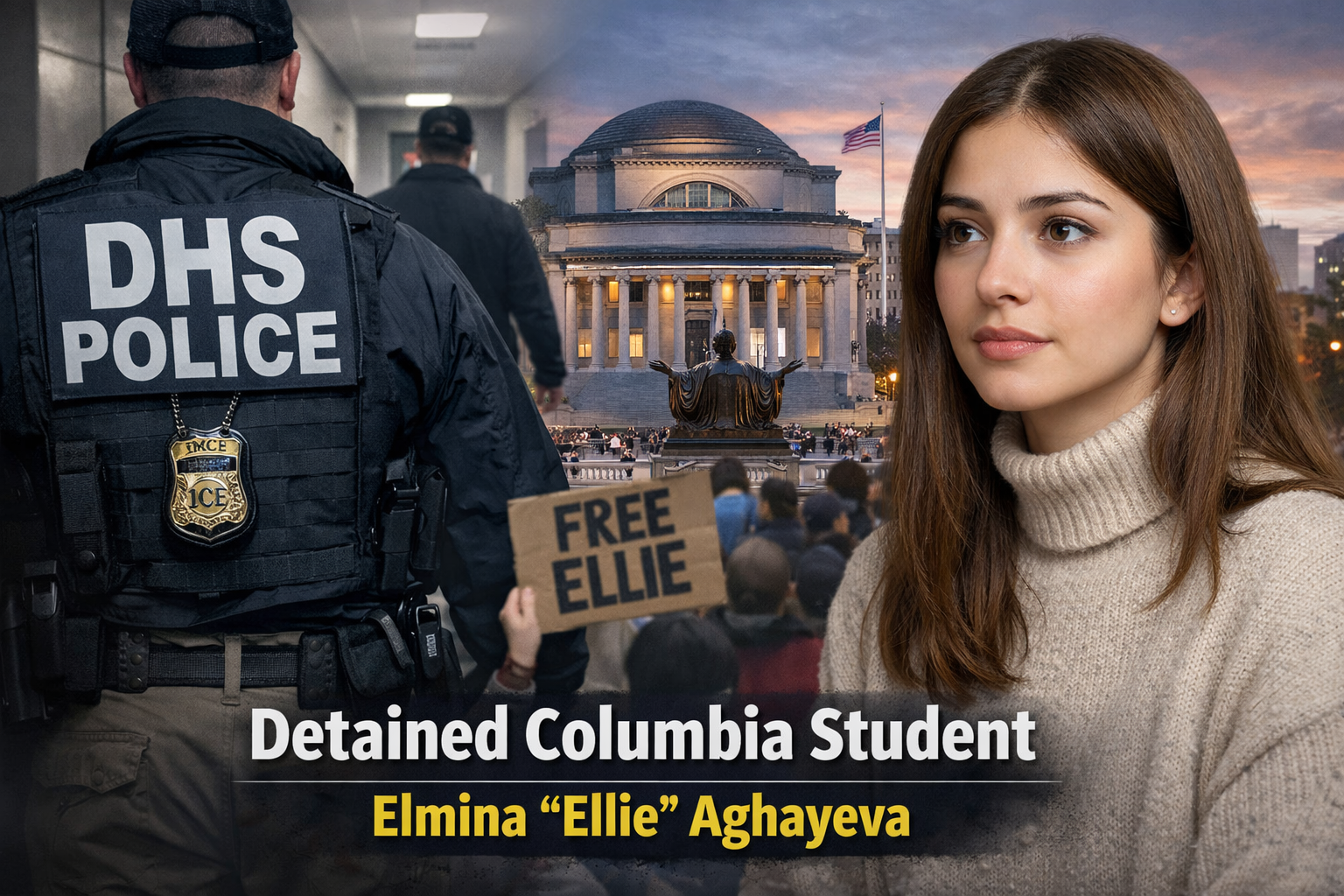
Federal immigration agents detained a Columbia University student inside university housing early Thursday, touching off a fast-moving confrontation between the university, elected officials, and the U.S. Department of Homeland Security (DHS). Within hours, New York City Mayor Zohran Mamdani said President Donald Trump told him the student would be released, and the student later confirmed she had returned home.
The case centers on Elmina Aghayeva, who also goes by “Ellie.” Columbia’s acting president, Claire Shipman, told the campus community that agents “made misrepresentations” to gain entry while searching for a “missing person.” DHS countered that agents identified themselves and detained Aghayeva because immigration authorities had terminated her student visa years earlier.
This article lays out the timeline, the competing accounts, the legal questions that surfaced immediately, and the broader context for universities and international students as immigration enforcement increasingly reaches into settings that many people still view as “sensitive” locations.
Key facts at a glance
- DHS agents entered a Columbia residential building around 6:30 a.m. and detained Elmina “Ellie” Aghayeva, according to Columbia and Reuters.
- Shipman said agents used a “missing person” claim to gain entry and lacked a judicial warrant or subpoena for non-public university areas, including housing.
- DHS said Aghayeva’s student visa “was terminated in 2016” for “failing to attend classes,” and DHS said a building manager and roommate let agents in.
- Aghayeva’s attorney filed a habeas corpus petition in federal court and asked a judge to stop any transfer out of New York while the case proceeded.
- Mayor Zohran Mamdani said Trump told him Aghayeva would be released “imminently,” and she later posted that she felt “safe” but “in complete shock.”
- Students and supporters organized protests at Columbia the same day.
Who is Elmina “Ellie” Aghayeva?
Public reporting describes Aghayeva as an undergraduate in Columbia’s School of General Studies who studies neuroscience and political science. Her federal court filing described the same academic track.
Reuters and other outlets also tied her identity to an Instagram account that posted a plea for help soon after the detention. Reuters reported that the account has more than 100,000 followers and features content about studying and products like AI study tools and translation glasses.
Scientific American added biographical color that sits outside the immediate legal dispute, noting that Aghayeva describes herself as a neuroscience researcher and that her name appears as a co-author on a Columbia-affiliated publication about mental imagery and perception.
DHS identified her as a citizen of Azerbaijan and described her immigration status in blunt terms, stating that she lacked lawful status after visa termination and that she had no pending appeals or applications with the agency.
That mix—student, international background, and a large social media presence—helped push the case from a campus incident into a national political story within hours.
A timeline of the detention and release
Early morning: entry into Columbia housing and detention
Columbia said federal agents from DHS entered a Columbia residential building at about 6:30 a.m. and detained a student. Shipman told the campus community that agents “made misrepresentations” to gain entry while claiming they sought a “missing person.”
Reuters reported the same core allegation from Shipman and noted that Columbia’s guidance requires a judicial warrant or subpoena for entry into non-public areas such as housing and classrooms.
Morning: social media posts and rapid legal action
Reuters reported that an Instagram post appeared around 8 a.m. showing a photo taken from inside a car and reading, “DHS illegally arrested me. Please help.”
ABC News reported that Aghayeva’s attorney filed a habeas corpus petition that morning and argued that agents detained her unlawfully “without justification.” The filing also asked a judge to prevent any transfer outside New York while the court reviewed the case, a common emergency request in fast-moving detention matters.
Midday: protests and public statements
Students, faculty, and supporters gathered at Columbia’s gates to protest and to demand details about the agents’ authority and the university’s response, according to Gothamist and CBS New York.
Elected officials also weighed in quickly. Reuters reported that Gov. Kathy Hochul accused agents of lying to gain access.
Afternoon and evening: Mamdani says Trump intervened; Aghayeva returns
ABC News and CBS New York reported that Mayor Zohran Mamdani said he spoke with Trump and that Trump told him Aghayeva would be released.
ABC News reported that Aghayeva posted soon after, telling followers she had gotten out, felt safe, and felt shocked. ABC also reported that it saw her enter a building later that evening without making a public statement to reporters on scene.
Columbia also posted that it felt relieved about her release, according to CBS New York.
What DHS says happened
DHS framed the operation as routine immigration enforcement rather than a campus free-speech conflict. In a statement cited by Reuters, DHS said ICE arrested Aghayeva because authorities had terminated her student visa in 2016 for failing to attend classes.
DHS also said a building manager and Aghayeva’s roommate let officers into the apartment. That detail matters because consent can change how courts evaluate entry into private spaces, even when the underlying arrest authority remains contested.
Multiple outlets reported allegations that agents misrepresented themselves or claimed to look for a missing child. DHS, however, denied that agents impersonated NYPD and said agents identified themselves as Homeland Security Investigators and wore badges.
DHS also suggested that Aghayeva had no open applications or appeals with the department, a point DHS sometimes raises to argue that a detainee lacks a pending pathway to relief.
What Columbia says happened
Columbia’s public position focused less on Aghayeva’s immigration history and more on process: what agents said, what authority they carried, and what policies govern law enforcement access to university-controlled spaces.
Shipman wrote that agents “made misrepresentations” to gain entry and that agents must show a judicial warrant or subpoena to access non-public university areas such as housing and classrooms. She stressed that an administrative warrant does not meet that standard for access to non-public areas under Columbia’s protocol.
Shipman also advised community members to contact Public Safety if agents seek entry and to wait for the university to coordinate a response through counsel.
This distinction—judicial versus administrative paperwork—became the center of the campus debate within hours, because it speaks directly to whether agents gained entry through lawful authority, consent, deception, or some combination of all three.
The legal fight: warrants, consent, and habeas corpus
Even in the first-day reporting, three legal questions surfaced immediately.
1) Did agents have a judicial warrant, an administrative warrant, or neither?
ABC News reported that the habeas petition said agents lacked a warrant for Aghayeva’s arrest and used a “missing person” representation to gain entry.
Columbia’s campus message did not confirm what paperwork agents carried, but it emphasized that agents need a judicial warrant or subpoena to enter non-public areas and that an administrative warrant does not suffice for access under university policy.
Because the case moved quickly and the public record remained thin on day one, reporting did not settle the question of what agents actually showed to whom inside the building. That gap likely explains why Aghayeva’s attorney sought emergency court oversight early in the day.
2) Who granted entry—and did that consent count?
DHS said a building manager and roommate let agents into the apartment. Columbia and several officials suggested agents gained entry through misrepresentation.
Courts often treat consent as fact-specific: who consented, what they understood, and what the officers said. If officers used deception, courts can scrutinize whether a person’s consent remained valid. Public reporting has not yet provided the underlying documents or video that would clarify this question.
3) Why file habeas corpus so fast?
ABC News reported that Aghayeva’s attorney filed a habeas petition to challenge custody and requested a temporary restraining order to block any transfer outside New York.
That move reflects a practical concern: immigration authorities can transfer detainees between facilities quickly, and transfers can complicate access to counsel and local court jurisdiction. Reuters noted that campus-area arrests remain relatively rare, but it also pointed to prior high-profile Columbia-related immigration cases that turned into long legal fights after transfers.
The policy backdrop: “protected areas,” schools, and dorms
Many Americans still associate schools and campuses with “sensitive locations” where immigration enforcement rarely happens. That perception has shifted in recent years as DHS has revised guidance.
In January 2025, DHS issued a directive titled “Enforcement Actions in or Near Protected Areas,” which addressed how ICE and CBP conduct enforcement in or near locations such as schools and other community settings.
Around the same time, DHS also publicly defended the change in direction, arguing that it would prevent people from “hide[ing]” in schools and churches to avoid arrest.
By September 2025, DHS published a message titled “DHS Sets the Record Straight: ICE Does Not Raid Schools,” insisting that ICE does not “target schools or children,” even as public concern rose after earlier policy changes.
Those documents help explain why the Aghayeva case resonated beyond Columbia. Even when enforcement actions remain uncommon on campuses, the underlying federal guidance no longer treats schools and universities as categorically off-limits in the way many people remember from earlier eras.
Reaction from officials, advocates, and campus groups
Public reaction split into two broad lanes: government officials and advocates who criticized the operation’s tactics and campus intrusion, and federal officials who defended enforcement authority and disputed claims of impersonation.
Reuters reported that Gov. Hochul accused agents of lying to gain entry.
CBS New York reported that several New York officials condemned the episode as “lawless” or a civil-rights violation, while DHS denied that agents impersonated NYPD and emphasized that agents wore badges.
Documented reported that roughly 200 people gathered to protest at Columbia’s gates and that the American Association of University Professors criticized the detention and warned about chilling effects on international students if the reports of misrepresentation proved accurate.
Gothamist described chants of “ICE off campus” and criticism aimed at both DHS and Columbia leadership, reflecting anger that focused not only on federal action but also on the university’s ability to protect students inside university-controlled housing.
DHS maintained its core narrative: agents acted within immigration enforcement authority, and third parties consented to entry.
Why the Mamdani–Trump angle mattered
The case took an unusual political turn when Mayor Mamdani said Trump personally told him Aghayeva would be released. ABC News reported Mamdani’s statement and described how quickly Aghayeva posted about her release afterward.
The speed of that sequence—detention at dawn, legal filing in the morning, protests by midday, and release within hours—made many observers ask whether the case turned on legal merits, discretionary enforcement choices, political pressure, or a combination.
No public reporting has yet laid out the internal DHS rationale for the release. In immigration cases, release can occur for many reasons, including logistical decisions, litigation risk, public scrutiny, or a decision to continue proceedings without immediate detention. The public record may become clearer if the court filings continue or if DHS provides further details.
What we still don’t know
Despite heavy coverage, several core facts remain unresolved in public reporting.
- Exactly what agents told the building manager, the roommate, or any university staff before entry.
- Whether agents carried a judicial warrant, an administrative warrant, or no warrant—and whether anyone inside the building saw or copied it.
- Whether DHS plans to pursue removal proceedings against Aghayeva after the release, and under what legal theory.
- Whether Columbia will request an external investigation or change on-campus protocols beyond increased patrols and trainings, which Documented reported the university planned after the incident.
As those details emerge, the story could shift significantly. Right now, the case rests on dueling narratives: Columbia and allies emphasize misrepresentation and warrant standards for entry into student housing, while DHS emphasizes visa termination history, consent to entry, and law enforcement identification.
What the case means for universities and international students
Universities sit at the intersection of immigration compliance, student safety, and free inquiry. When federal agents enter university housing—especially after a disputed “ruse” claim—universities face pressure from every direction.
Columbia’s message to campus tried to clarify a bright line: agents need judicial process to enter non-public spaces, and community members should route any law enforcement contact through Public Safety and university counsel.
At the same time, federal “protected areas” guidance has evolved in ways that reduce the categorical protections many students expect in educational settings. DHS has stated that ICE does not raid schools, but DHS has also published directives that place more discretion in the hands of enforcement leadership rather than blanket restrictions.
That gap between expectation and policy reality can generate fear, confusion, and misinformation—especially among international students who already navigate complex visa requirements and who may not know what rights apply in dorms, apartments, or shared housing.
In practical terms, the Aghayeva case will likely push more universities to do three things:
- publish clearer protocols about law enforcement access to campus-controlled housing,
- train staff who work in residential buildings on how to verify identity and paperwork, and
- expand rapid-response legal support for students caught in enforcement actions.
Columbia’s decision to publicly acknowledge legal support in Shipman’s first-day message stood out, because it signaled that the university expected legal consequences and scrutiny.
What comes next
Aghayeva’s release closed the day’s most urgent chapter, but it did not necessarily end the case.
If her attorney keeps the habeas petition active, the court may seek answers about the legal basis for detention, the risk of transfer, and the circumstances of entry into housing.
If DHS moves forward with immigration proceedings, the dispute may shift toward her underlying immigration history, any relief she might seek, and whether DHS considers detention necessary. DHS has asserted that her visa termination dates back to 2016 and that she has no pending applications; future court filings may test those assertions.
Columbia, meanwhile, may face internal pressure to explain how agents gained access to a residential building and whether campus security or building staff facilitated entry. Reporting already shows that protesters and some commentators blame the university for gaps in protection as well as DHS for tactics and intrusion.
For now, the clearest takeaway remains simple: the Aghayeva episode shows how quickly immigration enforcement, university policy, and national politics can collide—especially when actions occur inside student housing and when public officials dispute the tactics agents used to get through the door.