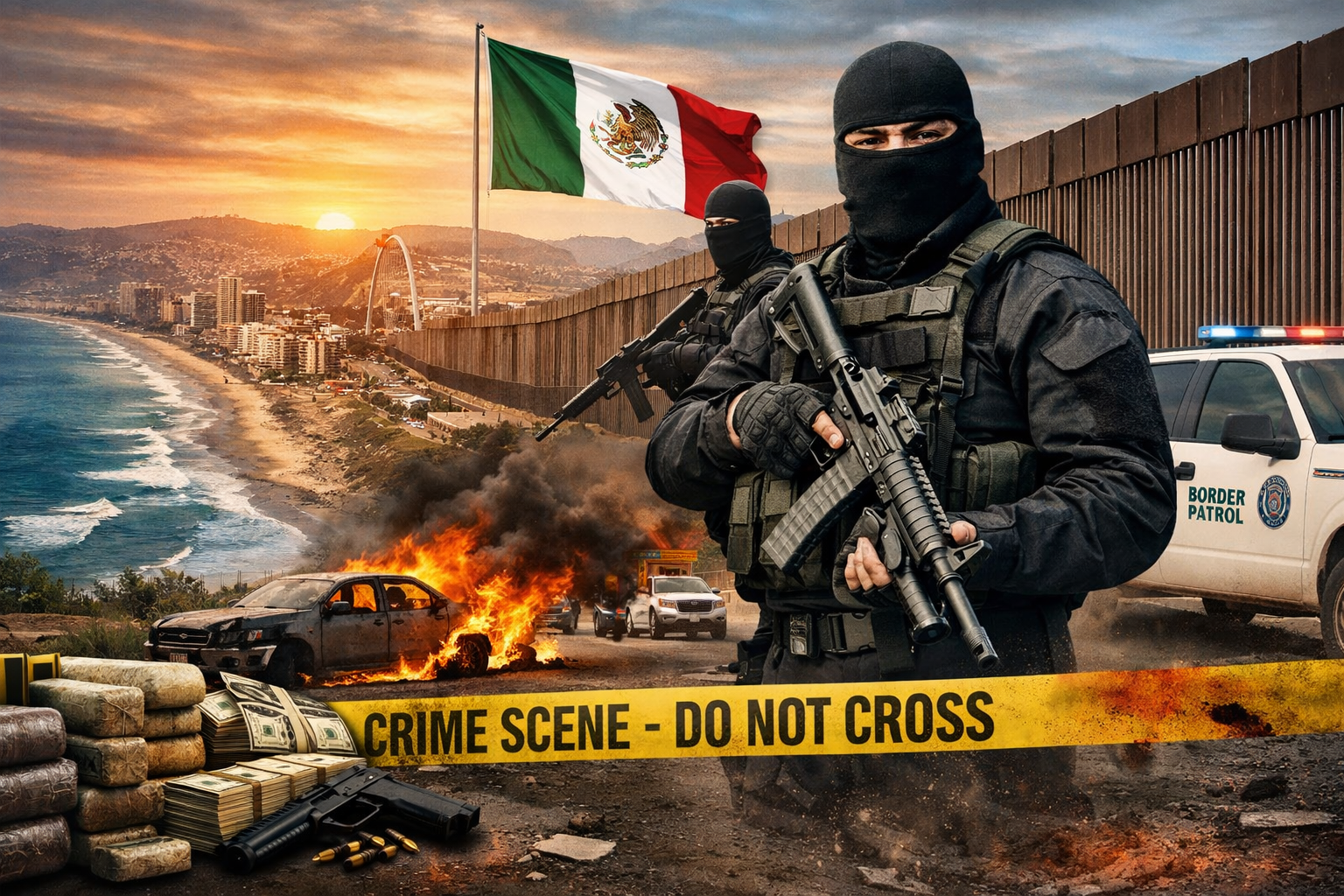
Baja California sits at a crossroads.
It is one of Mexico’s most dynamic border states. It has major cities, ports, factories, beaches, vineyards, and strong trade links with the United States. At the same time, it also sits inside a wider national conflict involving organized crime groups that compete for routes, markets, and influence.
That mix makes Baja California hard to describe with one label. It is not only a tourism destination. It is not only a security story. It is a place where normal economic life, cross-border movement, and criminal violence can exist in the same geography.
A useful article on Baja California and the cartels must avoid two mistakes.
The first mistake is romanticizing cartel power. The second is reducing the state to cartel headlines alone. Both distort reality. Baja California is a major economic and social region, but cartel activity still shapes risk, public trust, and daily routines in important ways.
Where Baja California Fits in Mexico
Baja California is Mexico’s northernmost state. It borders California and Arizona in the United States. It also borders Sonora and Baja California Sur inside Mexico. Mexicali is the state capital.
Its position matters.
The state sits on the Pacific coast and along one of the world’s busiest border regions. Cities like Tijuana and Mexicali connect directly to U.S. metropolitan areas and supply chains. That creates strong legal commerce. It also creates opportunities for criminal groups that seek control over smuggling corridors and border access.
Baja California’s population also helps explain its importance. Data México reports 3,769,020 residents in 2020, with Tijuana as the largest municipality by far, followed by Mexicali and Ensenada.
In plain terms, this is not a remote fringe. It is a dense, urbanized, cross-border state with large flows of people, goods, and money. That reality drives both prosperity and security pressure.
Why Baja California Matters Economically
Baja California is one of Mexico’s strongest export platforms.
Data México lists US$55.6 billion in exports for 2024. It also shows large concentrations of trade in Tijuana and Mexicali. Tijuana alone accounts for the biggest share of the state’s international sales.
The state’s export profile highlights advanced manufacturing and medical-related products, not only low-cost assembly. Data México lists monitors and projectors, medical science instruments, and goods transport vehicles among top exports in 2024. The United States is the dominant destination by a wide margin.
This matters for the cartel discussion.
When a state depends on trade, logistics, and movement, security disruptions carry broader costs. Road blockades, arson attacks, transport delays, fear, and misinformation can affect workers, small businesses, tourism, and cross-border commerce even when violence is not constant in every neighborhood.
Baja California also has a public confidence dimension. Data México’s public security section shows low perceived security rates and low trust in some authorities in 2024. Those indicators do not prove cartel control by themselves, but they do show a social climate where insecurity and distrust remain central issues.
The Cartel Story in Baja California Is Not Static
People often talk about “the cartels” as if they were one group. That framing misses how fragmented the landscape can be.
An official Canadian Immigration and Refugee Board research response notes definitional challenges because Mexico has many local gangs and affiliates, in addition to larger transnational groups. It also cites analysis that these criminal tiers can drive violence surges in border states, including Baja California.
That same source describes a broad national picture in which the Sinaloa Cartel and CJNG stand out as the largest transnational organizations, while smaller groups, local gangs, and affiliates compete, partner, or shift loyalties. This layered structure helps explain why local conditions can change quickly.
Baja California also carries the legacy of the Tijuana Cartel, often associated with the Arellano Félix organization. The IRB summary cites reporting that describes the Tijuana Cartel as now-defunct or in decline and fragmentation, while larger groups like Sinaloa and CJNG continue to project power through cells, alliances, and local affiliates.
So the security map in Baja California today looks less like one cartel “owning” the state and more like overlapping influence, contested zones, and shifting alliances. That pattern matches broader national trends in cartel fragmentation and local criminal subcontracting.
Sinaloa and CJNG Presence in Baja California
Recent public summaries that cite the U.S. 2025 National Drug Threat Assessment place both the Sinaloa Cartel and CJNG in Baja California.
The Canadian IRB response cites the NDTA as describing a significant Sinaloa presence in Baja California. It also cites the NDTA as describing a significant CJNG presence in Baja California. In other words, public source compilations now place both major organizations in the same state.
That overlap is one reason Baja California remains strategically important in cartel analysis.
The same IRB source cites reporting that Sinaloa cells in states like Baja California can provide access to border crossings, trafficking corridors, and money laundering opportunities. It also cites reporting that CJNG seeks expansion through alliances or coercion, including in border cities such as Tijuana.
A neutral reading of this evidence matters.
It does not mean every district in Baja California operates the same way. It does mean analysts and governments view the state as a contested and valuable corridor within larger criminal networks.
Why Border States Face Special Pressure
Border states face a specific mix of incentives.
They combine legal trade infrastructure, migration routes, transport corridors, cash-heavy businesses, and proximity to the U.S. market. Criminal groups often try to exploit those same systems. CFR’s conflict tracker describes how cartel violence in Mexico ties to territorial competition, trafficking routes, and shifting power balances after leader arrests and state crackdowns.
The pressure does not always look like direct confrontation.
It can also appear as extortion pressure on local businesses, intimidation, corruption, transport disruptions, or fear campaigns amplified online. Reuters reported that after the 2026 killing of CJNG leader “El Mencho,” cartel-linked unrest was accompanied by false and exaggerated social media claims, which experts said helped spread fear beyond confirmed incidents.
That information environment matters in Baja California because the state is heavily connected to media markets in both Mexico and the United States. Rumors can change behavior fast, especially in border cities where people make daily decisions about commuting, crossing, shopping, and tourism.
Recent 2026 Context and What It Shows
The February 2026 killing of CJNG leader Nemesio Rubén Oseguera Cervantes (“El Mencho”) triggered major national attention and retaliatory violence in multiple states, according to AP and Reuters. These reports also warned of possible instability tied to succession and power struggles.
That event was not centered in Baja California. But it still mattered for Baja California.
KPBS reported that Tijuana was calm the following Monday, and officials said there were no deaths in Tijuana or elsewhere in Baja California linked to that day’s national violence. At the same time, officials reported incidents in the state, including in Tijuana, and social media circulated images of a burned vehicle used in a road blockage.
This is a good example of how cartel-related shocks affect border states.
Even when a state avoids the worst violence during a national flare-up, people may still face uncertainty, temporary disruptions, and intense rumor cycles. That gray zone rarely gets enough attention in headline coverage.
Effects on Residents and Communities
The biggest cost often falls on ordinary residents.
Human Rights Watch’s 2025 Mexico chapter describes a national human rights crisis rooted in organized crime violence and impunity. It also notes high violent crime rates in many parts of the country and weaknesses in criminal justice outcomes.
Those national patterns shape how people in states like Baja California interpret risk.
Families adjust routes. Businesses change hours. Workers monitor local alerts. People rely on informal networks for updates. In border cities, these adaptations happen alongside normal life, not instead of it. Schools open, factories run, ports move goods, and restaurants operate, while residents still factor security into daily choices.
Cartel violence also has regional spillover effects. Reuters reporting on migration has shown that organized crime violence and extortion can push people to flee communities and head north, including toward border areas such as Tijuana. That does not mean every migrant story follows this path, but it remains part of the security and humanitarian picture in northern Mexico.
Government Response and the Limits of Kingpin Strategy
Mexico’s cartel strategy has shifted across administrations, but no single model has solved the problem.
CFR summarizes a long arc that includes militarized crackdowns, later reforms, and continued violence linked to territorial competition and power vacuums. It also notes the risk that high-profile captures or killings can trigger retaliatory violence or fragmentation.
Recent commentary around the 2026 CJNG leadership strike repeats that concern.
CalMatters quoted border and security experts who argued that removing leaders alone often fails to reduce crime and can produce short-term spikes in violence, including in border states. Those experts also stressed structural issues such as weapons trafficking from the United States into Mexico.
An official Canadian IRB response also cites analysis that, under President Sheinbaum, Mexico has used heightened deployments, intelligence-led operations, and high-profile arrests, while noting early evidence remains limited on long-term effects. That caveat is important. Immediate operational outcomes and durable public safety gains are not the same thing.
Travel, Safety, and Public Perception
Baja California is often discussed in travel advice, but the details matter.
The U.S. State Department’s Mexico travel advisory notes that most homicides appear targeted, while also warning that bystanders can be harmed. It also states that the only travel restrictions for U.S. government employees in Baja California are in the Mexicali Valley, and that there are no additional restrictions for places including Tijuana, Ensenada, and Rosarito.
Canada’s travel advisory for Mexico uses a broader national warning level and urges a high degree of caution due to criminal activity and kidnapping. That reflects national risk, not a single uniform condition across all Mexican states or cities.
Both points can be true at once.
Baja California includes major tourism and business destinations that remain active. It also exists inside a national security environment where criminal violence can escalate quickly. Travelers, residents, and businesses should avoid simplistic assumptions in either direction.
A Balanced View of Baja California Today
Baja California is a state of contrasts.
It is a manufacturing powerhouse. It is a border gateway. It is a tourism region with coastlines, food culture, and urban growth. It is also a state where cartel competition, local criminal networks, and national security shocks can shape daily life and public confidence.
The most accurate way to understand Baja California and the cartels is to hold those realities together.
Cartels matter here because geography, trade routes, and border access matter. But Baja California is more than cartel conflict. Any serious analysis should center residents, institutions, and the state’s legal economy, not just criminal organizations.
That perspective also improves public understanding.
It reduces panic. It avoids sensationalism. And it keeps attention on what actually changes long-term outcomes: stronger institutions, better investigations, public trust, economic opportunity, and sustained cross-border cooperation that addresses both trafficking networks and the conditions that let them thrive.