
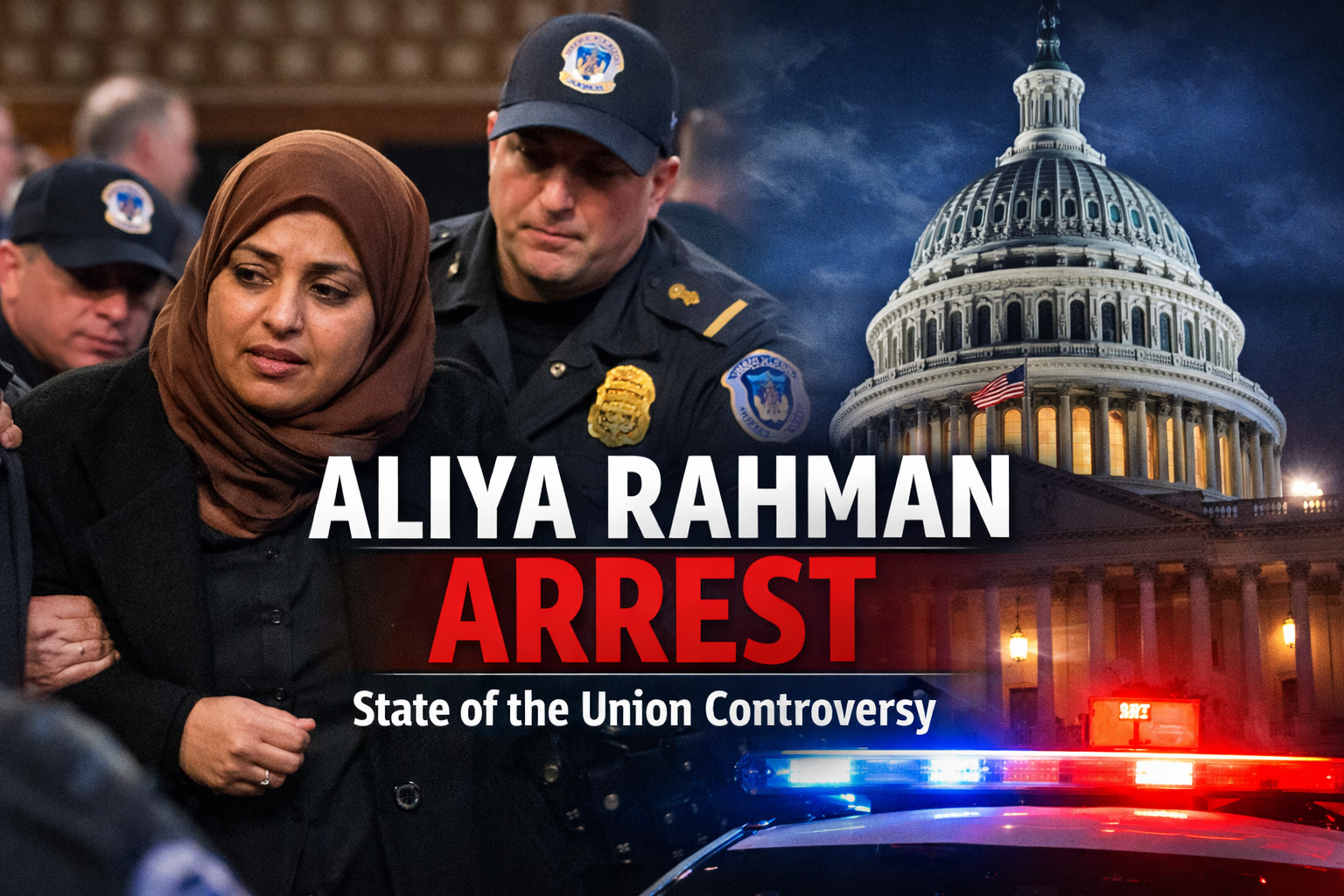
The Aliya Rahman arrest happened during President Donald Trump’s 2026 State of the Union address on February 24, 2026, when U.S. Capitol Police removed and arrested Rahman from the House gallery.
Rahman attended the speech as a guest of Rep. Ilhan Omar (D-Minn.). Omar’s office said Rahman stood silently for a short time during the speech, and officers removed her even after she warned them about shoulder injuries.
Capitol Police gave a different account. Police said a person in the House Gallery “started demonstrating” at about 10:07 p.m., ignored orders to sit, and triggered an arrest for unlawful conduct and disrupting Congress.
The Aliya Rahman arrest drew national attention because it followed a separate January incident in Minneapolis that involved federal immigration agents and viral video, plus later testimony and public statements about her injuries and disability.
What happened during the State of the Union
Multiple reports agree on the basic timeline: Rahman sat in the House gallery during the State of the Union, she stood up at some point during the address, and officers removed her from the chamber.
Capitol Police said the event rules prohibit demonstrations. Police said the guest refused lawful orders to sit, and police arrested her for unlawful conduct and disruption of Congress.
Omar described the moment differently. Omar said Rahman stood silently for a short period and other guests stood during part of that same window. Omar argued that officers treated Rahman’s action as a protest even though she did not shout or display signs, and Omar called the response heavy-handed.
Some reporting connected Rahman’s decision to stand with remarks Trump made during the speech about Minnesota’s Somali community and alleged fraud. The Minnesota Star Tribune reported that Trump cited an estimated $19 billion figure and noted that documented allegations fell short of that number.
What charges authorities reported
Reporting consistently references a charge of “unlawful conduct.” Omar’s office said prosecutors charged Rahman with “Unlawful Conduct” after officers removed her.
Capitol Police and some outlets also referenced “disruption of Congress” or “disrupting Congress” in describing the arrest.
Public coverage has not consistently included a full charging document that lists the precise statute and count structure, so some legal specifics remain unclear in widely shared reporting.
Omar’s account: injury warnings, medical care, booking
Omar said Rahman warned officers about injured shoulders before they removed her. Omar also said officers handled Rahman aggressively until someone intervened to secure medical attention.
Omar’s office said staff took Rahman to George Washington University Hospital for treatment, and officers later booked her at U.S. Capitol Police headquarters.
The Washington Post reported that Omar’s office said Rahman left custody early Wednesday morning, February 25, 2026.
Rahman’s account: “standing silently” and the role of context
Rahman described the Aliya Rahman arrest as punishment for standing silently. In an interview with Democracy Now!, she said she did not use gestures, signs, or sound when she stood.
The Guardian also reported that Rahman told Democracy Now! she stood silently, while Capitol Police described her action as demonstrating and noncompliance with orders to sit.
This gap matters because the legal and procedural logic often turns on two questions: whether officials viewed the act as a prohibited demonstration inside a restricted space, and whether the person complied once officers issued directions.
What “demonstrating” and “unlawful conduct” can mean in the Capitol
Several laws and regulations restrict demonstrations inside Capitol buildings.
D.C. Code § 10–503.16 makes it unlawful to parade, demonstrate, or picket within Capitol buildings, and it also covers conduct such as obstructing or impeding passage.
D.C. Code § 22–1307 addresses crowding, obstructing, or “incommoding,” and it also makes it unlawful to engage in a demonstration in an area where law otherwise prohibits demonstration and then continue after an officer instructs the person to stop.
Federal law also restricts certain activities on Capitol Grounds and in Capitol buildings. A commonly cited section, 40 U.S.C. § 5104, covers “unlawful activities,” including limits that law enforcement often references in Capitol enforcement contexts.
Public reporting about the Aliya Rahman arrest has not settled which exact provision prosecutors plan to rely on, so coverage often uses the umbrella phrasing (“unlawful conduct”) that appears in official statements and initial reports.
Why enforcement stays strict during a State of the Union
A State of the Union address brings heightened security, dense staffing, and strict gallery rules because it puts the President, Cabinet, Supreme Court justices, and members of Congress in one room. In that environment, officers often act quickly when they believe a guest is disrupting proceedings, even if the disruption looks small to viewers.
Capitol Police emphasized that tickets “clearly explain that demonstrating is prohibited,” and police framed the removal as enforcement of that rule after repeated orders to sit.
Omar framed the same enforcement as disproportionate, and she said it sent a chilling signal about civic expression in a highly controlled setting.
Until more video or official documentation emerges, outside observers have to weigh these accounts largely through statements from the parties involved and the limited reporting that captures the moment’s details.
Who is Aliya Rahman, and why the story already had national attention
The Washington Post described Rahman as a Minneapolis resident, a U.S. citizen, and a Bangladeshi American software engineer.
The Minnesota Star Tribune identified her as a south Minneapolis resident and reported she is 43.
Coverage links the Aliya Rahman arrest to a January detention in Minneapolis that involved federal immigration enforcement and widespread online video.
The January Minneapolis incident and the competing claims about it
On January 15, 2026, the Associated Press reported that video showed federal immigration agents pulling Rahman from her vehicle during an encounter near a Minneapolis intersection while she said she traveled to a medical appointment.
AP reported that Rahman said she went to a traumatic brain injury center appointment and that agents detained her afterward. AP also reported that the Department of Homeland Security disputed her account and described her as someone who obstructed agents and ignored commands to move her vehicle away from the scene.
Rahman’s written statement posted as a PDF on Sen. Richard Blumenthal’s website described her as disabled and said she sustained injuries during the detention, including a loss of normal arm movement. She also said authorities never charged her with a crime related to that incident.
You can treat that document as Rahman’s personal account rather than an independent finding, but it helps explain why members of Congress and national outlets kept following the story into the State of the Union.
Why the Aliya Rahman arrest matters beyond one night
The Aliya Rahman arrest sits at the intersection of protest boundaries, disability concerns, and the way security agencies enforce rules in sensitive government spaces. That combination often generates more scrutiny than an ordinary gallery removal because it raises both procedural questions (what did she do, and did she comply) and proportionality questions (how did officers handle removal, and what injuries did she sustain).
The story also fits into broader attention on federal enforcement tactics in Minnesota that has produced protests, political statements, and continuing coverage. Some reporting has focused on friction between local officials and federal agencies, and on how aggressive enforcement tactics affect U.S. citizens as well as non-citizens.
At the same time, the State of the Union creates a uniquely controlled environment. Officials do not treat the House gallery like a public sidewalk or a permitted demonstration zone, and the law includes specific restrictions on demonstration behavior inside Capitol buildings.
What we still don’t know about the case
Public reporting has not yet provided a widely circulated charging document that clearly lists each count and cites the precise code section, so analysts cannot evaluate the legal theory with full precision from news coverage alone.
Video coverage has also remained limited in most mainstream write-ups, and that limitation makes it harder to resolve the central dispute over whether Rahman’s standing blended into routine audience behavior or communicated protest in a way that officers treated as prohibited demonstration.
Medical documentation remains another missing piece in public reporting. Omar said Rahman went to George Washington University Hospital and later went through booking, but outlets have not published detailed medical records.
What happens next
In many Capitol-related misdemeanor cases, the process moves from an arrest report to charging paperwork, an initial court appearance, and then either dismissal, a plea agreement, or a trial—depending on evidence and prosecutorial decisions. Because public reporting has not yet highlighted specific court dates or filings for Rahman’s case, observers will likely look next to official docket updates and any released charging documents.
If prosecutors anchor the case primarily on refusal to follow lawful orders, they will likely focus on officer instructions and compliance. If prosecutors anchor the case on demonstration rules inside Capitol buildings, they will likely focus on whether Rahman’s conduct met the statute’s definition in that restricted setting.
If new video, witness accounts, or official statements emerge, they could clarify what officers saw and how the gallery reacted, which would help resolve the factual disagreement that now drives most of the debate about the Aliya Rahman arrest.