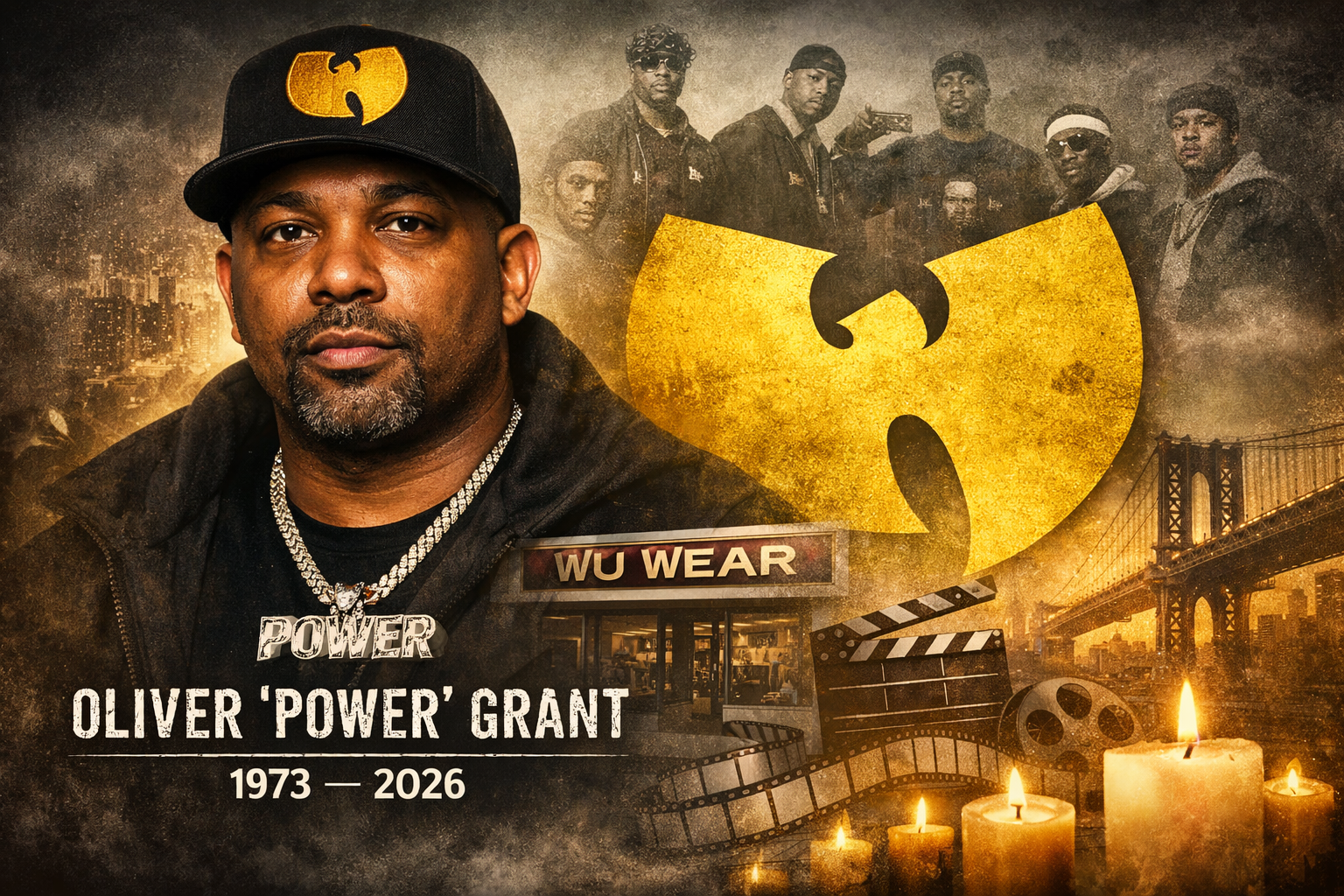
Oliver “Power” Grant was never the most visible face in the Wu-Tang universe.
He did not stand at center stage with a mic. He was not one of the nine core MCs. Yet his name kept showing up in the story, especially when people talked about how Wu-Tang became more than a rap group. In early coverage on February 24, 2026, HOT 97, AllHipHop, and HipHopWired reported that Grant had died at age 52, with Method Man publicly confirming his passing and tributing him on Instagram. HOT 97 also reported that the cause of death had not been disclosed as of press time.
That news immediately pushed many fans to ask the same question: who exactly was Oliver Power Grant, and why does his name matter so much in the Wu-Tang story?
The short version is that Oliver Power Grant helped build the business scaffolding around one of hip-hop’s most influential collectives. He is widely described in recent coverage as a foundational behind-the-scenes figure, an early financial backer, and the force behind Wu Wear, the clothing brand that helped turn Wu-Tang from a music phenomenon into a larger commercial and cultural enterprise.
The longer version is more interesting.
It is a story about early hip-hop entrepreneurship, artist-owned branding, merchandising before “merch” became a standard revenue stream, and the people behind the curtain who helped transform a movement into a durable platform. It is also a story that feels newly important in 2026 because the music industry now treats multi-channel brand building as normal, while Grant helped push that model decades earlier. GRAMMY.com’s retrospective on Wu-Tang’s legacy directly highlights the group’s apparel expansion and specifically notes Oliver “Power” Grant’s role in opening multiple Wu Wear stores and helping push the brand into national retail.
This article looks at Oliver Power Grant through that lens: not just as a passing headline, but as a case study in how hip-hop business infrastructure gets built.
Why Oliver Power Grant Is in the News Right Now
As of February 24, 2026, multiple music and hip-hop outlets reported Oliver Power Grant’s death and linked the confirmation to Method Man’s public tribute. HOT 97’s report identified Grant as a “founding business architect” of the Wu-Tang Clan and the creator of Wu Wear, while AllHipHop and HipHopWired described him as a longtime affiliate, co-founder of Wu-Wear, and a behind-the-scenes pillar in the Wu-Tang ecosystem.
HOT 97’s article gives the clearest early summary of the immediate facts in circulation: Grant died on February 23, 2026, he was 52, and no cause of death had been disclosed at the time of publication. The same report notes Method Man’s Instagram tribute and references Grant’s on-screen appearances in Belly and Black and White.
HipHopWired and AllHipHop reinforce the same broad picture while stressing his role in Wu-Tang’s rise, especially his impact on branding and merchandising. Both outlets frame him as essential to the group’s off-stage growth, not just a peripheral associate.
That matters because news cycles often flatten people into one-line descriptions. In Grant’s case, the one-line description does not capture the scale of the business ideas attached to his name.
The Role He Played in the Wu-Tang Story
Most fans know the Wu-Tang Clan through music, mythology, and member personalities. But every successful collective also depends on logistics, financing, deal structures, and brand extension. Recent coverage from HOT 97 and HipHopWired places Grant squarely in that operational zone, describing him as an early supporter and financial backer who helped build business infrastructure during the group’s formative years.
HOT 97 specifically reports that Grant helped secure studio access and financial backing around the time of Enter the Wu-Tang (36 Chambers) and worked on the business side that supported the group’s leverage. The article also describes him as someone who translated Wu-Tang’s creative energy into “sustainable enterprise,” which is a useful way to understand his function in practical terms.
AllHipHop pushes that same idea from another angle. Its coverage says many insiders credit Grant with helping shape the blueprint of Wu-Tang’s rollout, not only musically but culturally. Whether one prefers “architect,” “affiliate,” or “builder,” the recurring theme across outlets stays consistent: he helped turn a talented collective into an organized brand.
That distinction matters in hip-hop history.
A lot of artists built iconic sounds. Fewer built repeatable systems. The artists who changed the business usually did both, or they partnered with people who could. Oliver Power Grant appears in the record as one of those partners.
Wu Wear and the Shift From Music Act to Lifestyle Brand
If you only remember one part of Oliver Power Grant’s legacy, it will likely be Wu Wear.
GRAMMY.com’s Wu-Tang retrospective calls Wu Wear one of the first artist-inspired apparel lines in music history and notes that, as the group grew, members joined forces with Oliver “Power” Grant to open four Wu Wear stores across the country, including one on Staten Island’s Victory Boulevard. The same GRAMMY piece also notes that the line reached major retailers such as Macy’s, was later renamed Wu-Tang Brand in 2008, and was relaunched in 2017 with Live Nation Merchandise and RZA’s involvement.
HipHopWired echoes several of those points in its 2026 report, stating that Wu-Wear grew into a major streetwear brand, operated four U.S. brick-and-mortar stores, sold in Macy’s, later shifted to “Wu-Tang Brand” in 2008, and relaunched in 2017 as official Wu-Tang merchandise through Live Nation.
That combination of facts tells a larger story than nostalgia.
Wu Wear arrived before artist merchandise became a polished, always-on e-commerce machine. In the 1990s, a rapper-branded apparel line that moved through department stores and multiple retail locations represented a major business leap. It meant turning fan affinity into apparel demand at scale. It also meant product sourcing, quality control, distribution, branding discipline, wholesale relationships, and fraud/counterfeit management — all the unglamorous systems work that most music coverage skips. GRAMMY’s reporting on the line’s national footprint and relaunch timeline shows how durable that concept became.
Put differently, Oliver Power Grant helped prove that a hip-hop collective could monetize culture without reducing itself to a simple logo slap. Wu Wear worked because Wu-Tang already had a strong identity, but it also worked because someone organized the business mechanics.
That point feels obvious today. It did not feel obvious when the model was still emerging.
Why Wu Wear Was Historically Important
To understand Oliver Power Grant’s importance, it helps to zoom out.
Today, every major artist seems to have a brand strategy. They launch capsules, pop-ups, collabs, beverage lines, gaming tie-ins, podcasts, and direct-to-fan stores. Fans now expect music to exist inside a larger commerce ecosystem. But GRAMMY’s framing of Wu Wear as an early artist-inspired line shows why Grant’s work deserves historical attention: the Wu-Tang team was doing that at a time when the model had much less institutional support.
That early timing matters for three reasons.
First, it helped normalize artist-owned or artist-led fashion as a serious business category. HipHopWired and AllHipHop both frame Wu-Wear as a template-setting venture in hip-hop commerce, and that claim aligns with the broader historical picture described in GRAMMY’s retrospective.
Second, it showed that cultural authenticity and mainstream retail distribution could coexist. GRAMMY reports that Wu Wear reached retailers like Macy’s while still functioning as a visible marker of Wu-Tang identity. That dual positioning — street credibility plus national retail access — became the dream formula for many later artist brands.
Third, it extended the lifespan of the Wu-Tang brand beyond album cycles. Apparel can keep a movement visible between releases. It can also bring in people who may not know every record but recognize the symbol. Grant appears to have understood that dynamic early, and later profiles and interviews describe him in exactly those branding terms.
This is where Oliver Power Grant moves from “important associate” to “important strategist.”
Oliver Power Grant’s Own View of Branding
A 2024 A-M Journal profile based on an interview with Grant adds a valuable layer to how he saw his work.
The piece describes him as a co-founder and executive producer who moved between music and apparel while keeping “culture at the heart” of his mission, and it captures a recurring idea in his comments: branding is not separate from the music, but part of the same cultural experience. The article also reports his emphasis on representation, evolving Wu Wear for new generations, and maintaining a strong product experience rather than simply relying on logo recognition.
Even if one treats lifestyle profiles carefully, the interview is useful because it shows continuity.
Grant was not just attached to a successful 1990s brand by reputation. He still spoke in strategic terms about market shifts, audience age, collaborations, and experience design. A-M Journal’s interview notes his interest in contemporary merch strategy, global drops, and adapting Wu Wear’s presence while respecting cultural context.
That perspective helps explain why his name keeps resurfacing whenever people discuss Wu-Tang as a business institution. He did not appear to view fashion as a side hustle. He treated it as long-term brand architecture.
That is a very modern way to think.
He was doing it from a very early position in hip-hop history.
The “Behind-the-Scenes” Figure Problem
Public memory often favors performers. That is normal. Music fans connect to voices, songs, verses, and live moments.
But industries run on operators.
HOT 97’s obituary-style report explicitly points to this tension, describing Grant as someone who stood “behind the curtain” in a field that often spotlights performers. AllHipHop uses similar language by calling him a “loyal friend, business partner and behind-the-scenes force.”
This pattern shows up across entertainment history.
A movement becomes famous through talent, then survives through systems. The public usually remembers the first half more clearly. Oliver Power Grant’s death coverage, especially the way it spread through artist tributes and hip-hop media, is a reminder that fans often rediscover the operators only when a loss forces a retrospective.
That does not make the recognition less meaningful. It does suggest that hip-hop history still needs more writing about infrastructure builders.
Grant’s story is a strong example because it sits at the intersection of music, fashion, merchandising, and media.
Film, Screen Presence, and Cross-Media Work
Oliver Power Grant’s public profile also extended beyond business and apparel.
HOT 97 and HipHopWired both mention his appearances in Belly (1998) and Black and White (1999), noting that he and Method Man both appeared in those films. HipHopWired specifically references his roles as “Knowledge” in Belly and “Rich Bower” in Black and White. IMDb’s profile listing also identifies him as known for Belly, Black & White, and Coalition.
These credits matter less than Wu Wear in most assessments of his legacy, but they still fit the broader pattern.
Grant’s career sat inside a period when hip-hop’s influence exploded across film, fashion, and television. Wu-Tang’s members and affiliates moved through multiple media channels, and Grant appears to have done the same in a supporting and sometimes visible role. HipHopWired and AllHipHop both frame him as someone who helped extend the Wu-Tang brand into film and merchandising, not just albums.
That multi-lane profile now feels normal for entertainment entrepreneurs. In the 1990s and early 2000s, it was still a sign of unusual range.
Context: Why His Death Resonates in a Wu-Tang Legacy Moment
There is another reason Oliver Power Grant’s passing lands with extra weight.
Wu-Tang has been in a legacy-defining phase for several years, with documentaries, dramatizations, retrospectives, and major tour framing. GRAMMY.com’s 2025 coverage describes the group’s final-tour era and revisits the collective’s long cultural and commercial impact, including the role of Wu Wear and Grant’s involvement in the brand’s expansion.
When a figure like Grant dies during that kind of retrospective moment, the public tends to re-evaluate how the whole machine worked.
Fans remember songs first.
Writers then revisit business decisions, side ventures, and early strategic moves that helped those songs reach scale. That is exactly what has happened in much of the early reporting: the coverage does not treat Grant as a random affiliate. It places him in the institutional story of Wu-Tang.
In that sense, the timing of the news may drive broader interest in his biography, especially among younger audiences who know the Wu-Tang logo but may not know who helped commercialize it.
What Can Be Said With Confidence, and What Still Needs Verification
Because this is a fast-moving story, it helps to separate verified reporting from broader lore.
As of the sources reviewed here, these points appear consistently across multiple outlets:
Oliver Power Grant has been reported dead at age 52, with Method Man publicly confirming the loss via social media tribute. HOT 97, AllHipHop, and HipHopWired all support that summary.
He is widely recognized as a key behind-the-scenes business figure connected to Wu-Tang and as a founder/architect of the Wu Wear brand. This appears in all three 2026 reports and aligns with GRAMMY’s retrospective treatment of Wu Wear and his role in its expansion.
Wu Wear’s national expansion, four-store footprint, Macy’s distribution, later renaming to Wu-Tang Brand, and 2017 relaunch with Live Nation appear in multiple sources, including GRAMMY and HipHopWired.
He had screen credits associated with Belly and Black and White, supported by HOT 97, HipHopWired, and IMDb indexing.
What remains less clear in early reports is the full official cause-of-death information and the final shape of any formal obituary or statement from family/estate representatives. HOT 97 and HipHopWired both note that no cause had been publicly shared at the time of their reporting.
That uncertainty is normal in the first day of a breaking death report. It also means later reporting may add or revise details.
The Business Legacy of Oliver Power Grant
If you step back from headlines and focus on impact, Oliver Power Grant’s legacy looks bigger than a single brand.
His story helps explain how hip-hop evolved from music genre to business ecosystem. Wu-Tang did not just create songs and personas. The broader Wu universe also developed merchandising, visual identity, licensing potential, and long-tail brand value. The sources reviewed here repeatedly place Grant near that conversion point — where cultural energy becomes institutional structure.
That legacy has practical implications for today’s artists and entrepreneurs.
Build identity before products.
Protect brand coherence.
Think beyond album windows.
Treat merchandise as strategy, not leftovers.
Plan for longevity, not just hype.
Grant’s 2024 interview profile in A-M Journal reinforces that he still thought in these terms, emphasizing culture, audience experience, and future-facing development for Wu Wear. That makes his legacy feel less like a frozen 1990s success story and more like an ongoing blueprint.
For fans, Oliver Power Grant may remain best known as “the Wu Wear guy” or “the behind-the-scenes Wu-Tang architect.”
For business-minded readers, he represents something more specific.
He was part of the generation that helped prove hip-hop could own its intellectual property, shape its visual language, and extend its influence through retail and branded experience. Long before brand strategy became industry jargon, he was helping execute it.
Final Thoughts
Oliver Power Grant’s death has prompted a wave of tributes and renewed attention to a figure many listeners knew by name, but not always by full contribution. The early reports from HOT 97, AllHipHop, and HipHopWired all point in the same direction: he mattered because he helped build the machinery around Wu-Tang’s rise.
That machinery changed hip-hop.
Wu Wear’s scale, retail footprint, and long afterlife show that the Wu-Tang brand did not expand by accident. GRAMMY’s retrospective and later interviews with Grant himself make clear that this was sustained, intentional work.
As more formal tributes and reporting emerge, the details around Oliver Power Grant’s life will likely become clearer.
What already looks clear is the outline of his legacy.
He helped turn a legendary rap collective into a business model.
And that model still shapes the industry today.