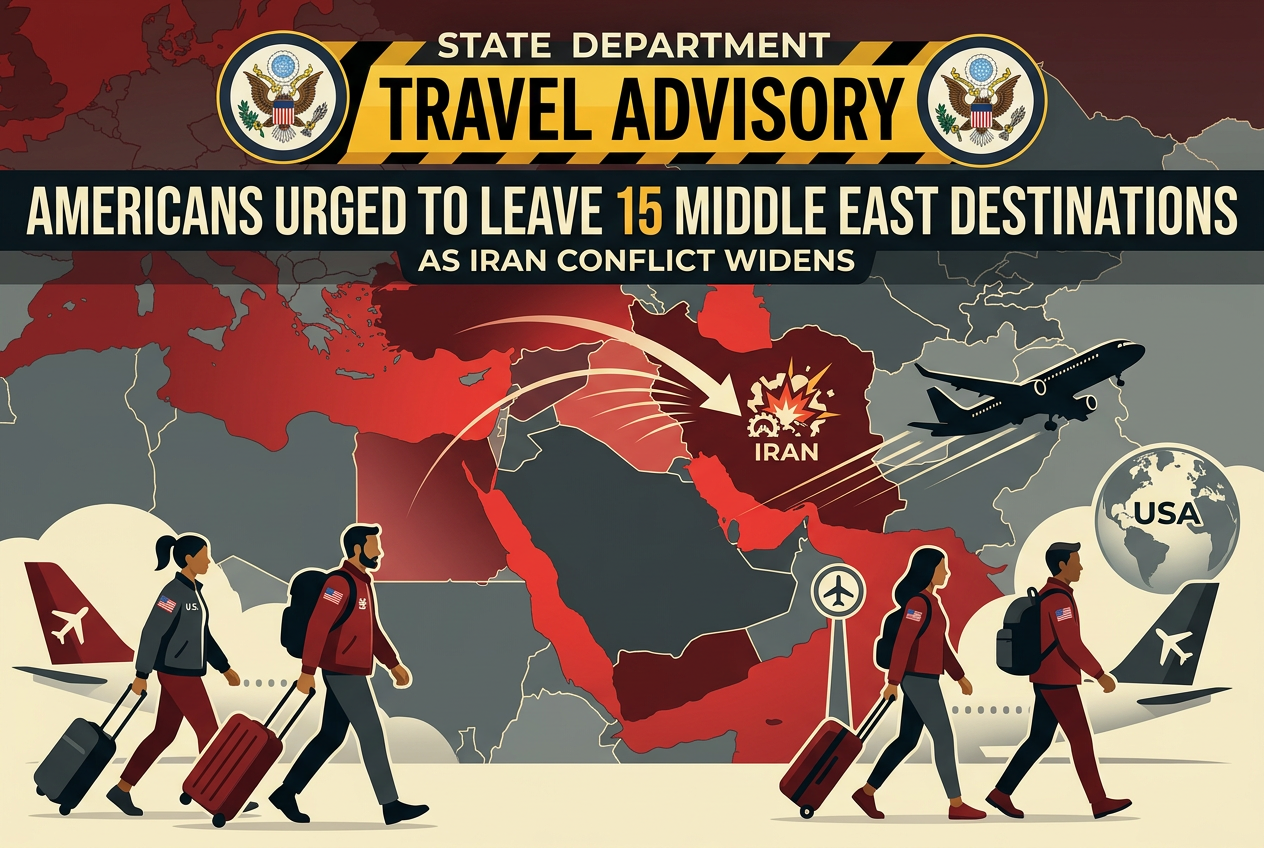
For the first time ever, the US State Department has issued a very wide-ranging travel warning related to the growing conflict with Iran, advising Americans to leave immediately from more than 15 countries throughout the Middle East, while commercial airfare is still available.
The message is intended for all U.S. citizens in the region currently, as well as any citizen planning on traveling to the area in the coming weeks/months. The travel warning will reflect the reality of the travel industry and its customers: rapidly evolving security issues; intermittent airspace closure; inconsistent access to regular diplomatic services, depending on the country.
What the travel advisory states & to which destinations
Reuters reported on March 2, 2026, that the State Department called upon Americans to leave immediately from the following destinations, via commercial means: Bahrain, Egypt, Iran, Iraq, Israel, the West Bank and Gaza, Jordan, Kuwait, Lebanon, Oman, Qatar, Saudi Arabia, Syria, the United Arab Emirates and Yemen.
While the countries included in the advisory differ significantly in terms of their respective security environments and travel experiences, the primary factor is the State Department’s view that the expanding regional conflict has elevated the risks of rapid escalation, travel disruptions and diminished capacity to assist in emergency situations, in the event that the security situation rapidly deteriorates.
Travel advisory vs Security alert: what does the difference in terminology mean?
Many people understand “travel advisory” to be simply a single designation. In fact, the State Department uses a number of methods to convey the risk of a particular destination to potential travelers:
country-specific travel advisories (Levels 1-4) located on destination pages
security alerts issued by U.S. Embassies and Consulates (faster-moving, and more operational)
global notices that affect many destinations simultaneously when a significant event impacts international travel generally
This week’s communication represents more of a regional risk directive: it is both “do not travel,” and “if you are currently in the area, consider departing as soon as possible, while you still have options.”
Why the U.S. State Department is advising Americans to leave immediately
The State Department issues “leave now” messages when officials perceive that the situation could rapidly evolve and when the normal avenues of travel (scheduled flights, open borders, normal ground transport) are likely to be interrupted.
According to the State Department’s worldwide notice (most recently updated on February 28, 2026), there are two primary reasons that create challenges for international travelers during a regional conflict:
rapidly changing security conditions
disruptions to travel caused by periodic airspace closures
Americans are advised to follow the latest security alerts issued by the nearest U.S. Embassy or Consulate, and to exercise extreme caution.
What “Depart Immediately” really means in practical terms
This phrase does not imply that each U.S. citizen in the listed destinations is under the same level of threat.
Typically, it implies three practical things at once:
the threat environment has changed (either improved or worsened)
your mobility will likely decrease rapidly (airlines selling out, routes change, airspace closes, border rules tighten)
help will be limited if you delay, including limited staff, limited movement of embassy employees and/or limited services
In other words, the State Department is advising people to make travel decisions while they still have the greatest amount of flexibility.
Understand the State Department’s travel advisory levels
Separately from “Leave Immediately” language, the State Department assigns a four-tiered advisory rating to each destination:
Level 1: Exercise normal precautions
Level 2: Exercise increased caution
Level 3: Reconsider travel
Level 4: Do not travel
An essential point for travelers to know: when a destination is assigned a Level 4, the State Department explicitly advises that in the event of an emergency, the U.S. Government may not be able to provide much assistance, and that citizens should not travel to the destination (or leave as soon as it becomes safe to do so).
Even though a country’s overall travel advisory level may not be changing on an hourly basis, security alerts can effectively increase the operational risk picture within hours.
What Americans in the region should do today
There is no better way to ensure safety than relying solely on official channels, having a straightforward plan, and avoiding predictable sources of risk.
1) Obtain the latest guidance from the embassy (not just news reports)
Embassy and consulate security alerts can contain specific information such as:
status of airport(s)
shelter guidance
updates on border crossings
availability of service (appointment cancellation, etc.)
Look specifically for alerts from the closest U.S. Embassy or Consulate to your location.
2) Sign up for STEP, and verify your contact information is up-to-date
The State Department advises all U.S. citizens abroad to register in the Smart Traveler Enrollment Program (STEP) to receive updates regarding travel warnings and emergencies, and to facilitate communication between the citizen and officials in the case of an emergency.
The State Department provides 24-hour telephone numbers for emergency assistance:
+1-202-501-4444 (abroad)
+1-888-407-4747 (U.S. and Canada)
3) Assume your travel plans will be disrupted, and plan accordingly
If you plan to leave, the challenge is typically less about making the decision, but rather the logistical components.
Be prepared for:
Last minute changes to your itinerary
Re-routing through alternative hub airports
Cancellation of airline flights at short notice
Limited availability of seats on some flights
Have a simple plan and be willing to adjust it as needed.
4) Minimize your exposure to predictable sources of risk
During times of heightened tensions, risk tends to concentrate in the following types of locations:
large gatherings and protests
Sensitive areas near government/military installations
Locations with symbolic significance that may attract attention
Crowded public transportation locations during peak travel times
The goal is not panic. The goal is to minimize the likelihood that you are in a vulnerable location when circumstances change.
5) Have necessary documents and items readily available
If you are leaving soon, keep the following easily accessible:
Passport and any required entry/exit documents
Digital copies of critical documents
Medication and essential supplies for delays
Phone charging capabilities and backup power
Emergency contact list
Do not overpack. Flexibility in travel is essential when plans change rapidly.
How this may impact travelers who have not yet departed
Not everyone will be able to leave immediately. Some travelers may experience:
Limited availability of commercial flights
Financial constraints
Family obligations
Medical concerns
Legal or residency issues
If you cannot leave quickly, then the priority shifts to remaining informed through official alerts, maintaining reliable communication systems and developing a realistic plan for moving when routes reopen or circumstances change.
Effects beyond tourism: Airlines, Business Travelers, Families
Regional travel advisories have a tendency to reverberate throughout the entire travel ecosystem:
Commercial carriers may alter routes to avoid restricted airspace, leading to longer flights and fewer options for passengers.
Business travel may suddenly cease, impacting meetings, projects and staffing movements.
Families may find it difficult to coordinate reunifications across borders, should new rules come into effect and flights become scarce.
If you are supporting a family member or loved one in the region from outside the region, the best form of support is practical: verifying that their documentation remains valid; assisting them in obtaining official alerts; and providing them with a simple travel plan.
What to watch for next
When the security environment rapidly evolves, travel advisories may also change quickly. Most frequently, travelers monitor:
Changes in airspace restrictions
Changes in the operating status of U.S. Embassies and Consulates (staffing and services)
Changes in the availability of commercial flights and routings
Updated Country-Specific Travel Advisories and Security Alerts
If the State Department continues to emphasize “Leave Immediately”, it is usually because officials perceive that the risks are trending toward rapid escalation and that time and flexibility are the traveler’s most valuable assets.
Frequently Asked Questions
Is this an evacuation order?
It is not necessarily a formal evacuation instruction. This is advice to Americans to leave while commercial options are still available. Official embassy alerts will advise as to specific instructions for a particular country.
Will “leave immediately” apply equally to every destination on the list?
No. Risk environments vary greatly among the destinations listed. However, the State Department’s concern is that the larger conflict may cause rapid changes in local conditions-even in places that are normally considered relatively stable for travel.
Should I cancel my upcoming trip to the Middle East?
If your trip is imminent, you should check the current advisory level for the destination and any recent security alerts from the U.S. Embassy or Consulate. Although you may still wish to travel to the destination, you should anticipate that travel will be impacted and have a plan in place for contingencies.
What is the most important thing a traveler can do today?
Be reachable, obtain the latest official information, and keep your plans simple and flexible. During volatile situations, complexity is the enemy of good decision-making.