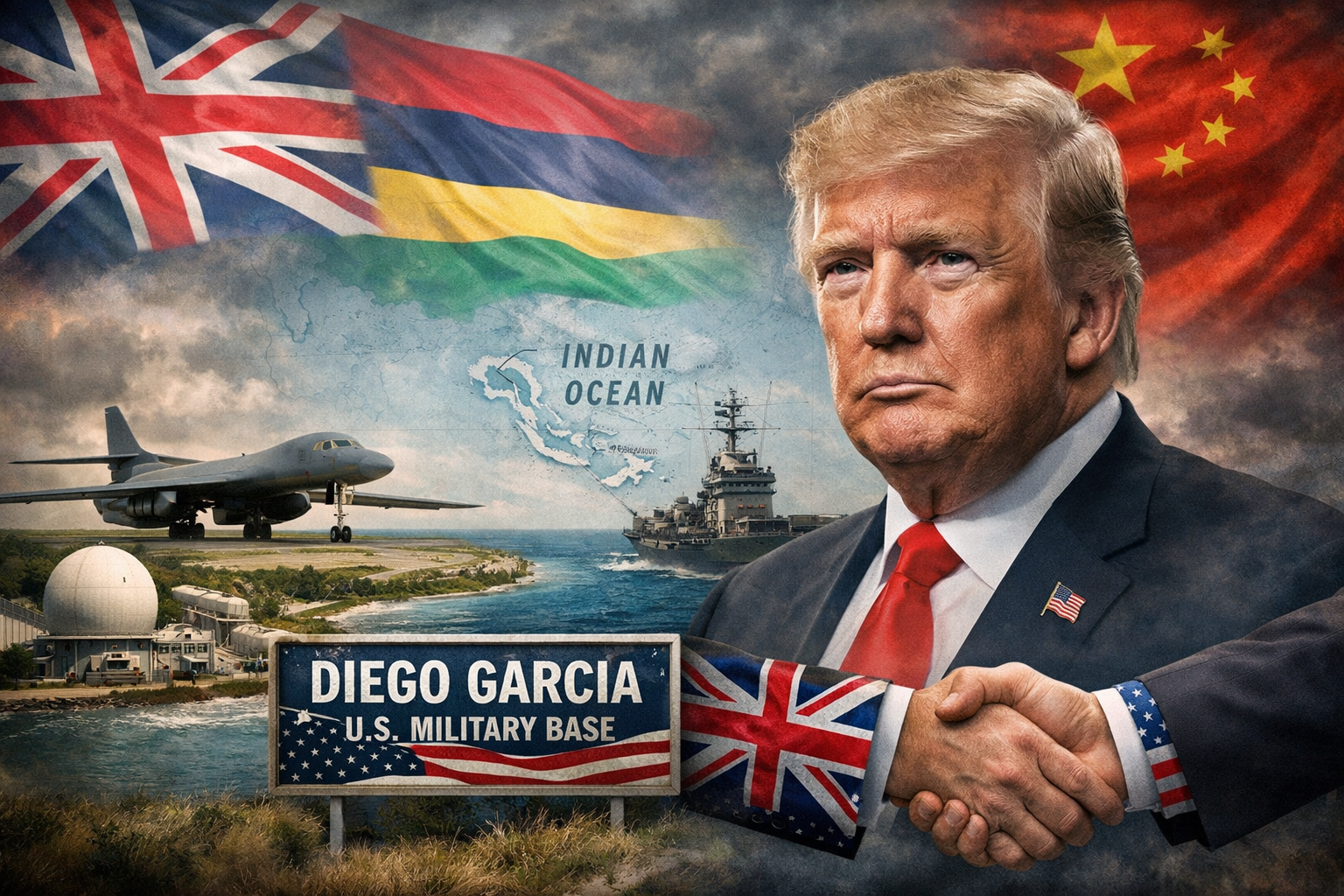
Republican lawmakers have stepped up pressure on President Donald Trump to oppose a U.K.-Mauritius agreement that would transfer sovereignty over the Chagos Archipelago while preserving long-term access to the Diego Garcia military base through a lease. Reporting in the Wall Street Journal and Reuters describes the push as part national-security argument, part skepticism about the durability of leases and treaty guarantees when strategic rivals compete for influence across the Indian Ocean.
The dispute matters because Diego Garcia anchors U.S. power projection across the Middle East, East Africa, and parts of the Indo-Pacific. It also sits inside a long-running sovereignty and decolonization controversy that has produced international legal pressure on the United Kingdom to resolve the status of the islands.
What Republicans ask Trump to do now boils down to a simple goal: stop Washington from endorsing the agreement and push London to abandon it, reopen it, or attach stricter conditions that guarantee U.S. freedom of action at the base for decades. Supporters of the agreement respond that the deal strengthens the base’s legal foundation and blocks adversaries from exploiting the sovereignty dispute in international bodies.
What Republicans want Trump to change
Republicans who oppose the U.K. plan focus on the sovereignty transfer itself. They argue that a formal handover to Mauritius, even with a long lease for Diego Garcia, creates strategic risk that the U.S. and U.K. cannot fully control. They also worry about how future Mauritian governments might interpret their new sovereign rights, especially if domestic politics or external pressure pushes them to renegotiate terms.
Several Republicans also tie the issue to China’s broader footprint in the Indian Ocean and to Mauritius’s international economic relationships. In that framing, the sovereignty transfer could offer Beijing additional diplomatic leverage or intelligence opportunities even if the agreement bars other foreign militaries from using the outer islands without U.K. consent.
Some lawmakers have taken their case public for months. Senator John Kennedy, for example, has urged the U.S. and U.K. to drop the agreement and has highlighted what he sees as strategic vulnerabilities if the transfer proceeds.
What the U.K.-Mauritius agreement actually does
The agreement does not propose closing Diego Garcia or removing U.S. forces. Instead, the deal transfers sovereignty over the Chagos Archipelago to Mauritius while granting the U.K. extensive rights to operate Diego Garcia for an initial 99-year period, with options to extend (including a further 40 years if both parties agree). Mauritius would also retain authority to support resettlement on islands other than Diego Garcia.
Money forms a major part of the bargain. UK parliamentary research describes an annual average payment of about £101 million (in 2025/26 prices), totaling roughly £3.4 billion over the life of the deal. Reuters reporting aligns with that scale and describes it as the price the U.K. agreed to pay to secure the long-term lease arrangement around the base.
The U.K. government has framed the agreement as a security measure as well as a legal settlement. UK parliamentary materials summarize the government’s view that the treaty resolves the sovereignty dispute, protects long-term base operations, and reduces the risk that courts or international bodies disrupt practical issues like access, contracting, and communications that the base depends on.
Why Diego Garcia matters strategically
Diego Garcia sits near the middle of the Indian Ocean, which lets the U.S. reach multiple theaters without relying on host-nation permissions that can shift with politics. Analysts often describe the base as an “anchor” that supports air operations, logistics, and naval activity across a very wide arc.
Chatham House notes that U.S. planners originally pushed for an Indian Ocean base to protect access and power projection as decolonization changed basing rights elsewhere. The base later supported major U.S. operations, including the Gulf War and Iraq War, and it played a role in Afghanistan-era strikes. Reuters also lists more recent operations that launched from Diego Garcia, including strikes against Houthi targets and humanitarian missions.
The base’s relevance also rises when Washington anticipates crisis escalation in the Middle East. Reuters reporting on Trump’s public criticism connects his objections to concerns about potential conflict scenarios, including Iran, and to his broader skepticism that long leases guarantee access when politics change.
The main arguments on each side
Critics: sovereignty transfer creates long-tail risk
Opponents focus on the difference between “practical control today” and “legal sovereignty tomorrow.” They argue that sovereignty gives Mauritius new pathways to apply pressure, raise disputes in international forums, or complicate U.S. operations through regulatory and political tools over time. They also argue that even remote intelligence collection benefits from proximity and from political leverage rather than from a formal foreign base on the same territory.
Critics also point to great-power competition. They argue that the U.S. should avoid arrangements that add uncertainty to a strategically unique base at a time when China expands its regional presence through commercial and dual-use infrastructure across the wider Indian Ocean.
Supporters: a treaty settlement protects the base better than the status quo
Supporters of the deal argue that the sovereignty dispute itself creates strategic vulnerability. They point to international legal and diplomatic pressure on the U.K., including the 2019 advisory opinion from the International Court of Justice that urged Britain to end its administration of the islands. They argue that unresolved disputes can produce binding constraints later, especially if litigation or international regulatory bodies affect technical aspects of operating the base.
UK parliamentary research summarizes the U.K. government’s rationale in practical terms: London wants to guarantee long-term basing rights, reduce legal risk, and prevent China or other powers from establishing a presence on other islands in the archipelago. In that reading, the agreement “locks in” restrictions and basing permissions that the U.K. and U.S. currently rely on informally.
The Chagos history that keeps shaping today’s politics
The sovereignty dispute traces back to the 1960s. The U.K. detached the Chagos Archipelago from Mauritius before Mauritius gained independence in 1968, and the U.K. removed Chagossians from the islands between 1968 and 1973 as part of the pathway for establishing the base. Those events created a long-running legal and human rights controversy that has never fully settled.
International institutions have also weighed in. Reuters summarizes the 2019 ICJ advisory opinion as a key milestone that increased pressure on Britain to relinquish control and address the legacy of forced displacement. That pressure, in turn, helped push London and Port Louis toward a negotiated settlement rather than an indefinite status quo.
That history complicates the policy debate inside the U.K. and the U.S. Security officials tend to prioritize continuity of operations, while legal advocates and many Chagossians prioritize sovereignty, resettlement rights, compensation, and recognition of wrongdoing. Policymakers often try to solve both sets of issues at once, and they rarely satisfy everyone.
Where Trump fits in and what he can actually do
Trump can’t “cancel” a U.K.-Mauritius treaty on his own, but he can shape whether the U.S. supports it. Reuters reports that the U.K. has emphasized it won’t proceed without U.S. support, which gives Washington practical leverage over timing and implementation.
Trump has also sent mixed signals over time. Reuters describes cycles of criticism and partial walk-backs, with Trump repeatedly returning to the theme that the U.S. needs certainty over Diego Garcia, especially during Middle East tensions. Those public comments matter because London treats Washington’s stance as central to whether ratification can proceed smoothly.
If Trump sides with Republican critics, he has a few pathways. He can direct the administration to withhold endorsement, seek additional bilateral assurances from the U.K., or request changes that clarify access rights and security controls around Diego Garcia. He can also encourage London to delay ratification until the U.S. and U.K. finalize their own basing arrangements in a way that satisfies U.S. defense planners and congressional skeptics.
What happens next
The U.K. still needs to move the agreement through its domestic processes. Reuters reports that the U.K. has not “paused” ratification despite conflicting statements, and it notes that the implementing bill sits in the House of Lords without a scheduled debate or vote date. That procedural reality gives opponents more time to lobby, and it gives the U.S. more time to signal conditions.
Several scenarios now compete.
One scenario keeps the deal intact while the U.K. and U.S. add parallel commitments that reassure skeptics about operational freedom and counterintelligence. That approach would let London claim legal closure while letting Washington claim stronger guarantees.
A second scenario delays ratification indefinitely. London could keep negotiating quietly with Washington and Port Louis, especially if Trump demands revisions or if lawmakers in either country raise new objections. That delay could preserve the status quo at the base while uncertainty continues around sovereignty and international litigation.
A third scenario collapses the deal. That outcome could trigger renewed diplomatic conflict and invite more legal pressure on the U.K. Supporters of the treaty argue that this path risks a worse strategic outcome over time if international bodies constrain Britain’s ability to administer the territory.
FAQ
Does the agreement force the U.S. to leave Diego Garcia?
No. The agreement centers on a sovereignty transfer paired with long-term basing rights through a lease framework. Both UK parliamentary research and Reuters reporting describe the arrangement as designed to secure continued base operations over decades.
Why do critics keep talking about China?
Critics worry about indirect leverage rather than an immediate Chinese base on the islands. Chatham House notes that many policymakers in Washington and London invoke a “counter-China” rationale, although it also argues that regional dynamics—especially Mauritius’s relationship with India—complicate simple predictions.
Why did the U.K. pursue a deal now?
UK parliamentary materials describe three drivers: secure the base long-term, reduce legal risk from future judgments that could disrupt operations, and prevent adversaries from exploiting the wider archipelago. Reuters also points to growing international pressure as a key catalyst.
What role do Chagossians play in the debate?
Chagossians and their descendants sit at the center of the dispute because the U.K. removed them decades ago. The agreement framework would allow resettlement on islands other than Diego Garcia, but debate continues over consultation, compensation, and governance after any sovereignty transfer.
What should readers watch in the next few weeks?
Watch for three signals: movement on the U.K. ratification timetable, any new U.S. conditions tied to basing rights, and statements from Mauritius about implementation details. Reuters reporting suggests London will keep coordinating with Washington before it advances the process.