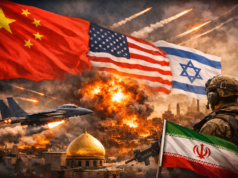
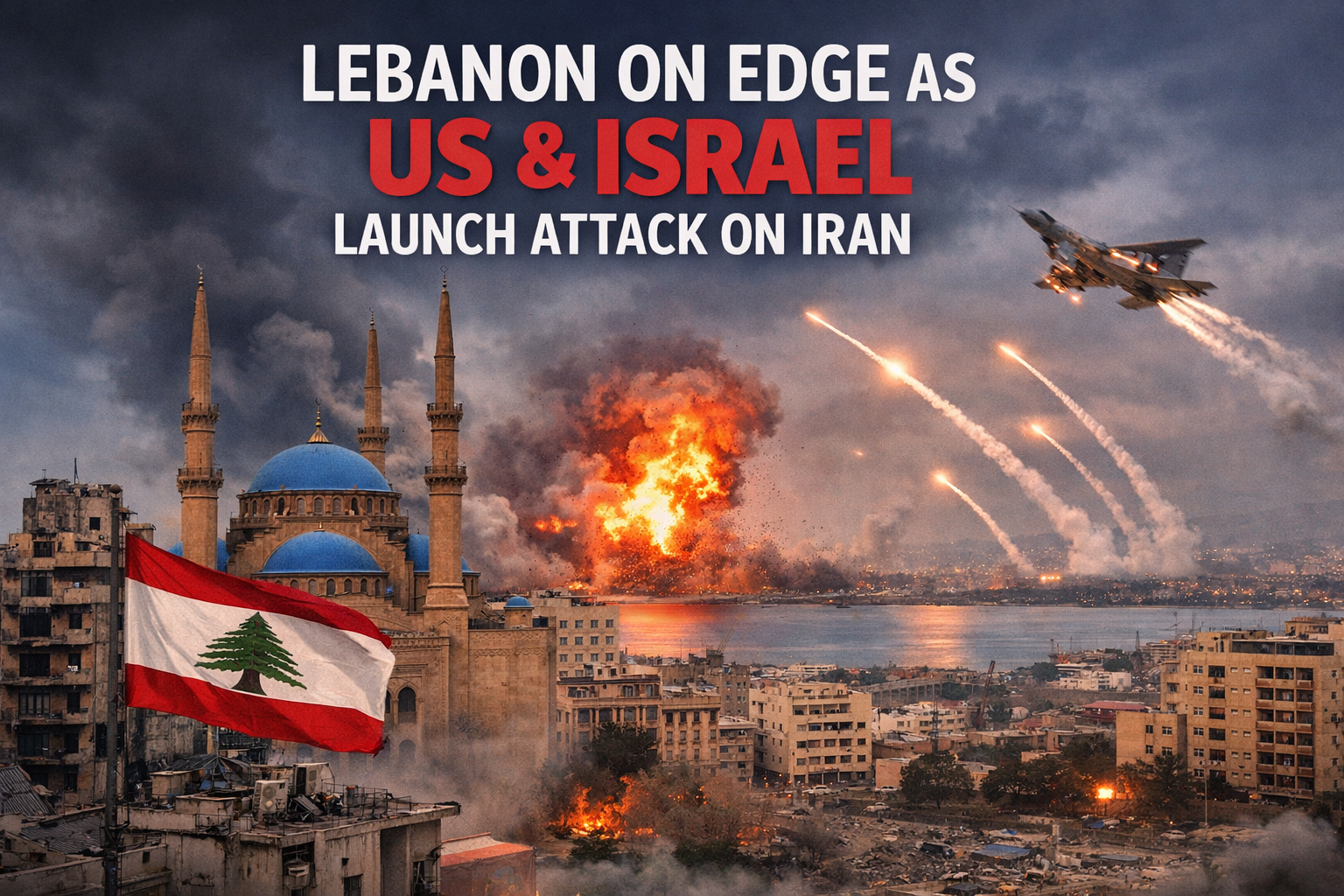
Lebanon woke up to another round of regional shock after the United States and Israel carried out coordinated strikes on Iran, triggering Iranian retaliation and a fast-moving security crisis across the Middle East. The escalation hit Lebanon in a uniquely vulnerable place: the country sits next door to Israel, hosts Hezbollah as a powerful armed actor, and still struggles to rebuild its economy and state capacity after years of political and financial turmoil. Lebanese leaders now face a narrow path between deterrence, domestic stability, and the risk of becoming a secondary battlefield.
Early reporting from outlets including Reuters and the Associated Press describes a conflict that started with a joint US–Israel operation and quickly widened to include missile activity across the region.
What happened in the opening phase
US and Israeli officials described the strikes as part of a coordinated campaign aimed at Iran’s leadership and military capabilities. Reuters reported that the Pentagon named the operation “Operation Epic Fury,” and that the strikes followed indirect nuclear talks mediated by Oman that failed to produce a breakthrough. Iran’s government condemned the strikes as illegal and responded with missile launches toward Israel, while several Gulf states reported intercepting missiles after Iran warned it would hit the region if an attack occurred.
Even in the first hours, the fog of war shaped public understanding. Officials and media reports offered competing accounts about damage, targets, and casualties, and independent verification lagged behind events. That uncertainty matters for Lebanon because rumors and misreporting can push armed groups, markets, and civilians into rushed decisions before facts settle.
Why Lebanon feels exposed
Lebanon’s exposure comes from geography and from politics. Any US–Iran confrontation raises the question of what Iran-aligned groups will do, and Hezbollah remains the most capable among them. The Lebanese state does not command Hezbollah’s military decisions, yet Lebanese civilians would absorb the consequences if Israel treats Lebanese territory as part of a wider confrontation.
Prime Minister Nawaf Salam acknowledged that reality in unusually direct language, warning that he would not accept anyone dragging Lebanon into “adventures” that threaten the country’s security and unity. His statement signaled both a domestic message to Hezbollah and an external signal that Beirut wants to avoid opening another front.
Israel’s warning and the risk to Lebanese infrastructure
Lebanon’s leaders have not dealt only with abstract risk. Reuters reported earlier in the week that Israel conveyed a message—delivered indirectly—that it would “strike the country hard” if Hezbollah intervenes in a US–Iran war, and that the warning included civilian infrastructure such as the airport. That kind of messaging aims to deter Hezbollah, but it also increases anxiety among Lebanese officials who already struggle to keep essential services running.
The same Reuters report also described an ongoing backdrop of friction since the 2024 ceasefire, with Israel conducting periodic strikes it says target Hezbollah rearmament efforts and Lebanese authorities disputing key claims. This dynamic raises the chance that a broader Iran-related escalation could merge with existing Israel–Hezbollah tensions rather than remain neatly separated.
Hezbollah’s options, and Hezbollah’s constraints
Hezbollah leadership has signaled that it does not view itself as neutral in a standoff that involves Iran, which created immediate concern that Tehran might expect a response from its allies. At the same time, Hezbollah operates in a more constrained environment than it did a few years ago. Israel inflicted heavy damage on the group in the 2024 war, and Lebanese public opinion has grown more sensitive to any action that risks another national catastrophe.
Hezbollah therefore faces a hard balancing act. If it stays on the sidelines, it may disappoint parts of its base and risk pressure from allies who frame the conflict as existential. If it escalates, it risks triggering Israeli strikes that could hit far beyond the border areas and push Lebanon into a crisis that the state cannot manage.
Beirut’s political calculus: sovereignty versus reality
Salam’s government has tried to assert a stronger state role over weapons and security decisions, but Lebanon’s internal structure limits how fast it can move. State institutions still contend with deep financial strain, political fragmentation, and a legacy of parallel power centers. Those realities make deterrence messaging difficult: the government can warn against escalation, but it cannot guarantee compliance from every armed actor.
External actors read that gap as well. When Israel threatens infrastructure, it effectively tells Lebanese officials: “You will pay even if you cannot control the decision.” That dynamic pressures Beirut to intensify political and security coordination at home while also seeking international backstops abroad.
Immediate economic shock: flights, insurance, and confidence
Conflict does not need to reach Beirut to damage Lebanon’s economy. Aviation provides a clear example. Reuters reported that major carriers suspended or halted routes across the region, including temporary halts affecting Beirut, as airspace closures and security risks expanded. Flight disruption hits tourism, business travel, and remittances, and it can raise insurance costs for airlines, shipping, and local firms that rely on predictable logistics.
These shocks matter more in Lebanon than in many countries because the economy depends heavily on services and on external flows of cash and goods. Even short interruptions can ripple through prices, supply chains, and confidence, especially when households already operate under tight financial conditions.
A security signal: the US embassy draws down staff
Diplomatic security moves can amplify public fear, even when they involve precaution rather than a specific threat. Reuters reported that the US embassy in Beirut ordered the departure of non-emergency government personnel and family members, citing a “security situation in Beirut.” The embassy did not provide details, but the decision signaled that US officials assessed elevated risk in the wider environment.
Such actions often trigger second-order effects. Companies revisit travel policies, international organizations adjust staffing, and local residents interpret the move as a warning—sometimes more strongly than the facts justify. In a fast escalation cycle, perception can drive behavior as much as confirmed information.
Regional spillover beyond Lebanon
Even if Lebanon avoids direct involvement, regional spillover can still shape Lebanese security. Reuters described missile activity and interceptions in Gulf states following the initial strikes, and other outlets reported wide-ranging alerts and airspace closures. The pattern suggests a region-wide confrontation rather than a bilateral exchange, which increases the chance of miscalculation and accidental escalation.
Lebanon also sits near other pressure points. Any instability in Syria, or any shift in Israel’s northern posture, can change the calculus on the Lebanese border. A broader regional crisis can also strain international attention and humanitarian capacity, which reduces the bandwidth available to help Lebanon de-escalate.
Diplomacy, narratives, and the fight over legitimacy
As military events unfold, countries race to frame the conflict in legal and political terms. Russia condemned the US–Israel strikes and called them an “unprovoked act of armed aggression,” while also warning about the risks of striking nuclear-related sites. France’s President Emmanuel Macron called for an urgent UN Security Council meeting and described the situation as a major threat to international peace and security.
Policy analysts also raised questions about objectives and endgames. Chatham House experts argued that airstrikes rarely deliver durable political transformation, and they highlighted the risks that multiple stated goals—nuclear limits, missile degradation, and support for internal opposition—can blur strategy and prolong conflict. Lebanon, which already struggles with governance and recovery, has little margin for a long regional war that erodes trade, investment, and security.
Energy markets raise the stakes for everyone
Energy risk makes every Middle East escalation global, and it also hits Lebanon through prices and supply expectations. Reuters summarized Iran’s role as a major OPEC producer and described how most Iranian crude exports ship via Kharg Island through the Strait of Hormuz, a chokepoint that markets watch closely during crises. Even without direct damage to infrastructure, traders often price in the possibility of disruption, which can raise fuel costs across import-dependent economies like Lebanon.
Lebanon does not control these global dynamics, but it pays for them. Higher energy prices can push up transportation and food costs, strain public finances, and deepen household hardship, especially if the confrontation drags on.
Scenarios to watch next in Lebanon
Lebanon’s near-term outlook depends on which actors choose restraint and which choose escalation. Several scenarios stand out.
One scenario involves Hezbollah maintaining a limited posture—political support for Iran, heightened readiness, but no cross-border strikes—while Beirut intensifies security coordination to prevent rogue action. That path reduces immediate risk but does not remove it, because Israel may still strike preemptively if it interprets Hezbollah movements as preparations.
A second scenario involves calibrated Hezbollah action, such as limited launches or proxy activity that Hezbollah claims avoids “full war.” This approach often fails to contain escalation because Israel may respond broadly, and because small attacks can still cause casualties or damage that force leaders to respond.
A third scenario involves a rapid diplomatic push that freezes the conflict before it solidifies into a longer campaign. Macron’s UN Security Council call and European statements urging restraint point in that direction, but diplomacy will need buy-in from Washington, Tehran, and regional capitals to work.
What this moment means for ordinary Lebanese
For Lebanese families, the stakes feel immediate even when missiles do not fly overhead. People watch the airport and borders, track fuel prices, and monitor whether schools and workplaces can operate normally. Businesses worry about supply delays, cancelled travel, and falling consumer demand.
Lebanon also carries psychological scar tissue from prior wars and political shocks. That history can drive quicker panic buying, faster withdrawals from banks, and heightened communal tension, all of which can destabilize daily life without a single new strike in the country.
Lebanon’s leaders now face a test of crisis management and communication. Clear messaging, coordination with the Lebanese army and security services, and rapid outreach to international partners may not eliminate risk, but they can reduce the chance that fear and misinformation pull the country toward the brink.