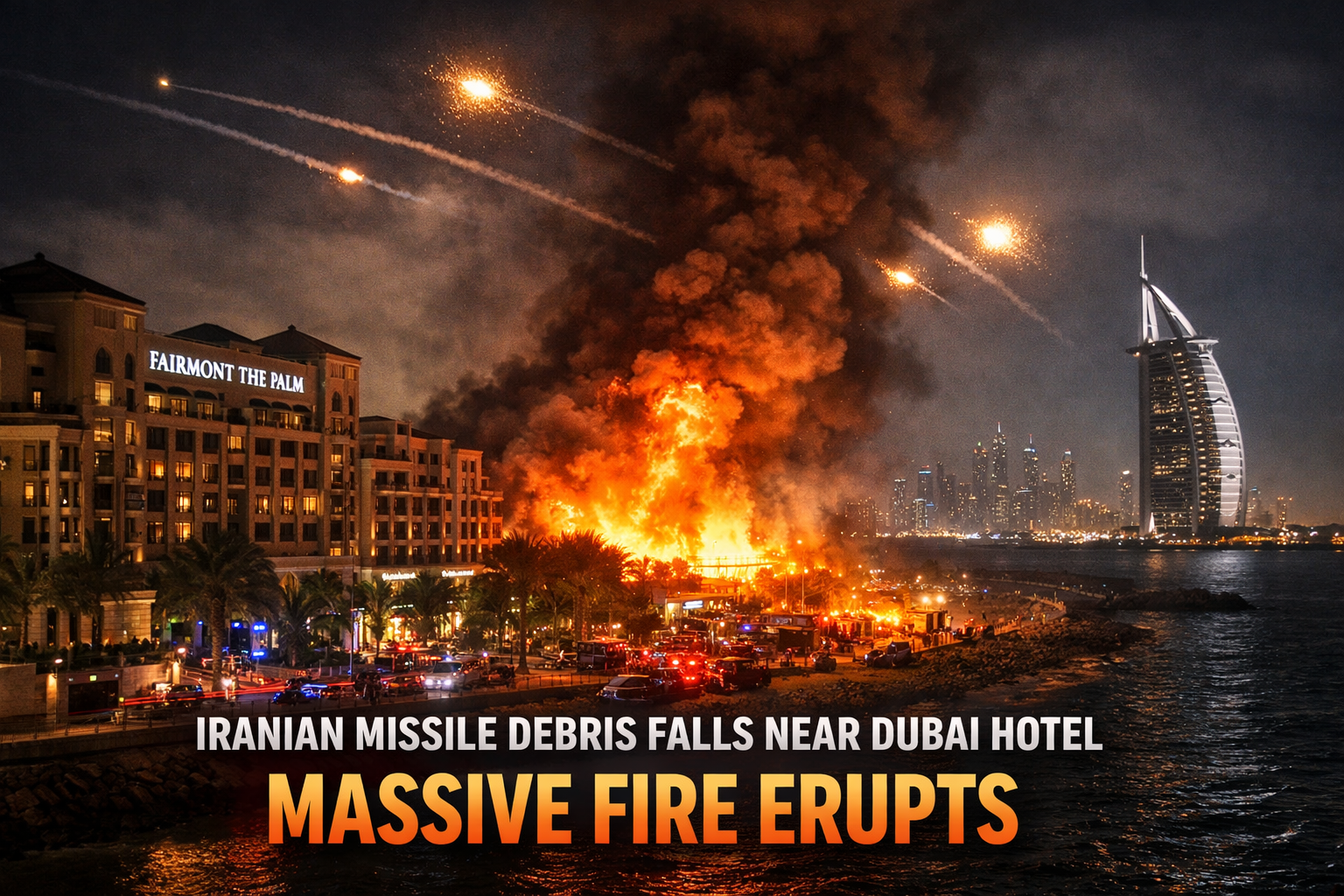
A large fire broke out near a luxury hotel complex on Dubai’s Palm Jumeirah after residents reported explosions and air-defense activity over the city. Videos shared online showed thick smoke rising from the area around Fairmont The Palm, but early reports still left key questions unanswered, including whether debris struck the property directly or whether interception fragments sparked the blaze.
Several outlets described the incident as linked to falling debris from missiles launched during Iran’s broader retaliation across the region. Some reporting said debris fell near the entrance area of the Fairmont The Palm and flames spread quickly in the immediate vicinity. Officials in the UAE had not publicly confirmed hotel damage in the initial hours, and reporting continued to stress uncertainty about the precise cause.
The incident unfolded as the UAE faced incoming threats and activated air defenses. The Associated Press reported air-defense fire over Dubai, underscoring that the situation extended beyond online footage and involved active defensive measures in the skies above the city.
What witnesses and videos showed in Palm Jumeirah
People in Dubai described a sudden sequence of loud booms and visible flashes consistent with interception activity. Residents in neighborhoods near Dubai Marina and the Palm reported shaking windows, and journalists on the ground said the explosions sounded close enough to rattle buildings. Those observations matched the timing of videos that captured smoke plumes and an apparent fire near the Palm’s hotel corridor.
The videos that circulated most widely focused on the Palm Jumeirah skyline, with black smoke rising above beachfront towers and resort structures. Several posts framed the fire as a direct “hit,” but more cautious reporting emphasized that intercept debris can fall unpredictably and ignite fires even when air defenses stop incoming munitions. That distinction mattered because it shaped how officials and investigators would classify the incident.
Early reporting also differed on the exact point of impact. One account described debris landing near the hotel’s entrance area, while others described a fire “at” the hotel without specifying whether the property itself took a direct strike. Until investigators publish a definitive timeline, the public record supports only a narrower claim: a fire erupted in the vicinity of Fairmont The Palm after reported explosions and missile-interception activity over Dubai.
Why intercepted missiles can still cause damage on the ground
Air-defense systems aim to destroy or disable incoming missiles before they reach their targets, but interceptions can create dangerous fragments that fall over wide areas. A successful intercept often breaks a missile into many pieces, and gravity does the rest. Debris can land in streets, on rooftops, or near building entrances, and a single hot fragment can ignite combustible material on contact.
That dynamic helps explain why officials and reporters often avoid declaring a “direct hit” in the first wave of coverage. Investigators typically need blast-pattern analysis, debris identification, and corroborated time-stamps before they can state whether the fire began from a direct strike, an intercept fragment, or a separate ignition source. In fast-moving crises, viral video can outrun verification, so responsible outlets often keep language conditional until officials release confirmed findings.
What UAE officials confirmed about the wider attack
While details around the Palm Jumeirah fire remained fluid, UAE authorities issued clearer statements about the broader threat environment. UAE-linked reporting cited the Ministry of Defense saying the country faced an attack involving Iranian ballistic missiles, and UAE air defenses intercepted a number of them. Officials also said debris fell in a residential area, caused material damage, and led to one civilian death.
The Ministry of Foreign Affairs issued a separate statement condemning Iranian missile attacks that targeted the UAE and other states in the region. The statement also offered condolences to the family of a Pakistani national who died as a result of the attacks, and it reiterated calls for restraint and diplomatic solutions.
Reuters also reported that multiple Gulf states said Iranian missiles targeted them, with one death reported in Abu Dhabi. In the same report, Reuters described alerts that advised residents to shelter in secure buildings and stay away from windows amid missile threats, reflecting the practical steps authorities urged civilians to take during the exchange.
Emergency response and public safety in Dubai
Dubai’s emergency services have extensive experience managing high-rise and coastal incidents, and the city typically moves quickly to cordon off risk zones when debris may still fall. In situations involving possible shrapnel, authorities often focus on two immediate priorities: securing the area to prevent injuries from unexploded fragments, and containing any secondary fires before they spread. Residents and hotel guests also face a different set of risks than they do in ordinary building fires, because debris fields can include sharp metal and components that remain hazardous after impact.
For visitors in tourist zones like Palm Jumeirah, the biggest immediate challenge often involves information flow. People see smoke, hear explosions, and then rely on a mix of official alerts, hotel guidance, and social media posts that may conflict. That mix can cause confusion about whether to evacuate, shelter in place, or move away from windows, especially if authorities expect additional launches or interception activity.
Reuters described mobile alerts in Abu Dhabi that instructed people to shelter and avoid windows, and similar guidance commonly appears across jurisdictions during missile threats. That guidance prioritizes blast safety and reduces the risk of injuries from shattered glass, which can occur even when missiles do not land nearby. People who follow those instructions often reduce risk significantly during the most volatile window of an attack.
Travel disruption hits Dubai’s airport and regional air routes
The incident also hit the travel sector quickly, because Dubai functions as a global transit hub and relies on predictable air corridors. The Associated Press reported that Emirates said multiple flights faced disruptions tied to the closure of UAE airspace, and the airline urged passengers to check flight status updates. Those disruptions ripple beyond the UAE, because a single closure can force reroutes across multiple continents and strand travelers mid-journey.
Reuters reported that airlines suspended flights across parts of the Middle East and flight maps showed airspace over Iran almost empty. When carriers face rapid changes in threat conditions, they often choose conservative routing and cancellation decisions even if the risk sits far from the departure airport. That approach protects passengers and crews, but it can also create cascading delays and crowding at terminals, especially at airports that serve as major connecting points.
For travelers in Dubai, that disruption can feel sudden because airport operations usually run with high reliability. A closure can strand passengers on aircraft, push others back through immigration, and trigger hotel rebookings at scale. Reports from multiple outlets described exactly that kind of scramble as airlines and authorities adjusted to the evolving security picture.
Regional context behind the Palm Jumeirah incident
The fire near Palm Jumeirah did not happen in isolation, and that context shapes how governments interpret risk to civilian infrastructure. Reuters reported that Iran launched missiles at multiple Gulf Arab states after strikes by the United States and Israel, bringing conflict into a region that often markets itself on stability and safety. That broader exchange raised the likelihood of interceptions over populated areas, because air defenses operate near cities and military installations alike.
At the same time, officials across the region pushed public warnings that urged civilians to shelter indoors. Those advisories can reflect both confirmed launches and a desire to reduce panic-driven movement on roads during uncertain conditions. In Gulf cities with dense high-rise districts, authorities often treat “glass risk” as a major hazard during any episode of nearby explosions or interceptions.
In that environment, even a localized fire near a hotel carries outsized symbolic weight. Dubai’s Palm Jumeirah stands as one of the city’s most recognizable tourist areas, and any incident there spreads quickly through social media and international broadcasts. That reality increases pressure on officials and property operators to clarify what happened, what risk remains, and what steps guests should take next.
What remains unconfirmed and what to watch next
As of the first wave of reporting, journalists and officials had not established a fully verified chain of causation between the explosions, any falling debris, and the ignition point of the fire near Fairmont The Palm. Some reports framed debris as the trigger, but other reporting emphasized uncertainty and noted that neither officials nor the hotel had confirmed damage in the early hours. That gap matters because it separates verified facts from plausible explanations that still need evidence.
The next set of updates will likely focus on three questions. Investigators will aim to identify any debris recovered at the scene and determine whether it matches known missile or interceptor components. Emergency officials will also clarify whether the fire spread into hotel structures or remained confined to an exterior or entrance-adjacent area. Finally, authorities and airlines will publish more detailed timelines for airspace restrictions and flight resumptions as the regional security picture shifts.
For readers following the story, the most reliable signals usually come from official statements, confirmed casualty reports, and reporting that cites named agencies or on-the-record spokespeople. Social media can provide early visuals, but it can also collapse separate incidents into one narrative or mislabel older footage. Until investigators publish findings, a careful reading treats the Palm Jumeirah fire as a serious incident linked in time to regional missile activity, while leaving room for officials to confirm the precise mechanism that sparked the blaze.