
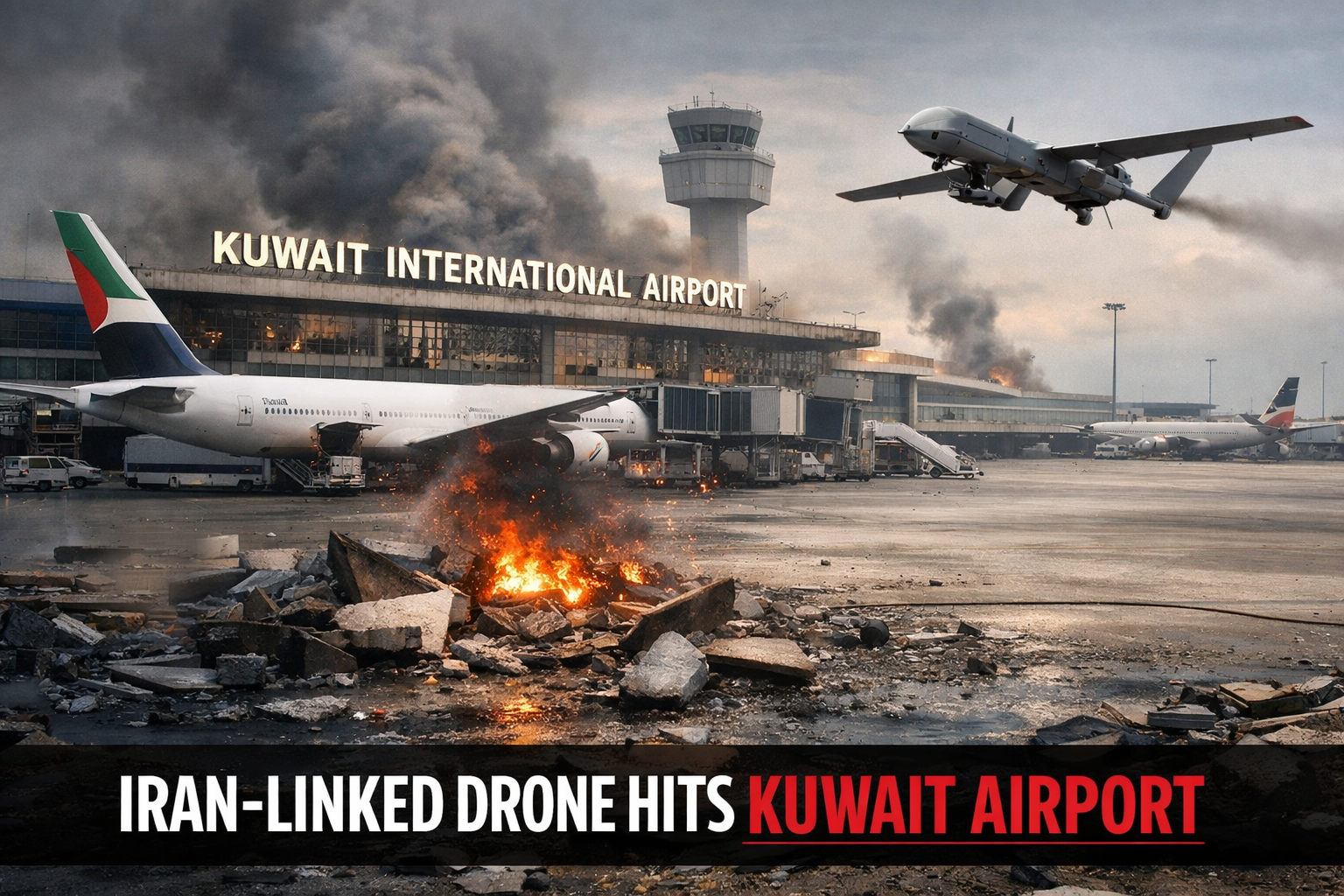
Kuwait’s civil aviation authorities say a drone struck Kuwait International Airport on Saturday, injuring several airport workers and causing limited damage to the passenger terminal. Officials moved quickly to activate emergency procedures, secure the site, and reassess flight operations as tensions surged across the Gulf amid a broader regional escalation.
The incident adds a new layer of concern for civilian aviation in a region that already sits near multiple conflict flashpoints. Even when an attack causes limited physical damage, a strike near airport infrastructure can disrupt schedules, strain security resources, and raise the risk level for passengers and crews. With multiple countries temporarily restricting airspace and airlines rerouting flights, the drone strike at Kuwait’s main airport has become part of a fast-moving security and travel story that continues to develop hour by hour.
What happened at Kuwait International Airport
Kuwait’s Directorate General of Civil Aviation (DGCA) reported that a drone targeted Kuwait International Airport and hit the passenger terminal area, with officials later specifying Terminal 1. Authorities reported minor injuries among several workers and described the material damage as limited.
Early reporting did not describe widespread structural damage, and officials did not indicate that the drone caused a prolonged fire or large-scale destruction. Still, any impact involving an airport terminal creates immediate operational challenges, because security teams must treat the site as a potential ongoing hazard until they complete sweeps, evaluate risks, and confirm the status of critical systems.
In practical terms, airport leadership must respond on several tracks at once. They need medical checks for injured staff, security containment of the affected zone, rapid inspections of terminal access points and adjacent facilities, and coordination with airlines and air traffic services. Even if the strike remains limited, the airport must prove it can protect passengers and maintain safe movement across terminals, aprons, and controlled areas before it resumes normal flow.
Emergency response and airport operations
Kuwaiti officials said they activated approved emergency procedures immediately after the drone strike. The DGCA’s spokesperson, Abdullah Al-Rajhi, said authorities dealt with the incident, secured the site, and continued assessment and recovery operations while they reorganized flight operations to align with safety standards.
That language matters, because it signals a controlled response rather than a full shutdown with unknown timelines. Reorganizing flight operations can involve shifting passenger processing, redirecting foot traffic away from affected spaces, tightening access control, and revising gate usage. Airports also coordinate with airlines to stagger departures, manage diverted arrivals, and reduce congestion if staffing or infrastructure capacity drops.
At the same time, the wider regional situation complicated decisions. When nearby airspace becomes contested or states issue air-defense alerts, airport managers and regulators can face pressure to suspend movements even if facilities remain intact. That combination—localized damage plus regional risk—often drives the largest disruptions in modern aviation incidents.
Why officials connected the attack to Iran
Some initial statements focused on the airport impact itself rather than publicly detailing the drone’s origin. However, Kuwaiti government messaging tied the broader set of attacks and violations to Iran. A Kuwaiti Cabinet statement described a “heinous Iranian attack” targeting the country’s airspace and territory, while other official messaging framed the incident within a larger Iranian strike pattern in the Gulf.
Kuwait’s Ministry of Foreign Affairs also condemned what it described as an Iranian attack on Kuwaiti territory, calling it a violation of sovereignty and international law and citing Kuwait’s right to self-defense under the UN Charter. The ministry said Kuwait’s air defense systems intercepted the attack and warned that continued escalation would undermine regional stability.
Officials did not publicly release detailed technical evidence—such as launch point, flight path, or component forensics—in the immediate aftermath. Governments often hold those details for investigations or share them only with security partners. For readers, that means the clearest public attribution in the early hours came through official government statements rather than a publicly presented technical dossier.
How the regional escalation set the stage
The drone strike at Kuwait International Airport occurred during a wider regional confrontation that triggered reports of attacks and interceptions across multiple countries. Reporting from major outlets described Iran launching retaliatory strikes across the region after joint U.S. and Israeli action, with Gulf states condemning attacks on their territory and airspace.
Even when military actions focus on bases or state targets, the spillover can reach civilian infrastructure quickly. Airports sit high on that risk list because they concentrate people, require predictable patterns of movement, and depend on uninterrupted navigation, communications, and power systems. A drone strike on a terminal—or even nearby—forces authorities to assume attackers may seek disruption rather than maximum physical destruction, which can still impose major costs.
Regional dynamics also affect how quickly a country restores normal operations. If sirens sound, missile defenses engage, or regulators see credible threats to flight corridors, aviation authorities may hold traffic longer than the facility damage alone would justify. That logic helps explain why travelers across the region saw sudden cancellations and reroutes even in places that reported limited damage on the ground.
Impact on flights, airspace, and travelers
The Middle East’s air network relies on several major hubs and a dense web of routes that connect Europe, Asia, and Africa. When conflict expands, airlines often reroute around risk zones, which lengthens flight times, increases fuel use, and reduces scheduling flexibility. During the escalation tied to the Iran-related strikes, flight tracking and airline advisories showed widespread disruption and airspace restrictions, including skies above Kuwait.
Travelers feel those decisions immediately. Airports can face crowding from delayed departures, diverted arrivals, and passengers who cannot connect onward. Airlines may issue waivers for rebooking, but capacity constraints can persist for days if aircraft and crews end up out of position. In these scenarios, even passengers traveling nowhere near Kuwait can get pulled into ripple effects because carriers reassign aircraft to protect key routes.
Government advisories also shape passenger behavior. The UK’s Foreign Office, for example, urged British nationals in Kuwait and other Gulf states to shelter in place amid reported attacks, a signal that authorities viewed the security environment as unstable and potentially fast-changing.
For Kuwait specifically, the drone strike adds a direct airport-security incident to the broader airspace picture. Even if the airport restores operations, airlines may still avoid the area if they cannot reliably plan safe routings. Passengers should expect rolling updates rather than a single “reopening” moment, because aviation decisions often shift with each new warning, interception, or diplomatic development.
What a drone strike near an airport changes
A drone incident at an airport triggers a different risk calculus than many other infrastructure attacks. Airports operate under strict safety management systems, and any threat to terminals, runways, navigation equipment, or fuel infrastructure forces an immediate, layered response. Leaders must protect passengers and staff, preserve evidence for investigators, and keep the system safe enough for controlled operations if authorities permit flights to continue.
Drones also challenge traditional perimeter defenses. A small unmanned aircraft can approach from unexpected angles and at low altitude. That reality pushes airports and governments to invest in detection, electronic countermeasures, and coordinated response protocols that involve civil aviation, police, military air defense, and intelligence services.
For airlines, the operational question often becomes simple: can crews safely land, taxi, and disembark passengers without unacceptable risk, and can aircraft depart without exposure in climb-out corridors? If the answer turns uncertain, airlines cancel first and ask questions later, because commercial aviation risk management prioritizes prevention over recovery.
What comes next
Investigators will likely focus on several immediate questions. They will want to confirm what type of drone struck the airport, how it navigated into a protected zone, and whether attackers targeted the terminal specifically or aimed more generally at airport infrastructure. Authorities will also review how quickly emergency teams contained the area, how effectively they preserved passenger safety, and what gaps—if any—allowed the strike to occur.
On the operational side, Kuwait’s aviation authorities will keep balancing two pressures. They must restore travel and reduce disruption, but they also need to avoid reopening too aggressively if the regional threat environment stays elevated. That balance will shape how quickly airlines bring back schedules, how long passengers face delays, and whether neighboring states keep restrictions that affect flights in and out of Kuwait.
For readers tracking the story, the most reliable near-term signals will come from official aviation notices, government security statements, and airline advisories. The situation can change quickly, and the next updates will likely clarify whether Kuwait’s airport returns to normal operations soon or continues operating under restricted conditions as the wider regional crisis evolves.