As fighting intensifies between Iran and the U.S., the Strait of Hormuz has become the flashpoint for a rapidly-evolving global logistics crisis featuring a feature all too familiar: the strait is the primary maritime outlet of the overwhelming majority of the Persian Gulf’s energy exports, as well as a key channel for little-seen regional containerized trade.
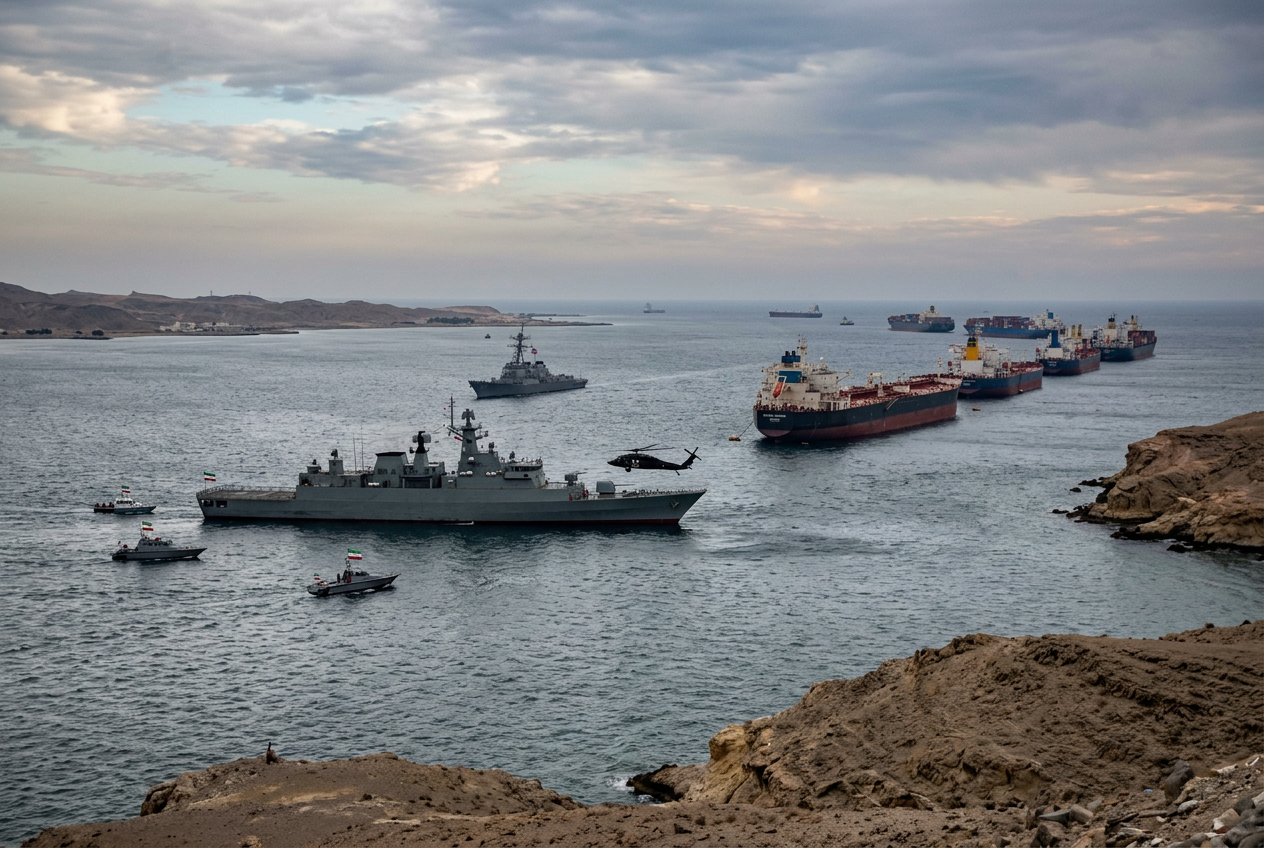
In recent days, vessel traffic has slowed to a crawl, with many ships anchoring en masse rather than transiting, and major carriers and insurers seeking to mitigate exposure. The net effect is a rising risk that delays and cost surge will spread well beyond the Middle East—and into global freight rates, port congestion and supply chains for energy, consumer goods and more.
Why the Strait of Hormuz matters to global cargo
The Strait of Hormuz connects the Persian Gulf with the Gulf of Oman and the Arabian Sea, making it a classic “chokepoint.” Energy data from the U.S. Energy Information Administration shows that in 2024, oil flows through the Strait of Hormuz averaged about 20 million barrels per day—roughly 20% of global petroleum liquids consumption. The waterway also carried about one-fifth of global LNG trade, largely from Qatar.
That concentration is significant because there are no real-world alternatives at scale. When a chokepoint is disrupted, the first-order impacts are all-too obviou (delayed cargo and more expensive transport). The second-order impacts can be broader: rerouting squeezes capacity elsewhere, surcharging goes up, insurers reprice risk, and ports and inland networks absorb unpredictable patterns of arrivals.
How does one make the Strait of Hormuz ‘closed’?
There is the theoretical or legal concept of this, and there is the idea inherent in what shipping companies decide gives rise to undue risk or makes a route uneconomic.
Legal status vs operational reality
The real key, UK Maritime Trade Operations (UKMTO) have warned, is around the concept of closure that is repeated about in open-source reporting (UKMTO mentions VHF communications too but it is conceivable that other channels may be relevant too). A publicly broadcast claim of closure by Iran does not amount to a legally recognised closure. Yet at the same time the U.S. Maritime Administration (MARAD) warned shipping to steer clear of the Strait of Hormuz, Persian Gulf, Gulf of Oman, Arabian Sea, where possible, again, citing significant military activity and danger to commercial shipping.
In shipping parlance these warnings matter as much as formal closure declarations. All it takes is for shipowners, charterers and most crucially for them, insurers to deem a corridor high risk and shipping traffic will dry up even a waterway is not militarily closed.
A surprise shock of congestion
Reuters reported “shipping through the strait ground to a near halt” with more than 150 vessels dropping anchor in and around the Strait, grounds to believe that port congestion and slow circulation of equipment through a port has been lightly seeded in variability. All sorts of vessels – energy tankers as well as cargo ships – are encountering growing backups in their respective volumes.
Container shipping: bookings frozen, reroutes, and surcharges
Container shipping is particularly vulnerable to chokepoint shocks because the industry is reliant on regular schedules, tight asset utilization, and the relative balance of network services. “Taking a different road” isn’t always an option (except in this case – many vessels making the transit must now take another route around Africa – which we’ll get to), but carriers may need to redraw into which ports they take vessels and cut capacity.
Carrier moves and what they mean for schedules
A handful of big boxes have now made public moves tied directly to the Hormuz risk.
Maersk says it is “pausing … all vessel crossings” in the Strait of Hormuz with “immediate effect”, and warns that services calling Arabian Gulf ports may face delays, rerouting, or schedule adjustments (the same update also describes rerouting certain services to circumvent trouble areas via the Cape of Good Hope). MSC said it is making a “precautionary suspension of all bookings” for worldwide cargo to Middle East region “until further notice.”
The short-term suspension of vessel crossings is the practical capacity effect of a halt in loading, and importers can be forced to wait for carriers to reposition vessels and containers. Even if some traffic continues, the price of moving a container typically climbs as carriers seek to price in risk, delay, and higher insurance and security costs.
CMA CGM announces emergency conflict surcharge from March 2 of fixed amounts per container (higher for refrigerated and special equipment), applied broadly across multiple Middle East and adjacent markets. Reuters also reports that Hapag-Lloyd are applying war risk surcharges for cargoes to/from Gulf markets and that carriers are moving to reroute away from Suez and the Bab el-Mandeb sides as the situation in Hormuz deteriorates.
The surcharges arise fast for shippers, often with little notice. This raises landed costs, makes quoting more complex for importers and retailers, and with responsibility for “extraordinary charges” unclear lays the basis for contract disputes.
Energy shipping: tankers at anchor and freight rates soar
If the container sector is about schedules and balance of equipment, the energy sector is about scale and the immediacy of price transmission. Oil and LNG disruption feeds directly into market pricing and tanker freight is ultra-reactive – it is the mechanism that links producers to buyers.
War risk insurance withdrawal
This is the core accelerant in the crisis – insurance. Reuters report that “Multiple insurers said they had issued cancellation notices for war risk coverage, with exclusions for Iranian waters and the Gulf and adjacent waters, with cancellations taking effect from March 5.”.
When war risk cover is withdrawn or sharply repriced shipowners may not agree to fixtures, charterers find it difficult to get tonnage fixed, and all voyages that do move must build some higher risk into freight. In effect, insurance can “close” a route economically even if it isn’t closed physically.
Freight market mechanics: why rates jump so fast
Costs of shipping oil from the Middle East to Asia were already at multi-year highs and expected to rise further, with the key Middle East–to–China benchmark (TD3C) almost tripling since the start of 2026, and broker indications pointing to very high voyage economics for VLCC fixtures.
This kind of spike happens because risk reduces supply. When there are fewer owners willing to send ships into a high-threat area, the “available fleet” is smaller. Meanwhile buyers still need cargoes and alternative sources of supply (say the U.S. or West Africa) usually means a longer voyage, tying up the ships for more days, further tightening capacity, pushing rates higher again.
Knock-on effects across global supply chains
A Hormuz disruption doesn’t stay nicely contained to energy or Gulf-bound cargo. Modern logistics is inter-connected: ships, ports, trucks, rail, warehouses, and inventory planning all depend on reasonably predictable flows.
Port congestion and equipment imbalances
Cargo could start piling up at ports and transshipment hubs in Europe and Asia as dislocation from Hormuz grows, a major container carrier executive warned. Moreover, reportedly 10% of the global container ship fleet is wrapped up in the broader Hormuz backup conditions, Reuters reported.
When vessels are forced to wait at anchor, container equipment (boxes, chassis and reefers) also becomes stuck. That may have strange knock-on effects far away from the Gulf. Exporters in Asia may have a tough time finding available empty containers. Import terminals in Europe may see such lumpy arrivals after reroutes that they push yard and labor planning to the limit.
Higher costs for insurers, charterers, end consumers
As war risk premium rise, the extra costs settle not only with shipowners, but can be passed through by charterparty clauses and freight invoices, ultimately to importers and consumers. That “pass-through” may be evident with higher delivered prices for goods fuel-intensive to produce; higher costs for time-sensitive cargo; and as a broad pressure on inflation if energy prices rise and transport surcharges are extended.
Air cargo spillover
When ocean routes become less reliable, some shippers switch high-value or urgent cargo to air- including spare parts, pharmaceuticals, and critical electronics. But that air network can also be restrained when regional security conditions undermine aviation routes or insurance terms. Reuters reported that the aviation sector has also become more sensitive to insurance issues as the conflict spreads, which adds another layer of uncertainty for those providing time-critical logistics.
Can the World Circumvent Hormuz?
The short answer is: Only part way, and not for everything.
Limited pipeline bypasses
The EIA analysis points out that Saudi Arabia and the UAE have pipeline infrastructure bypass the strait, but that there is limited spare capacity available relative to usual seaborne flows. EIA figures show that some 2.6 million bpd of capacity could be available to bypass Hormuz in a disruption, versus flows of oil through the strait on a regular basis that are closer to 20 million bpd.
EIA describes some of the main bypass routes: Saudi Aramco’s East-West pipeline to the Red Sea, the UAE’s pipeline to Fujairah on the Gulf of Oman, and Iran’s Goreh-Jask pipeline (whose effective capacity is much less and patchy).“Pipelines can help us on the margins, but they don’t “replace” the strait for global markets when that disruption extends to LNG as well to which there are even fewer alternatives,” says subordinate Heller.
Supply substitutions and stockpiles
If Hormuz is left constrained, the response of the market is in general will be some combination of:
Oil importers relying more heavily on non-Gulf barrels if available, even if they are more expensive due to freight and longer transit times.
Some states may tap strategic stocks or increase drawdowns of the more expensive higher stocks to cushion the shock and buy time for their logistics to adjust.
LNG buyers may compete for flexible cargoes from other producers, which would tend to support prices in the spot market and redirect flows.
EIA data indicates Asia especially vulnerable as part of a large share of the flows of both crude and LNG that transit Hormuz destined for Asian markets (including major importers China and India).
What to watch next
The direction of the market through the near-term likely depends on risk conditions whether things ease up quickly, or harden into a longer lasting disruption. Cases for different scenarios to resume or extend disruption.
A fast resume scenario would see clear signs of maritime deconfliction signals that lead to lower incident rates and insurers returning to cover at workable premiums.
Carriers could restart bookings once freight dispatched for essential cargo first, then later expanded to others.
What a longer disruption looks like.
Continuing uncertainty. Prolonged high war risk pricing. Network reshaping that lasts weeks or seagoing months. This is where the congestion spreads even more, as missed sailings strand and eddies, equipment imbalances get worse, leans against cargoed or empty, risking carriers routing that cargo to the most profitable or least risky lanes.
The nodding UKMTO looks to addition by fact and substance, saying days by sending signals in clear messages and not through formally published messaging about a closure—it highlights how quickly the world can drop, and how hard for commercial shipping to plan a trip.
Watch what insurers say and markets advise and also when.