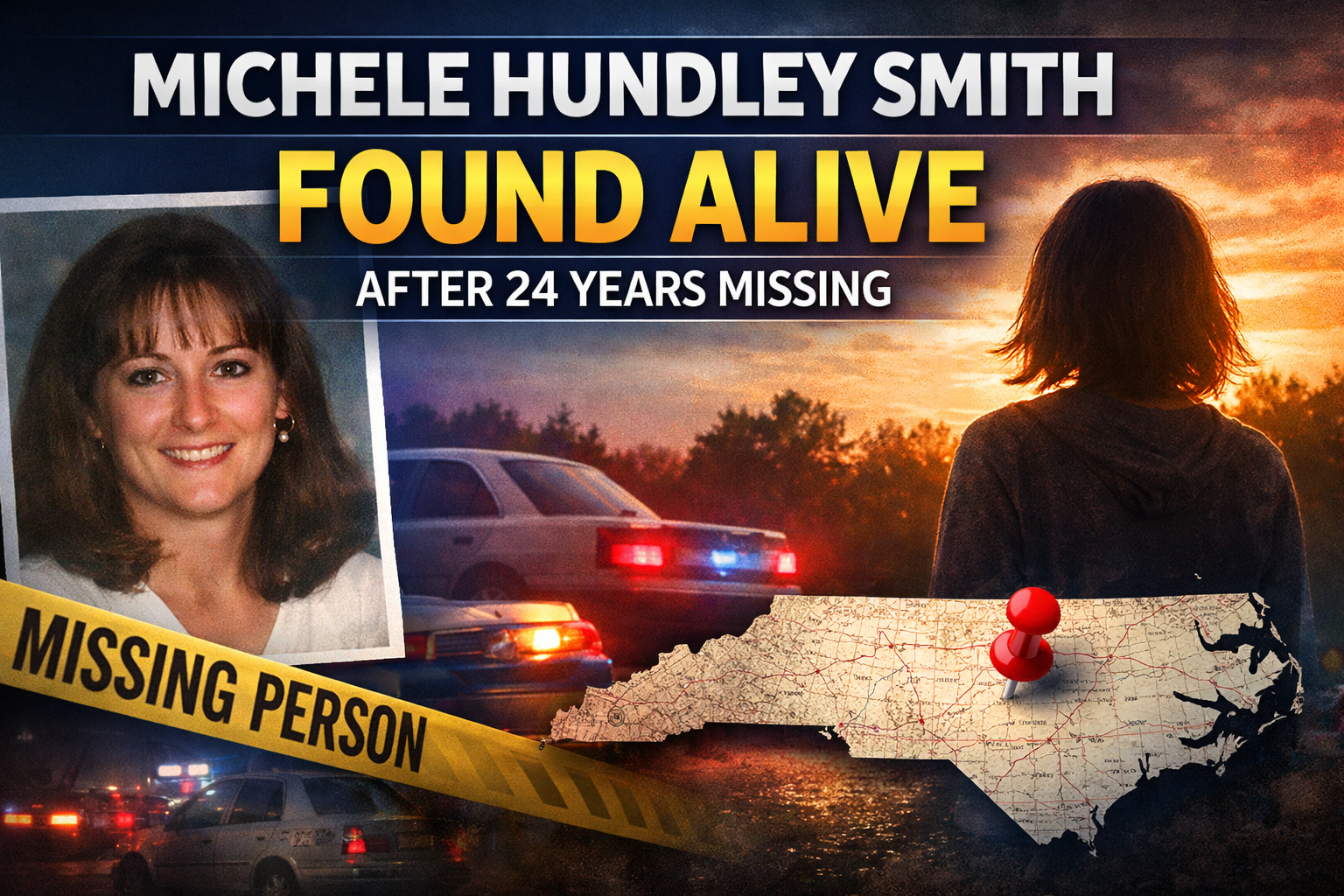
The story of Michele Hundley Smith has drawn national attention because it combines two realities that rarely happen together in the same case: a decades-long disappearance and a confirmed outcome in which the missing person is found alive. According to multiple reports citing the Rockingham County Sheriff’s Office in North Carolina, Smith was located in February 2026 after being missing for more than 24 years, and authorities said she was found “alive and well” at an undisclosed location in North Carolina. Her current whereabouts were not released at her request.
That update brought a form of closure to one of North Carolina’s long-running missing-person cases, but it did not produce a simple ending. Public reaction has focused not only on the astonishing fact that Smith was found alive, but also on the emotional fallout for her family, especially her daughter Amanda Smith, who had spent years publicly searching for answers and gathering tips. Media coverage of Amanda’s response shows a mix of relief, anger, heartbreak, compassion, and uncertainty about what comes next.
This article looks at what is publicly known about Michele Hundley Smith, what authorities and family members have said, how the case evolved over time, and why this case continues to resonate even after the headline discovery.
Who Is Michele Hundley Smith?
Michele Hundley Smith is a North Carolina woman from the Eden area (Rockingham County) whose disappearance in late 2001 became a long-standing missing-person case. In reporting published after she was found, outlets consistently identified her as a mother of three and noted that she was 38 years old at the time she vanished and 62 when authorities located her in 2026.
Her case became widely known over the years because it remained unresolved for decades despite repeated investigation and public appeals. Coverage also notes that her family, including her daughter Amanda, continued to search and keep attention on the case through media outreach and social media efforts.
Some coverage uses slightly different spellings (for example “Michelle” instead of “Michele,” and in some cases “Hundely” instead of “Hundley”). Those inconsistencies appear across articles and quoted statements, but the subject of the reporting is the same missing-person case from Rockingham County.
The Disappearance in 2001
According to reporting that cites law enforcement statements, Michele Hundley Smith left home in December 2001 to go Christmas shopping at a K-Mart in Martinsville, Virginia, and did not return. Multiple reports place the shopping trip on December 9, 2001, and say she was traveling from Eden, North Carolina, to Martinsville, Virginia, a short drive across the state line.
Authorities later said a missing-person report was received on December 31, 2001. Local TV reporting (WXII) and People both cite sheriff’s office information stating that she was first reported missing on Dec. 31, even though her disappearance date was earlier in the month.
The facts made the case especially difficult: a routine errand, no immediate confirmed public explanation, and no quick resolution. News reports say she left behind a husband and three children, and the case became the subject of local speculation for years.
A Long, Multi-Agency Investigation
One reason the Michele Hundley Smith case remained in the public eye is the scale and duration of the investigation. Reports quoting the Rockingham County Sheriff’s Office say an extensive investigation began and that multiple agencies in North Carolina and Virginia were involved over the years. Those agencies reportedly included the North Carolina SBI, DEA, and FBI.
Despite what the sheriff’s office described as years of investigative work and numerous leads, Smith’s whereabouts remained unknown for more than two decades. That long gap is part of why the 2026 announcement felt so extraordinary: the case was not just old, it was deeply entrenched as a cold missing-person mystery.
Media coverage after she was found emphasized that detectives had continued working the case and that the breakthrough came only after new information was received in February 2026. WXII and other outlets reported that investigators got new information and followed up, leading to contact with Smith the next day.
The Breakthrough in February 2026
The central development in the case came in February 2026, when authorities said they received new information related to Michele Hundley Smith’s disappearance. Reporting from People, WXII, WRAL, and other outlets states that the sheriff’s office received a new lead on Feb. 19, 2026, and investigators made contact with Smith on Feb. 20.
According to multiple reports quoting the sheriff’s office, Sgt. A. Disher and Detective C. Worley met with her in person at an undisclosed location in North Carolina and confirmed that she was alive and well. Authorities also said her family was notified.
A key part of the announcement was privacy. The sheriff’s office said Smith requested that her current whereabouts remain undisclosed, and law enforcement honored that request. That decision has shaped nearly every follow-up story about the case because it means the public learned the case was solved in a basic sense, but not the details people often expect in a decades-old disappearance story.
Why the Story Became So Widely Discussed
Many missing-person cases receive coverage at the start and then fade from the news cycle. Michele Hundley Smith’s case was different because her daughter Amanda Smith kept searching publicly and spoke about the family’s experience over the years, including in media interviews that brought renewed attention to the case around 2020. WRAL and WXII both reference Amanda’s prior NBC News comments about her father’s theory and the possibility that her mother may have started a new life.
The case also carried the emotional weight of uncertainty. In older comments cited by WXII and WRAL, Amanda Smith acknowledged both possibilities: that her mother may have left voluntarily, or that something could have happened to her on the way home. That tension — between fear of harm and fear of abandonment — helped define the family’s public search.
When the 2026 breakthrough came, it did not erase that tension. It changed the facts, but it did not automatically resolve the emotional consequences of the previous 24 years. That is one reason the story resonated far beyond local media.
Amanda Smith’s Response
A major reason the post-discovery coverage drew so much public attention is Amanda Smith’s reaction. Multiple outlets quoted her social media statement, where she described being “ecstatic,” “pissed,” “heartbroken,” and “all over the map” after learning her mother had been found alive.
Reports also say Amanda expressed uncertainty about whether she would have a future relationship with her mother, while at the same time asking people to avoid assumptions and to respect the family as they processed the news. That combination of pain and empathy stood out in coverage because it reflected a very human response to a situation with no easy script.
Amanda also reportedly defended her father against years of suspicion and rumors. WRAL and other reports quote her describing how accusations had followed him for years in their small community, and Guardian/People coverage similarly notes her emphasis that he had been unfairly blamed.
At the same time, Amanda’s statements as quoted in coverage did not frame the situation as simple forgiveness or simple condemnation. Instead, they showed conflicting emotions and a request for compassion, accountability, and privacy — all at once.
Family Search Efforts and Public Advocacy
People’s coverage notes that Amanda created a Facebook page in 2018 dedicated to collecting tips and maintaining visibility for her mother’s case. That kind of family-led digital advocacy is increasingly common in missing-person cases, especially when years pass without a breakthrough.
The reporting also mentions other relatives, including cousin Barbara Byrd, who reportedly spoke publicly over the years and again after the case update. In People’s account, Byrd expressed both joy that Smith was alive and unanswered questions about what happened in 2001.
Those reactions matter because they show how a missing-person case can become a long-term family and community project. The search is not just police work; it often becomes a sustained emotional labor performed by relatives who must keep attention on the case while living with uncertainty.
The “Domestic Issues” Reporting and Why It Requires Care
One of the most discussed follow-up details came from a later People report quoting Rockingham County Sheriff Sam Page. According to that report, Page said Smith told authorities she left due to “ongoing domestic issues” at the time. The same report also states that Page said she did not elaborate and that his office had no prior records related to domestic issues before her disappearance.
This is an important part of the story, but it is also one that should be handled carefully. As publicly reported, the claim is attributed to Smith through the sheriff, not a detailed public statement from Smith herself. The sheriff also reportedly said there were no allegations of foul play regarding her leaving, while noting the limits of what his office could confirm from records.
That means the public record — at least in the reporting available so far — remains incomplete. There is a difference between a broad explanation relayed through law enforcement and a full account of what happened over 24 years. It is reasonable to report the sheriff’s statement, but not to treat it as a complete reconstruction of events.
Were Charges Possible?
Another issue raised in coverage is whether any charges could result from the circumstances of the disappearance. People reported that after Smith was located, the case was referred to the local district attorney’s office and that sheriff’s investigators had discussed possible considerations, including abandonment, because she had three children when she left.
The same report said no charges had been filed at that time and quoted District Attorney Katy Gregg as saying the case was ongoing and no decisions had been made.
This is a reminder that the “found alive” headline may end one phase of a case while opening another. Law enforcement can confirm a person is alive and safe, but legal questions, record review, and family consequences may continue well after the public announcement.
The Role of Media Over Time
The Michele Hundley Smith case also illustrates how media coverage of missing-person cases evolves in stages.
In the early stage, local reporting typically focuses on the disappearance and immediate facts. In the long middle stage, coverage often becomes sporadic and depends on anniversaries, family appeals, or investigative updates. In the late stage — if there is a breakthrough — coverage expands quickly across local TV, regional outlets, national publications, and true-crime media. That pattern is clearly visible here, where local stations, national news, and people-focused outlets all covered the 2026 development.
Media can help maintain pressure and awareness, but it can also amplify speculation. Several reports directly reference years of rumors and accusations around the case, especially involving Amanda Smith’s father. Amanda’s comments after the discovery underscore how damaging unproven assumptions can be to families living through unresolved cases.
That makes this story not only a missing-person case update, but also a case study in how public narratives form — and how they can harden long before the facts are fully known.
What Is Publicly Known — and What Is Still Unknown
As of the reporting cited here, several facts appear consistent across outlets:
Michele Hundley Smith disappeared in December 2001 after leaving for a shopping trip to Martinsville, Virginia. She was reported missing later that month. Authorities and multiple agencies worked the case for years. In February 2026, after new information was received, Rockingham County investigators located her alive in North Carolina. Her location was not released at her request, and her family was notified.
At the same time, major questions remain either private or unresolved in the public record: where she lived during those years, how she supported herself, what specific events led to her departure, what contact (if any) occurred over time, and whether any legal action will follow. Reports also indicate a formal review was being considered or underway, but no final public legal outcome was reported in the sources used here.
In other words, the case has a factual resolution on the central question (“Is she alive?”), but not a full public explanation.
Why This Case Resonates
There are several reasons the Michele Hundley Smith story has resonated so strongly.
First, the outcome is rare. A person missing for more than two decades being located alive is unusual enough to draw broad attention on its own.
Second, the family reaction is emotionally complex and unusually candid. Amanda Smith’s publicly quoted response does not fit a neat media narrative of pure celebration or pure outrage. It reflects grief, relief, empathy, uncertainty, and anger at the same time — which is probably why so many people found it compelling.
Third, the case highlights the limits of public storytelling. The public often expects a final revelation after a cold case breakthrough. But in this case, law enforcement confirmed safety while protecting privacy, and the person at the center of the story has not publicly provided a full account in the sources reviewed. That leaves the public with facts, but not full closure.
A Measured Ending, Not a Simple One
The Michele Hundley Smith case is now widely described as “solved” in the narrow sense that authorities located her alive. But for her family, and for anyone following the case closely, that word may feel incomplete. The discovery ended one form of uncertainty and began another: how to process what happened, what accountability means, what privacy requires, and whether reconciliation is possible.
What stands out most in the public reporting is not just the shock of the discovery, but the humanity of the aftermath. Law enforcement emphasized closure and safety. Family members expressed relief and unanswered questions. Amanda Smith, in particular, gave voice to the emotional contradiction at the center of the story — the reality that a long-awaited answer can still hurt.
As more information becomes available, some parts of the story may become clearer. But even now, the case already says something important about missing-person investigations: finding an answer is not always the same as ending the story.