Burger King has started rolling out the first notable updates to its signature Whopper in nearly a decade, and the company frames the move as a refinement rather than a reinvention. Burger King says it built the update around guest feedback, especially complaints about burgers arriving “smushed” and messy after travel.
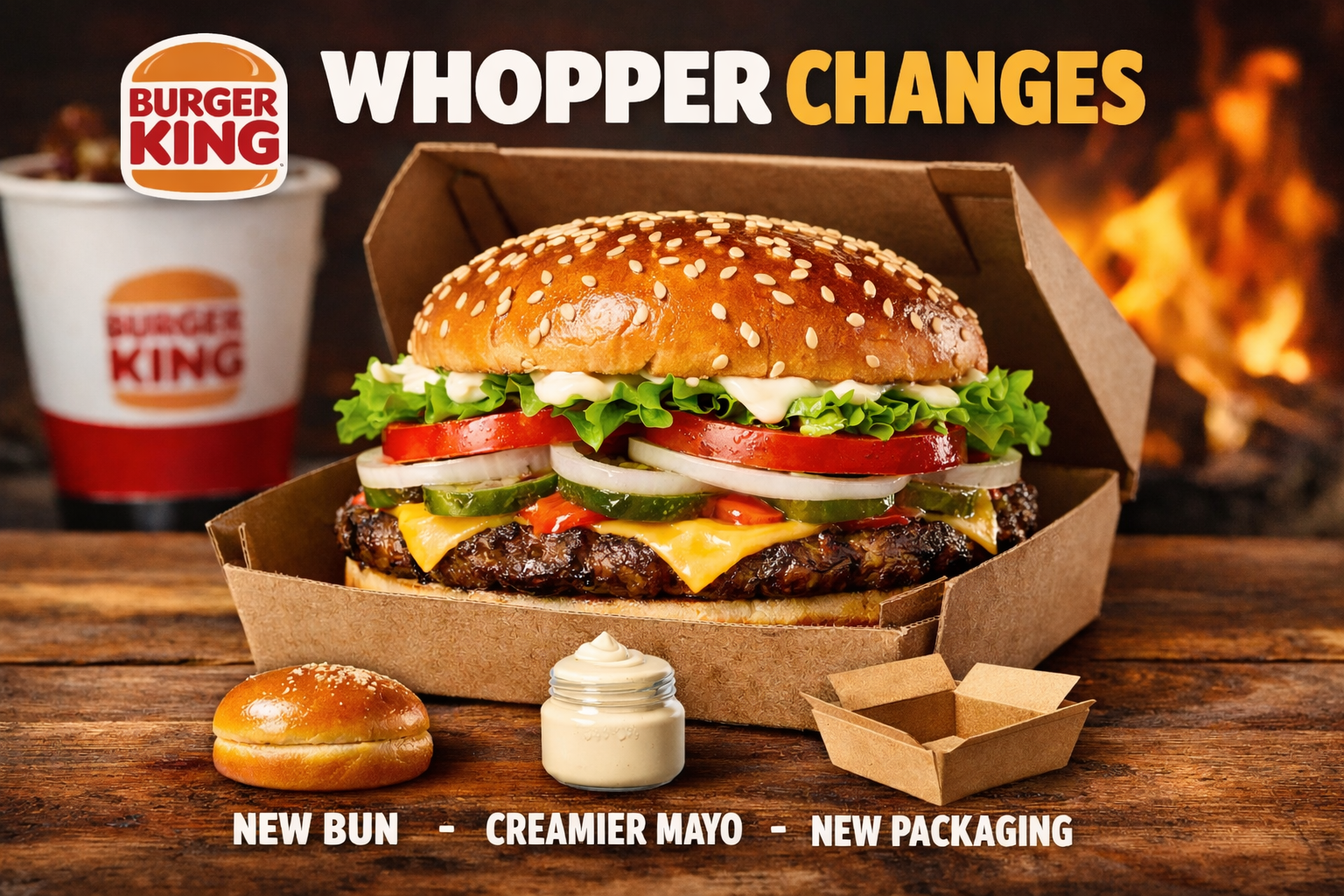
If you order a Whopper in the coming days and weeks, you might notice the difference before you take a bite. Burger King says it now uses a more “premium” bun, swaps in a “better tasting” mayonnaise, and puts the sandwich in a box to help it hold its shape from kitchen to car to couch.
What follows breaks down the changes, the business context behind them, and what customers should watch for as the rollout expands across restaurants.
The short version: three core Whopper changes
Burger King describes the update as a “higher-quality” Whopper experience built around three practical tweaks.
- Burger King uses a new, more premium bun.
- Burger King uses an upgraded, creamier mayonnaise.
- Burger King now packages the Whopper in a box (a clamshell-style container in many reports) instead of a simple wrapper.
Burger King also highlights “freshly cut” onions and tomatoes and a tall, tidy build, even though the Whopper already includes those toppings in its classic lineup.
What exactly changed in the Whopper recipe
Burger King kept the Whopper’s identity intact on purpose. Company leadership says it didn’t aim to reinvent the sandwich, and it points to operational improvements over the last few years as the foundation that made a core-menu tweak feel less risky.
Instead, Burger King focused on the “bookends” of the eating experience: the bun, the sauce, and how the burger travels.
1) A “more premium” bun
Burger King says it upgraded the bun to taste better and feel more premium.
CNN’s reporting (carried by KESQ) adds detail on how Burger King and its test kitchen approached that change. The company reportedly coordinated with nearly a dozen bakeries, adjusted baking pan sizing to add lift, and added a glaze designed to improve appearance and help sesame seeds adhere.
From a customer standpoint, that combination aims at a practical outcome: a bun that resists sogginess and holds up when you drive home or order delivery. Food outlets that reviewed the update also describe the bun as more substantial and less prone to getting soft.
2) A creamier, upgraded mayonnaise
Burger King says the Whopper now includes “better tasting” mayo.
Reporting tied to CNN describes the change as a move toward a creamier, more premium mayonnaise, and it attributes the push in part to franchisee feedback.
The same reporting describes flavor goals that lean toward creamier notes with a hint of sweet and citrus. That detail matters because mayo changes can shift the overall profile more than people expect, even when the rest of the build stays the same.
3) New packaging: a box to prevent “smushed” burgers
Packaging sits at the center of the update, because it targets the most common complaint Burger King cites: customers receiving Whoppers that flatten and fall apart.
Burger King says it now serves the Whopper in a box so the burger reaches guests “exactly the way it left the kitchen.”
Nation’s Restaurant News frames the box as a functional upgrade that helps with heat retention from kitchen to customer.
CNN’s reporting adds that the team tested packaging approaches for months and landed on a clamshell box to keep the burger intact while retaining warmth (including a better chance of a “melty cheese experience” when customers add cheese).
“Freshly cut” toppings and a more consistent build
Burger King highlights “freshly cut” onions and tomatoes and a “stacked tall” presentation as part of the elevated experience.
A key nuance: the Whopper already includes onions, tomatoes, lettuce, pickles, ketchup, and mayo in its classic build, so the company’s emphasis points more to prep standards and portioning than to new ingredients.
In other words, Burger King seems to chase consistency: cleaner cuts, more uniform topping amounts, and a burger that looks like the menu photo more often. Packaging supports that goal, but training and execution at the restaurant level still drive the real outcome.
What stayed the same (and what Burger King avoided changing)
Burger King repeatedly signals what it did not change, likely because iconic menu changes can trigger backlash when customers feel a brand “messed with” a favorite.
Burger King says the Whopper still uses more than a quarter-pound of flame-grilled beef (based on pre-cooked patty weight).
CNN’s reporting also says Burger King kept the beef patty the same while it adjusted bun, mayo, and packaging.
Burger King also continues to position the Whopper as customizable, and its broader “Whopper by You” platform (which invites fan-created variations) still runs alongside the classic sandwich.
A note on the “no artificial colors, flavors, and preservatives” claim
Some coverage on February 26, 2026 repeated that the Whopper remains “free of artificial colors, flavors and preservatives.”
However, PR Newswire later posted a correction stating it removed that sentence from the release text.
Because Burger King revised the wording publicly, readers should treat that claim as unsettled until Burger King publishes a clear, current ingredients statement for the updated build in each market.
When and where customers will see the new Whopper
Burger King announced the update on February 26, 2026, and CNN’s reporting (via KESQ) says the revamped Whopper rolls out across more than 7,000 restaurants nationwide “this week.”
Burger King’s own newsroom post invites “guests nationwide” to try it.
In practice, customers should expect some variation during the transition period, since supply chains and restaurant inventory can phase in changes at different speeds even under a “nationwide” rollout.
Why Burger King made these changes now
Burger King ties the Whopper refresh directly to guest feedback. The company launched a high-profile initiative on February 17, 2026 that invites customers to call or text Burger King U.S. & Canada President Tom Curtis with feedback, and Burger King says it uses that input to guide decisions across the business.
CNN’s reporting describes years of complaints about smashed burgers and messy builds as a direct driver of the packaging and bun focus.
Industry context matters too. Nation’s Restaurant News points to Burger King’s longer-running turnaround effort (“Reclaim the Flame”) and references a $700 million investment aimed at operations, restaurant modernization, and marketing. That kind of foundational work can make a “signature item” update feel less like a gamble because execution improves first.
The economics: franchise costs and pricing pressure
Even “small” ingredient upgrades can carry real cost, especially at scale.
CNN’s reporting says the enhanced Whopper will cost franchisees about $4,000 more per year, and it says Burger King advised owners not to raise prices for inflation-weary consumers.
That dynamic creates a familiar tension in fast food: corporate leadership wants a quality signal that drives traffic, while franchise operators watch food, labor, and packaging costs closely. The same report quotes a Technomic researcher describing how tough it can feel to absorb extra spending when other costs already climb.
If Burger King holds pricing steady, it likely hopes the change lifts frequency and improves customer sentiment enough to offset higher unit costs.
What customers might notice: taste, texture, and travel
Many customers will pick up on the packaging first. A box changes how the burger arrives, how it steams, and how it looks when you open it.
From there, the bun and mayo do the sensory work. Reviews and early taste impressions suggest the bun feels sturdier and less soggy, and the mayo tastes “higher quality,” though most writers describe the change as subtle rather than dramatic.
Customers who love the current Whopper usually worry about one thing: a new sauce flavor can shift the signature profile. Since reports describe the mayo as creamier with a slightly sweet/citrus direction, some longtime fans may love the freshness while others may prefer the older taste.
One more practical point: a box can retain heat, and retained heat can soften buns and lettuce if the burger sits too long. Burger King appears to chase a balance: it wants the burger to stay intact without turning the toppings limp. That outcome will vary by location, drive-thru speed, and how long the burger sits before you eat it.
How this fits into Burger King’s broader menu strategy
Burger King has leaned into guest-driven menu marketing recently, especially through “Whopper by You,” which turns fan-submitted ideas into limited-time builds.
The February 17 phone-number campaign reinforces that positioning: Burger King wants customers to believe feedback shapes real decisions, not just social content.
CNN’s reporting suggests Burger King already hears patterns beyond the Whopper, including feedback about fries, which hints that the company might pursue more core-item refinement if this Whopper update lands well.
What to watch next
A signature-item tweak often serves as a test of trust. If customers accept the updated Whopper (or barely notice it), Burger King gains room to refine other staples. If customers push back, Burger King may limit changes to packaging and consistency rather than flavor.
Here are the clearest markers to track over the next few months:
- Customer reaction to the mayo flavor change (especially among frequent Whopper buyers)
- Whether Burger King holds prices steady as it suggested to franchisees
- Whether stores execute the “freshly cut” and portion-consistency promise reliably
- Whether Burger King expands “elevations” to other core items after the Whopper
FAQ: Burger King Whopper changes (2026)
Did Burger King change the Whopper recipe?
Burger King describes the update as refinements to the bun and mayonnaise, plus new packaging.
What changed on the Whopper?
Burger King says it upgraded the bun, the mayo, and the packaging (now a box). It also highlights freshly cut onions and tomatoes and a tall build.
Did Burger King change the Whopper patty?
Reports say Burger King kept the beef patty the same and focused on bun, mayo, and packaging.
When will the new Whopper arrive everywhere?
CNN’s reporting says Burger King will roll out the revamped Whopper across its 7,000+ restaurants nationwide this week (as of February 26, 2026).
Will the Whopper cost more now?
CNN’s reporting says Burger King advised franchisees not to raise prices, even though the enhancements increase costs for operators. Actual pricing can still vary by location.
Bottom line
Burger King’s Whopper changes focus on experience and consistency: a sturdier bun, creamier mayo, and packaging that keeps the burger intact.
The move also doubles as a brand statement. Burger King wants customers to connect feedback with visible action, and it has paired the Whopper refresh with a direct-outreach campaign that invites guests to contact the company’s president.
If the updated Whopper delivers what Burger King promises—less mess, better structure, and a slightly upgraded taste—Burger King could use it as a template for improving other core items without triggering the backlash that bigger recipe changes often bring.