
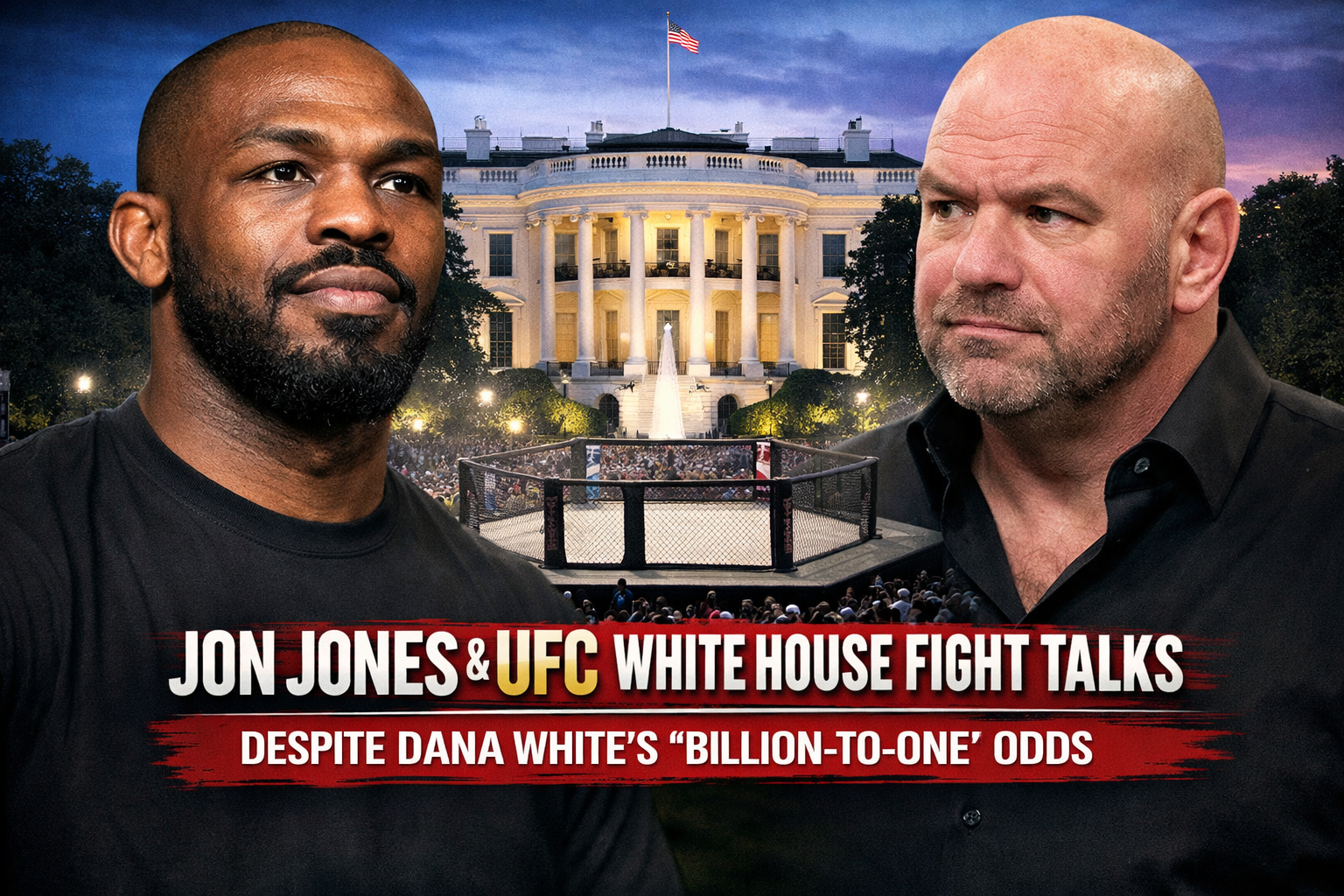
Jon Jones says he still has a path to the UFC’s planned White House mega-event, even after Dana White publicly dismissed the idea of booking him with a blunt “billion-to-one” line. The contrast between Jones’ optimism and White’s skepticism has turned a one-off promotional concept into an ongoing storyline: Can the most decorated fighter of his era land a slot on the most unconventional stage the UFC has ever pursued?
For Jones, the appeal looks obvious. He has built his brand on legacy, spectacle, and high-stakes moments. A White House card would offer all three—plus a rare chance to attach his name to an event that would live in UFC history regardless of results. For the UFC, Jones brings name value that few fighters can match. But White’s comments underline the other side of the equation: the promotion wants reliability, clean logistics, and predictable professionalism when it tries something this complicated.
The result: negotiations that sound real, public messaging that sounds icy, and a fan base trying to figure out whether this becomes a historic comeback or a familiar bout of “almost.”
What Jon Jones Said About the White House Fight
Jones recently told fans he remains in discussions with the UFC about competing on the White House card, framing the opportunity as something bigger than a typical booking. He emphasized national pride and the desire to represent “one more time,” while stopping short of confirming an opponent or a final agreement.
That update matters because it shifts the conversation from pure wish-casting to something closer to an active negotiation. In fight promotion terms, “talks” can mean anything from preliminary feelers to real contract language. Still, Jones chose to speak as if he expects a genuine chance—an approach that often signals he thinks the door remains open, even if it only sits ajar.
Why Dana White Said “A Billion to One”
White’s “billion-to-one” quote did not come out as playful hype. He framed it as a trust issue and pointed to Jones’ history of disruptions that can derail main events and force late changes. White also stressed that he had not been communicating with Jones in a way that suggested imminent planning at the time of his remarks.
Promoters almost never want to build a complicated tentpole event around an athlete they worry might not reach fight week smoothly. White’s public posture suggests he views the White House card as a brand-and-logistics project first, and a typical pay-per-view card second. From that perspective, reliability becomes a feature, not just a preference.
The White House Event: What the UFC Wants to Build
The UFC has described the White House concept as a rare “one-of-one” production rather than a standard arena show. Planning details have evolved since early discussions, and reporting around the event has pointed to a date change from initial July 4 framing to a later schedule. ESPN has described a plan for a limited fight card on the South Lawn, with a major broadcast distribution strategy and unusually constrained live attendance compared with normal UFC numbered events.
That structure alone helps explain why Jones’ candidacy triggers debate. A typical UFC numbered card can absorb turbulence because the promotion can reshuffle fights, lean on a deep undercard, and rely on standard venue operations. A White House event would run on tighter margins—fewer bouts, more restrictions, heavier coordination, and far less room to improvise.
Why Jones Still Thinks He Fits the Moment
Jones has never positioned himself as “just another contender.” Even when he talks about opponents, he tends to talk about narratives—greatness, legacy, and the kind of stage that turns a fight into a cultural moment. From that vantage point, a White House card aligns perfectly with how he sells himself.
He also has a practical case. If the UFC wants star power, Jones still sits near the top of the list, even as new champions reshape divisions. He remains one of the few MMA athletes casual sports fans recognize immediately. If the promotion wants mainstream attention beyond the core MMA audience, Jones offers a familiar headline.
But Jones also faces real questions that go beyond the usual competitive debates: timing, health, and how much he can commit to a full camp and a clean run-up to the event.
The Competitive Complication: Divisions, Opponents, and Timing
Fans often jump to a simple conclusion—“Book Jones in a blockbuster and move on.” The UFC rarely works that way, especially around title pictures.
If Jones fights, the promotion has to decide what the bout represents:
A championship fight would require a clear contender and a champion—or an interim structure the UFC can justify.
A non-title superfight would require the right opponent with enough credibility to make the matchup feel worthy of the setting.
A legacy showcase would require an opponent who sells the event but does not derail other divisional plans.
Each option has ripple effects. A Jones fight can’t just fill a slot; it can shift divisional direction for months.
Alex Pereira, Heavyweight Speculation, and the Superfight Magnet
Speculation around Jones often circles back to Alex Pereira because the matchup offers an easy pitch: two stars, two striking styles, two brands, one unusual stage.
Recent movement in Pereira’s situation has only added fuel to that talk. Any time a champion vacates a belt or signals a weight move, the UFC gains flexibility to reimagine matchups. Pereira also carries a rare selling point: fans already view him as an event fighter, not just a divisional player.
That said, the UFC still has to manage credibility. A White House headliner will attract mainstream attention, and mainstream attention tends to scrutinize matchmaking more than hardcore fans expect. If the UFC chooses spectacle, it will still need sporting logic that a casual viewer can understand in one sentence.
The UFC’s Risk Calculation: Star Power vs. Certainty
From a business standpoint, Jones represents upside and volatility at the same time.
The upside: He can headline anywhere, he can drive conversation without a fight announcement, and he can elevate a card that might already carry historic novelty.
The volatility: White has repeatedly signaled he worries about dependability. That concern grows when the event itself involves unique operational constraints.
This dynamic also explains why Jones’ public confidence matters. Fighters often talk themselves into negotiations as a pressure strategy. If Jones can keep the public conversation loud enough, he can raise the cost of excluding him—especially if the UFC wants maximum attention.
But the UFC will still prioritize execution. If the promotion believes it can sell the White House card through novelty, broadcast reach, and a stacked but smaller lineup, it may decide it doesn’t need Jones’ risk profile.
Logistics Make Everything Harder Than a Normal PPV
A typical UFC event revolves around an arena built for sports television, with controlled entry, standardized security procedures, established locker room areas, and production routines the UFC can replicate city to city.
A White House event flips that. It forces the UFC to adapt to the venue rather than tailor the venue to the UFC. It also narrows flexibility around everything fans rarely think about: staging, lighting, camera placement, credentialing, crowd management, and emergency planning.
That environment rewards fighters who bring minimal uncertainty. Even if a fighter never causes trouble, any promoter will prefer the simplest variable set possible for a once-in-a-generation production.
How a Smaller Card Changes Matchmaking Strategy
If the event truly runs with fewer fights than a standard numbered card, every matchup has to do more work. The UFC can’t hide a lukewarm bout on the prelims. Every fight has to feel intentional and meaningful.
That reality could help Jones, because the UFC might decide it needs maximum star density in a short format. But it can also hurt Jones, because the promotion might prefer athletes it can plug into clear title narratives, without debate about readiness and reliability.
In other words, a smaller card raises the value of stars—but it also raises the cost of uncertainty.
The Public Reaction: Excitement, Criticism, and the UFC Brand
A White House UFC card will draw a wide range of reactions.
Some fans will treat it as a once-in-a-lifetime sports spectacle.
Others will criticize the symbolism of mixing combat sports and government imagery.
Many will simply want the best possible fights, regardless of venue.
Jones sits at the center of that cultural push-pull because he represents the UFC’s biggest “legacy” name of the modern era. If the UFC includes him, it signals a “biggest possible moment” approach. If the UFC excludes him, it signals a “cleanest possible execution” approach.
What to Watch Next
Several practical signals will tell fans whether Jones’ talks have real traction:
Specific opponent chatter from credible reporters, not just fighter callouts.
Any hint from White that he has reopened direct communication with Jones.
Evidence that Jones has committed to a full camp timeline aligned with the event date.
How the UFC structures the heavyweight picture in the months leading up to the show.
Jones can say he’s negotiating—and he may mean it—but the UFC will decide based on planning realities, not just star appeal.
FAQs
Is Jon Jones officially booked for the UFC White House card?
No. Jones has said he’s negotiating, but no official booking has confirmed his participation.
Why did Dana White dismiss Jones’ chances so strongly?
White framed his view around trust and reliability concerns, describing extremely long odds for putting Jones on that specific event.
When will the UFC announce the White House fight lineup?
The UFC has shared planning updates, but it has not locked in a full public lineup yet. The promotion has indicated it will build the card on its usual matchmaking timeline while it finalizes logistics.
Bottom Line
Jon Jones has not given up on fighting at the UFC’s White House event, and his own comments suggest he believes negotiations have substance. Dana White’s earlier “billion-to-one” dismissal, however, shows the UFC still weighs risk and logistics as heavily as star power.
Until the UFC names opponents and dates with full clarity, Jones’ White House fight will remain exactly what it looks like today: a real conversation, a real negotiation—and an outcome no one should treat as guaranteed.