
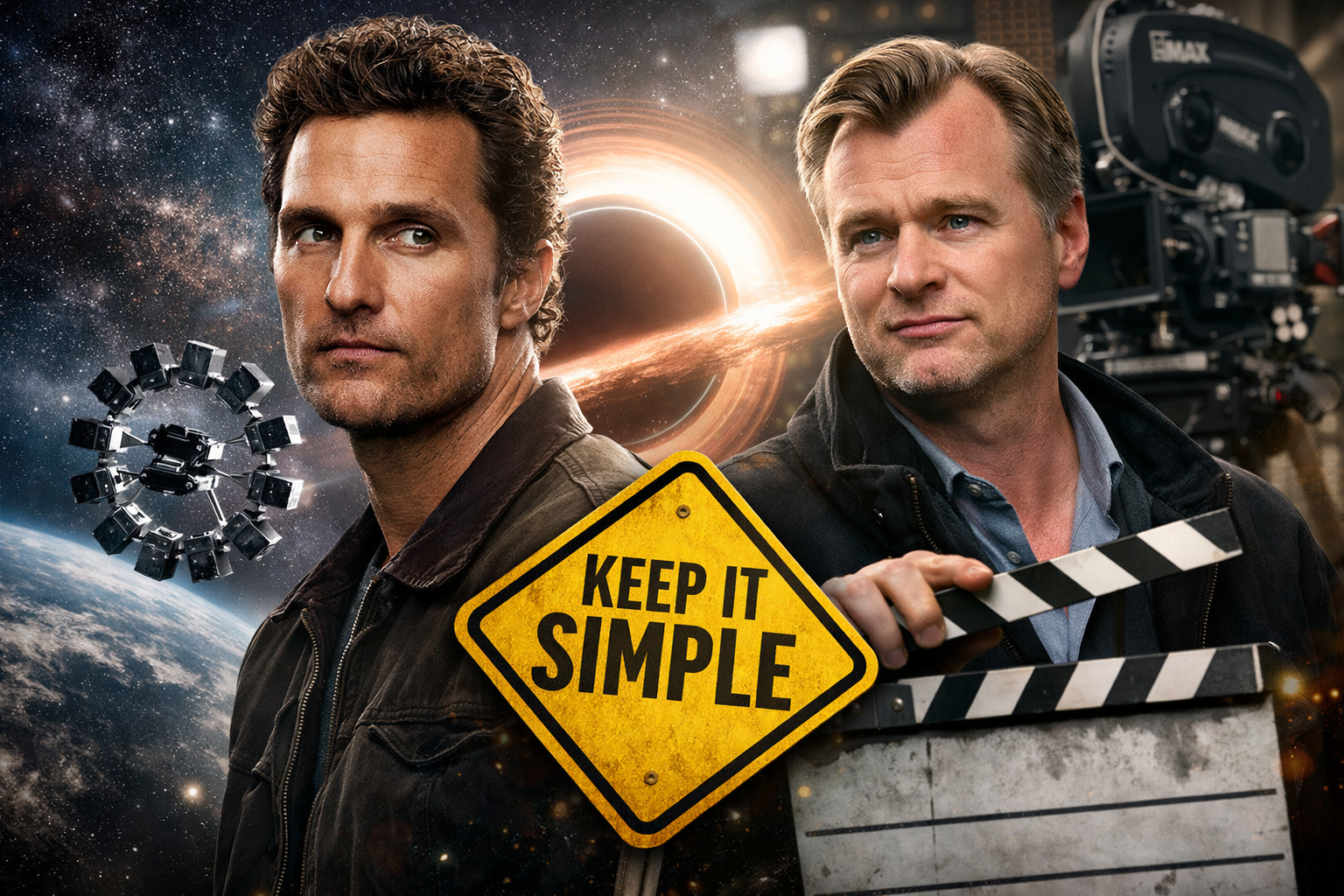
When Matthew McConaughey thinks back on making Interstellar, the “rule” he highlights that stands out most is neither a science fiction insight nor an acting trick: it’s that Christopher Nolan “will not make something simple complicated.” You’ll take heavy duty gear and billing blocks into production, but you mustn’t burden the production with complication unless it’s earned.
In highlights, it sounds simple enough, but in major movies it’s astoundingly easy to break the protocols of simplicity. Complex blockbusters are made in the name of “coverage,” and “options,” or “production value”—while Nolan’s reputation accrues partly around his skepticism of complexity for its own sake.
In the moment that cemented it for McConaughey, time travel is an active character, time behaves differently depending on where characters are within the science fiction world. McConaughey talked about going to Nolan and asking about the “rules of this world,” and how sometimes the director would have an answer on the spot, and sometimes, he’d make it clear he wasn’t sure yet. Then he’d report back once he had an answer that “would make sense.” And that’s the point: simplicity isn’t a deft evasion of work, it’s a resolution to be clear. If the world has rules, the director has to know them well enough to explain them, enforce them, and shoot them without turning every scene into a debate.
In that same reminiscence, McConaughey noted a more practical aspect of Nolan’s motto from the set: “Even with a blockbuster checkbook, he would not complicate a shot with a bunch of gear if we could get the image we needed physically. There are scenes where I appear to be weightlessly floating above the surface of Saturn, and this was done with just me on a gimbal as opposed to outrageously expensive cranes and other gear. And the way Chris framed it was effective and efficient.”
Why “don’t make something simple complicated” on a film set
The film set is essentially a factory for transmuting time into usable takes. Complexity creates friction. More prep time, more points of failure, more resets, more waiting. Nolan’s rule is a good one because it’s there to keep the day running and keep the set being a production set, not a production meeting.
It saves performance
The actor performs for a moment, not a rig. A set that promises elaborate engineering effort and then isn’t alert can leave actors drained before the camera even rolls; or, at best, spent trying to hold the subtleties in readiness in the “B roll” that sooner or later disappears. A back-to-basics human approach in the production mimics a steadier rhythm—the marks are clearer, the gags easier, the passages because the scene is or just in bad cheer with less fallible devices to withstand without something cool in that just right, prep-storied, flash-in-the-pan Chem.
It prevents “process” from becoming the thing
Big productions can fall into a trap of sidling up next to process, which becomes something good in itself. But we’re not in a lab. Nature’s paths aren’t designed or even planned for. The weather won’t hang for changes in the sky and the human cloud shining on them in a too-perfect scenario. A “keep it simple” mindset leaves more room to adapt when reality doesn’t cooperate.
It keeps money aligned with what audiences actually see
Budgets are priorities in numeric form. If money and time are spent on complexity that doesn’t change what the audience feels, something else pays the price—often the schedule, which is the most unforgiving resource on any production.
Simplicity as a leadership style
McConaughey’s memory that Nolan would return days later with a better answer hints at another side of the rule: it’s also about communication. On many sets, confusion becomes “normal.” A performer asks a question and gets a half-answer because the day is moving too fast. Departments work from different assumptions and discover the mismatch only when the shot fails. Everyone compensates by adding more meetings, more checklists, more layers of sign-off—more complexity on top of complexity. A director who insists on clear rules and clean solutions is often doing something quietly radical: reducing ambiguity. When the frame is clear—what the scene is, what the camera needs, what the world’s logic allows—departments can align without endless negotiation. That alignment is what keeps a big machine from grinding.
How Nolan’s broader reputation fits the rule
McConaughey’s description lines up with Nolan’s own public comments about why he prefers capturing as much as possible in-camera. In a widely cited interview, Nolan argued that CGI can feel “safe,” and that images created with something physically real on camera—even if achieved through traditional effects—can have more “bite” and impact. Not anti-digital, but hierarchy. Practical and photographic first, digital is only to augment or polish what’s wrung from the camera. The coverage on the craft of Inception describes how much of the production was about physical set pieces and in-camera work, describing VFX as used to build on top of that, rather than replacing it. Across Nolan’s work the principle is revisited in how he handles big sequences. In The Dark Knight, for instance, so many of the making-of the film are about what if he didn’t avoid CGI unless necessary – he preferred a real stunt like the 18 wheel truck flip rather than constructing the whole moment digitally.
Whether or not you love every twist or story beat Nolan makes, you can see the through-line; treat camera like a witness, treat the simple pieces of that event – gravity, light, impact, spatial logic – as if they feel reliable so that when story swims deeper, it’s not a surprise where it takes you.
Simplicity of method versus complexity of meaning
Part of the reason this rule sticks out is that, being such an ambitious storyteller, Nolan’s films are hardly “simple,” even in concept. Interstellar mixes grief and family intimacy with ideas about time and space and survival across vast distances. Strutcturally, sure, his films are packed tight, but the working method McConaughey describes is about keeping the simple parts simple.
That’s important.
Simplicity isn’t the absence of ambition. It’s a stripping away of unnecessary obstacles so the ambitious parts can take root. If the rules of the world are clear, the audience can stay with the story as the ideas get big. And if the rules of the shot are clear—real light real objects real reference points—then the images can feel grounded even while the scenario gets extraordinary.
There’s a difference between “complicated” and “complex.” Complex work can be necessary—multiple story threads, technical choreography, logistics. Complicated work is just what happens when the solution is bigger than the problem. Nolan’s rule, as McConaughey frames it, is a kind of filter: keep the complexity that serves the story, cut the complication that serves the ego.
Why McConaughey says he wouldn’t break it
For an actor a director’s rule becomes an ecosystem. In a complicated ecoystem the actors burn extra energy navigating the machinery—technical resets shifting plans long pauses—instead of living inside the scene. In a clear ecosystem the work is more direct—understand the stakes trust the framework commit.
This is especially salient in Interstellar where emotional credibility is doing heavy lifting. It is a film asking families (and viewers) to accept quite a lot—extreme time dilation enormous cosmic distances—but the scenes still have to feel like something we recognize as human decision. If the actor’s process on set becomes a maze it’s hard to stay connected to the core.
McConaughey’s specific memory that Nolan would take time to think through the all the questions but take time to come back with an answer implies another subtler notion as well: simplicity doesn’t have to mean fast. It often means taking the extra time early—on logic, on clarity, on decisions—so you don’t spend triple the time later fixing avoidable confusion.
What the rule looks like from an actor’s point of view
From the outside, Nolan’s “keep it simple” philosophy can sound like a technical preference. For actors, it often shows up as fewer mixed messages.
When productions overcomplicate solutions, performers feel it as uncertainty. Blocking changes because the rig changes. A scene’s rhythm collapses into long resets. Emotional beats get postponed because the shot becomes a “technical” shot. Over time, that pushes attention away from character and toward logistics.
A director who keeps the method straightforward can keep performance as the center of gravity. The actor’s questions—about the rules of the world, the purpose of a scene, the logic behind a choice—have a better chance of getting a clear answer because the day isn’t constantly fighting its own complexity. McConaughey’s memory that Nolan would think through a question and return later with an explanation that made sense is a clean example of that kind of leadership: protect the story’s logic so the actor can protect the moment.
Why audiences respond to it, even if they can’t name it
Most viewers don’t praise “workflow,” but they do notice results: scenes that feel present, images that feel weighty, action that has consequences. Simple, practical solutions help because the camera records real light, real motion, real space. Even when you’re doing work digitally, the likelihood is high that it reads differently when you’re extending something you already believe in rather than replacing it outright. That’s the tacit law behind the rule McConaughey won’t break: it’s not just a guideline for how to run a set. It’s a guideline for guarding the audience’s belief.
Lessons filmmakers and actors can take from the Nolan rule
The “simple, not complicated” principle scales down as well as up. Whether you’re making short films, internet content, or bigger productions, the same pressure rears its head: the struggle to add wrappers around things to feel more professional. A few ideas:
Define the rules early
If your story has a concept or a tone with boundaries, write those down in simple language. Do test scenes against those rules. If that scene only works when the rules are broken, that’s a signal to rethink the scene.
Ask one question before adding complexity: what changes on screen?
You’ve got to be able to see it in order to feel it. If the audience wouldn’t notice the difference, you’re probably making it more complicated for the wrong reason.
Use tech meaningfully
Digital tools are powerful, but you get the most out of them when they’re solving a discrete problem—not the entire foundation. When you watch practical effects work in Interstellar (Nolan’s 2014 sci-fi epic, also starring McConaughey), what you’re seeing is a carefully engineered choice on the part of people who clearly understand how heavy their story is going to feel onscreen. Jennings.
Protect the emotional temperature
If setting up a certain setup takes half a day and that scene relies on something really fragile emotionally, this is one of those times it makes sense to let the shot be simpler so you can get more of them while the feeling is still alive.
Keep departments aligned on the “why”
Most arguments on set are about arguments within a department. If everybody on-set agrees what purpose a shot serves—what it needs to communicate—then a certain level of simplicity in execution is easier to defend and aim for.
Where the rule can go awry
“Keep it simple,” can sound like “cut back, do less,” and in practice that results in needing more preparation. The reason that the simple solution actually works is that somebody has done enough thinking that they can trust it. The best practical effects work is the best because it’s thoroughly pre-engineered. They made it look easy, but it’s hardly “winging it.” It definitely isn’t “winging it;” more like “don’t bole-variance inflate the solution”.
Interstellar as proof of concept
Interstellar is a useful case study because the film pairs blockbuster scale with an emotional core. The film is a 2014 sci-fi epic directed by Nolan and starring McConaughey, and it’s frequently noted for successfully interspersing spectacular large-scale filmmaking with practical and miniature effects as well as digital work. That combination—big ideas held down by a grounded method—echoes the rule with which McConaughey abides. If your goal is to get the audience to follow you into something scrabbling and vast, there’s nothing like the reassurance of an image that feels like it’s standing on solid ground.
The bottom line
McConaughey’s Nolan rule—don’t make something simple complicated—sounds almost stupid in the best way, at first, kind of like how all rehearsal sounds so stupid until you do it. But on a set where every added layer you put on top of that simple thing could mean wasting days of time, focus and momentum, it starts to feel like a boundary worth guarding.