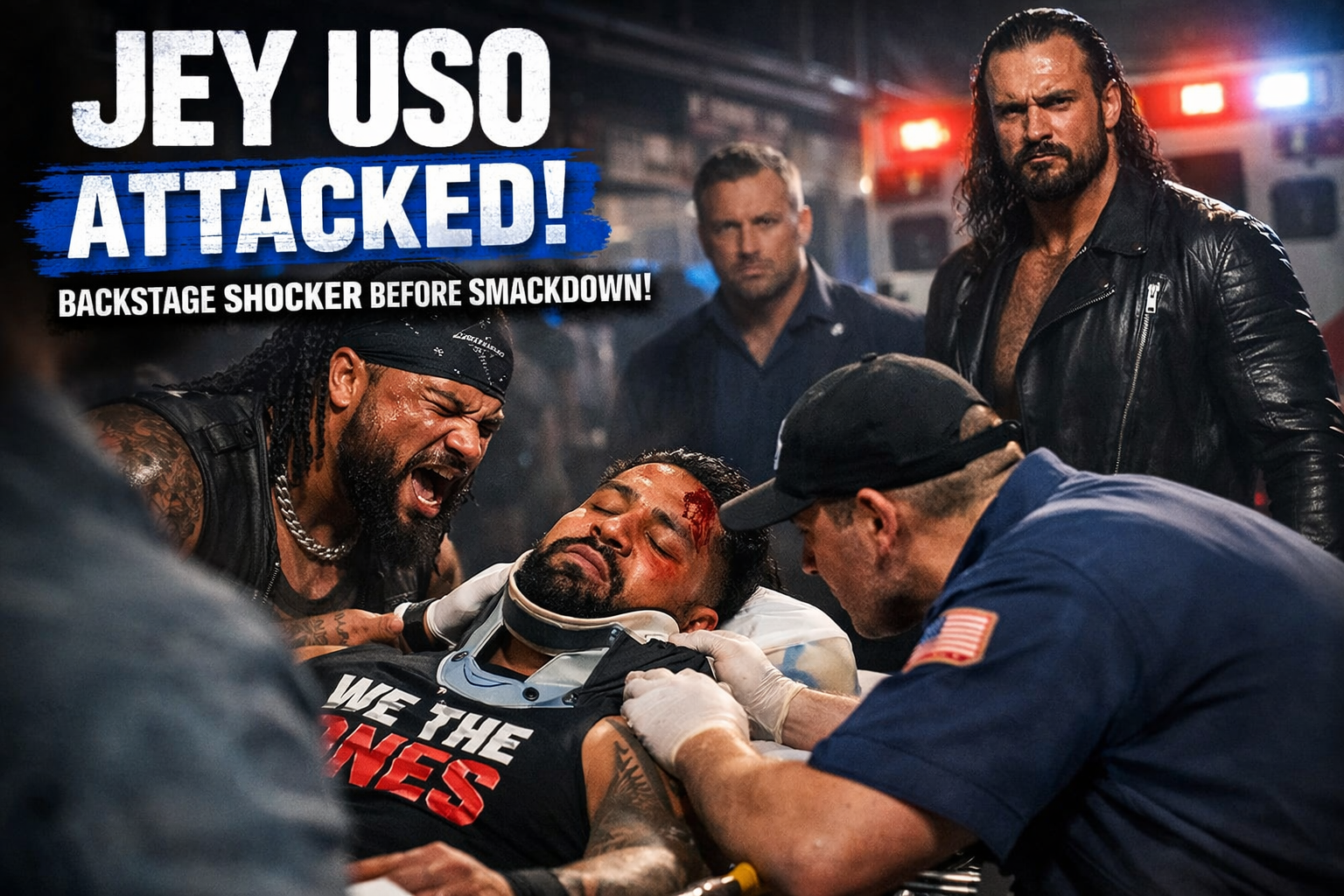
WWE kicked off its Feb. 27, 2026 episode of Friday Night SmackDown with a sudden curveball: an unknown attacker targeted “Main Event” Jey Uso backstage before the broadcast, creating immediate uncertainty around his status one night ahead of Elimination Chamber 2026. WWE’s own coverage framed the incident as a developing situation that put Jey’s Chamber participation in doubt.
Because WWE often blends reality and storyline, fans immediately debated two questions at once: Who attacked Jey Uso? and Will Jey still compete inside the Elimination Chamber? WWE hasn’t named a culprit, and the company has kept the details intentionally limited so the angle can drive the next beat of the Road to WrestleMania.
Below is a full breakdown of what happened, what SmackDown showed on-screen, how this affects the Chamber match, and the most likely directions WWE can take next—without pretending we already know an answer the show hasn’t revealed.
What happened backstage before SmackDown went on the air
In the hours leading into SmackDown, WWE pushed “breaking news”-style messaging across social media and coverage outlets. WWE’s messaging emphasized the chaos backstage and the involvement of medical personnel, while also noting that early reports remained unconfirmed as the story unfolded.
That framing matters. WWE rarely uses that specific “breaking” presentation unless it wants viewers to treat the moment as urgent and must-see. It also lets WWE build suspense without showing the attacker on camera, which keeps the mystery alive for future episodes and premium live events.
Even if you read it strictly as storyline, the timing still stands out. SmackDown served as the go-home show for Elimination Chamber, and Jey entered the weekend as one of the six confirmed Chamber participants. An attack angle on the final show before a major PLE usually signals one of two things: a last-second replacement twist, or a storyline hook that follows someone into the cage with an injury disadvantage.
How SmackDown presented the attack on TV
SmackDown didn’t treat this like a throwaway social clip. The broadcast leaned into the drama right away with backstage footage of Jey’s aftermath and a scramble of officials and wrestlers trying to make sense of what happened.
Multiple recaps described the same core beats: Jey left on a stretcher into an ambulance, and Jacob Fatu rode with him while demanding answers from SmackDown authority figure Nick Aldis.
WWE also connected the angle directly to the top of the card. Drew McIntyre, presented as the Undisputed WWE Champion, appeared in the early portion of the show and drew heat while denying involvement. The broadcast then pivoted into an escalating confrontation among major names positioned around the Chamber and WrestleMania season, with tensions rising across multiple rivalries.
In other words, WWE didn’t isolate the attack as a side story. The show used it as an engine to spike conflict across the main event scene.
Why the attack matters right now: Elimination Chamber stakes
WWE has already locked in the men’s Elimination Chamber field: Randy Orton, Cody Rhodes, Je’Von Evans, Trick Williams, Jey Uso, and LA Knight. WWE also clearly laid out the prize: the winner earns the right to challenge Drew McIntyre at WrestleMania.
That stakes structure makes Jey’s status a major plot point, not a minor injury tease. If Jey can’t compete, WWE has to make a choice that affects the WrestleMania main-event pipeline:
- Insert a replacement and reshape the match’s rhythm and finish.
- Keep Jey in the match but tell an “entering hurt” story that adds drama and sympathy.
- Turn the attack into a clue-driven mystery that points directly to the Chamber winner or McIntyre himself.
The Chamber match also thrives on momentum. WWE typically uses the go-home SmackDown and Raw episodes to position one or two wrestlers as the “hot hand.” An attack angle can instantly change that calculus by shifting attention, creating a revenge motive, or forcing a last-minute underdog into the field.
What WWE could do next: the most likely storyline directions
WWE has several well-worn—but still effective—paths for a mystery attack angle, especially this close to a premium live event.
1) A replacement enters the Chamber at the last possible moment
This is the cleanest option if WWE wants a shock pop and a new layer of unpredictability. A replacement also gives WWE an easy explanation for why someone suddenly appears in a match with huge WrestleMania implications.
If WWE chooses this route, expect one of these patterns:
- Nick Aldis (or another authority figure) announces medical clearance issues.
- A top heel gloats about “taking someone out” without fully confessing.
- WWE unveils the replacement late in the show or at the start of the PLE to maximize suspense.
2) Jey competes anyway, but WWE tells a “wounded warrior” Chamber story
The Chamber structure supports this perfectly. Wrestlers can sell injuries, get isolated in a pod, or take long stretches without action while other competitors fight.
If WWE keeps Jey in the match, the attack becomes a storytelling tool:
- The announcers can question his conditioning and durability.
- Rivals can target him as the “easy elimination.”
- Jey can rally late for a heroic comeback spot even if he doesn’t win.
This option also protects Jey’s aura. WWE can let him look tough without needing to give him the WrestleMania shot.
3) The attacker ties directly to Drew McIntyre’s WrestleMania defense
Since the Chamber winner challenges McIntyre, WWE can use the attack to frame McIntyre’s reign as paranoid, calculating, or outright ruthless.
Even if McIntyre denies involvement, WWE can still plant seeds:
- McIntyre benefits the most if a dangerous competitor misses the match.
- McIntyre can manipulate others into fighting each other.
- McIntyre can later reveal he orchestrated it “for WrestleMania insurance.”
This direction keeps the champion central, which WWE often prefers during the final stretch before WrestleMania season locks in.
4) The attack sets up a separate Jey Uso feud that runs parallel to the Chamber story
WWE sometimes uses the Chamber field as a staging ground while also building non-Chamber feuds. If WWE pulls Jey out, it can pivot him into a revenge program that peaks at WrestleMania or a post-Chamber television main event.
That lets WWE do two things at once:
- Preserve the Chamber finish WWE already planned.
- Give Jey a personal storyline that doesn’t require winning the Chamber.
Who might have targeted Jey Uso? The suspects that make sense (and the ones that don’t)
Right now, WWE hasn’t confirmed a culprit, so anything beyond what the show revealed counts as speculation. Still, WWE storytelling usually points toward a shortlist of logical suspects.
Drew McIntyre: the obvious beneficiary
Even without a confession, McIntyre gains the most from chaos among Chamber competitors. If Jey misses the match, the path to WrestleMania can become more favorable for whoever WWE already positioned as McIntyre’s preferred opponent.
WWE also leaned into denial and confrontation early in the show, which often signals that creative wants viewers to keep McIntyre in mind.
A rival within the Chamber field: sabotage for a WrestleMania ticket
The Chamber prize creates motive for everyone involved. A competitor can remove a threat without needing to out-wrestle them inside the structure. WWE loves that kind of “win before the bell” psychology, especially for characters who lean opportunistic.
A separate faction or ally storyline: Jacob Fatu, Bloodline ties, or collateral damage
The angle included Jacob Fatu reacting strongly and demanding answers. That can go multiple ways:
- Fatu serves as the loyal family member who drives the investigation.
- WWE uses the family presence as misdirection.
- WWE uses the aftermath to spark friction, blame, or a surprise heel turn.
The “mystery attacker” wildcard
WWE also leans on masked or unseen attackers when it wants flexibility. This lets the company decide the reveal later, based on crowd reactions, injury status, or last-minute creative changes.
That doesn’t guarantee a debut or return, but WWE often uses this structure when it wants options.
Storyline vs. real injury: why WWE angles feel “real” on purpose
WWE has a long history of presenting kayfabe injuries with “official” language, medical personnel visuals, and urgent social media updates. It’s not a mistake; it’s part of the presentation. The company wants the moment to feel consequential even when the audience understands wrestling is scripted entertainment.
Right now, WWE has not publicly identified the attacker or provided a clear medical diagnosis in the reporting around this segment. Outlets have largely treated it as a developing storyline that directly impacts the Chamber match rather than a confirmed legitimate injury situation.
The timing: WWE chose the go-home SmackDown for maximum impact
This episode already had a built-in hook: the six men scheduled for the Chamber match had been advertised to appear together on SmackDown, one night before the PLE.
When WWE stacks a show like that, it usually wants a strong “last image” before a premium live event. A backstage attack accomplishes that in a single move:
- It creates urgency.
- It gives commentators instant stakes to talk about.
- It drives social chatter and clip sharing.
- It makes the PLE feel less predictable.
From a purely promotional standpoint, it’s a classic wrestling tactic: raise the temperature right before the cage lowers.
What to watch for next
If you want to track where WWE plans to take this, watch for these signals:
- A medical update: WWE may mention “cleared,” “not cleared,” or “evaluation” language.
- Camera placement: If WWE shows security footage, locker room reactions, or a suspicious exit, it usually narrows suspects.
- Authority figure decisions: Nick Aldis announcing a replacement would confirm the “out of the match” direction.
- Chamber match structure: If Jey competes, WWE may place him in an early pod entry or give him a protected elimination to keep him strong.
Bottom line
Someone attacked Jey Uso backstage before the Feb. 27, 2026 episode of SmackDown, and WWE framed the incident as a major development that could change the men’s Elimination Chamber match.
Until WWE reveals the attacker (or announces Jey’s final status for the PLE), the best read is simple: WWE designed this angle to inject uncertainty into a match that decides who challenges Drew McIntyre at WrestleMania.
Sources: WWE; Fightful.