
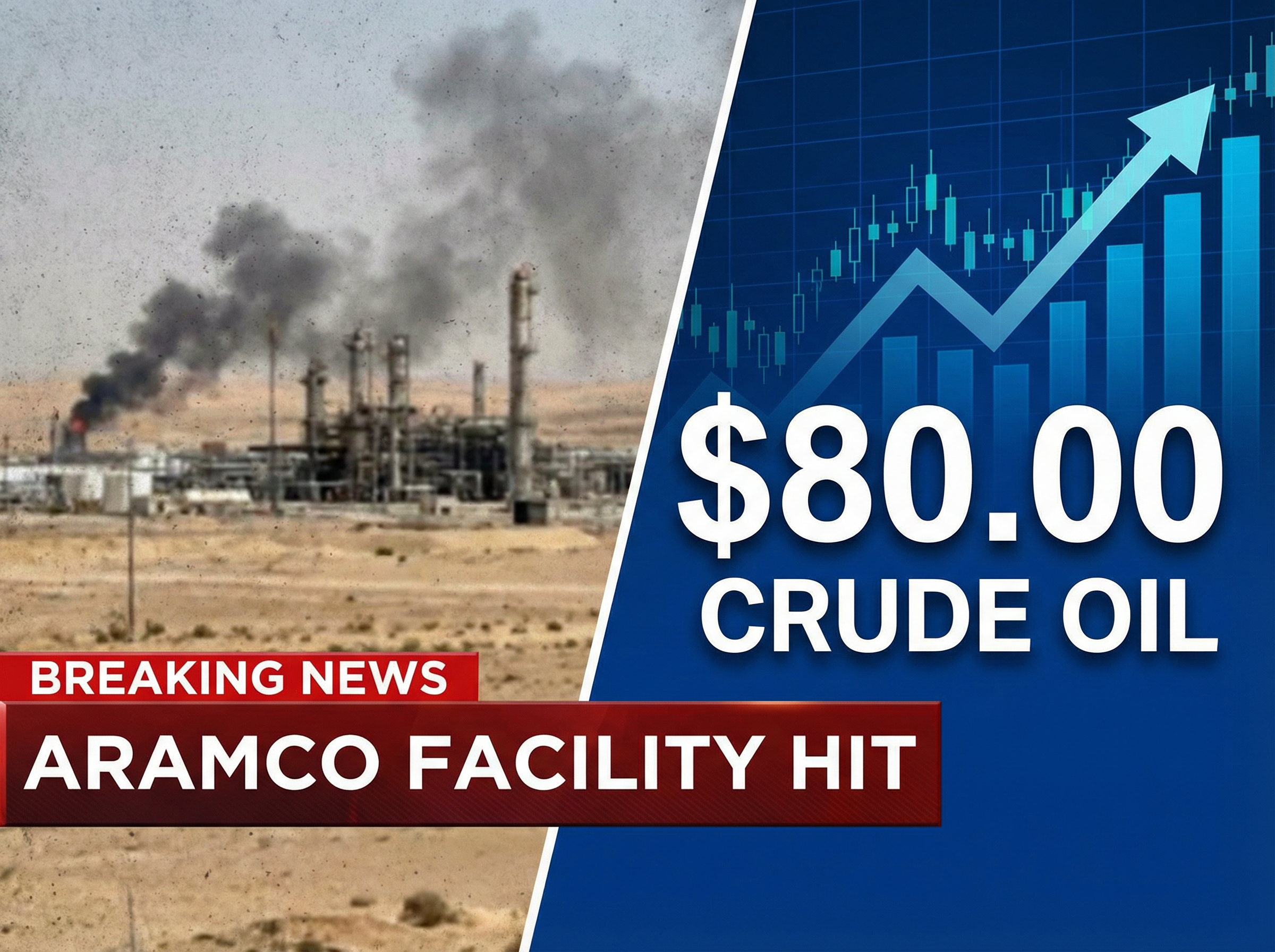
Oil markets reacted to the report that Saudi Aramco’s Ras Tanura complex was attacked, thereby requiring a shutdown of one of the world’s largest energy centers, by rapidly rising to higher prices. Oil markets react this way when there is a credible possibility of a reduction in supply. Brent crude traded approximately $80/Barrel, and briefly moved above this price point.
For both consumers, businesses, and governments, “oil at $80” is significant, because it can create ripples through gasoline and diesel prices, airfare, shipping costs, and inflation expectations. For the market, the return of the so-called “risk premium,” or the factor that prices in the possibility of an adverse occurrence (other than an absolute supply shortage) in addition to the current supply and demand fundamentals, is a signal that oil prices are not simply reacting to day-to-day supply and demand fundamentals, but to the potential for something worse to occur.
Below is a description of what we currently know regarding the attack on the Ras Tanura complex, why an oil price of $80 seems plausible (and in certain trading environments already realized), and the key factors that will determine whether oil continues to climb, or begins to fall.
What was hit at Saudi Aramco, and why is Ras Tanura so Important?
While Ras Tanura is simply another refinery, it is a major refining and export terminal located along Saudi Arabia’s Gulf Coast. Sources, who are reportedly knowledgeable about the situation, reported that a drone strike caused Aramco to temporarily suspend operation at its Ras Tanura refinery, which has an operational capacity of approximately 550,000 bbl/day, while Aramco evaluates the extent of the damage. Local reports indicated that there were initial reports of a minor fire and a temporary suspension, and that the local supply of fuels appeared unaffected at that time.
Even when the damage is minor, a shutdown at a location such as Ras Tanura will get the attention of the market due to three basic reasons.
First, the scale of the refinery is large enough to make a difference
A refinery of that size is a significant portion of regional supplies, particularly of refined products such as diesel, jet fuel, and gasoline.
Second, Ras Tanura is very closely associated with exports
Therefore, when exporters experience uncertainty related to their terminals, it can lead to delayed loadings, increased insurance premiums, and complications with regards to scheduling for buyers throughout Asia and Europe.
Third, it reinforces the trader’s fear
It reinforces the trader’s fear, which has been developing over the past several days, that the conflict could grow from targeting military assets, to targeting energy infrastructure across the entire region.
Why Did Oil Prices Move Upward So Rapidly Toward $80
As stated earlier, oil prices don’t require an actual supply shortage to move upward; all that is required is a credible threat of a future supply shortage.
During early trading, following the escalation, Brent crude surged, reaching price levels above $80 per Barrel, while U.S. crude also rose, prior to retreating as the market attempted to assess the nature of the temporary versus permanent impacts.
There are two complementary factors driving this rapid movement upward in prices.
Risk Premiums are Being Repriced Regarding Energy Infrastructure Risk
When a critical facility is damaged, traders typically broaden the range of “acceptable outcomes.” Although the immediate damage may be contained, the next attack may not be, and the market begins to price in that risk.
Additionally, as previously stated, refined products can move more rapidly upward than crude, during events such as these, because refineries and terminals are chokepoints. If they are unavailable, the consequences can manifest themselves rapidly in the downstream product markets, regardless of whether the underlying crude production is interrupted immediately.
The Strait of Hormuz is the Larger Lever
Although Ras Tanura is an important facility, the Strait of Hormuz is the global pressure valve.
The Strait of Hormuz is a narrow waterway connecting the Persian Gulf to the open ocean. As of 2024, the average daily flow of oil through the Strait of Hormuz was approximately 20 million barrels per day, representing approximately 20% of the global petroleum liquids consumption, as reported by the United States Energy Information Administration (EIA).
Therefore, whenever shipping risk increases within this waterway, oil prices can jump, even though producers continue to possess oil in inventory, and refineries continue to have excess capacity. If tankers slow down, or divert to avoid the Strait of Hormuz, the effective supply of oil to the global market decreases. This decrease can appear rapidly, as buyers and traders are reluctant to wait to discover how severe the disruptions will be; instead, they choose to hedge against the potential losses.
Why Is $80 Per Barrel a Psychological Line
Oil prices are influenced by a combination of mathematics, and non-mathematical influences, including narratives, thresholds, and positioning.
$80 Per Barrel is a threshold value for oil prices, as it represents a headline number that has the power to influence consumer expectations. Many businesses develop budgeting assumptions, fuel surcharge assumptions, and forecasting assumptions based upon rounding values (i.e., $80).
$80 Per Barrel can also influence inflation discussions. Energy costs are a component of the cost of transporting goods, of providing food logistics, and of manufacturing processes. Central banks observe these secondary effects.
Finally, $80 Per Barrel can influence the behavior of oil producers. As prices rise, producers may feel less pressure to relax production constraints quickly; conversely, the higher prices provide greater scrutiny on spare capacity and export reliability.
In summary, $80 Per Barrel does not necessarily represent a crisis; however, it does represent a market perception that the risks to the oil supply chain are serious enough to warrant paying a premium for supply security.
How High Could Oil Go From Here
Markets are now attempting to anticipate scenarios, rather than certainties.
A useful method of evaluating the price trajectory is to divide the possible outcomes into three categories: a base case, a disruption case, and an escalation case.
Base Case: Elevated But Range-Bound
In a base case, the market expects the repair work to be completed rapidly, and that no additional facilities will be damaged; moreover, the market expects Hormuz traffic to be restricted, but not completely blocked. Under these conditions, the oil price may be able to stabilize in the vicinity of $80 Per Barrel, because although the risk will remain elevated, the physical supply of oil should continue to flow.
This type of scenario is typical in periods of geopolitical tension; prices may spike and volatility increases; subsequently, the market stabilizes in a new range until additional information becomes available.
Disruption Case: Longer Duration Impact to Shipping Through the Strait of Hormuz
If tanker traffic through Hormuz significantly slows for more than a few days, the impact will compound.
Cargo schedules will begin to slip. Inventory levels will decline. Refiners will bid more aggressively for barrels that will arrive on schedule. Shipping insurance and freight rates will increase, thereby raising the delivered cost of crude.
Due to the importance of the Strait of Hormuz as a global conduit, a material reduction in shipping traffic will result in higher Brent prices, and periodic spikes in prices.
Escalation Case: Multiple Strikes on Energy Infrastructure, or Major Outage
The larger price upside risk is repeated attacks on energy infrastructure, or an attack that results in a prolonged outage at a major facility.
This scenario results in traders discussing prices in the range of $90-$100 Per Barrel, since the market is beginning to price-in not only the risk, but the actual barrels that will be lost and cannot be quickly replaced.
Can the World Bypass Hormuz if Necessary
Partially.
Saudi Arabia and the United Arab Emirates have pipeline systems that allow them to transport some volumes without using tankers to pass through the Strait of Hormuz. However, the unused bypass capacity is relatively small compared to normal flows. A Reuters article, referencing EIA estimates, states that the unused bypass capacity of the Saudi and UAE pipelines that could be used to bypass Hormuz, is estimated to be approximately 2.6 million barrels per day.
While this is meaningful, it is nowhere near sufficient to replace the amount of oil that passes through the Strait of Hormuz each day. Thus, even with alternative routing, a protracted disruption in Hormuz traffic will result in higher global prices.
What Can OPEC+ Do, and Why May it Not Calm Markets Quickly
OPEC+ still matters, but in this type of shock, the routes for exporting oil can be more important than OPEC+’s announced production targets.
OPEC+, in April, agreed to a 206,000 barrels-per-day production increase. Analysts have stated that this agreement does little to alleviate the market’s primary concerns: the length of shipping disruptions, and the duration of the conflict risks.
However, there are also practical limitations to consider.
Some OPEC+ member states are already producing at maximum capacity
Some OPEC+ member states are already producing at maximum capacity.
Regardless of the increase in production, the barrels must travel safely
Regardless of the increase in production, the barrels must travel safely, and via insurable routes, to reach their intended destinations.
Oil markets respond in real-time, while production changes take time
Oil markets respond in real-time, whereas, formal production changes take time to implement.
Thus, while OPEC+ policy can influence the medium-term pricing of oil, the short-term movements in oil prices are primarily influenced by logistical issues, security issues, and sentiment.
Which Groups Will Feel $80 Oil First
Not all groups feel the effects of higher crude prices equally, nor do they feel the effects of higher crude prices at the same time.
Drivers/Households
Retail fuel prices can rise quickly, especially when crude prices jump, and refiners experience higher costs. How quickly this occurs depends on local taxes, refinery capacity, and how much fuel is already stored in the distribution network.
Airlines/Shippers/Logistics
Jet fuel/diesel prices can move quickly in response to volatile market conditions. Airlines may impose, or increase, fuel surcharges, while shippers may adjust their rates if bunker fuel prices rise, and routes become longer, or riskier.
Manufacturers/Food Supply Chains
Energy is a cost embedded in many goods, including plastics, fertilizers, and refrigerated transportation. If crude prices remain elevated for more than a week, rather than just a few days, those costs will begin to manifest themselves in various forms.
Governments/Central Banks
When energy-based inflationary pressures rise, they can make it more difficult for central banks to set interest rate policy. Even if the current inflationary pressures are temporary, policymakers must consider the secondary effects, particularly if households and businesses begin to expect higher prices to remain persistent.
What to Watch Next
The next few days are likely to be far more influential than the next few months, as markets will be assessing the trajectory of risk.
There are four key indicators that tend to drive oil markets during times of this type:
Updates regarding the status of Aramco and Saudi Authority Statements
The single most influential indicator of the direction of oil prices will not be the fact of the damage, but the duration of any outage, and the impact of any damage on the export operations of the affected facility. Market participants will be looking for evidence that cargo loadings are continuing to slip.
Evidence of Additional Attacks on Energy Infrastructure
A single attack on a facility can be isolated. A series of attacks on similar types of facilities is a different story altogether. If additional attacks on high-value energy-related targets occur, the market will likely include a greater “risk premium.”
Behavior of Tankers and Insurance Companies
An attack that results in a suspension of operations at a facility such as Ras Tanura can be considered a “contained” event. An attack that results in a suspension of tanker traffic through the Strait of Hormuz is a different story altogether. If insurance companies raise rates dramatically, or if ship owners begin to cancel sailings, the practical consequence will be reduced shipping traffic, and therefore, higher delivered crude prices.
Policy Indicators Regarding Strategic Petroleum Reserves
Consuming countries can release strategic petroleum reserves in extreme cases. While releasing reserves may temporarily lower prices, it will depend on coordination, and scale.
Signals from OPEC+ Regarding Future Production Increases
While headlines regarding “additional production” may be positive, they will only be effective if the market believes the barrels can actually be transported to buyers. Market participants will be watching for any signals from producers indicating that they intend to accelerate supply additions, or to redirect exports.
End-Line
The fact that Saudi Aramco was attacked at Ras Tanura has reordered the priorities of the oil market. Regardless of the fact that the initial damage may be minimal, the attack has highlighted the vulnerabilities of critical energy infrastructure at a time when shipping risks are at a heightened level.
This is why an oil price of $80/barrel is not just a technical price move, but a reflection of the broader re-pricing of security, and logistical risks across the Gulf, given the fact that the Strait of Hormuz is the sole route through which approximately 25% of the world’s oil is transported.
Ultimately, whether oil prices stabilize at $80, drop, or move higher will depend on the duration of the disruption of key facilities, the safety of shipping through the Strait of Hormuz, and the extent of expansion of the conflict.
Sources: Reuters; United States Energy Information Administration (EIA).