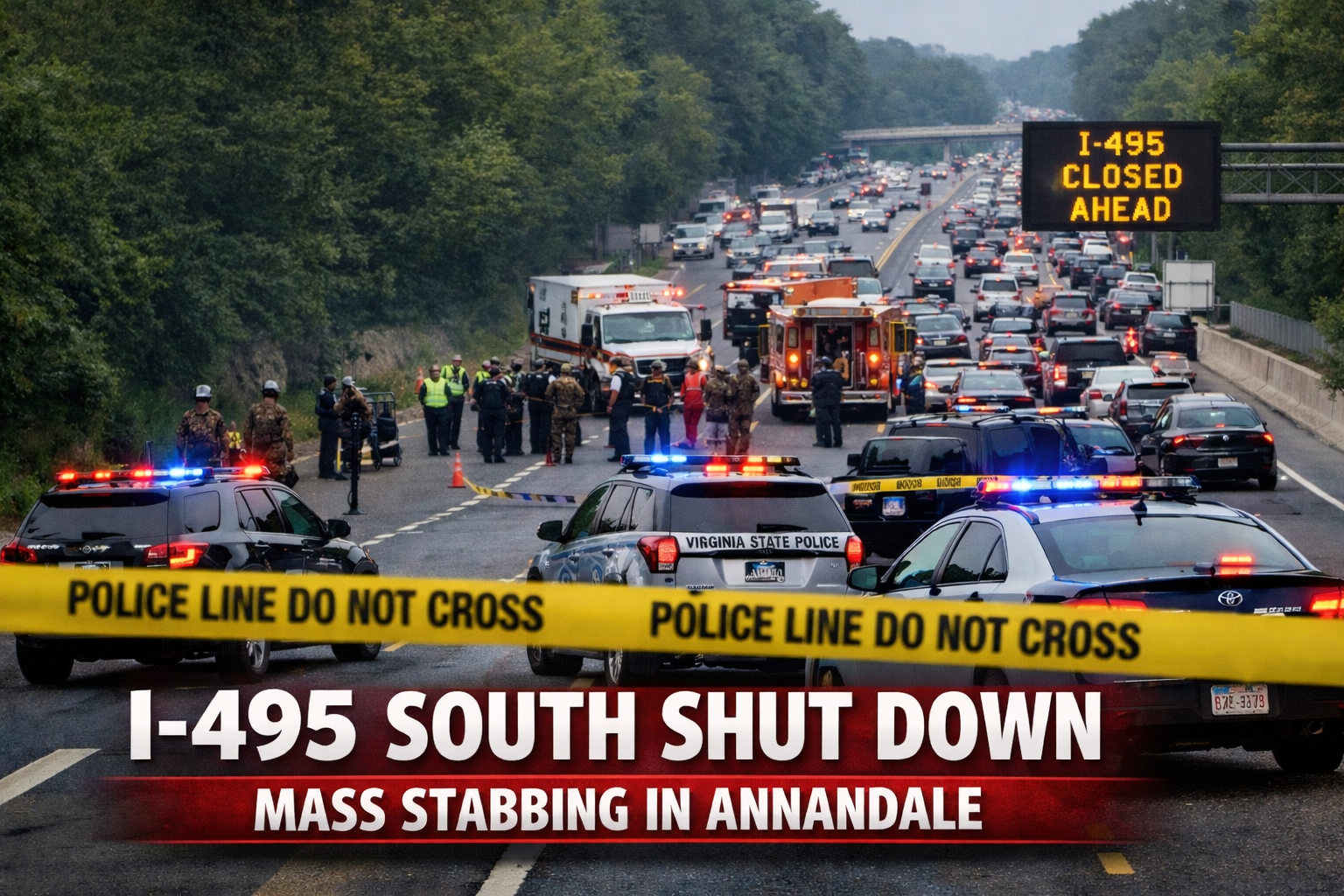
Traffic on I-495 into Annandale— the Capital Beltway’s Outer Loop— was stalled by police activity that centered around Gallows Road and Little River Turnpike Sunday afternoon. Early info linked the closure to a crash and stabbings on highway slamming cars to a halt on the busy thoroughfare. Drivers were diverted off the Beltway and into daytime delays that spread across much of Fairfax County.
The ongoing police work diverted vehicles not only from traveling south through Annandale, but also from leaving the Beltway toward Washington, D.C. or routing toward Arlington, Alexandria, and other points in Northern Virginia. As traffic investigators worked along the stretch, officials said details are limited and encouraged drivers to avoid the area while detours were in effect.
What Reportedly Happened on I-495 in Annandale, VA
In initial reports, authorities described the situation as police activity related to a crash and stabbing on the road. In the earliest hours after the shutdown, officials did not issue an arrangement of events and the public updates centered more on the roadway and detours. Early reports say a person may have stabbed multiple people before being shot himself by responding Virginia State Police. The time is placed close to 1:19 p.m., and the place just before the exit for Little River Turnpike on the southbound side of the Beltway. At this stage, law enforcement had not confirmed the number of injured people or their condition, or say if they knew each other or what—if any—connections they had before executive force was used.
Where the shutdown was
Travel alerts and local traffic reporting said the closure was near mile marker 51.6, between Gallows Road and Little River Turnpike/Route 236. That stretch of road, on a heavily trafficked part of the Beltway a commuter and regional thoroughfare meet, can fill in tight with a small disruption and cascade into interchanges and surface roads.
Most major incidents on I-495 are traffic crashes and disabled vehicles, but the stampede of a criminal investigation could manifest a long closure period. In reports of violence and a large footprint of emergency vehicles, authorities may take longer to go in, secure that scene, determine witnesses, and safeguard evidence in ways that can hold the lanes longer than the time it takes to clean a lane of a crash all one or several of the vehicles involved is moved off the roadway and the road parts let return to normal operations.
Traffic impact, detour
The shutdown drew things up quickly, making southbound I-495 a parking lot of stopped vehicles stacked in behind the closure. Reports indicated backs off into about four miles, indeed, detours where implemented and drivers advised to stay with alternate routes.
Traffic was brought off the Beltway at Exit 50A onto Route 29/Route 50, forcing motorists onto surface roads and other interstate connections. For those already waiting drivers, there was nothing to do: barriers and narrow shoulders limit getting turned around, and the safest choice is often to stay put in line and listen for traffic officers in the direction to take until detours were rolling.
Transportation cameras and road updates showed a near-total halt of movement in multiple lanes in that area. For many drivers, it was no longer a matter of a delay, but a matter of reprisal planning—changing interstates, leaving an hour or two later, or just staying out of that corridor until the scene cleared.
More than the bottleneck on the Beltway, closures like this often unwound to other interchanges, and spill onto local streets as drivers escape that delay. Sick cars build around the exit where interstate traffic has to suddenly meet traffic lights, shopping lanes and neighborhood roads. For motorists not using I-495 even, there were cars piling into neighborhood streets as close routes began to slow and GPS began routing all those cars onto the same second-tier streets.
For big truckers, a long Beltway stoppage deep into the heart of the holiday disrupts delivery, freight across the Motion Picture of the surrounded world. For families and tourists, it complicates vital trips to the hospital, sports venues, the airports for travel and return—and no telling how long in themselves to be off those detours and rapid plunges.
What they’ve said
This happened very early in the morning and there was no immediate official account in the early confused hours but all public reporting to date has been that this was an investigation and they would know more later as more data emerged. A representative of Virginia State Police said they were trying to gather information and piece this together before the fuller report would be ready. That lag from witnessed events to official confirmation is a common factor in fast-moving incidents. On a highway, responders seek to establish immediate safety—separating involved parties, seeing that medical aid is on the way, and preventing secondary crashes—before investigators can be expected to reliably re-create a narrative of events. If the incident was an officer-involved shooting, agencies also typically adhere to specific documentation and review steps, which delay release of details until the basics can be confirmed.
How highway investigations usually play out
When a serious incident occurs on an interstate—especially fiasco that involves both a collision and an allegation of violence—investigators frequently regard it as two closely related scenes: traffic, and a criminal investigation scene. That can mean photographing vehicle positions, noting road conditions, seizing video sources, and securing points of evidence before vehicles are moved and traffic resumes.
Witness identification is another major task. On I495, a crash or confrontation can erupt in seconds, but many motorists may have seen part of what transpired; investigators may seek drivers who braked, motorists with dashcam footage, and people who were just off either side of the incident at the time. They may collect information from traffic control systems, including roadway cameras and incident logs, and re-create a minute-by-minute timeline.
If a suspect is shot by law enforcement, additional review steps usually follow, typically focusing on the actions leading to force being used, whether any threats were immediate, and what officers on scene took action. Agencies also reviewed communications logs and recording from dispatch to better understand how the call was received, what information responders had as they arrived, and how quickly things escalated.
What they might not yet know
Despite the level of public attention, many foundational details were not confirmed early in the coverage, including:
How many were injured and their conditions
Whether it was one suspect or multiple people working together
What precipitated the confrontation after the reported crash
Whether any arrests took place or if charges are anticipated
Whether the lanes would open back up and when, and whether traffic patterns would continue to be affected.
Given that early alerts used the language “mass stabbing,” it is also worth noting that some agencies rely on that term in breaking situations to describe multiple who were victims before final victim totals have been confirmed by officials. Agencies try to avoid confirming totals of number of victims, and severity of injury, until investigators have reconciled information with hospitals.
In the first hour or hour and a half of a major incident, information from dispatch traffic, transportation alerts, and eyewitness accounts posted online can give a picture before a public briefing takes place. That can create a partly blended view of observations that are true, not true and incomplete. For readers and drivers, the safest course of action is to assume that early calls about what is happening (especially regarding motive, identity, and victims) are unofficial and fairly fluid until investigators confirm them.
“Mass stabbing” is also not a legal prescriptive. We usually report it that way in breaking news to indicate that more than one person may have been attacked, but agencies may later slightly rephrase once they have a clearer head count and know whether the reported injuries might also have other causes, or others that are unconfirmed.
Why this stretch of I-495 is so sensitive to disruption
The Capital Beltway is one of the region’s major arteries, and the Annandale area is important for people heading between Northern Virginia and the D.C. metro area. When a section of I-495 is shut down, even momentarily, that load is diverted to other busy areas, which then are so quickly overloaded that nearby exit ramps may operate over capacity. These also have a cascading effect on surface streets nearby.
The effects are sudden: missed shifts, delayed deliveries and appointments moved around. For some people, closings make reaching services nearby more difficult, because ambulances and police and other law enforcement often rely on the Beltway for faster movement across the county.
I-495 South Shut Down in Annandale as Police Respond to Stabbings
Traffic on I-495 into Annandale— the Capital Beltway’s Outer Loop— was stalled by police activity that centered around Gallows Road and Little River Turnpike Sunday afternoon. Early info linked the closure to a crash and stabbings on highway slamming cars to a halt on the busy thoroughfare. Drivers were diverted off the Beltway and into daytime delays that spread across much of Fairfax County.
The ongoing police work diverted vehicles not only from traveling south through Annandale, but also from leaving the Beltway toward Washington, D.C. or routing toward Arlington, Alexandria, and other points in Northern Virginia. As traffic investigators worked along the stretch, officials said details are limited and encouraged drivers to avoid the area while detours were in effect.
What Reportedly Happened on I-495 in Annandale, VA
In initial reports, authorities described the situation as police activity related to a crash and stabbing on the road. In the earliest hours after the shutdown, officials did not issue an arrangement of events and the public updates centered more on the roadway and detours. Early reports say a person may have stabbed multiple people before being shot himself by responding Virginia State Police. The time is placed close to 1:19 p.m., and the place just before the exit for Little River Turnpike on the southbound side of the Beltway. At this stage, law enforcement had not confirmed the number of injured people or their condition, or say if they knew each other or what—if any—connections they had before executive force was used.
Where the shutdown was
Travel alerts and local traffic reporting said the closure was near mile marker 51.6, between Gallows Road and Little River Turnpike/Route 236. That stretch of road, on a heavily trafficked part of the Beltway a commuter and regional thoroughfare meet, can fill in tight with a small disruption and cascade into interchanges and surface roads.
Most major incidents on I-495 are traffic crashes and disabled vehicles, but the stampede of a criminal investigation could manifest a long closure period. In reports of violence and a large footprint of emergency vehicles, authorities may take longer to go in, secure that scene, determine witnesses, and safeguard evidence in ways that can hold the lanes longer than the time it takes to clean a lane of a crash all one or several of the vehicles involved is moved off the roadway and the road parts let return to normal operations.
Traffic impact, detour
The shutdown drew things up quickly, making southbound I-495 a parking lot of stopped vehicles stacked in behind the closure. Reports indicated backs off into about four miles, indeed, detours where implemented and drivers advised to stay with alternate routes.
Traffic was brought off the Beltway at Exit 50A onto Route 29/Route 50, forcing motorists onto surface roads and other interstate connections. For those already waiting drivers, there was nothing to do: barriers and narrow shoulders limit getting turned around, and the safest choice is often to stay put in line and listen for traffic officers in the direction to take until detours were rolling.
Transportation cameras and road updates showed a near-total halt of movement in multiple lanes in that area. For many drivers, it was no longer a matter of a delay, but a matter of reprisal planning—changing interstates, leaving an hour or two later, or just staying out of that corridor until the scene cleared.
More than the bottleneck on the Beltway, closures like this often unwound to other interchanges, and spill onto local streets as drivers escape that delay. Sick cars build around the exit where interstate traffic has to suddenly meet traffic lights, shopping lanes and neighborhood roads. For motorists not using I-495 even, there were cars piling into neighborhood streets as close routes began to slow and GPS began routing all those cars onto the same second-tier streets.
For big truckers, a long Beltway stoppage deep into the heart of the holiday disrupts delivery, freight across the Motion Picture of the surrounded world. For families and tourists, it complicates vital trips to the hospital, sports venues, the airports for travel and return—and no telling how long in themselves to be off those detours and rapid plunges.
What they’ve said
This happened very early in the morning and there was no immediate official account in the early confused hours but all public reporting to date has been that this was an investigation and they would know more later as more data emerged. A representative of Virginia State Police said they were trying to gather information and piece this together before the fuller report would be ready. That lag from witnessed events to official confirmation is a common factor in fast-moving incidents. On a highway, responders seek to establish immediate safety—separating involved parties, seeing that medical aid is on the way, and preventing secondary crashes—before investigators can be expected to reliably re-create a narrative of events. If the incident was an officer-involved shooting, agencies also typically adhere to specific documentation and review steps, which delay release of details until the basics can be confirmed.
How highway investigations usually play out
When a serious incident occurs on an interstate—especially fiasco that involves both a collision and an allegation of violence—investigators frequently regard it as two closely related scenes: traffic, and a criminal investigation scene. That can mean photographing vehicle positions, noting road conditions, seizing video sources, and securing points of evidence before vehicles are moved and traffic resumes.
Witness identification is another major task. On I495, a crash or confrontation can erupt in seconds, but many motorists may have seen part of what transpired; investigators may seek drivers who braked, motorists with dashcam footage, and people who were just off either side of the incident at the time. They may collect information from traffic control systems, including roadway cameras and incident logs, and re-create a minute-by-minute timeline.
If a suspect is shot by law enforcement, additional review steps usually follow, typically focusing on the actions leading to force being used, whether any threats were immediate, and what officers on scene took action. Agencies also reviewed communications logs and recording from dispatch to better understand how the call was received, what information responders had as they arrived, and how quickly things escalated.
What they might not yet know
Despite the level of public attention, many foundational details were not confirmed early in the coverage, including:
How many were injured and their conditions
Whether it was one suspect or multiple people working together
What precipitated the confrontation after the reported crash
Whether any arrests took place or if charges are anticipated
Whether the lanes would open back up and when, and whether traffic patterns would continue to be affected.
Given that early alerts used the language “mass stabbing,” it is also worth noting that some agencies rely on that term in breaking situations to describe multiple who were victims before final victim totals have been confirmed by officials. Agencies try to avoid confirming totals of number of victims, and severity of injury, until investigators have reconciled information with hospitals.
In the first hour or hour and a half of a major incident, information from dispatch traffic, transportation alerts, and eyewitness accounts posted online can give a picture before a public briefing takes place. That can create a partly blended view of observations that are true, not true and incomplete. For readers and drivers, the safest course of action is to assume that early calls about what is happening (especially regarding motive, identity, and victims) are unofficial and fairly fluid until investigators confirm them.
“Mass stabbing” is also not a legal prescriptive. We usually report it that way in breaking news to indicate that more than one person may have been attacked, but agencies may later slightly rephrase once they have a clearer head count and know whether the reported injuries might also have other causes, or others that are unconfirmed.
Why this stretch of I-495 is so sensitive to disruption
The Capital Beltway is one of the region’s major arteries, and the Annandale area is important for people heading between Northern Virginia and the D.C. metro area. When a section of I-495 is shut down, even momentarily, that load is diverted to other busy areas, which then are so quickly overloaded that nearby exit ramps may operate over capacity. These also have a cascading effect on surface streets nearby.
The effects are sudden: missed shifts, delayed deliveries and appointments moved around. For some people, closings make reaching services nearby more difficult, because ambulances and police and other law enforcement often rely on the Beltway for faster movement across the county.