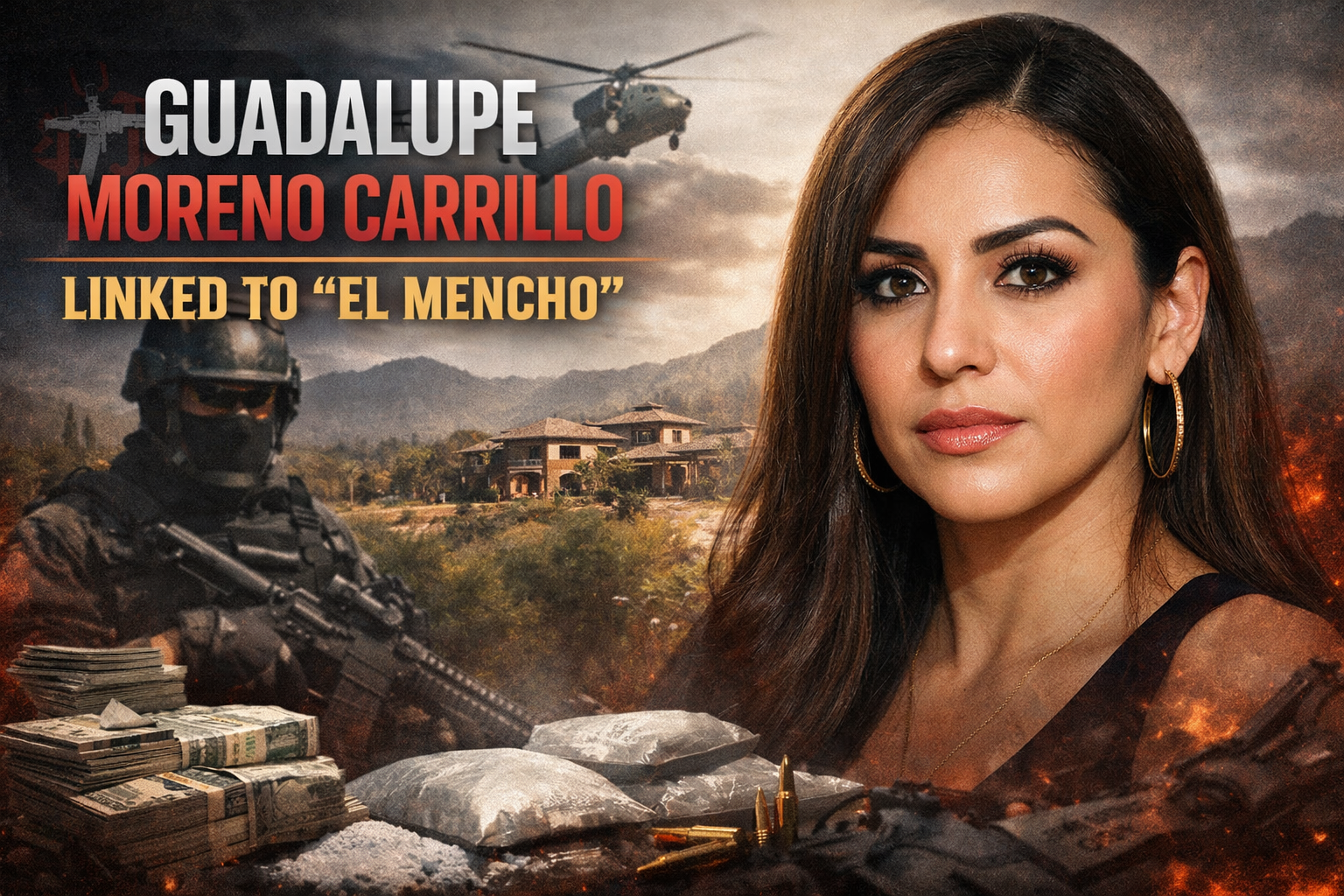
Guadalupe Moreno Carrillo became a widely searched name after Mexican authorities said a romantic partner of CJNG leader Nemesio Oseguera Cervantes (“El Mencho”) played a key role in the intelligence trail that led to the February 2026 operation in Tapalpa, Jalisco. In official public briefings, authorities described the partner but did not publicly name her. Mexican media outlets later identified that person as Guadalupe Moreno Carrillo, often citing prior military leaks and earlier reporting.
This article explains what major reporting says, what remains unconfirmed, and why the name matters in the wider story about CJNG, intelligence work, and public-interest reporting in Mexico. I will keep the focus on verified reporting and clear attribution.
Why her name resurfaced in 2026
Mexican officials said they tracked a trusted associate linked to one of Oseguera’s romantic partners on February 20. That lead pointed security forces to a site in Tapalpa, Jalisco. Officials said the partner later left, and intelligence confirmed Oseguera stayed there with bodyguards. Reuters reported this timeline from Mexican officials and noted that authorities did not name the partner in that public account.
El Financiero published a similar chronology based on statements by Defense Secretary Ricardo Trevilla Trejo. The outlet reported that Trevilla described military intelligence as the core source of the location data, while the United States provided “additional information.” It also repeated the Tapalpa timeline tied to one of Oseguera’s partners.
Reuters also reported that U.S. intelligence helped pinpoint the compound, while Mexican officials stressed that Mexican forces led the operation and that no U.S. forces took part directly. That distinction matters because it shapes how officials frame sovereignty, cooperation, and responsibility in a highly sensitive operation.
After the briefing, several Mexican outlets moved quickly to identify the unnamed partner as Guadalupe Moreno Carrillo. Reports in Excélsior and Infobae linked her name to prior military documents that surfaced through the Guacamaya leaks and said her public profile remains very limited.
What media reports say about Guadalupe Moreno Carrillo
Excélsior reported that leaked documents attributed to Mexico’s Defense Ministry identified Guadalupe Moreno Carrillo as a partner of Oseguera after the 2021 arrest of Rosalinda González Valencia. The outlet also said public information about Moreno Carrillo is scarce and that no confirmed public biography exists.
Infobae reported a similar account. It said a leaked Sedena document named Guadalupe Moreno Carrillo as Oseguera’s current partner at the time and placed her in a section labeled for regional coordinators and plaza bosses, while noting that public details about her life remain limited. Infobae framed that as suggestive, not definitive proof of a specific operational role.
That distinction is important. Media reports often repeat labels from intelligence files. Those labels can guide investigations, but they do not by themselves prove criminal conduct in court. Excélsior also noted that no public formal accusation had been detailed against her in the reporting it cited at that time.
Some outlets also reported that U.S. authorities had sanctioned Moreno Carrillo and described her as part of a support network for CJNG. A recent article snippet surfaced in search results through a Mexican outlet syndicating APRO/Proceso-style reporting, which cited a U.S. Treasury/OFAC action and described allegations of financial support. Because public coverage varies and full primary documents were not consistently linked in every article, readers should treat those details as attributed claims unless they verify the underlying Treasury records directly.
The Guacamaya leaks and why they matter here
The Guacamaya leaks sit at the center of this story. Reuters reported in 2022 that Mexico’s government confirmed a major cyberattack on Defense Ministry data and that local media had reported the hack exposed six terabytes of information, including data on criminal figures and communications. Reuters also noted that the president said the leaked material was genuine in that context.
That matters because many later media stories about cartel networks, military intelligence notes, and personal ties pulled details from those leaked records. In practical terms, the leaks expanded what journalists and the public could see, but they also created a new verification challenge. Reporters then had to sort confirmed records from interpretation, rumor, and recycled claims.
In the case of Guadalupe Moreno Carrillo, recent reports mostly tie her name to those leaked military documents, not to a public courtroom proceeding that spells out charges or evidence in detail. That does not make the reporting false. It does mean careful wording matters.
What officials confirmed, and what they did not
Officials publicly confirmed a key operational point: intelligence tied to one of Oseguera’s romantic partners helped authorities narrow down his location in Tapalpa. Reuters and Mexican outlets reported that point from official briefings.
Officials also described the broader sequence: surveillance, planning, deployment of mixed ground and air units, an armed confrontation, Oseguera’s injuries, and his death during aerial evacuation. Reuters and El Financiero both summarized this timeline from public statements.
However, the official Reuters-based timeline said the romantic partner remained unnamed in the briefing. The name “Guadalupe Moreno Carrillo” entered the mainstream cycle largely through media identification after the fact. That gap between official description and media naming explains why some reports sound more certain than others.
This gap also shapes legal and ethical risk. If a government spokesperson does not name a person, journalists usually rely on documents, prior reporting, and cross-confirmation. Strong reporting can still emerge that way, but readers should expect qualifiers until authorities publish formal records or court filings.
Why the story gained so much attention
The operation that killed Oseguera triggered a major national reaction. Reuters reported retaliatory roadblocks, arson attacks, and disruptions across multiple states after the raid. Reuters also reported that airlines canceled flights to Puerto Vallarta and that authorities later worked to stabilize the situation.
That scale made every detail of the operation headline news. Once officials mentioned a romantic partner as part of the intelligence path, audiences wanted a name. Newsrooms then searched older reporting, leaked documents, and prior investigations, which pushed Moreno Carrillo’s name into public view.
Reuters also described how the Tapalpa hideout became central to the final phase of the operation and noted that authorities were led there by a tip tied to Oseguera’s lover. That detail connected the tactical operation, the location, and the partner narrative in one story.
The limits of public knowledge
Right now, public reporting offers far less detail about Guadalupe Moreno Carrillo than it does about Oseguera, CJNG, or the Tapalpa operation itself. Multiple outlets say basic biographical data remains limited in public view. Those same reports rely heavily on leaked intelligence references and secondary reporting.
That creates a common problem in high-profile crime reporting. A person can become nationally visible overnight, while verified personal history remains thin. In those cases, speculation spreads fast, especially on social media and short-form video platforms. Responsible coverage should resist that drift.
It also helps to separate three things: intelligence labels, media allegations, and judicial findings. Those categories often overlap in public discussion, but they do not carry the same evidentiary weight. This distinction keeps the article accurate and fair.
The broader CJNG context
Reuters described Oseguera as the mastermind of CJNG and a major figure in cross-border drug trafficking, including fentanyl supply to the United States. Reuters also noted the long U.S. reward offer for information leading to his arrest. These facts explain why any person linked to his inner circle draws immediate attention from both Mexican and U.S. authorities.
Reuters also reported concern about possible cartel restructuring after Oseguera’s death. Security officials said they were monitoring possible successors and watching for further retaliation. In that environment, press attention often expands from the top leader to associates, financiers, family members, and alleged facilitators.
So even if public data on Moreno Carrillo remains limited, the strategic interest in her name follows a familiar pattern. Authorities and reporters focus on personal networks because cartel leadership often depends on trusted circles, logistics, and financial support systems.
How to read future reporting on this topic
Watch for primary documents. Court records, formal indictments, Treasury notices, and official statements usually add the most durable facts. Secondary articles often move faster, but they may compress uncertainty.
Watch the verbs. “Identified,” “linked,” “alleged,” and “charged” do not mean the same thing. Good reporting keeps those words separate. That helps readers avoid turning an intelligence reference into a legal conclusion.
Watch for sourcing chains. If several outlets repeat the same claim, they may still rely on one original source. That source might be strong, but repetition alone does not create new proof. The Guacamaya leak reporting around Moreno Carrillo shows this issue clearly.
Bottom line
Guadalupe Moreno Carrillo entered the spotlight because authorities said a romantic partner of El Mencho helped lead intelligence services to the Tapalpa location, and Mexican media later identified that partner by name. Current public reporting ties her name mainly to leaked military documents and media investigations, while official briefings reported by Reuters left the partner unnamed.
That means two things can be true at once. First, her name now matters in public reporting about the 2026 operation. Second, much of what people think they know about her still comes from attributed reporting, not fully detailed public judicial records. If you plan to publish on this topic, use careful language, cite your sources, and update the article as new primary documents appear.