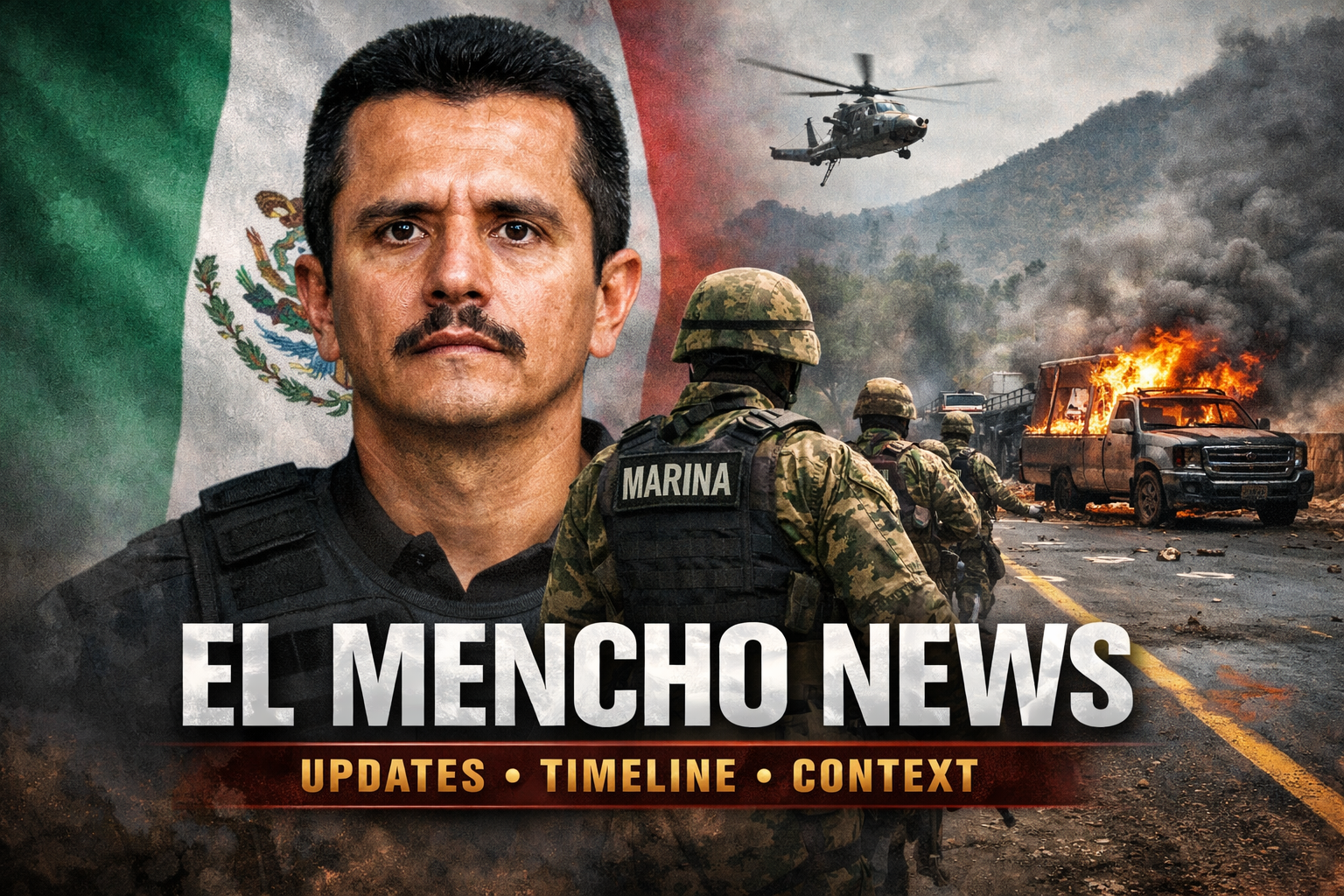
On February 22, 2026, multiple major news organizations reported that Nemesio Rubén Oseguera Cervantes (“El Mencho”), the longtime leader of Mexico’s Cártel Jalisco Nueva Generación (CJNG), was killed during a Mexican military operation in the state of Jalisco.
Because this is fast-moving, high-stakes breaking news, it’s important to separate (1) what reputable outlets say they’ve verified through officials, (2) what is still based on anonymous sourcing, and (3) what is circulating online without confirmation.
What follows is an unbiased, evidence-based overview of today’s reporting, why it matters, and what to watch next.
The headline development today: reports that El Mencho was killed in a military operation
Reuters reported that a government source familiar with the operation said El Mencho was killed in a military operation. Reuters also reported that the operation was linked to a federal security action in Tapalpa, Jalisco, and noted that Jalisco’s governor Pablo Lemus Navarro posted publicly about a federal operation there.
The Associated Press separately reported that a Mexican federal official, speaking anonymously because they were not authorized to speak publicly, said the Mexican army killed El Mencho in an operation in western Jalisco.
Several other international outlets echoed the same core claim (that he was killed), generally attributing it to government sources and/or Mexican media reporting.
What’s important about the sourcing
Even when top outlets agree, the details matter:
- Reuters’ central claim hinges on a government source familiar with the operation (not an on-record statement).
- AP’s central claim hinges on a federal official speaking anonymously.
- Reuters ties public acknowledgment to a governor’s post describing the operation, not necessarily a full federal briefing about El Mencho personally.
That combination can still be strong evidence, but it also explains why some observers will wait for a formal federal confirmation (for example, a defense ministry statement, a prosecutor’s briefing, identification details, or an official press conference).
Immediate aftermath: disruption, roadblocks, and travel impacts
Both Reuters and AP reported that the operation was followed by widespread disruption, including vehicles set on fire and highway blockades in parts of Jalisco and nearby states—tactics that are widely reported in Mexico as a way to impede security operations and create pressure.
One immediate international ripple effect came from aviation:
- Reuters reported that Air Canada temporarily suspended operations in Puerto Vallarta, citing an “ongoing security situation.”
AP also reported that the security situation included incidents that caused public alarm in the region, including at airports, during the same period.
If you’re reading this as a traveler or someone with family in the region, the practical takeaway is simple: rely on official travel advisories and local authorities, because conditions can change hour-to-hour during a major security operation and its aftermath.
Who El Mencho is, and why his reported death is globally significant
El Mencho has been widely described by U.S. authorities as a top fugitive and as the leader of CJNG, a group the U.S. government has linked to large-scale drug trafficking and violence.
A key point for understanding the scale: in a 2018 press release, the U.S. DEA described CJNG as having grown rapidly since 2009, expanding across Mexico and internationally, and said El Mencho was the lead defendant in a U.S. superseding indictment alleging “continuing criminal enterprise” and major drug-trafficking conspiracy activity.
In a later DEA statement (Dec. 4, 2024), the agency described El Mencho as one of its priority targets and noted that U.S. authorities were offering up to $15 million for information leading to his arrest and/or conviction.
Regardless of what one thinks about cartel policy, that “most wanted” status is not symbolic: it reflects a view within law enforcement that El Mencho and CJNG sit near the very top of the contemporary organized-crime landscape affecting Mexico, the United States, and parts of Latin America.
Understanding CJNG’s position in Mexico’s criminal landscape
CJNG is often compared to other major Mexican criminal organizations because of:
- Territorial presence and trafficking routes
- Diversified revenue streams (drug trafficking plus other criminal enterprises)
- Ability to mobilize armed responses and intimidation in certain areas
U.S. law enforcement statements have emphasized CJNG’s rapid expansion and broad trafficking footprint.
Today’s reporting matters because leadership changes in large criminal organizations can produce several outcomes, ranging from internal stabilization to fragmentation.
What happens to CJNG if El Mencho is truly gone?
Analysts typically consider a few scenarios after a top leader is killed or captured:
1) Consolidation under a successor
CJNG could maintain continuity if a clear successor (or leadership committee) already has operational control. In that case, external effects might be limited in the medium term, even if there’s a short-term spike in violence or disruption.
2) Internal struggle and fragmentation
If multiple factions compete for authority, violence can rise as rivals fight for:
- Local “plazas” (territory and routes)
- Financial flows and supply relationships
- Protection networks inside institutions and business fronts
This can be the most destabilizing scenario for civilians because it often increases conflict in contested areas, at least temporarily.
3) Strategic de-escalation or rebranding
Sometimes criminal groups reduce visible conflict for a time to lower pressure, reorganize, or avoid provoking a larger security response. A short-term lull does not necessarily indicate long-term weakening.
Which scenario emerges depends on facts that are not publicly known today: command structure, succession planning, internal discipline, and the intensity of pressure from rivals and the state.
The U.S. policy context: rewards, prosecutions, sanctions, and “terrorist organization” designations
One reason El Mencho’s reported death is headline news outside Mexico is how deeply CJNG has been woven into U.S. criminal-justice and financial-enforcement policy.
Rewards and “most wanted” posture
The DEA publicly described the U.S. reward framework for information leading to El Mencho’s arrest/conviction and linked it to broader efforts against fentanyl and methamphetamine trafficking.
Indictments and long-running U.S. cases
The 2018 DEA release also describes an earlier U.S. indictment posture, including allegations tied to large-scale narcotics distribution and a continuing criminal enterprise theory.
Foreign Terrorist Organization designation
A U.S. State Department notice published in the Federal Register on Feb. 20, 2025 lists CJNG among multiple groups designated as Foreign Terrorist Organizations (FTOs).
That designation matters because it can broaden the legal and financial toolkit (for example, material support theories, sanctions, and enhanced interagency focus). It also affects how U.S. officials frame certain cartel-linked prosecutions.
For example, a U.S. Treasury press release on Feb. 19, 2026 described actions against a cartel-linked timeshare fraud operation and referenced U.S. indictments that include material support to a foreign terrorist organization charges for certain CJNG-linked defendants in a separate case context.
And a U.S. Justice Department press release on Jan. 21, 2026 explicitly referred to fugitives tied to cartels “designated as Foreign Terrorist Organizations,” including CJNG.
Why “confirmation” can lag in cartel-leader stories
People often ask: “If it happened, why isn’t there instantly a full official announcement with every detail?”
There are practical reasons confirmation can be slower than the rumor cycle:
- Operational security: authorities may avoid releasing details that expose tactics or personnel.
- Identification protocols: confirming a high-profile death can require formal processes before officials speak on record.
- Public-order concerns: officials may prioritize stabilizing the security situation first.
- Information warfare: cartels and rival factions sometimes spread false claims to manipulate perception.
This is why the strongest early reporting often cites anonymous officials while waiting for an on-record federal briefing. Today’s Reuters and AP reports fit that familiar pattern: consistent core claim, limited public operational detail, and immediate signs of turmoil.
What to watch over the next 24–72 hours
If you want to track this responsibly (without getting misled by viral posts), here are the signals that typically matter most:
- A federal government statement naming El Mencho directly (or an official confirmation from relevant institutions)
- Clarification of the operation’s location and scope (Tapalpa is repeatedly referenced today)
- Arrests, seizures, or follow-on operations that indicate authorities anticipated retaliation
- Transportation and travel updates (airlines, airports, and road networks)
- Evidence of CJNG internal messaging or a successor emerging (harder to verify, but often visible through credible reporting later)
Bottom line
As of Sunday, Feb. 22, 2026, the dominant “news today” story about El Mencho is that reputable outlets (Reuters and AP) report he was killed in a Mexican military operation in Jalisco, tied to a federal action reported in/around Tapalpa, followed by significant disruption and security fallout.
At the same time, because much of the early information relies on anonymous officials and limited public operational detail, the cleanest approach is to treat this as highly credible but still developing, and to watch for formal federal confirmation and additional verified specifics.