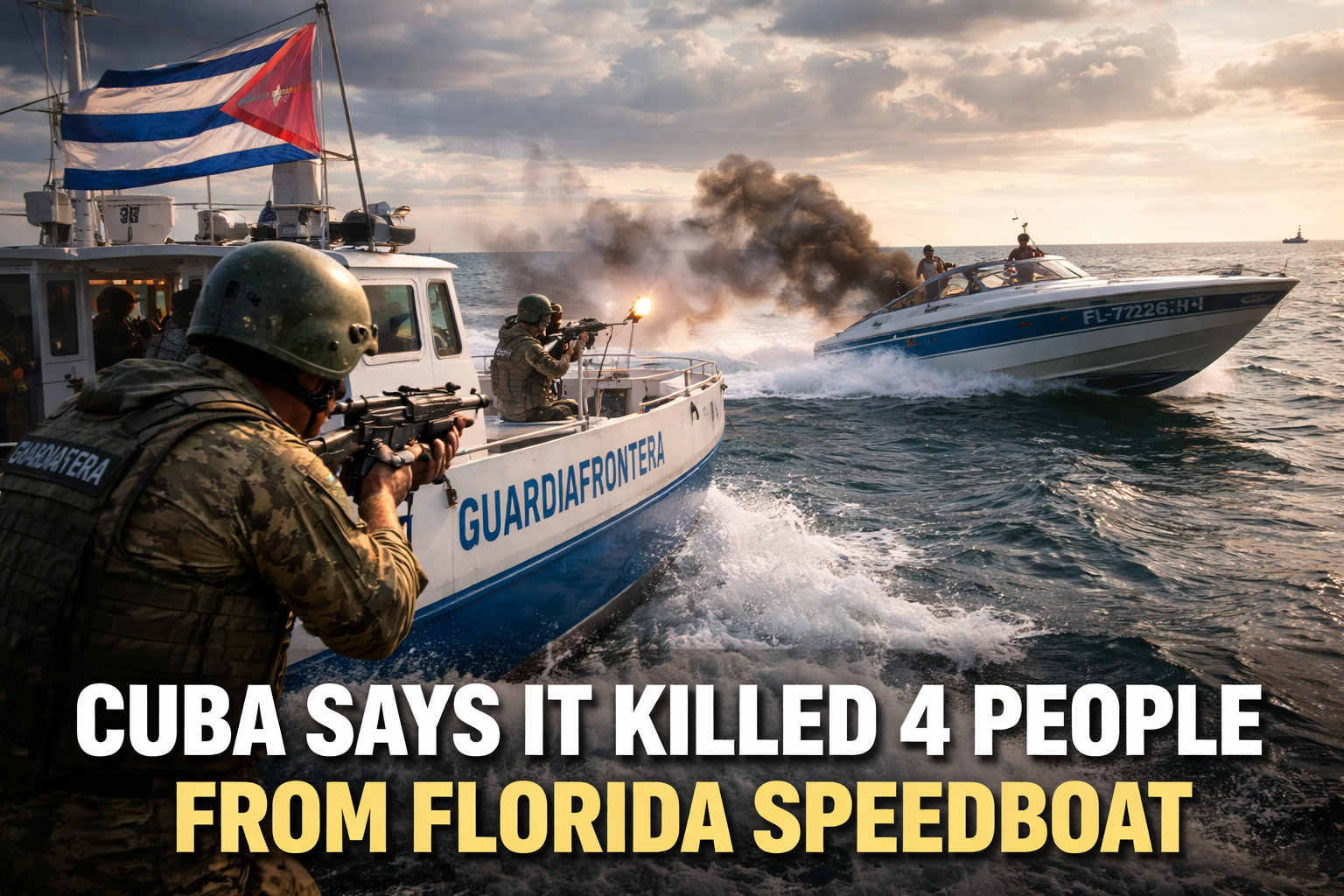
Cuba’s government says Cuban border forces killed four people on February 25, 2026 after an exchange of gunfire involving a Florida-registered speedboat in Cuban territorial waters. Cuban officials say the people on the speedboat fired first when Cuban Border Guard Troops approached to identify the vessel near the El Pino channel off Cayo Falcones, on Cuba’s north coast.
The incident stands out because Cuban authorities describe a rare, armed confrontation involving a U.S.-registered civilian vessel near Cuba’s coastline. U.S. officials had not publicly confirmed key facts in early reporting, including who rode the boat and why it entered Cuban waters.
What follows summarizes what major outlets have reported so far, what remains unclear, and what experts typically look for when officials investigate maritime use-of-force incidents.
What Cuba says happened on February 25, 2026
Cuba’s Interior Ministry says authorities detected a “violating” speedboat inside Cuban territorial waters near the El Pino channel in the area of Cayo Falcones, in Corralillo municipality, Villa Clara province. The ministry says the vessel carried Florida registration FL7726SH and came within about one nautical mile of the channel.
Cuban officials say a Border Guard Troops unit with five service members approached the speedboat to identify its occupants. Cuban authorities say the people on the speedboat opened fire, injuring the commander of the Cuban patrol vessel. Cuban forces returned fire, according to the Cuban account.
Cuba says Cuban forces killed four people on the speedboat and injured six others. Cuban officials say responders evacuated the injured and provided medical care. Cuban authorities say they continue investigating to clarify what happened.
Some local U.S. coverage briefly reported a different number of injured people, which likely reflects early updates and conflicting summaries rather than a confirmed revision to Cuba’s statement. Most major reports tied to the Cuban Interior Ministry statement cite six injured.
Where the confrontation occurred: Cayo Falcones and the El Pino channel
Reports consistently place the confrontation off Cuba’s north coast near Cayo Falcones, in Villa Clara province, specifically near the El Pino channel and within roughly one nautical mile of that channel.
That geography matters for two reasons.
First, Cuban officials frame the encounter as an incursion into sovereign waters rather than an incident on the high seas.
Second, the north coast faces the Florida Straits, a corridor that regularly sees interdictions, rescues, and smuggling cases, especially involving small, fast boats that can close distance quickly.
What we know about the boat: Florida registration, not confirmed ownership
Cuba says the speedboat carried Florida registration number FL7726SH. Cuba and multiple outlets describe the vessel as Florida-registered or U.S.-registered based on that number.
A registration number helps investigators trace paperwork, but it does not automatically confirm who operated the boat at the time of the incident or what nationality the passengers held. A U.S.-registered vessel can carry non-U.S. passengers, and a boat can change hands or operate under informal arrangements.
Reuters reported that Cuba’s Interior Ministry cited the Florida-based registration and said Cuba would investigate to clarify what happened. Reuters also noted the incident occurred during a period of heightened tension between Cuba and the United States.
What remains unconfirmed: identities, motive, and an independent timeline
Early reporting leaves major questions unanswered.
Authorities have not publicly identified the four people who died or the injured survivors. Cuba has not released names or nationalities in the initial public account.
Officials also have not explained why the boat entered Cuban waters. Reporters have not published a verified account from survivors, and no outlet has published independently verified details such as radio logs, body-worn video, or a minute-by-minute sequence from neutral investigators.
That gap does not prove or disprove Cuba’s account. It simply reflects how these incidents typically unfold: governments speak first, then investigators gather evidence, then a more complete picture emerges—if authorities release it.
U.S. and Florida reactions: calls for investigations and accountability
Florida Attorney General James Uthmeier said he ordered prosecutors to open an investigation in coordination with federal, state, and law enforcement partners. Coverage describes his comments as skeptical of Cuba’s account, and it notes he posted about the case on social media.
U.S. Rep. Carlos Gimenez condemned the killings and accused the Cuban government of murder in a social media post, according to local TV reporting that summarized his statement.
Major outlets also emphasized uncertainty about whether any U.S. citizens were on board, at least in the initial public reporting window.
Why verification takes time in maritime shooting incidents
Sea incidents create investigative challenges even when every party cooperates.
Small boats often lack AIS transponders or disable them, which limits public tracking data. Saltwater and impact damage can also degrade evidence quickly. Investigators must secure the vessel, recover any weapons if authorities allege weapons, and document damage patterns before conditions change.
A thorough reconstruction usually relies on:
- Patrol logs, radar data, and communications records
- Forensic examination of the vessel (impact points, trajectories)
- Survivor interviews and medical records (timing, injuries consistent with the account)
- Photographs, video, or drone footage, if authorities captured any
Cuba says it will investigate the confrontation to clarify what happened. Whether authorities release evidence will shape how much the public can independently evaluate.
Territorial waters and “innocent passage”: what international law says
International law gives coastal states sovereignty in their territorial sea. Under the U.N. Convention on the Law of the Sea (UNCLOS), a state can claim a territorial sea up to 12 nautical miles from its baseline.
UNCLOS also recognizes a right of “innocent passage” through territorial seas, but passage must remain “innocent,” meaning it cannot threaten the peace, good order, or security of the coastal state. A vessel that fires on coastal security forces would not qualify as “innocent” if evidence confirms that action.
The United States has not ratified UNCLOS, but U.S. policy often treats many of its navigation rules as customary international law. Separate from UNCLOS, U.S. State Department “Limits in the Seas” publications analyze coastal states’ maritime claims, including Cuba’s straight baselines and its 12-nautical-mile territorial sea claim.
None of that legal framework settles the factual dispute in a specific case. Law answers “who can enforce what,” but evidence decides “what happened.”
Why the Florida Straits see small-boat confrontations at all
The waters between Florida and Cuba sit among the most monitored maritime corridors in the region. Governments patrol the area because of migration, smuggling, and safety risks, especially involving overloaded or fast-moving craft.
U.S. Coast Guard press releases routinely warn about the dangers of maritime crossings and report repatriations of migrants intercepted at sea. For example, one Coast Guard release stated that crews repatriated 348 migrants to Cuba in fiscal year 2024 (which began October 1, 2023).
Those figures provide context for why authorities treat unidentified boats near shorelines as security and safety concerns. They do not explain the purpose of the specific Florida-registered speedboat in this incident. Officials have not released a confirmed motive.
Diplomatic stakes: why this incident could escalate tensions
Reuters described the shooting as occurring amid heightened U.S.-Cuba tensions. Bloomberg similarly framed the clash as one with potential to deepen an already tense relationship.
A lethal encounter involving a U.S.-registered vessel can increase pressure on officials to act quickly, even before investigators establish facts. Families may demand answers. Politicians may call for sanctions or other measures. Cuba may cite sovereignty and deterrence. Each side can also use the incident to support broader narratives about security, migration, and cross-border hostility.
That dynamic often amplifies the importance of transparent evidence. When authorities release clear documentation—maps, timelines, photographs, verified communications—public debate tends to focus on facts. When authorities release little, speculation tends to fill the gap.
What to watch next
Several developments will likely shape the next phase of coverage.
Identification of victims and survivors
Authorities may confirm names and nationalities through documents, family reporting, or consular channels. Early reporting has not established whether U.S. citizens were involved.
Clarification of injury totals
Most major coverage cites six injured based on the Cuban statement, but at least one outlet summarized a different figure in early updates. A definitive update from Cuban authorities or corroborating agencies will resolve the discrepancy.
Evidence releases
Photos of the vessel, weapons (if recovered), damage patterns, and official timelines will carry heavy weight. Reuters reported that Cuba’s Interior Ministry said it would investigate to clarify what happened.
U.S. investigative findings
Florida’s attorney general said he ordered an investigation with law enforcement partners. Investigators may focus on ownership, launch location, and any criminal conduct connected to the trip, even if Cuba controls the vessel and survivors.
FAQ: quick answers based on confirmed reporting
Did Cuba say the boat came from Florida?
Cuba said the boat carried a Florida registration number (FL7726SH). That establishes registration, not a confirmed departure point.
Where exactly did the confrontation happen?
Cuba and multiple outlets place it near the El Pino channel at Cayo Falcones in Corralillo municipality, Villa Clara province, about one nautical mile from the channel.
Did U.S. officials confirm Cuba’s account?
Early coverage did not show public confirmation from U.S. agencies about key facts such as who was on board and why the boat entered Cuban waters.
What did Cuba say triggered the shooting?
Cuba said the people on the speedboat opened fire when Cuban border troops approached to identify the vessel, injuring the commander of the Cuban patrol craft.
Bottom line
Cuba says Cuban forces killed four people and injured six others on February 25, 2026 after a Florida-registered speedboat entered Cuban territorial waters near Cayo Falcones and fired on Cuban border personnel. Florida officials and U.S. lawmakers have called for investigations, and major unknowns remain—especially identities, motive, and independently verified evidence that can confirm the sequence of events.