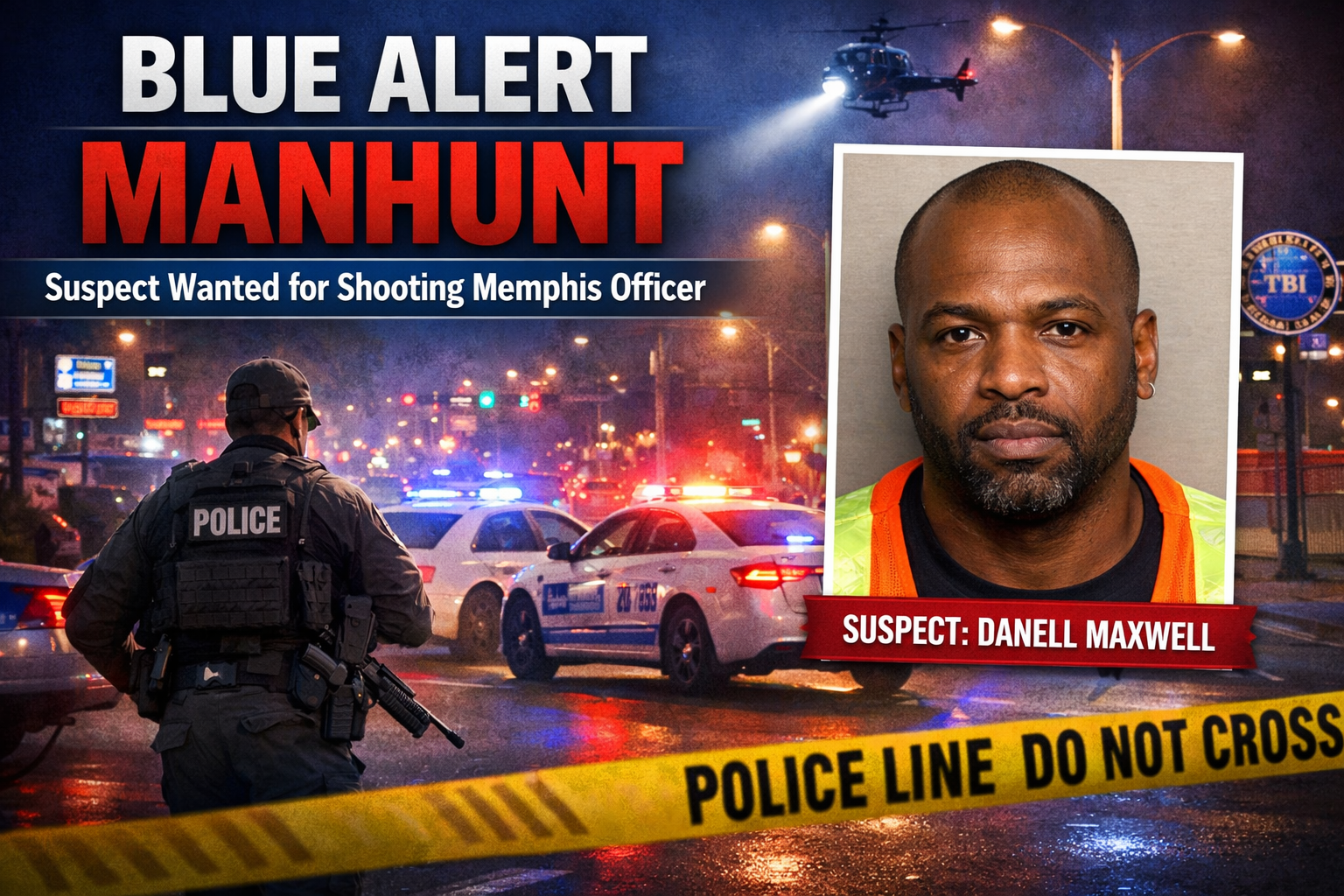
A statewide manhunt continues in Tennessee after authorities said a suspect shot a Memphis Police Department (MPD) officer during an encounter Thursday night in Memphis. The Tennessee Bureau of Investigation (TBI) activated a Blue Alert shortly after midnight Friday as officers searched for the suspect, identified as 40-year-old Danell Maxwell.
Police took the injured officer to Regional One Health (also known as Regional Medical Center) as multiple agencies converged near the scene and the hospital. Reporters and officials described a heavy law-enforcement presence in the area as investigators worked to secure the scene, gather information, and expand the search beyond Memphis.
As of Friday morning, MPD had not released the officer’s name or detailed the full circumstances that led to the shooting. Officials and local reporting described the officer’s condition as critical but stable, and they continued to characterize the case as developing.
What Happened in Memphis
Authorities said the shooting happened around 8:15 p.m. Thursday in the Parkway Village area of Memphis. Law-enforcement vehicles concentrated along South Perkins Road near Cottonwood Road as officers restricted access in the immediate area during the initial response and follow-up work.
Local reporting described a temporary “lockdown” around the most active police perimeter as responders controlled traffic and limited movement through the scene. Officials also reported a brief closure of Interstate 240 as emergency personnel transported the officer to the hospital.
A Memphis City Council member, JB Smiley Jr., said the shooting occurred during a traffic stop, although MPD had not confirmed that detail in the immediate aftermath. Officials often withhold specific operational details early in investigations to protect witness statements, preserve evidence, and avoid compromising active search efforts.
Officer Condition and What Police Have Confirmed
A spokesperson for MPD confirmed the officer suffered critical injuries and remained in critical but stable condition, according to local reporting. That phrasing typically signals that medical staff have stabilized vital signs while the patient still faces serious risk and may need intensive care and close monitoring.
Action News 5 reported that an MPD spokesperson described the officer as “fighting for their life” while remaining stable, and other police sources suggested the officer had a chance to survive. Those statements can change quickly as doctors assess internal injuries, complications, and recovery trajectory over the first 24 to 72 hours.
MPD had not publicly identified the officer as of early Friday in the sources available, and officials had not announced any arrests connected to the shooting. Police departments often delay naming an injured officer until they notify family members and confirm the safest way to share details without creating additional security concerns.
Who Authorities Are Searching For
TBI identified the suspect as Danell Maxwell, age 40. TBI and MPD listed him as wanted for “Criminal Attempt First Degree Murder” in connection with the shooting of the Memphis officer.
Authorities described Maxwell as about 5 feet 10 inches tall and approximately 180 pounds. They said he last wore dark clothing along with an orange-and-green reflective vest, and they warned the public that he may carry a silver handgun.
Officials urged residents not to approach Maxwell. When police label a suspect “armed and dangerous,” they want the public to prioritize distance and immediate reporting rather than direct engagement, because any confrontation can escalate quickly and create additional victims.
The Blue Alert: Why Tennessee Activated It
TBI issued the Blue Alert around midnight Friday as the search continued. Tennessee uses Blue Alerts to push time-sensitive information to the public when a suspect seriously injures or kills a law-enforcement officer and remains at large.
TBI’s Blue Alert page explains that the state began issuing Blue Alerts in 2011 under Tennessee law and built the system on the same infrastructure used for AMBER Alerts. When TBI activates a Blue Alert, the agency can distribute details through multiple channels, including direct outreach to media and law enforcement and the Tennessee Department of Transportation’s Smartway signs in relevant regions.
TBI also lists formal activation criteria. The criteria include a serious injury or death (or a missing officer under concerning circumstances), an imminent threat to public safety and law enforcement, and enough descriptive information about the suspect or vehicle for statewide broadcast.
How a Blue Alert Reaches Your Phone and the Public
People often associate Blue Alerts with phone notifications because many alerts arrive through Wireless Emergency Alerts (WEA) or similar state and local systems. The goal focuses on speed: investigators want tips from people who may see a suspect walking, driving, or seeking help shortly after the incident.
TBI’s process also relies on coordinated distribution, including direct communication with law enforcement agencies, dispatch centers, and media outlets. That approach helps ensure that descriptions, tip lines, and safety warnings remain consistent, which matters when rumors and screenshots spread quickly on social media.
Residents can help most by following official guidance, sharing confirmed descriptions, and reporting credible sightings to the proper numbers. Police typically treat a time-stamped, location-specific tip as more useful than a general rumor, especially when they need to allocate officers across a wide area.
Search Efforts in Memphis and Beyond
The law-enforcement footprint expanded quickly after the shooting. Reports described numerous vehicles from multiple agencies at the hospital and along the perimeter near the incident location, reflecting both an emergency response and a growing search operation.
Large responses often serve several purposes at once. Officers secure the scene for investigators, protect medical transport routes, coordinate communications, and run down immediate leads such as nearby surveillance footage, witness statements, and vehicle descriptions. Police also try to prevent a suspect from using the initial chaos to slip into a nearby jurisdiction.
Officials also referenced West Memphis, Arkansas, across the Mississippi River from Memphis, which suggests that investigators quickly considered cross-border movement. The wider the potential search area grows, the more agencies rely on standardized alert systems like the Blue Alert to keep descriptions and instructions aligned.
New Detail: Police Detain the Suspect’s Girlfriend
On Friday, Action News 5 reported that officers located Maxwell’s girlfriend during the early morning hours near Third Street and Horn Lake Road. According to that report, she told officers she had recently dropped Maxwell off on Broadway Street in West Memphis. Police detained her as the search continued for Maxwell.
Investigators commonly detain and interview people close to a suspect when they need to verify timelines and movements. Police may seek phone records, vehicle information, and other evidence to confirm whether a person aided a suspect knowingly or simply encountered them under pressure or confusion.
Officials had not publicly filed charges against the girlfriend in the reporting available, and police had not released additional specifics about what she told investigators beyond the location detail. Readers should treat this part of the story as fluid, because police can update detention status and allegations quickly as they verify statements.
What We Know About Danell Maxwell From Official Sources
TBI’s official Blue Alerts page lists Danell Maxwell as wanted by MPD and TBI for Criminal Attempt First Degree Murder, with a “Date Added” of February 27, 2026. That listing functions as a centralized, authoritative reference point for the suspect’s status during the active alert period.
Beyond the physical description and charges, authorities had not shared additional background information about Maxwell in the sources available, such as prior criminal history or a motive. Many agencies avoid releasing those details early because investigators often need to corroborate records, avoid prejudicing future legal proceedings, and protect sensitive investigative leads.
Officials also said they did not know Maxwell’s direction of travel at the time of the initial alert. That uncertainty often leads to broader geographic messaging, especially in a region with multiple major roads and interstates that can carry someone out of the area quickly.
What the Public Should Do Right Now
Authorities asked anyone with information about Maxwell’s location to contact the Tennessee Bureau of Investigation at 1-800-TBI-FIND or the Memphis Police Department at 901-528-2274. If someone believes they see Maxwell in real time, they should contact local emergency services instead of approaching him.
People can help police most by sharing tips that include specific details: time, location, direction of movement, and any identifying markers that match the official description. Officers can check a tip quickly when it includes those elements, and dispatchers can route the information to the right agency when the tip comes from outside Memphis city limits.
Residents should also avoid amplifying unverified screenshots, edited photos, or “heard it from a friend” posts that claim to pinpoint Maxwell. False leads can pull officers away from credible information, and they can also put bystanders at risk if people misidentify an innocent person.
What Happens Next in a Blue Alert Case
If officers locate Maxwell, the Blue Alert will typically end once police take him into custody or otherwise remove the immediate public threat. In many cases, agencies update the public through a follow-up post, a news release, or a cancellation notice through the same channels that delivered the original alert.
After an arrest, prosecutors generally move quickly to set an initial court appearance, address bail or detention, and present the core allegations behind the arrest. Courts can impose no-contact orders, weapons restrictions, and other conditions that aim to protect witnesses and the community while the case proceeds.
Investigators also continue work even after an arrest. They often gather additional evidence, interview witnesses again, and request forensic testing that can take days or weeks, especially when the case involves complex scene processing or multiple locations.
Key Unanswered Questions
Public reporting left several critical questions unresolved early Friday. MPD had not publicly confirmed what led to the encounter or whether a traffic stop initiated the incident, even though a city council member referenced that detail.
Authorities also had not announced whether they believe Maxwell acted alone or whether investigators seek additional suspects or accomplices. Police sometimes keep that information private until they identify everyone involved, because premature disclosure can push a person to flee or destroy evidence.
Finally, the public still lacks clarity on the officer’s longer-term prognosis. Hospitals and departments often share only broad updates in the first day because the patient’s status can shift rapidly, and families often ask agencies to limit details.
Why This Case Has Drawn Regional Attention
Blue Alerts aim to mobilize the entire state, not just the city where a crime occurred. Tennessee’s system can activate message boards and broadcast channels beyond Memphis, which matters because suspects can cross county lines quickly and because residents elsewhere may spot a person who tries to blend in outside the immediate scene area.
The case also highlights how agencies coordinate across jurisdictions in the Mid-South. Memphis sits near state borders, and the metro area includes frequent cross-river travel into Arkansas, which can complicate early search decisions and tip routing.
Public safety officials also view attacks on officers as high-risk events that can lead to additional violence if a suspect feels cornered. That risk drives the strong safety language in Blue Alerts and explains why agencies urge the public to report sightings rather than intervene.
Timeline So Far
Thursday, February 26, 2026: Authorities said a suspect shot an MPD officer around 8:15 p.m. in the Parkway Village area, and officers transported the injured officer to Regional One as police secured the area near South Perkins Road and Cottonwood Road.
Early Friday, February 27, 2026: TBI issued a statewide Blue Alert naming Danell Maxwell as the suspect and listing him as wanted for Criminal Attempt First Degree Murder.
Friday morning, February 27, 2026: Reports said officers detained Maxwell’s girlfriend after she told police she had dropped him off on Broadway Street in West Memphis, and the search continued.
The Bottom Line
Authorities continue to search for Danell Maxwell after the shooting of a Memphis police officer Thursday night. TBI’s Blue Alert identifies Maxwell as wanted for Criminal Attempt First Degree Murder, describes his appearance and clothing, and warns that he may carry a handgun.
MPD and local reporting described the officer as critically injured but stable, and officials have not released the officer’s identity. Police have asked the public to avoid approaching the suspect and to report credible information through the official tip lines.
This story remains active, and the next major updates will likely focus on the suspect’s location status, any arrest or charges beyond the attempted murder allegation, and changes in the officer’s condition as medical staff continue treatment.