

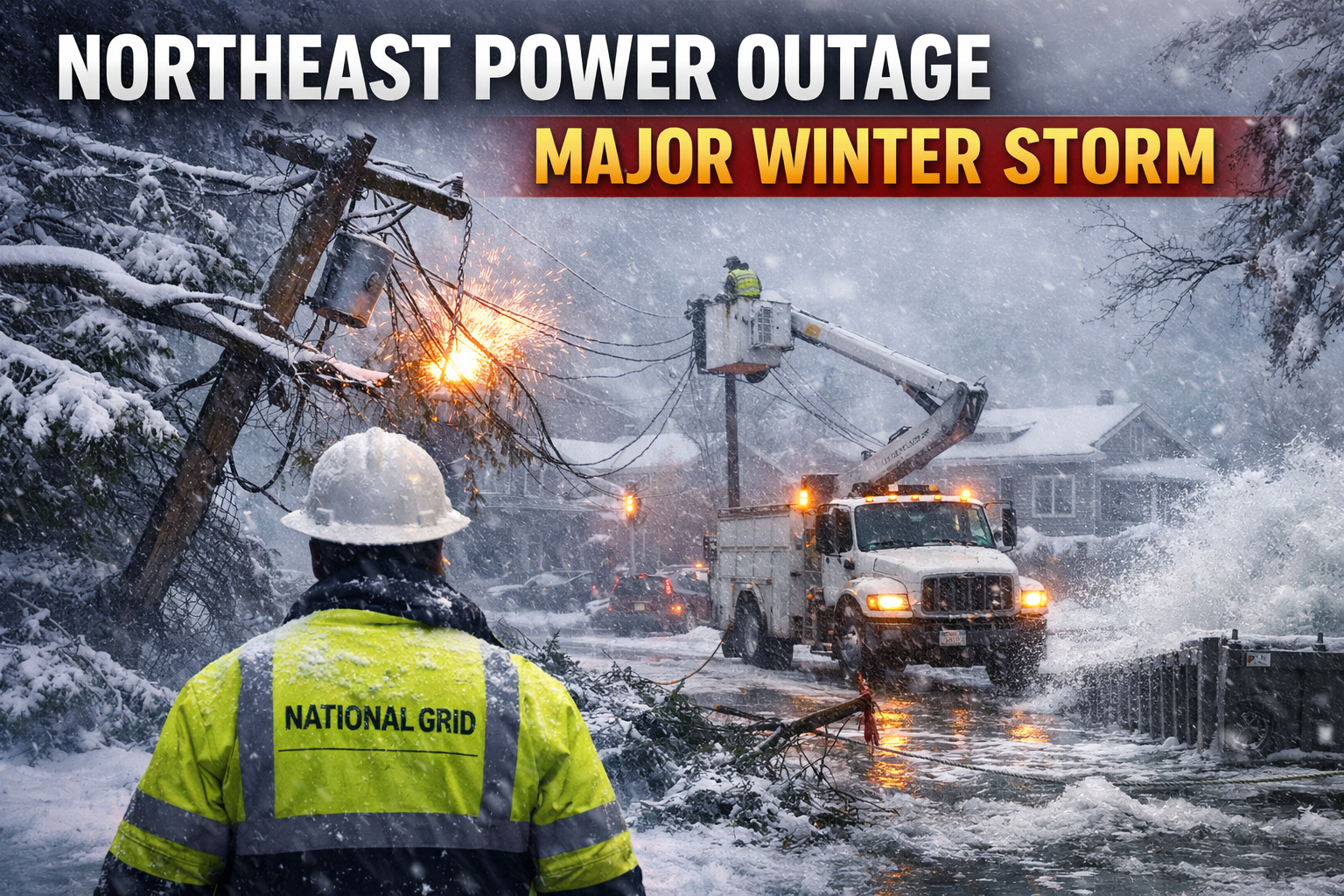
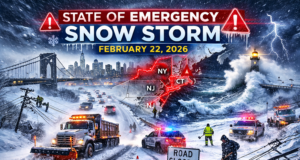
A powerful nor’easter is hitting the Northeastern United States on Monday, February 23, 2026, bringing blizzard conditions, damaging wind gusts, and coastal flooding concerns from the Mid-Atlantic into New England. Officials across multiple states have declared emergencies, schools are closed in major districts, and travel disruptions are widespread.
Within that larger regional storm story, the “National Grid power outage” question is mostly about National Grid’s electric distribution territories in Massachusetts and upstate New York, where wind + heavy snow are knocking down trees and power lines. Outage counts are changing quickly as the storm peaks, so the most accurate picture comes from live outage maps and utility updates rather than static morning snapshots.
The storm driving outages across the Northeast
This system is being described as a major, high-impact nor’easter capable of producing near-hurricane-force impacts along exposed coastal areas: intense snow bands, whiteout conditions, and strong gusts that can reach well beyond typical winter-storm wind speeds.
In the core impact corridor, the National Weather Service briefing for the New York City / Long Island / southern Connecticut region highlights a combination of heavy snowfall, blizzard conditions, and coastal flooding risk around high tide—exactly the mix that tends to cause both dangerous travel and widespread utility damage.
Reuters also reports broad emergency measures and closures across the region, including school closures in New York City, non-essential travel restrictions, and thousands of flight cancellations as the storm intensifies.
What “National Grid power outage” means in the Northeast
National Grid is a major utility brand in the Northeast, but it doesn’t serve every place being hit hardest by the storm.
National Grid’s electric territories most relevant to this storm coverage are:
- Massachusetts (electric distribution in many communities)
- Upstate New York (electric distribution in large parts of the region)
For these areas, National Grid publishes live outage maps and restoration information. In Massachusetts, National Grid states its outage map updates every five minutes and can show estimated restoration times (ETRs) by county and town.
National Grid provides a similar outage-map portal for upstate New York.
If you’re in the Tri-State area (NYC/Long Island/NJ) and your power is out, many customers there are served by other utilities, so “National Grid outage” may not match your local provider—even though the same storm is driving outages across the region. Reuters describes the storm’s broad footprint and disruptions, but utility responsibility remains local.
What outage data shows right now in National Grid territory
Because outage totals can jump (or drop) quickly during peak winds, any number should be treated as time-stamped.
One useful regional indicator is PowerOutage.us, which aggregates utility-reported data. As of the time of its update, PowerOutage.us showed tens of thousands of customers without power across National Grid’s service area, with a notable concentration in parts of Massachusetts.
National Grid’s own outage maps provide the most precise, location-specific status:
Massachusetts outage map
The Massachusetts National Grid outage map displays “Total Customers Affected” and is updated frequently (the site notes updates every five minutes).
Upstate New York outage map
The upstate New York National Grid outage map similarly lists active outages and affected customers and notes frequent refreshes.
If you’re writing this as a news update for readers, the cleanest approach is to cite the maps directly, then describe the trend (rising/peaking/declining) rather than locking your whole story to a single number.
Why this storm is knocking out power so effectively
National Grid and regional reporting repeatedly point to the same core drivers:
1) Wind gusts bring trees and limbs into overhead lines
High wind is the single most common trigger for widespread distribution outages in wooded Northeast communities. The Washington Post described wind gusts and storm intensity severe enough to produce large-scale outages across multiple states.
2) Heavy, wet snow loads branches and lines
When snow is wet and adhesive, it adds significant weight to tree limbs and wires. This increases breakage risk—especially when wind gusts shake trees and pull on already-stressed lines.
National Grid’s Massachusetts storm preparedness update specifically warned that wind gusts could damage trees and knock down lines, and that heavy snow can contribute to sagging lines and falling limbs.
3) “Repair-delay weather”: crews can’t safely do bucket-truck work in peak wind
One of the most frustrating realities for customers is that restoration pace often depends on safety windows. A Massachusetts report noted that dangerous wind conditions can slow restoration because bucket-truck operations may be restricted until winds ease.
This is why some utilities publicly caution that restorations can stretch into multiple days during severe wind events. Connecticut utility coverage made a similar point, describing multi-day timelines tied to hazardous conditions and delayed field work.
Where outages are most likely in National Grid’s Northeast footprint
Even within the same utility territory, outage risk is not evenly distributed. During a coastal nor’easter, these patterns usually dominate:
Coastal and wind-exposed Massachusetts communities
Coastal and southeastern Massachusetts often see stronger gusts, salt spray exposure, and rapid tree damage during nor’easters. Local reporting in Massachusetts described outage totals climbing sharply during the storm’s early peak, with wind and heavy snow highlighted as key contributors.
Some island and coastal communities may also experience localized issues that are hard to reach quickly depending on ferry/service conditions and wind timing.
Tree-dense suburban circuits (inland MA and parts of upstate NY)
Inland neighborhoods with mature roadside trees can see “distributed” damage—many small faults scattered across a wide area—rather than one single transmission issue. This tends to slow restoration because crews must locate and fix many separate problems.
Upstate New York: varied impacts by region
The storm’s most extreme blizzard conditions are widely reported in and around the NYC/Long Island/southern Connecticut axis, but upstate can still face outages from wind, snow load, and drifting—especially where line corridors run through wooded areas.
New York State’s emergency statements emphasize broad preparation across multiple counties, reflecting how the impact zone extends beyond the immediate coast.
What National Grid says it’s doing during this storm
Utilities typically shift into “storm mode” before the worst conditions arrive: staging crews, preparing materials, and coordinating with tree-removal contractors.
National Grid’s Massachusetts blizzard preparedness update described:
- Increased readiness for wind-driven tree damage and downed lines
- Challenges expected from sustained winds and poor road conditions
- Pre-storm preparation to restore outages as safely and quickly as possible
On the customer-facing side, National Grid directs customers to use its outage maps and reporting channels to confirm status and get ETRs when available.
How restoration actually works (and why your neighbor might come back first)
During a widespread storm, restoration isn’t “one house at a time.” Utilities generally triage in a way that restores the largest number of customers safely:
- Immediate hazards (downed wires in roads, sparking equipment)
- Critical infrastructure (hospitals, emergency services, water/wastewater)
- Major feeders/substations that restore large blocks of customers
- Smaller lateral lines and individual service drops
This is also why ETRs can be missing early in the event: crews must first assess damage, isolate faults, and confirm which repairs will restore the most customers fastest.
What to do if you’re out right now (National Grid customers)
These are practical steps that fit a nor’easter scenario (heavy snow + strong wind) without assuming specialized equipment.
Check the outage map and report your outage
Use National Grid’s outage maps for Massachusetts or upstate New York, which are designed to refresh frequently and show outage extent and ETRs when available.
If your outage is not shown (or you’re unsure), report it through the utility’s outage tools.
Treat downed wires as energized
Do not approach or touch downed wires or branches on lines. Snow can hide hazards, and wind can move debris unexpectedly.
Keep refrigerator and freezer doors closed
Food safety becomes an issue quickly in multi-hour outages. Minimizing door openings is the simplest way to preserve safe temperatures.
Use safe lighting and heating choices
If you’re using backup heat, ensure ventilation and follow manufacturer guidance. Avoid risky indoor heating methods. Storm coverage and utility safety messaging consistently emphasize that the outage period is also the time when secondary hazards (fires, carbon monoxide exposure) rise.
Plan for “stop-and-start” restoration
In high-wind storms, restoration can come in waves. Some customers are restored quickly; others may lose power later as wind shifts and additional trees come down. Reports across the region show outage numbers fluctuating as the storm evolves.
The bigger Northeast picture: outages and disruption beyond National Grid
Even if you’re focusing your article on National Grid, readers will be seeing widespread outage headlines across the Northeast because this storm is impacting many utility territories at once.
Reuters described large-scale disruptions across the Northeast: emergency declarations, school closures, and thousands of canceled flights.
The Washington Post reported widespread outages across multiple states during peak storm intensity.
ABC News live updates reported that New Jersey was among the hardest hit for outages in the broader region at the time of its update.
That context matters because it explains why mutual aid crews, lineworker staging, and restoration timelines become regional stories during major nor’easters.
What to watch next (the next 12–48 hours)
If you’re updating this story throughout the day, these are the signals that typically predict how quickly outages will decline:
Wind easing and visibility improving
Once gusts drop below operational safety thresholds, bucket-truck work accelerates and restoration rates typically improve.
Outage-map “clusters” shrinking
Total outages can stay flat even while crews restore power if new outages occur at the same time. The more meaningful indicator is whether the outage areas contract and whether ETRs become more specific.
Coastal flooding and road access
If coastal flooding peaks at high tide, some neighborhoods may become temporarily difficult to access, delaying repairs and damage assessment. The NWS briefing explicitly highlights coastal flooding risk layered onto the blizzard conditions.
Bottom line
The National Grid power outage situation on February 23, 2026 is part of a wider Northeast storm emergency: a powerful nor’easter producing blizzard conditions, extreme winds, and widespread disruptions from the Mid-Atlantic to New England.
For National Grid customers in Massachusetts and upstate New York, the most reliable way to track what’s happening in your town is National Grid’s live outage maps, which update frequently and provide restoration information when available.




.)