
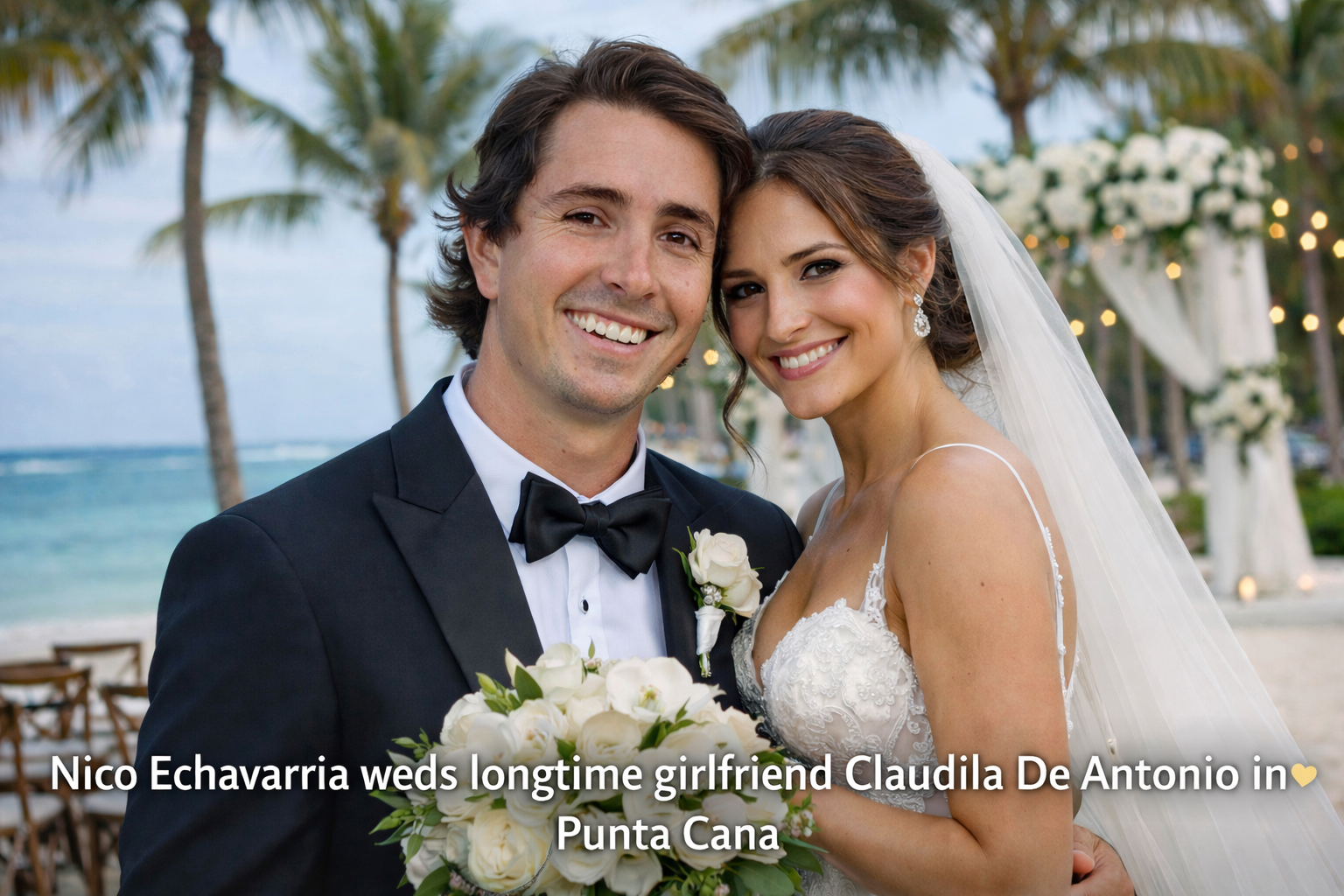
PGA Tour journeyman Nico Echavarria wed his longtime girlfriend, Claudia De Antonio in Punta Cana, Dominican Republic, translating a relationship of several years into a destination wedding weekend of formal and resort elements. Public details suggest the wedding was on Saturday, Nov. 29, 2025.
In top golf, personal life markers often get relayed in a brief social post and perhaps a couple photos—a tiny window into someone’s life filled with blocks of practice, weekly travel, and the pressures of performing in front of the cameras on Sunday afternoons. Still, a wedding can feel like a significant “chapter marker,” especially for a player still rising in profile after only a few seasons of heightened competition.
Here’s what is known about the Punta Cana wedding, who De Antonio is in the golf world’s ecosystem and how timing informs the ebb and flow of the PGA Tour schedule.
A wedding vacation in Punta Cana
The couple’s publicly posted schedule framed the affair as a days-long grouping of family and friends rather than a one-night event. A welcome party was planned to take place Thursday, Nov. 27, described via “tropical white” cocktail dress code—an easy fit for a beach destination and common way of giving guests guidance on expectation during their travel across time zones and over multiple waves of flights. The wedding itself offered an itinerary framing from 4:00 to 5:00 p.m. for the ceremony—set in the Catholic tradition at Capilla Nuestra Señora de Punta Cana—with a reception at The Puntacana Club spilling late into the evening. Guests were asked to dress black tie, with a note of invitation to don bright colors—an understated sign that the couple wanted classic formalwear without dulling the tropical vibe.
Those elements—a public welcome event, relatively formal ceremony, and long reception—are typical of destination weddings where the objective is often about gathering a people in place as much as the single “main” evening. They also match the resort geography of Punta Cana, where venues, hotels, and beaches are generally packed relatively inside a short drive radius.
ARRANGEMENTS Social media confirmation and vendor credits
Echavarria referenced the wedding on social media, repeating the date and location and crediting the videographer and wedding planner. While that doesn’t divulge much about guest list or the private moments of the day, the credits are a reminder that destination weddings commonly need a specialty team for travel-heavy logistics, a new timeline, and multiple venues.
For public figures this “share a moment, not the whole story” style is increasingly common, allowing couples to mark the event, thank the people who helped make it happen, and leave that “social moment,” so to speak, for a return to normal life without turning a wedding into an extended media cycle. That can be an especially appealing option in golf where the competitive calendar just keeps moving forward.
Who is Claudia De Antonio?
De Antonio is best known to golf fans as Echavarria’s long-time partner and present around the tournament. Golf is a sport where the support circle—caddie, coach, family, partner—can show up on screen without necessarily becoming part of the narration, and she’s been present in that “inside the ropes” atmosphere during critical stretches of his career.
Some coverage has noted that she has a game background herself, and is comfortable in Tour life, though the couple hasn’t tried to build a public brand around their duo. Adding to that privacy is common in golf—routine life for many players is separate from the week-to-week storyline unless a major event or personal change pokes its head up into the view of the cameras.
Outlets that have profiled the couple indicate that they started dating back around the mid-2010s, though how they met, and the exact timeline, have not been disclosed.
From rising pro to PGA Tour winner
Echavarria’s wedding drew attention in part because his own profile has deepened. He’s a Colombian player who made his way through college at the University of Arkansas and has moved through the ladders of the sport into PGA Tour contention.
His breakthrough on that stage came in March 2023, when he scored his first PGA Tour win, one that brought with it a slew of exemptions, and opportunities to plan schedule strategically.
He quickly followed that up, with a second win at the ZOZO in Japan in October 2024. Winning away from home—different grasses, different time zones, unfamiliar course visuals—might feel more significant for this reason: that it hits that golfer’s sweet spot rather than designs it.
It’s part of the explanation for why the milestones in Scottie Scheffler’s personal life have been increasingly visible, too. As a player shows up on more leaderboards, the curiosity broadens from swing mechanics to geography—where is this player from, what does their week looks like, and who is behind the scenes experiencing it with them.
Why Punta Cana works for this kind of celebration
The reasons Punta Cana is a popular wedding destination aren’t difficult to discern. The project blends a major international airport with a bowl of hotel, beaches, and event spaces, minimizing the friction that can ensue trying to move dozens (or hundreds) of guest through a foreign country.
The couple’s travel guide led guests to Punta Cana International Airport (PUJ) as the closest airport and identified The Westin Puntacana Resort & Club as the suggested hotel, with additional options elsewhere in that same resort complex or nearby. That “host hotel plus alternatives” setup comes in handy; it centralizes check-ins and pre-wedding plans in one location, but allows guests some degree of flexibility on price and other choices.
It also fits the reality of modern friend groups. Wedding weekends are now commonly adding guests from multiple cities and countries, and resort destination can often make that logistics job seem that much more like a shared vacation and less like a taxing web of transfers and separate venues.
Timing: A key to the Tour’s mileposts
Golf’s calendar runs long, but it does have its breathing spaces. For many players a late-fall window opens for significant family milestones. It’s far enough past the summer stretch not to feel crushed against it, and far enough before early-year Tour events to feel like it’s not sitting on top of one another.
A late-November date fits that approach. The player can break away for a quick concentrated period, miss no meaningful stretch of Tour events, and then reenter training and planning with longer runway. Not easier, just easier.
For a destination wedding, that date can also be better for guests. Travelers combine the trip with year-end vacation patterns, and it’s easier for families traveling far from the Tour to find ways to fit in school and calendar, mid-season months being much more challenging.
What marriage changes about the Tour and what it does not
In competitive terms, not much. Golf is a game of small margins, and the Tour remains judged by results. But marriage can change the physical infrastructure of a Tour life: Where in particular the player bases himself, how he travels, and how he preserves rest.
Dozens of small decisions are made week to week by Tour golfers, decisions of which the fans and followers are often unaware: What day to arrive in a city, how to handle time zone changes, scheduling practice rounds, when to take a full day off, how to hold training consistent through living in hotels. When there’s a domestic life off the course waiting for his return, all those decisions are easier. For a lot of players, it’s the difference between “fine” and “sharp” that amounts to energy management.
It’s easy to overread personal milestones as predictors. Getting married is a life moment, not a performance variable. The more realistic takeaway is that the person we’ve seen on the leaderboard has a full life outside of the leaderboard, and from time to time we get to see that life.
The support system golfers seldom discuss
TV makes golf look lonely, but in reality it’s seldom lonely. A caddie is a part of it, and behind the caddie is a network of coaches, trainers, agents, and family members to help keep a season on track. Partners often play a unique role in that mix because they live with the consequences of the schedule, the emotional roller-coaster of making or missing cuts, and the need for the “reset” the next tournament demands.
With no team locker room to metabolize blame or share glory with, players often have no choice but to dispatch the results rapidly.
Practice more, take a break, or talk it through.
A consistent personal relationship does not ensure success on the scorecard, but it might help the players build habits that allow for a kind of weekly marathon. In that sense, the wedding is less about changing who Echavarria is as a competitor and more about formalizing a life structure that has presumably been in place for years. The relationship was already part of the routine; marriage simply stamps it with a seal.
The wedding details that fit their world
Even the small set of public details come with hints to the couple’s shared context of golf. The welcome party was described as a “tee-off” to the weekend, and the text of an itinerary talked about two golfers who have shared adventures on and off the course. It’s the type of reference that’s personal without trying to turn a wedding into a sports-themed event.
That balance sometimes matters for the athlete. The desire is for the celebration to reflect who they are not turn into a branding exercise. A little reference to golf language is authentic; too much makes the weekend seem like an addendum to work rather than a break from it.
What comes next
Post-wedding weekend, Echavarria’s next chapter will be written in the familiar PGA Tour cadence: practices, travel and the attempt to stack solid weeks into a season long enough to test patience and persistence.
For fans, the Punta Cana wedding is best taken for what it is: a milestone in a long relationship, not a statement on goals, schedules or future results. But it does provide context to a player whose story has been growing: a Colombian pro, multiple Tour wins, expanded recognition, and now a major life event that took place away from the fairways.
Why athlete weddings become public previously
For most couples, a wedding is a private event shared with a limited guest list. When one half of the couple is a professional athlete, even a carefully contained announcement can be a story simply because the audience has an investment in the athlete.
Often that’s not gossip-driven; often it’s simply a desire to see the human side of someone who is seen through competition.
Golf, in particular, entices that curiosity. Fans are accustomed to seeing players move through shots alone, living through every single decision in real time, and then greet the same small group after the round.
Now and again, those familiar faces are named—those people, in this case, numbering just short of 150 guests.
A wedding, like an announcement like this one, is one of the few sets of friendships in clear view.
There is a timing element. The golf calendar is pretty awful, so when a player leaves for a major life event outside the all-consuming sport, that alone can feel noteworthy. A destination wedding like this one drops into a quieter place on the calendar, and disappears again when the next tournament week arrives.
The bottom line
Nico Echavarria and Claudia De Antonio were married in Punta Cana on Nov. 29, 2025. The weekend included a welcome party, an actual Catholic ceremony and a black-tie reception structured around resort venues in the Punta Cana area.
It’s a headline that sits comfortably along the contemporaneous golf of Echavarria: professional milestones on the course, and a personal milestone off it—a couple of social media posts that flip quickly through our news feeds.