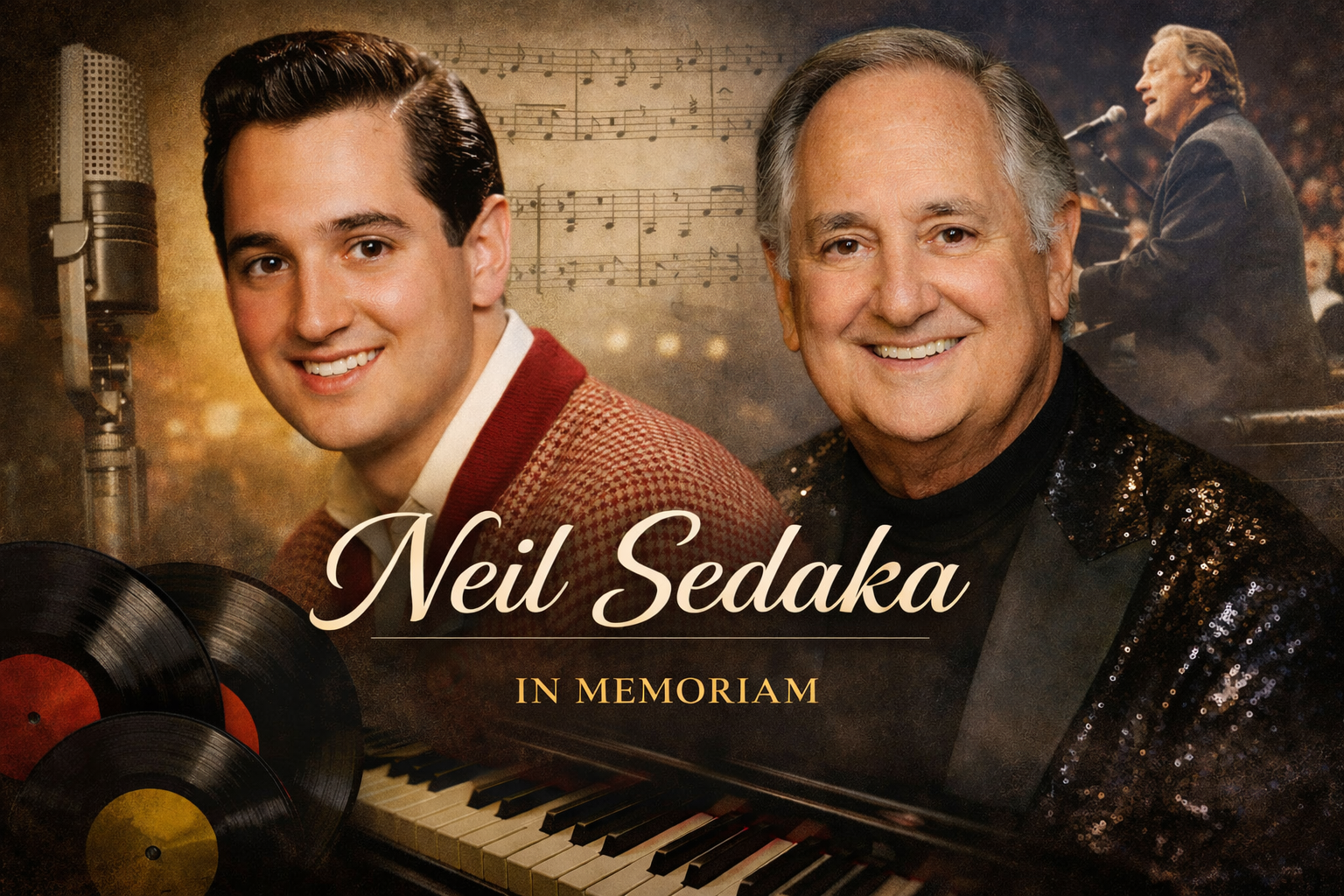
Neil Sedaka, the Brooklyn-born singer-songwriter whose bright melodies powered early rock-and-roll pop and later fueled a major 1970s comeback, has died at age 86, according to reporting from The Associated Press and CBS News.
Sedaka built a rare kind of career: he wrote and performed his own hits, and he also supplied other artists with songs that turned into standards. Audiences first met him as a clean-cut teen-pop presence in the late 1950s and early 1960s, when his songs captured the anxieties and sweetness of young romance. Decades later, he returned to the top of the charts with a softer, adult-leaning sound that still carried the same melodic clarity.
His death immediately prompted tributes that focused on the work ethic behind the smile: Sedaka wrote constantly, performed for decades, and treated songwriting as craft as much as inspiration. In an era when pop often prizes novelty, his legacy points to something more durable—structure, hooks, and emotional directness that listeners can hum after one play.
What we know so far
Reports say Sedaka died Friday at age 86, and his family confirmed the death in a statement.
The family said they felt “devastated” by his passing and described him as a “true rock and roll legend” and “an inspiration to millions.”
News outlets have not reported an official cause of death.
A family statement and limited details
In the first hours after the news broke, most reputable reporting focused on confirmation rather than explanation. The Associated Press reported no additional immediate details beyond the family statement. CBS News similarly reported that a cause of death was not immediately available.
That restraint matters, especially with public figures. In the social media era, rumors can outrun verification, and the most responsible coverage tends to prioritize what family members and representatives confirm. For now, the public record emphasizes Sedaka’s work and the scope of his influence rather than any medical specifics.
From Brighton Beach to Juilliard
Sedaka’s story begins in Brooklyn, where he grew up in Brighton Beach and showed unusual musical ability early. Britannica notes that he earned a scholarship to Juilliard’s preparatory division as a child after progressing quickly at the piano.
The Songwriters Hall of Fame describes him as a piano prodigy who later attended Juilliard and performed on classical radio as a teenager—early proof that his foundation sat as much in discipline as in show business ambition.
That classical training left fingerprints all over his pop writing. Even when he aimed straight at Top 40 radio, he tended to build songs with clear harmonic movement and memorable melodic arcs. You can hear that sensibility in the way his choruses “arrive” with a sense of inevitability—simple on the surface, carefully engineered underneath.
The Brill Building partnership with Howard Greenfield
One relationship shaped the first half of Sedaka’s career more than any other: his songwriting partnership with lyricist Howard Greenfield. The Associated Press described them as key figures in the Brill Building “songwriting factory,” and it highlighted the way their songs expressed teen innocence in the post-Elvis, pre-Beatles moment.
The Songwriters Hall of Fame adds important texture: Sedaka and Greenfield met young, wrote relentlessly (a “song a day” routine), and navigated the New York music business together while they learned how publishers, producers, and artists turned demos into hits.
If you want a shorthand for why Brill Building writers mattered, you can look at Sedaka and Greenfield. They treated pop like a professional field with standards: strong titles, concise storytelling, and hooks that a singer could sell in three minutes. That approach helped define an assembly line of hits in an age when radio demanded immediacy.
Teen-pop stardom and early signature hits
As a performer, Sedaka paired an approachable stage presence with a voice that stood out—higher, lighter, and more “boyish” than many of his contemporaries. AP coverage noted his “boyish soprano” and “bright melodies,” which made him a top act in rock’s early years.
His early run included songs that still function as shorthand for a whole slice of American pop: “Calendar Girl,” “Happy Birthday Sweet Sixteen,” “Oh! Carol,” and “Breaking Up Is Hard to Do.” Those titles show the range of his early brand: playful novelty, earnest romance, and clean heartbreak that teens could claim as their own.
“Breaking Up Is Hard to Do” became especially central to his public identity. The song sits right at the intersection of craft and instinct: it sounds effortless, but it lands its emotions with precision. Over time, it also became a marker of his adaptability, because he later recorded it again in a different style, proving he could reshape a familiar hook for a changing audience. (Many artists chase reinvention; Sedaka often achieved it by refining, not replacing, his core strengths.)
A songwriter for other voices
Sedaka’s influence doesn’t stop with his own discography. He wrote or co-wrote an enormous amount of material—Britannica puts his output at more than 500 songs—and other major performers recorded his work, including Frank Sinatra and Elvis Presley.
The Associated Press also emphasized the breadth of covers and the way his songs traveled across genres and generations, from classic pop to later rock-era interpretations. That’s a key indicator of songwriting durability: artists cover songs when the composition itself holds value beyond one arrangement or one voice.
Sedaka and Greenfield also helped propel Connie Francis with “Stupid Cupid” and the theme song “Where the Boys Are,” according to AP reporting and the Los Angeles Times. In practical terms, that meant Sedaka didn’t just write hits—he helped define the sound and emotional vocabulary of an era’s pop storytelling.
Then he did it again later. CBS/AP reporting notes that Captain & Tennille took “Love Will Keep Us Together” to the top in 1975. When a song succeeds with one artist and then explodes with another, it usually signals a composition sturdy enough to survive new production trends.
Reinvention after the British Invasion
Many Brill Building artists struggled when the Beatles and the British Invasion changed what American pop rewarded. The Los Angeles Times described Sedaka as someone who didn’t fully “weather” that shift and eventually left the U.S. for England after record-label problems in the late 1960s.
That period matters because it sets up the second act. Sedaka didn’t disappear. He kept writing, kept recording, and kept looking for the right conditions to reintroduce himself to the mainstream on his own terms. The “dry spell” in U.S. charts didn’t reflect a lack of output; it reflected a market that had moved on—and an artist patient enough to keep working until the market moved again.
The 1970s comeback: Rocket Records and chart-toppers
Sedaka’s return in the 1970s stands as one of pop’s more notable comebacks because it didn’t rely on nostalgia alone. He delivered new songs that fit the decade’s radio sound while still sounding unmistakably like him.
CBS/AP reporting credits Elton John with “rediscovering” Sedaka when John launched his Rocket label, and it points to Sedaka’s renewed success with “Laughter in the Rain” and “Bad Blood.” The Los Angeles Times similarly reports that Elton John signed him to Rocket and that Sedaka notched No. 1 hits again in that era, while Captain & Tennille’s version of “Love Will Keep Us Together” added to the moment.
The comeback also highlighted a key Sedaka trait: he didn’t treat pop trends as threats. He treated them as arrangements waiting to happen. He could place the same kind of melodic clarity into softer production, bigger choruses, and adult contemporary pacing without losing his identity.
Why his songwriting endured
A Sedaka song tends to do three things well:
It uses titles that sound like conversations people already have (“Breaking Up Is Hard to Do” works as a statement before it even becomes a lyric).
It builds melodies that resolve cleanly, so listeners feel satisfaction even when the subject turns bittersweet.
It respects time. His best songs move quickly, say what they need to say, and leave before they over-explain.
That approach explains why his catalog stayed active long after first release. When songs rely on a production fad, they age with the fad. When they rely on structure and melody, new generations can repaint them with new instrumentation and still keep the core intact.
Sedaka also wrote as both composer and performer. That dual identity often improves a song’s “singability” because the writer imagines breath, phrasing, and audience reaction from inside the act, not from outside the booth.
Late-career visibility and a new generation of fans
Sedaka didn’t stop performing when radio stopped calling. AP reporting says he played dozens of concerts a year well into his 80s and maintained enthusiasm for performing even after singing the same standards hundreds of times.
He also found ways to reach younger audiences. People reported in 2025 that he shared TikTok duets with his grandson, including performances at the piano that framed his early hits as living family music rather than museum pieces.
That kind of late-career moment says something important: Sedaka’s songs didn’t require a specific cultural context to work. They could live in a 1962 radio countdown, a 1975 adult contemporary slot, or a casual social media clip decades later. Not many catalogs travel that easily.
Honors and recognition
Industry institutions also recognized Sedaka’s songwriting legacy. The Songwriters Hall of Fame inducted him in 1983 and later honored him with a lifetime achievement distinction (as listed on his profile). His official biography also notes major career honors, including recognition for his songwriting and charitable work.
Awards can’t fully measure cultural impact, but they do signal something real: peers and institutions viewed him as more than a hitmaker. They viewed him as a craftsman who helped write the vocabulary of modern pop.
Where to start listening
If you want to understand Sedaka’s range quickly, you can start with three lanes:
Early, teen-pop brilliance: “Calendar Girl,” “Oh! Carol,” “Happy Birthday Sweet Sixteen,” “Breaking Up Is Hard to Do.”
The comeback centerpieces: “Laughter in the Rain,” “Bad Blood,” and the broader Rocket-era material that reframed him for 1970s radio.
The songwriter’s reach through others: “Stupid Cupid” and “Where the Boys Are” (associated with Connie Francis) and “Love Will Keep Us Together” (popularized by Captain & Tennille).
That path shows why his reputation lasted: he didn’t just “have hits.” He built a toolkit for hits.
The legacy he leaves
Neil Sedaka’s career offers an unusually clear lesson about pop longevity. He didn’t depend on mystery, controversy, or reinvention-by-erasure. He depended on melody, on repetition as craft, and on the willingness to keep working when trends turned against him.
For fans, the immediate moment centers on loss. For music history, the longer view centers on output: a catalog that helped define early rock-pop, survived the genre’s upheavals, and returned with enough force to dominate a second decade of radio. Reporting continues to develop, but the through line already reads clearly—Sedaka wrote songs that outlived the eras that produced them.