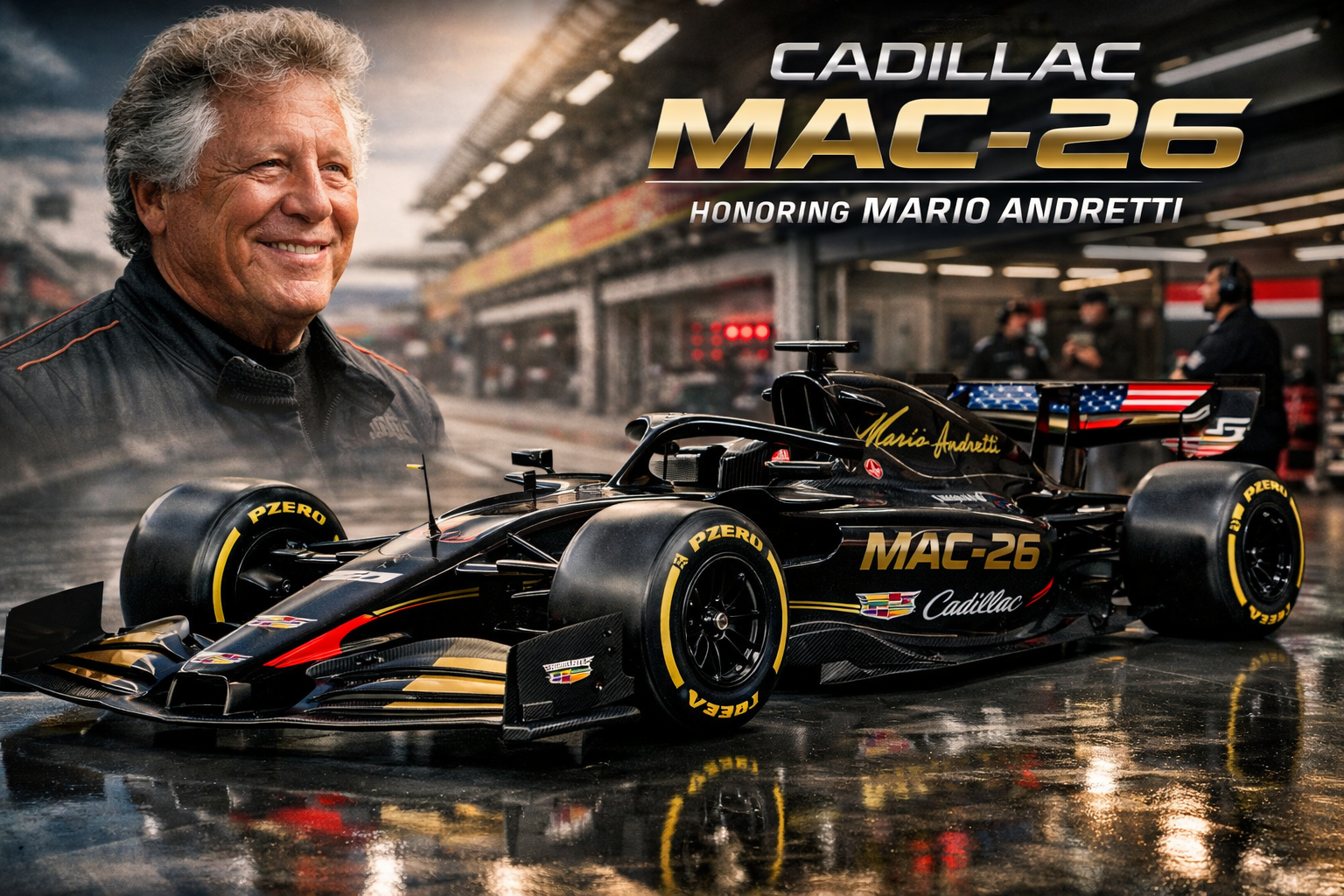
Cadillac will take its first official step onto the Formula 1 grid in 2026 with a debut chassis name that leans hard into American racing history. The new team will call its first car the MAC-26, a reference that ties Cadillac’s F1 identity directly to Mario Andretti, the 1978 Formula 1 world champion. Andretti described the gesture as the “ultimate compliment,” framing it as a lasting bond between his career and the sport’s modern era. The announcement lands just ahead of Cadillac’s first race weekend, which will start the 2026 season in Melbourne.
What “MAC-26” means and why Cadillac chose it
Cadillac didn’t pick a random internal code or a sponsor-friendly nickname for its first Formula 1 chassis. The team chose MAC-26 as a deliberate acronym: Mario Andretti Cadillac, paired with 26 to mark the 2026 campaign. The name places Andretti’s legacy right on the face of the project, and it tells fans exactly which lineage Cadillac wants to project. It also gives the team a simple identifier that fits the sport’s tradition of chassis designations, while still sounding like a statement. Cadillac’s leadership framed the choice as recognition for Andretti’s influence on the team’s formation and the wider push to bring a top-tier American brand to the grid.
The timing: a naming reveal right before Cadillac’s first F1 season
Cadillac’s naming news arrives at a moment when teams normally focus on testing data, reliability fixes, and the final development sprint before the opener. The 2026 season will begin in Australia, with the race weekend running March 6–8, 2026, so Cadillac’s message does double duty as branding and momentum. In practical terms, the name becomes the label that follows every early performance talking point: first laps, first qualifying, first points chase, and the first comparison against the midfield. In symbolic terms, Cadillac gets to introduce itself with a story that predates most of the current paddock. That matters because a brand-new team needs more than a logo and a livery to feel “real” in Formula 1.
Why Mario Andretti still carries unique weight in Formula 1
Mario Andretti holds a rare position in global motorsport: he connects American racing culture to Formula 1’s most storied decades without sounding like a marketing invention. He won the 1978 Formula 1 world championship, and he remains the most recent American champion in the sport. He also built a broader résumé that includes major wins across disciplines, which helps explain why Cadillac wants his name attached to its first chassis. For many fans, Andretti’s career represents a period when drivers crossed categories more freely and when American success in F1 still felt possible rather than hypothetical.
Just as important, Andretti serves as a living reference point in a time when Formula 1 has expanded aggressively in the United States. That growth creates opportunity, but it also creates noise, with new audiences trying to sort substance from spectacle. Andretti offers Cadillac a form of credibility that doesn’t depend on social media traction or celebrity paddock shots. His involvement signals that Cadillac wants to look serious to long-time followers as well as newer fans.
Andretti’s personal reaction: pride, gratitude, and continuity
Andretti framed the honor in personal terms, emphasizing how much racing shaped his life and identity. He did not treat the naming as a nostalgic gimmick, and he didn’t pitch it as a victory lap for the past. Instead, he positioned it as a recognition that connects his history to Cadillac’s future in the sport. That framing matters because the team needs to present itself as forward-looking under the 2026 ruleset, not as a museum exhibit. Andretti’s “ultimate compliment” line works because it expresses emotion without turning the project into a tribute act.
How Cadillac got here: from an ambitious idea to an approved 11th team
Cadillac’s F1 entry didn’t happen overnight, and it didn’t follow the smoothest path. The project developed through years of lobbying, planning, and negotiation, with shifting public narratives about whether Formula 1 wanted an additional team. Cadillac’s involvement, backed by General Motors and aligned with the Andretti-linked effort, helped reshape the pitch into something F1’s commercial leadership could support. The final result put Cadillac in position to join the grid as the sport’s 11th team, a rare expansion moment in modern F1. That journey explains why Cadillac now leans on legacy and credibility, because the team had to prove it could add value rather than simply take a slice of the revenue pie.
The role of leadership: Towriss and Lowdon as the public faces
A new team lives or dies on execution, and Cadillac has emphasized leadership stability as it ramps toward its first races. Team CEO Dan Towriss has spoken publicly about presenting an “American spirit” while still competing inside F1’s technical and sporting realities. Team principal Graeme Lowdon brings direct F1 experience and a reputation for operational focus, which matters when a team builds its processes from scratch. Together, they represent the “now” of the Cadillac effort, while Andretti represents the historical through-line. The MAC-26 name links those two halves into one identity.
Why naming a chassis matters more than it sounds
Fans often treat chassis names as trivia, but a first chassis name can shape a team’s identity for years. Formula 1 teams use naming conventions to signal culture, engineering philosophy, or brand priorities. Some teams stick with clean numbering systems that highlight iteration, while others embed sponsor cues or internal project language. Cadillac chose a third route: it put a person—specifically a motorsport legend—at the center of the first-year story.
That choice also sets a reference point for future names. If Cadillac uses MAC-27, MAC-28, and beyond, the team creates continuity that keeps Andretti’s connection visible without needing to repeat the tribute every season. If Cadillac changes conventions later, the MAC-26 will still stand as the “origin marker” that fans and historians cite. Either way, Cadillac ensures that its first entry in F1 record books carries more than a sterile code.
Cadillac’s broader strategy: winning attention without promising wins
A new team can’t realistically promise immediate podiums, especially under the cost cap era and the modern technical complexity of F1. Cadillac instead appears to pursue a two-track strategy: build a credible long-term program while earning near-term attention through smart storytelling. The MAC-26 name fits that approach because it generates headlines without distracting from engineering work. It also avoids the trap of overhyping performance, which often backfires when reality arrives in qualifying. Cadillac can celebrate heritage and ambition while still talking about learning curves and development.
The 2026 rules: why the timing favors a new entrant
Cadillac enters Formula 1 right as the sport resets major technical regulations in 2026. Regulation shifts can compress gaps, at least temporarily, because every team starts from a new baseline with new design constraints. That dynamic doesn’t guarantee competitiveness, but it can reduce the advantage that entrenched teams usually gain from continuity. Cadillac can design its systems and workflows specifically for the 2026 framework instead of unlearning legacy habits. A new team also gets to recruit talent with a clear “build something new” pitch, which can attract engineers who want ownership and influence.
At the same time, the 2026 changes increase risk. New power unit architectures, new aero philosophies, and new operational demands can punish teams that miss early decisions. Cadillac will need strong integration between chassis, power unit packaging, and race operations from day one. The name MAC-26 may celebrate legacy, but the car itself will need ruthless modern efficiency.
Power units and partnerships: the practical side of a romantic story
Every new team must solve the power unit puzzle, because engine supply and integration shape performance, reliability, and packaging. Cadillac has aligned its early program around a partner supply arrangement before it transitions toward greater vertical integration later. That approach mirrors how other newcomers have entered the sport, balancing speed-to-grid against long-term ambition. Fans may focus on the name and the tribute, but the team will win credibility through clean weekends, solid reliability, and visible development. If Cadillac shows it can operate like a mature organization early, the MAC-26 name will feel earned rather than ornamental.
The driver line-up factor: experience as an accelerator
Cadillac has signaled that it values experience for its first season, which makes sense for a team that needs fast feedback loops. Veteran drivers can translate handling traits into actionable engineering direction and can help a new organization avoid costly dead ends. They also bring familiarity with race-weekend rhythm, which matters when hundreds of small decisions determine whether a team executes or unravels. In year one, Cadillac likely gains more from consistency and clarity than from raw youth upside. That approach doesn’t diminish long-term goals, but it does set a pragmatic tone for 2026.
What the MAC-26 needs to achieve in year one
Cadillac doesn’t need miracle results to define its first season as a success. The team needs to clear a set of foundational benchmarks that show readiness and momentum. It needs to finish races consistently, avoid operational chaos, and demonstrate steady upgrades that move performance forward. It needs to build pit stop processes that don’t hemorrhage time, and it needs to establish a clear engineering direction that survives early setbacks. If Cadillac hits those markers, the MAC-26 will become the first chapter of a credible program rather than a novelty entry.
The cultural message: Cadillac, Andretti, and the idea of American F1 ambition
Formula 1 has grown rapidly in the United States, but the sport still lacks deep American competitive representation at the front. Cadillac’s arrival attempts to change that narrative by combining an iconic American automotive brand with a legendary American racing name. The Andretti connection, even in a symbolic chassis name, suggests that Cadillac wants to root its F1 identity in authentic racing history rather than “sports entertainment” vibes. That approach can resonate with fans who want the U.S. boom to produce competitive substance. It can also appeal to international fans who respect legacy and achievement regardless of nationality.
What comes next: the first weekend, the first data, the first reality check
The story will shift quickly once the season begins in Melbourne. Fans will stop debating branding and start watching lap times, tire wear, and reliability. Cadillac will face immediate comparison against teams that have refined their systems for decades, and the paddock will measure everything from strategy calls to pit wall communication. Early races will reveal whether Cadillac built a stable baseline or whether it needs to scramble to fix fundamental issues. Either way, the MAC-26 name will travel with every headline, because it now functions as the shorthand for Cadillac’s entire first impression.
Final take: a tribute that also serves as a mission statement
Cadillac didn’t just honor Mario Andretti with the MAC-26 name; it also told the world what kind of entry it wants to be. The team wants to look serious, rooted, and ambitious, not loud and temporary. Andretti’s reaction reinforces that tone, because he treated the moment as recognition and continuity rather than nostalgia. Now Cadillac has to match the symbolism with execution, because Formula 1 judges everyone on the stopwatch. If Cadillac builds competence and momentum in 2026, the MAC-26 will read less like a tribute and more like the start of a long-term American project in the sport.