
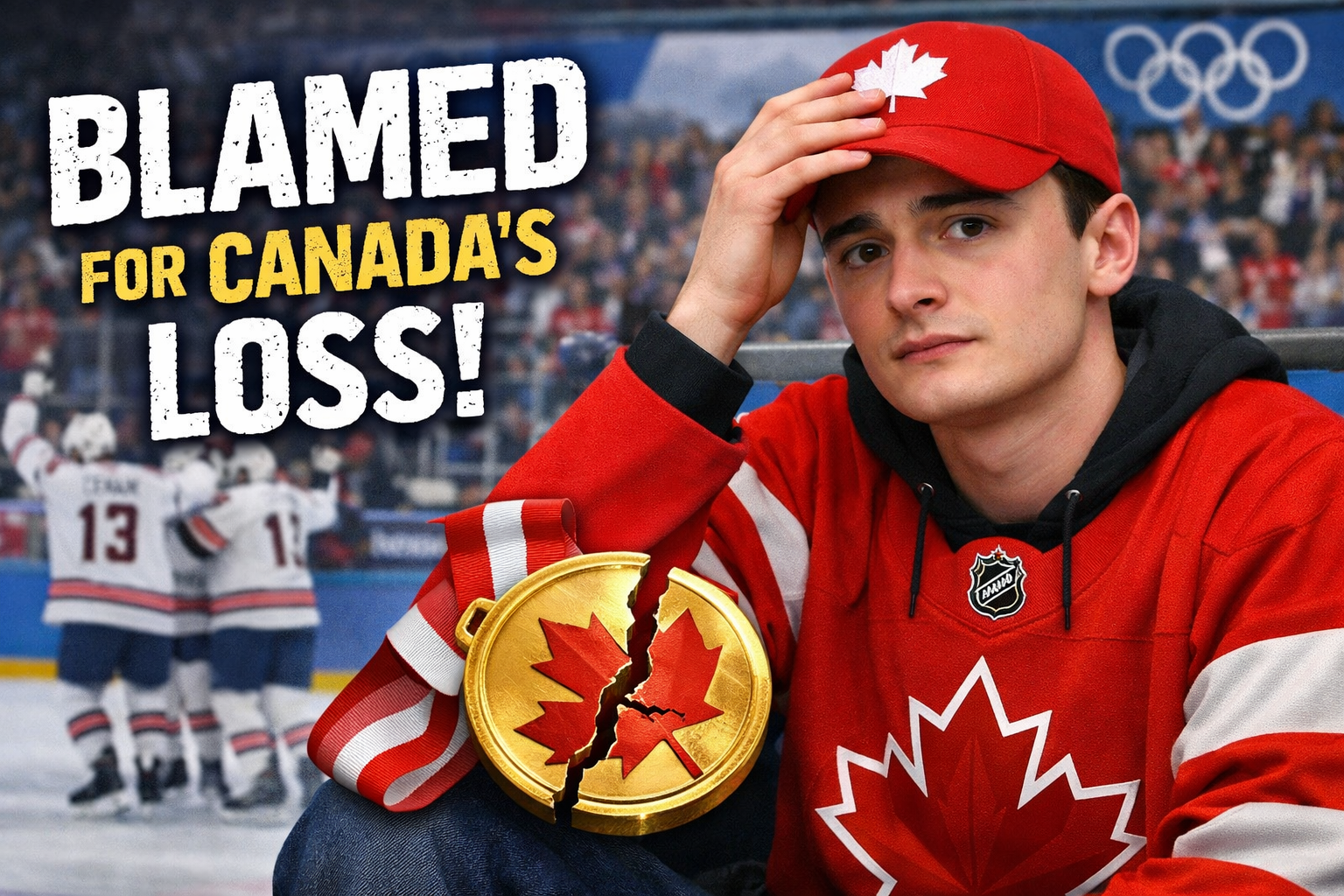
Canada’s men’s hockey team didn’t just lose a gold-medal game on Olympic closing day. It also lost the internet.
After Team USA beat Canada 2–1 in overtime in the Milano Cortina 2026 men’s hockey final, a completely unrelated name started trending in postgame chatter: Noah Schnapp, the actor best known for playing Will Byers on Stranger Things.
To be clear: nobody rational thinks Schnapp affected the outcome of a hockey game played by NHL stars in an Olympic arena. But online sports culture doesn’t run on rationality alone. It runs on screenshots, vibes, superstition, and the irresistible urge to explain a painful loss with a story that’s funny enough to share.
That’s how, within hours, the meme took shape: “Canada lost because Noah Schnapp showed up.”
What follows is what actually happened on the ice, what people think they saw in the stands, and why the internet loves turning a celebrity cameo into a scapegoat narrative—especially when Canada vs. USA hockey is the backdrop.
What actually happened in the Olympic final
The hockey part is straightforward—and brutal if you were cheering for Canada.
Team USA defeated Canada 2–1 in overtime to win the Olympic men’s hockey gold medal, their first Olympic gold in the event since 1980. The game went to extra time tied 1–1, and Jack Hughes scored the winner 1:41 into overtime. Connor Hellebuyck was a major reason the Americans survived regulation, turning aside a huge volume of Canadian chances.
Canada’s tying goal came late in the second period from Cale Makar, setting up a tense third where Canada pushed hard but couldn’t break through.
In other words: a classic, painful rivalry loss. The kind that makes fans start scanning the environment for an explanation that feels simpler than “their goalie was unreal and we didn’t finish.”
The moment that launched the Noah Schnapp meme
During the broadcast (and then in clips and screenshots that raced across social platforms), Noah Schnapp appeared in the crowd wearing Team Canada gear—most notably a red jersey—at the USA vs. Canada gold-medal game in Milan.
That’s the whole “evidence” pile.
No controversial quote. No sideline interview. No locker-room cameo. Just a celebrity face in a very Canadian-looking jersey on the biggest rivalry night in the sport.
Within minutes, X (Twitter) posts started riffing on the idea that Schnapp “jinxed” Canada, calling it a “curse” or implying his presence brought bad luck.
A few entertainment/viral write-ups summarized the reactions with the now-clickable framing: “Internet blames Noah Schnapp for Canada’s loss.”
Why was he cheering for Canada in the first place?
If you only know Schnapp as an American actor from a Netflix mega-hit, the jersey choice looks like a plot twist. But his connection to Canada isn’t new.
Schnapp holds dual U.S.–Canadian citizenship and has long described a strong personal connection to Montreal, where much of his family lives.
More than that, he’s openly a Montreal Canadiens fan. In an NHL interview years ago, he said he’s “true-to-heart” a Habs fan and explained that his fandom came from watching games with his dad.
So if you’re looking for the most boring explanation for why he wore Canada colors, it’s this:
He likes Canadian hockey, he has Canadian ties, and he was at a once-in-a-generation USA–Canada Olympic final.
That’s it.
How the internet turns a random cameo into a “jinx”
Sports fandom has always flirted with superstition. The difference now is scale and speed.
A modern “jinx” meme usually follows a predictable sequence:
- A high-stakes loss happens (especially in a rivalry).
- A weird coincidence is spotted (celebrity in the stands, someone wearing the “wrong” jersey, an unlucky tweet).
- A clean, funny narrative forms (“This person cursed us”).
- The narrative becomes shorthand for emotion (anger + grief + coping, packaged as a joke).
- The joke gets repeated so much it starts sounding like a claim.
Schnapp’s cameo was perfect meme material because it checks every box:
- he’s recognizable,
- he was visibly supporting Canada,
- and Canada lost in a moment that hurt.
The “curse” idea isn’t meant to be a serious causal argument. It’s a way to make the loss feel explainable—and shareable.
Why this one spread so fast
A Canada–USA Olympic hockey final is already a global attention magnet. This specific game had extra fuel: it ended the Olympics, it went to overtime, and it carried the emotional weight of a historic U.S. gold (plus the entire rivalry storyline).
When a clip like “celebrity spotted in the crowd” enters that ecosystem, algorithms do the rest.
A few dynamics amplify it:
The screenshot effect
A single frame of a celebrity in team colors travels faster than any nuanced recap of the third period.
The simplicity advantage
“Canada lost because of X” spreads more easily than “the U.S. goalie was brilliant and Canada couldn’t convert key chances.”
The tribal signal
A celebrity appearing to pick a side in a rivalry invites instant reactions—even if the celebrity has a legitimate reason for that loyalty.
The remix culture
Once the first “jinx” post lands, thousands of people can iterate on it with their own punchline.
Jokes vs. harassment: where memes go wrong
It’s normal for sports fans to vent. It’s also normal for the internet to cope with humor. But there’s a line.
A meme is one thing:
- “Not the Noah Schnapp curse 😭”
- “Why was he there in a Canada jersey??”
- “That’s the jinx, I’m calling it.”
Directing real hostility at a person who was literally just sitting in the stands is another thing—especially when the pile-on starts attracting people who weren’t even watching the game but love a trending target.
What this says about modern fandom
This whole episode is a tiny case study in the new shape of sports attention.
In the past, postgame talk lived on radio, newspapers, and maybe a call-in show. Now it lives in:
- trending tabs,
- viral clip accounts,
- reaction memes,
- and quote-tweet dogpiles.
That ecosystem doesn’t just cover sports. It fuses sports with celebrity culture, fashion-week culture, streamer culture, and whatever else is one algorithmic hop away.
It’s also why a Stranger Things actor can become a postgame talking point in an Olympic hockey final.
The irony: Schnapp is exactly the kind of fan hockey wants
If you’re the NHL or the Olympic broadcasters, you want crossover attention. You want celebrities showing up, taking an interest, signaling that this event is bigger than the sport’s usual bubble.
Schnapp has also publicly engaged with hockey media before, and his Canadiens fandom has been on record for years.
So the same visibility that helps hockey grow its audience is also what makes celebrity fans vulnerable to becoming memes—especially when the game ends in heartbreak for the side they’re cheering for.
The takeaway
Canada didn’t lose Olympic gold because Noah Schnapp wore a jersey.
Canada lost because the game was tight, the margins were ruthless, and the U.S. finished the one chance that mattered most in overtime—behind a massive performance in net.
The internet “blamed” Schnapp because sports fans are human: when a loss stings, people look for a story. And in 2026, the easiest story to share is often the one that fits in a single screenshot.