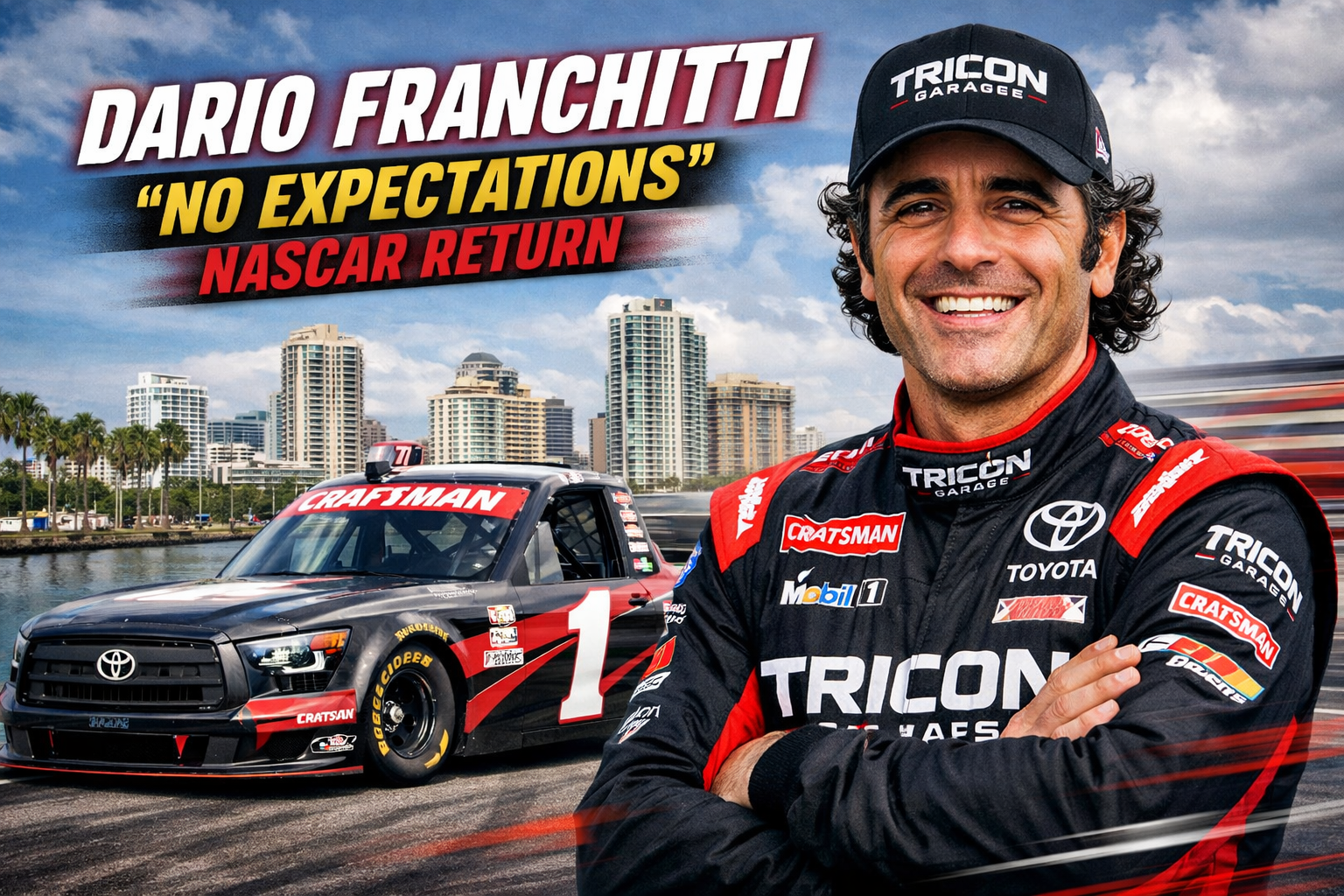
Dario Franchitti will climb back into a race vehicle this weekend in a place that already knows his name: the streets of St. Petersburg, Florida. This time, he won’t wear an IndyCar firesuit or chase points in an open-wheel paddock. He will drive a NASCAR Craftsman Truck Series entry in what NASCAR calls its first Truck street race, a new test that mixes tight walls, short sightlines, and the unpredictability that downtown street circuits always deliver.
The surprise comes from the timing as much as the venue. Franchitti spent the last decade mostly on the other side of the conversation, helping drivers refine lines, brake traces, and decision-making as a team adviser and coach. Now he has to do it in real time, with a spotter in his ear, fenders around him, and a field full of drivers learning the same circuit with almost no meaningful practice time.
Franchitti has leaned into that reality with a simple message: he feels cheerful, curious, and realistic. He said he has “no real expectations,” and he framed the weekend less like a comeback and more like an experience he wants to feel again. NASCAR, his team, and his friends have built a safety net around the challenge, but the race will still demand precision from the first restart onward.
A famous name on an unusually stacked entry list
When fans scan a Truck Series lineup, they usually expect rising prospects, short-track lifers, and a handful of NASCAR veterans who know how to manage chaos. St. Petersburg adds a different ingredient: recognizable road-racing names who already understand how street circuits punish small mistakes. Franchitti sits near the top of that list because he brings both elite street-course experience and a long record of winning in high-pressure moments.
His presence also changes the way people will talk about this event. NASCAR scheduled the Truck Series’ St. Petersburg debut alongside IndyCar’s season-opening weekend, and that pairing naturally invites crossover stories. The series gets new eyes, the venue gets a deeper weekend narrative, and the drivers inherit a race that feels closer to a festival than a traditional Saturday standalone.
Franchitti doesn’t show up as a curiosity act, though. He will start near the front in the No. 1 Tricon Garage Toyota, and he has driven this circuit far more than most of the field. On a street course where drivers often learn by surviving, that familiarity can matter as much as raw speed.
Why the St. Petersburg street race matters for NASCAR Trucks
St. Petersburg gives the Truck Series something it has never had: a true downtown street circuit with walls that crowd the racing line. The course runs 1.8 miles and forces drivers through a rhythm of heavy braking zones, short straights, and corners where passing usually requires trust. NASCAR also scheduled the race at 80 laps and 144 miles, which creates a sprint-like feel even when cautions stack up.
Weather has already shaped the weekend story. Rain cut the scheduled practice short, and NASCAR canceled qualifying, which pushed teams to rely on limited laps, simulation, and their notes from track walks. That lack of time makes the opening phase of the race even more valuable, because everyone will still tune brake feel, shift points, and corner approach under green conditions.
Street circuits also create a specific kind of uncertainty. Normal road courses offer runoff areas and wider margins, but downtown layouts punish over-commitment immediately. A single lockup can turn into a blocked track, and a minor contact can turn into a damaged toe link or a cut tire within a lap.
Franchitti’s “no expectations” mindset isn’t a throwaway line
Athletes often say “no expectations” as a defense against headlines. Franchitti’s version reads more like an honest inventory of variables. He understands the surface, the bumps, and the corner geometry, but he also expects the truck to feel nothing like an IndyCar through the same turns.
He has also acknowledged the randomness that weather can add. On city streets, rain changes more than grip levels because the road holds oil and residue from daily traffic. Drivers can find traction in one braking zone and lose it entirely at the next, and the track can evolve mid-run as the field lays rubber and cleans the racing line.
That mix of confidence and caution fits the moment. Franchitti knows he can still process speed and risk, but he doesn’t pretend he can instantly match drivers who race these trucks every week. He has treated the start as a chance to compete hard without building a storyline that he must “prove” anything.
From mentor to driver again: the mental switch
Franchitti has spent years helping Chip Ganassi Racing drivers find tenths with cleaner entries and better exits. Coaching lets you pause, review data, and talk through alternatives after the lap ends. Racing removes that distance and forces you to commit to decisions before you have full information.
Franchitti has actually laughed about that shift. He described the feeling of arriving at the track as the guy who usually points out mistakes, then realizing he must execute everything himself. That mental flip can energize experienced champions because it returns them to the part of the sport they loved in the first place: the intensity and the personal accountability.
He has also talked about preparation habits that he missed. He mentioned reviewing data, thinking through the day, and feeling that pre-race focus that coaching can’t fully replicate. For him, the value sits in the process, not only in the finish.
Jimmie Johnson made the call—and he plans to stay involved
This start does not happen without Jimmie Johnson. The seven-time NASCAR Cup champion has a long friendship with Franchitti, and he pushed the idea from conversation into a concrete plan. Johnson will also stay involved during the race, offering guidance and adding an extra layer of experience to a weekend where teams already juggle a brand-new venue.
Franchitti has said Johnson dove into the details like a crew member, calling late at night and early in the morning to talk about restarts. That emphasis makes sense because restarts often decide street races. The field bunches up, drivers attack narrow braking zones, and one mistimed move can trigger a pileup that wipes out contenders.
Their dynamic also adds a human element that fans understand. A champion convinces another champion to try something unfamiliar, then invests time to help him survive it. The story sells itself because it feels less like a marketing stunt and more like two racers chasing a fresh challenge.
Franchitti’s career context makes this weekend heavier—and lighter
Franchitti doesn’t need this start for a résumé line. He already built a Hall-of-Fame-caliber career with four IndyCar championships and three Indianapolis 500 wins, and IndyCar’s own retirement announcement in 2013 tied his exit directly to medical advice after his Houston crash. He left at the top level of the sport, and he built a respected second chapter as an advisor and mentor.
That context makes the surprise start feel heavier because fans remember why he stepped away from full-time racing. It also makes the moment lighter because he has nothing to chase. He can approach the weekend like a competitor who values the experience, respects the risk, and still wants to feel that unique pressure that only a start grid creates.
His background also fits St. Petersburg specifically. He has won on this circuit in IndyCar, and he understands how a street track rewards patience more than bravado. That familiarity won’t solve every Truck Series problem, but it will help him anticipate where the race will bite people.
What changes when an open-wheel champion drives a NASCAR Truck
Street-circuit knowledge travels well, but the vehicle still dictates the technique. A NASCAR truck carries more mass, asks for different braking management, and responds differently when the rear steps out over bumps. The truck also invites contact in a way that open-wheel racing never encourages, and that changes how drivers defend and attack.
Franchitti will need to manage the “accordion effect” that happens on restarts and in tight sections. Trucks can bump, slide, and lean on each other without immediate retirement, so drivers often accept a level of friction that would end an IndyCar race. Franchitti has NASCAR experience from earlier in his career, but he still has to re-learn the feel in a modern field, on a circuit that leaves no room for indecision.
He will also have to adapt to visibility and reference points. An IndyCar sits low and gives a different sightline into corners, while a truck’s nose and ride height change what you can see at turn-in. On a street course, where walls block peripheral vision, drivers rely heavily on rhythm and consistent landmarks, and those landmarks feel different from a higher cockpit.
The weekend format amplifies uncertainty and opportunity
Because weather erased most of the available practice and NASCAR canceled qualifying, teams have fewer chances to dial in a perfect setup. That situation often helps experienced racers who can live with an imperfect balance and still put the vehicle in safe places. It can also hurt newcomers to street racing, because they don’t get enough laps to build trust in the braking zones.
The race distance should keep urgency high. Eighty laps can disappear quickly when cautions don’t arrive, but street circuits usually create interruptions through incidents and debris. That combination often rewards drivers who can stay calm, protect the truck early, and then attack when the field thins out.
Franchitti’s starting position gives him a real shot to matter in the opening stage. Starting near the front reduces the risk of mid-pack chaos, at least until the first restart reshuffles everything. If he can keep the truck clean through the first major rhythm of the race, he can turn the day into a legitimate performance instead of a survival story.
What to watch once the green flag drops
Watch how Franchitti handles restarts, especially the first two. He has said Johnson has already coached him on that specific skill, and restarts can decide who escapes the early mess. If Franchitti times the first braking zone well and avoids wheel hop into the corner, he can set a tone for the day.
Watch how he manages aggression around him. NASCAR drivers will not give him extra space simply because of his IndyCar résumé, and the field will race him like any other competitor. If he responds with clean, predictable moves, he can earn the kind of respect that reduces risky dive-bombs later.
Watch how the race evolves if rain arrives. Street-course rain tends to create sudden leaders because drivers who find grip first can open gaps fast. If Franchitti’s track knowledge helps him identify where the surface drains and where it stays slick, he can gain time without forcing hero moves.
Bottom line: a challenge, not a comeback tour
Franchitti has framed this weekend the right way: a one-off challenge with too many variables for guarantees. NASCAR will run a historic first for the Truck Series on a circuit that punishes overconfidence, and Franchitti will jump into the middle of it with a smile and a realistic outlook. He has the background to look comfortable quickly, but the race will still demand adaptation to trucks, restarts, and traffic.
If he runs near the front, the story will write itself as a successful crossover. If he struggles, the result still won’t define him, because he already owns the career that most drivers only dream about. Either way, his “no expectations” line fits the moment: it keeps the focus on the experience, the event, and the simple thrill of competing again.