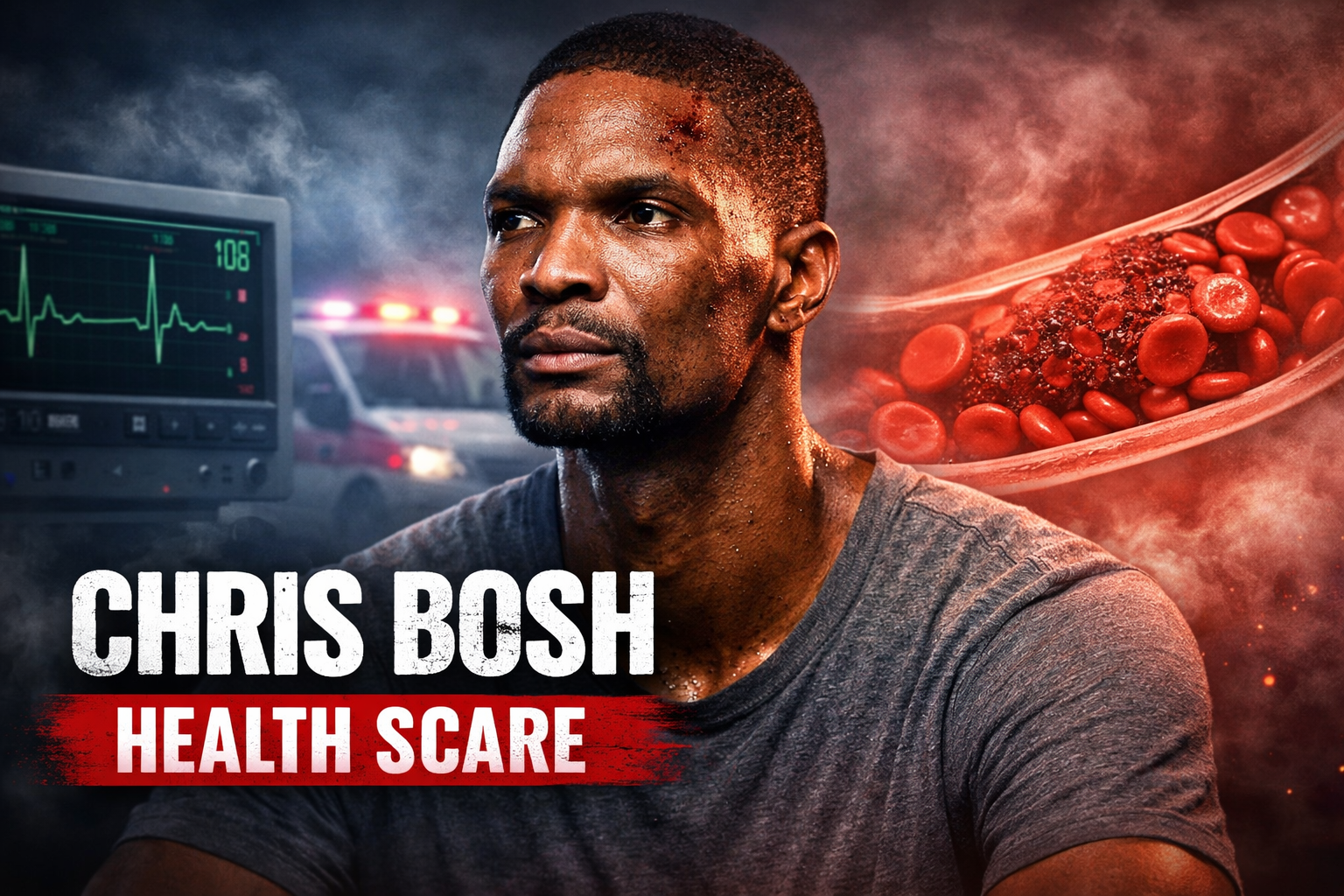
Chris Bosh says a sudden medical emergency left him shaken and grateful to still feel “alive.” He shared the story in an essay titled “Return From the Darkness,” which he published on February 22, 2026, through his Substack newsletter, The Last Chip.
Sports and celebrity outlets picked up the account in the days that followed, including a TMZ report published on February 25, 2026. That coverage focused on Bosh’s description of blacking out without warning and waking up injured while his wife contacted emergency responders.
The story gained extra attention because fans already connect Bosh’s name with a prior, career-ending health fight. Blood clots forced him away from the NBA during what should have been his prime years, and that history makes any new “health scare” headline feel heavier than it would for many other retired athletes.
What Chris Bosh said happened
Bosh described an ordinary moment that turned scary fast. He wrote that he walked from his closet toward the bathroom while preparing for an evening out. He then felt a sharp, electric numbness shoot down his left leg. He says the next moment arrived without warning: he blacked out and found himself on the floor.
When he regained awareness, he says his wife spoke with 911 and he struggled to move the way he normally would. He described the event as terrifying and unfamiliar, and he emphasized how quickly life can “collapse” without warning signs. TMZ echoed the same sequence, noting that he did not disclose when the incident occurred and that he appeared to show visible signs of recovery afterward.
Bosh did not share a medical diagnosis in his essay. He framed the piece as a reflection on mortality, attention, and priorities rather than a clinical update. That distinction matters, because the public only knows what he chose to write and what outlets repeated from that writing.
What remains unknown and why responsible coverage avoids guessing
Because Bosh kept medical specifics private, no one outside his care team can responsibly label a cause. A blackout can come from many different issues, and the same symptom can point to something benign, serious, or somewhere in between. Bosh did not describe tests, treatments, or a doctor’s conclusion, so any definitive claim would go beyond confirmed facts.
That gap often fuels online speculation, especially when a famous athlete carries a well-known medical history. Readers can still engage with the story in a grounded way by separating two questions that often blur together: what happened in the moment, and what caused it medically. Bosh answered the first question in personal detail. He left the second question unanswered in public.
TMZ highlighted the most dramatic lines from his account and stressed the “health scare” framing. That approach can draw attention, but it can also compress a nuanced, reflective essay into a single alarming takeaway. The original post reads less like a breaking-news alert and more like a wake-up call about how quickly a normal day can shift into an emergency.
Why this hit fans harder than a typical celebrity update
Bosh’s basketball résumé keeps him in the public eye even years after his last NBA game. He won championships with the Miami Heat in 2012 and 2013 and earned 11 All-Star selections across 13 seasons. The Naismith Basketball Hall of Fame lists him as part of the Class of 2021.
Miami also honored him in a very visible way. The Heat announced a jersey retirement ceremony for his No. 1 jersey on March 26, 2019, which reinforced his status as a franchise cornerstone from the LeBron James–Dwyane Wade era.
So when Bosh says he blacked out and needed emergency help, fans do not hear it as a random scare involving a retired player. They hear it through the lens of a career that already ended because health risk overtook competition.
The blood-clot timeline that shaped the public’s reaction
Bosh’s earlier health problems centered on blood clots that affected his ability to play safely. Sporting News describes how doctors discovered blood clots in one of his lungs in February 2015, which ended his season and started a long stretch of uncertainty around treatment and recurrence.
He returned for the 2015–16 season, but doctors later found another clot during the 2016 All-Star break, according to the same timeline. The situation then moved from “temporary setback” to “repeat risk,” because recurrence can change how doctors and leagues evaluate long-term safety in high-contact, high-impact sports.
Sporting News also reports that he failed a physical before training camp for the 2016–17 season and that the NBA later ruled his blood-clotting condition a career-ending illness in June 2017. The timeline explains why fans react strongly to fresh health news, even when Bosh does not connect the new incident to clots.
How clinicians think about “blacking out”
Doctors often use the term “syncope” to describe fainting or passing out. The American Heart Association explains that syncope often happens when blood pressure drops too low and the heart does not pump enough oxygen-rich blood to the brain. The AHA also notes that syncope can range from harmless to a symptom of an underlying condition, which explains why clinicians take it seriously when it occurs suddenly.
Cleveland Clinic outlines how clinicians evaluate syncope with tools like blood tests, an electrocardiogram (EKG), and monitoring that tracks heart rhythm over time when needed. Doctors choose tests based on the circumstances, witness accounts, and risk factors. A single symptom does not automatically point to a single cause.
This medical context helps explain why the public should avoid racing toward one diagnosis, especially with limited information. Bosh described the experience vividly, but he did not publish a medical explanation, and responsible reporting should not fill that blank with certainty.
Why people immediately mention clots and pulmonary embolism
Fans often connect Bosh’s blackout story to his clot history because clots can cause serious emergencies, including pulmonary embolism. The CDC lists symptoms of pulmonary embolism that can include very low blood pressure, lightheadedness, or fainting, along with breathing difficulty and chest pain. Mayo Clinic also lists fainting (syncope) as a possible symptom when heart rate or blood pressure drops suddenly.
Those sources explain why the public mind goes there first, but they do not establish what happened in Bosh’s case. Many conditions can cause syncope, and only a clinician who reviewed his vital signs, history, and test results could confirm a cause. Without that, the most accurate approach keeps the medical discussion general and clearly labeled as background.
Bosh himself did not frame the episode as a recurrence of a known disease. He framed it as a reminder that life can change quickly, even when you think you have regained stability after a major setback.
What Bosh emphasized instead of a diagnosis
Bosh used the incident to confront a mindset he says he carried after his earlier career-ending health crisis. He wrote that he thought he controlled his future and that he chased momentum, validation, and “markers of success” he saw online. He then admitted that he felt “owed more” from life after surviving the health situation that ended his playing career, and he said the scare challenged that belief directly.
He described a change that sounded less like inspiration and more like simplification. He wrote that he did not experience a dramatic life-flashing moment, but he did feel immediate gratitude and a sobering awareness of how fragile ordinary routines can be. TMZ quoted the same theme, portraying the scare as something that reset his perspective rather than something that delivered a neat, cinematic lesson.
That framing helps explain why the essay resonated beyond basketball fans. Bosh did not ask readers to treat him as a medical mystery. He asked them to treat time, attention, and relationships as urgent, because the next “normal” moment can disappear without warning.
The larger media lesson in a direct-to-fan era
Bosh chose a modern path for sharing personal news: he published first in his own voice. That approach gives public figures more control over tone and meaning, but it does not fully control how headlines amplify the most dramatic detail. TMZ centered the emergency description and then summarized the message as a call to pay attention to yourself and your surroundings. Both elements existed in the story, but each one leads readers toward a different takeaway.
Direct publishing can reduce rumor cycles, but it can also create an information gap. Fans want updates, diagnoses, and timelines. Writers want confirmation and documents. Bosh offered neither in public, and that choice forces everyone else to either respect boundaries or speculate. High-quality coverage typically chooses the first option and builds context from reliable medical and sports sources rather than from guesswork.
In practical terms, this story shows why readers should return to primary sources. Bosh’s own essay includes the clearest chronology and the clearest intent. Secondary coverage can add visibility, but it rarely adds certainty unless it includes confirmed medical statements from Bosh or his representatives.
What comes next
Bosh may share more details, or he may keep the medical specifics private. Either outcome fits what he already published, because he used the scare to talk about how he wants to live, not to invite the public into a clinical file.
For now, the most accurate summary stays straightforward. Chris Bosh says he blacked out during an ordinary evening routine, regained consciousness during an emergency response, and walked away with a sharper awareness of how quickly life can change. He did not share a diagnosis or a date for the incident, and outlets reporting on the story have relied on his own words.
Fans can still take something useful from the story without making medical assumptions. Bosh’s message points toward attention, presence, and urgency in the everyday parts of life. He asks the reader a simple question—“Why wait?”—and he frames that question as the only response that makes sense after a moment that could have ended differently.