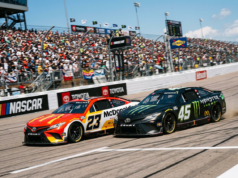

Former NASCAR driver Chase Pistone has died at age 42, according to announcements shared by family and covered by multiple motorsports outlets on March 2, 2026.
As of the initial reports, no official cause of death was released publicly. Several coverage items emphasized the suddenness of the news and focused on family tributes and the racing community’s reaction rather than medical details.
Pistone wasn’t a long-tenured Cup Series name, but he was a recognizable figure in the NASCAR ecosystem because his career touched multiple levels of the sport. He made starts in what are now the Xfinity Series and the Craftsman Truck Series, along with ARCA competition, and he was well known in Legends and short-track circles as both a racer and a car builder.
In other words, this is the kind of loss that lands in two places at once: the national-series record book and the grassroots racing community where many careers are built.
Who Chase Pistone was in the NASCAR world
Chase Pistone’s name carried a family connection to NASCAR history. He was the grandson of “Tiger” Tom Pistone, a two-time NASCAR Cup Series race winner whose era predates the current media-and-sponsorship machine but remains part of the sport’s lineage.
That family thread matters for context, but Pistone’s own identity in racing wasn’t simply inherited. His career is better understood as a blend of two tracks: driving and building.
On the driving side, Pistone’s NASCAR national-series résumé was compact, spread across a small number of starts and concentrated in specific windows of opportunity. On the building side, he developed a reputation for helping other racers with equipment, preparation, and the kind of behind-the-scenes work that rarely makes television but often decides whether young drivers can keep climbing.
That combination is why tributes hit so hard in the motorsports community. Many people knew him not only as a competitor, but also as a person who made it easier for others to compete.
A career shaped by the ladder system: from Legends to national series
To understand Pistone’s role in racing, it helps to view him through the ladder system that feeds NASCAR: karting and youth divisions, then Legends cars, then Late Models and regional touring series, and finally the national platforms when the right funding and timing line up.
Legends racing, in particular, is a proving ground. The cars are spec, the races are tight, and the environment teaches drivers to be aggressive without being reckless. It also teaches teams how to operate with limited resources, because Legends programs often run on hustle more than budget.
Pistone became closely associated with that world. Even when he wasn’t running NASCAR races, he remained connected to the sport’s pipeline by staying active in the forms of racing that create the next generation of drivers and crew members.
That matters, because a lot of NASCAR’s public conversation focuses on the top. But the sport survives because of the middle: the racers, builders, and mentors who keep local competition alive and keep talent moving upward.
The NASCAR timeline: key starts, key moments, and what he accomplished
Pistone made his first NASCAR Truck Series start in 2005 at Martinsville, one of the most technically demanding short tracks on the schedule because it exposes any weakness in braking, handling, and patience.
He made a NASCAR Busch Series (now Xfinity Series) start in 2006, also at Martinsville, a detail that underscores how early opportunities often come at tracks where teams can control costs and where a driver’s short-track background can translate quickly.
The most significant chapter of his national-series career, though, came in 2014. NTS Motorsports signed Pistone to drive the team’s No. 9 Chevrolet in a scheduled slate of Truck Series races, which positioned him for a more consistent run than his earlier one-off appearances.
That 2014 period is where his best NASCAR result lives: a ninth-place finish in the Truck Series at Gateway (now World Wide Technology Raceway). Multiple outlets highlight that top-10 as the marker of his peak national-series day.
He also made Xfinity (then Nationwide) starts in 2014, adding to a record that shows how drivers in his lane often move between opportunities rather than staying locked into one full-time seat.
On paper, it’s a short list of starts. In reality, it represents something many fans understand: the gap between “has the talent to belong” and “has the funding and continuity to stay” is enormous in modern stock-car racing.
The part of his racing life many people knew best: car building and mentorship
If you only measure success by national-series starts, you miss a big portion of why Chase Pistone mattered to the racing community.
Pistone was also associated with CP Inc., a program tied to building and supporting Legends and Late Model stock cars. In the world of grassroots racing, that kind of operation can be as influential as a driving résumé. The builder becomes a multiplier: one person’s knowledge improves multiple cars, multiple weekends, and multiple careers.
This is where Pistone’s reputation often lands in tributes. People who work around short tracks know how rare it is to find someone who can both drive and build, because those skills pull in different directions. Driving demands focus on feel and execution. Building demands patience, process, and repetition.
When someone can do both, they tend to become a hub in their local racing ecosystem. Drivers seek them out. Teams listen. Younger racers learn faster because mistakes get corrected before they become expensive.
That’s a quieter legacy than trophies, but it’s a real one.
How the motorsports community responded
The first wave of reaction to Pistone’s death centered on family grief and a broad outpouring from the racing world. The tone across posts and coverage was consistent: shock, sadness, and a reminder that even in a sport built around risk, loss still feels sudden and personal when it comes to someone people saw at tracks and in shops.
In moments like this, fans often learn a different truth about motorsports culture: the community is large, but it’s not distant. People travel together, race together, compete hard, then share the same garages and the same small circles week after week.
That closeness is why the reaction spreads quickly. It’s also why the response often extends beyond racing stats into stories about character, generosity, and the ways someone showed up when others needed help.
At the same time, early reporting also made clear what wasn’t confirmed. Without an official public statement on cause, most outlets avoided speculation.
Why this story resonates beyond one name
There are a few reasons the death of a former NASCAR driver, even one without a long Cup career, hits harder than people outside the sport might expect.
One is that NASCAR’s national series are only the visible tip. Underneath is a massive support structure: short tracks, Legends programs, Late Model teams, haulers, fabricators, engine builders, parts suppliers, and families who spend weekends making racing possible.
Drivers like Pistone sit at the intersection of those worlds. They represent the path a lot of racers dream about: climb from grassroots racing into NASCAR’s national garage, even if the run is brief.
Another reason is that NASCAR fans tend to value “racers” as much as “stars.” There’s a deep respect in the culture for people who can wheel a car and also understand what it takes to prep it, fix it, and make it faster.
And finally, this is a reminder that racing careers are rarely linear. Many competitors move between driving, building, owning, mentoring, and supporting. Their impact can be spread across dozens of people who were faster, safer, and more confident because of what they learned from them.
What we know, what we don’t, and how to cover it responsibly
In any death story, especially one moving quickly online, accuracy matters more than speed.
What we know from early coverage is limited to the confirmed facts: Chase Pistone died at 42, and news of his passing was shared publicly by family and reported by established motorsports outlets.
What we do not know, at least from the same early reporting, includes detailed circumstances and an officially released cause.
That boundary matters. It’s the difference between reporting and rumor, and it’s especially important in motorsports where tight communities can amplify speculation fast. The most respectful approach is to focus on the life and the contributions, and to leave medical details to the family unless they choose to share more.
If additional confirmed information becomes public later, it can be addressed then. But in the immediate moment, the clearest thing the public record supports is a remembrance: a competitor and builder who left a mark in the places that develop racing talent.
Remembering Chase Pistone’s place in racing
If you want the simplest summary of Chase Pistone’s racing identity, it’s this: he was part of the working fabric of stock-car racing.
He reached NASCAR’s national series level, including Truck Series starts and an Xfinity appearance, and he logged a best national-series finish that stands out as proof he could deliver when the opportunity was real.
He also remained deeply connected to the grassroots side of the sport through building and supporting Legends and Late Model cars, which shaped the weekends and careers of other racers in ways the stat sheets won’t capture.
That mix is a big reason his death is being felt across multiple layers of the NASCAR world. It’s not only about a name that appeared on national-series entry lists. It’s about the person behind the name—someone who competed, worked, and helped keep racing moving.
For many fans, the best way to honor someone like that is also simple: show up to local racing, support the tracks and teams that keep the pipeline alive, and remember that the sport’s most important figures aren’t always the ones on the biggest stage.