
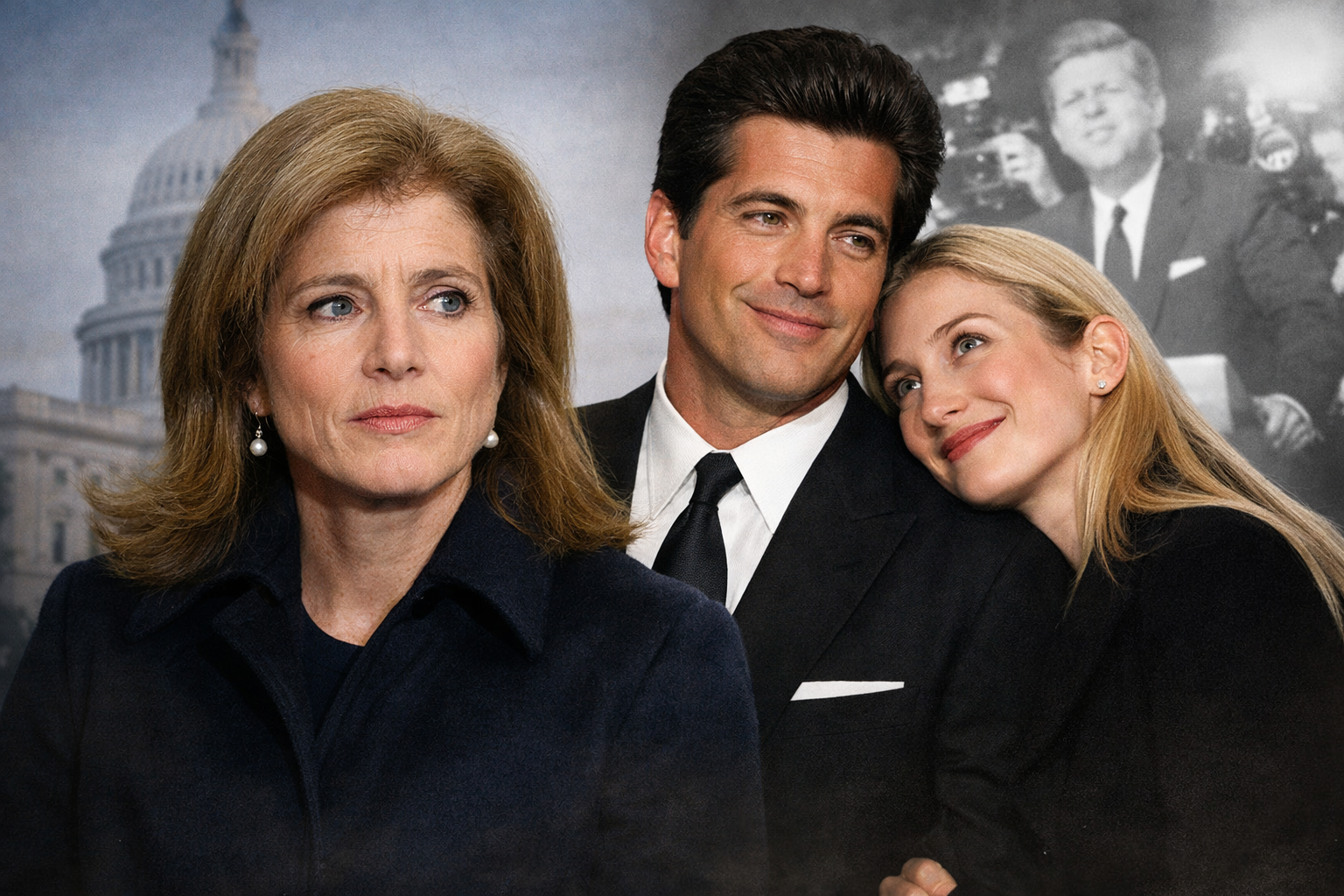
FX’s Love Story: John F. Kennedy Jr. & Carolyn Bessette sells itself as a romance, but it can’t tell that romance honestly without the Kennedy family system around it. That system shaped where John F. Kennedy Jr. could go, who he could trust, and how the public framed his choices. In that orbit, Caroline Kennedy matters more than many viewers expect.
Caroline doesn’t “compete” with the central couple for attention in real life, and she doesn’t need to in a dramatization, either. Instead, she functions as something rarer in celebrity storytelling: a character who embodies memory, responsibility, and the rules of survival inside a famous family. When a show wants to dramatize how an outsider like Carolyn Bessette experienced the “Kennedy glare,” Caroline provides an intimate, believable bridge between two worlds—the private family and the public myth.
This article breaks down how Love Story can use Caroline as a narrative anchor, why writers almost have to include her, where the portrayal can go wrong, and what viewers should watch for if they want to separate drama from history.
What FX’s Love Story Is Trying to Do
Love Story frames JFK Jr. and Carolyn Bessette as an iconic 1990s couple caught between devotion and constant exposure. FX positions the series as a sweeping, research-driven romance, and it casts Grace Gummer as Caroline Kennedy alongside the actors playing John and Carolyn.
That casting choice signals intent. The show doesn’t treat Caroline as a background Kennedy relative. It treats her as part of the core lens through which viewers interpret John’s relationships, the family’s expectations, and the emotional cost of life inside a national legend.
Caroline Kennedy’s Real-World Relevance to the Love Story
In real life, Caroline occupies a singular position in the Kennedy narrative. She grew up with the same family trauma as her brother, lived through the same public fixation, and learned the same rules about privacy and control. She also carried different expectations than John did. The public read John as the charismatic heir—photogenic, flirted with by politics and media. The public read Caroline as steadier, more private, more dutiful.
That contrast matters in a relationship drama because it gives writers a built-in tension: John can romanticize freedom, while Caroline remembers the bill that always comes due. Even without inventing villainy, a show can plausibly depict Caroline as the person who asks hard questions: What happens when the honeymoon ends? What happens when paparazzi camp outside your door? What happens when someone marries into this and decides she hates it?
The Character Function Caroline Can Serve on Screen
In a limited series, every major supporting character should do a job. Caroline’s best “jobs” in Love Story fit into four buckets.
First, she can act as John’s emotional translator. John might explain his restlessness as ambition or romance. Caroline can call it what it often looks like from the inside: grief, pressure, identity conflict, and a lifetime of strangers projecting destiny onto you.
Second, she can act as the family’s boundary keeper. Viewers understand boundaries through conflict. When a writer needs to show “this is what the Kennedy machine demands,” Caroline can deliver that message in a personal way.
Third, she can act as a mirror for Carolyn. Carolyn’s discomfort with fame becomes sharper when she meets someone who already mastered the performance of public life. The show can contrast two coping strategies—Carolyn resists; Caroline manages.
Fourth, she can act as a moral reality check. Not a scold, not a caricature—just the person who remembers that public fascination can ruin private happiness.
Caroline as Protector, Not Villain
A dramatization risks turning Caroline into the easy antagonist: the frosty sister who “doesn’t approve.” Some critics have already noted that the show can position her as an obstacle even when the performance adds humor and humanity.
But the strongest interpretation doesn’t need that framing. A protector can create friction without cruelty. A protector can dislike the spotlight without disliking the person caught in it. A protector can question Carolyn’s fit in the family without reducing Carolyn to an intruder.
If the series wants emotional credibility, it should let Caroline hold two truths at once: she wants her brother happy, and she fears the costs of the story the world insists on telling about him.
Caroline as the “Institution” in Human Form
Families don’t appear on TV as systems. They appear as people. Caroline can represent the institution of “Kennedy-ness” because she embodies continuity. She links John’s childhood to his adulthood. She connects the famous past to the precarious present.
That representation matters because the show doesn’t just dramatize a relationship. It dramatizes a collision between a person (Carolyn) and an inheritance (the Kennedy brand). A show can stage that collision through press scrums and tabloid headlines, but it lands harder when it shows the quiet internal enforcement: the family dinner etiquette, the political small talk that feels like a test, the expectation that you smile through discomfort.
When Caroline steps into scenes like that, she doesn’t need to deliver speeches about legacy. She only needs to behave like someone who has lived with cameras long enough to develop reflexes.
Caroline and Jackie: A Two-Generation Pressure Cooker
One of the show’s most interesting possibilities comes from a triangle: John, Caroline, and their mother, Jacqueline Kennedy Onassis.
John and Caroline didn’t just inherit fame. They inherited a parent who guarded them against it while also living inside it. A series can use Caroline to show what that does to siblings: one child becomes the charismatic risk-taker; the other becomes the stabilizer. That dynamic doesn’t require exaggeration—many families under extreme stress split roles like that.
When Love Story depicts Caroline as “still playing surrogate parent” to John, it taps into a recognizable sibling pattern, not just a Kennedy-specific one.
Caroline as a Foil to the Fantasy of Escape
Romance stories love a fantasy: “Love will free us.” In this particular romance, the fantasy runs into a harder truth: love can’t dissolve celebrity.
Caroline helps the show dramatize that truth without turning Carolyn into a symbol. If the series only uses paparazzi as the antagonist, it risks simplifying the problem into “bad media.” When the series uses Caroline, it can show something more nuanced: the family’s protective habits can also feel controlling; privacy strategies can also feel like cages; loyalty can also feel like surveillance.
In other words, Caroline can reveal the paradox of famous families: they develop defenses to survive, and those defenses can damage intimacy.
The Privacy Theme and Why Caroline Strengthens It
A major thread in commentary around Love Story involves privacy—how the story condemns intrusion while also recreating it for entertainment.
Caroline’s presence sharpens that theme because she stands closest to the line between public and private. The show can depict her as someone who learned to treat privacy as an ethical duty, not a preference. That framing matters because it keeps the series from collapsing into a simplistic battle: “the lovers vs. the paparazzi.”
It also helps viewers understand why the family might close ranks. When you watch characters who have endured public tragedy, you understand how they might respond to a new outsider—especially one who didn’t grow up rehearsing the performance of being watched.
The Hard Part: Limited Public Record and the Temptation to Invent
Caroline keeps a relatively private posture compared with many public figures tied to famous dynasties. That reality creates a writing problem: you can’t pull endless quotable material from interviews to build a “definitive” character.
So the show faces a choice.
It can depict Caroline narrowly, as a bundle of traits that serve the romance plot: disapproving, anxious, controlling.
Or it can depict her as a person built from credible inferences: a sister who loves her brother, a family member who understands how quickly attention turns predatory, and an adult who developed coping strategies that look cold to outsiders.
The second option requires restraint. It also requires writers to admit what they don’t know—and to avoid presenting invented private conversations as settled fact.
Why the “Consultation” Controversy Changes How Viewers Read Caroline
Even if the series avoids sensationalism, some viewers will judge it through an ethical lens: did the production consult the families, and should it have?
Producers have said they didn’t contact members of either the Kennedy or Bessette families and chose instead to rely on research and “emotional truth.”
That choice matters for Caroline’s portrayal more than it matters for some other characters. Viewers will assume—fairly or not—that the show invents more of her private interior life, because she offers fewer public soundbites. If the series wants trust, it should treat Caroline with particular care: fewer cartoonish confrontations, fewer overly neat “explainer” scenes, and more moments that feel like human behavior under pressure.
What to Watch For: Signs of a Careful Portrayal
If you want to evaluate whether Love Story handles Caroline well, look for these indicators.
The show gives her private stakes beyond the romance. She should care about John’s mental health, identity, work, and stability—not only whether he dates Carolyn.
She experiences conflict with the family system too. A realistic portrayal shows that even insiders chafe under expectations.
She shows warmth in small ways. Protective people often look sharp on the outside and tender in the details. A series can reveal that without turning her into a saint.
She doesn’t exist only to deliver exposition. If every Caroline scene explains the Kennedy family to the audience, the character will feel like a plot device.
FAQ: Caroline Kennedy and FX’s Love Story
Does Love Story treat Caroline Kennedy as a major character?
Yes. FX lists Grace Gummer as Caroline Kennedy in the main cast lineup for the season, which signals central importance rather than a cameo role.
Why does the story “need” Caroline?
Because the romance didn’t happen in a vacuum. Caroline can show the family pressures John carried and the cultural machinery Carolyn faced after the relationship went public.
Does the show portray her as antagonistic?
Some reviews argue that the series frames Caroline largely as an obstacle, even while acknowledging dimension in the performance.
Should viewers treat Caroline’s scenes as factual?
Viewers should treat the series as dramatization. The production emphasizes research and emotional truth, but it also acknowledges it didn’t rely on family participation.
Bottom Line: Caroline Anchors the Story’s Real Conflict
A romance about JFK Jr. and Carolyn Bessette can easily slide into glossy tragedy: beautiful people, beautiful clothes, inevitable doom. Caroline Kennedy helps prevent that—if the writing uses her well.
She can ground the series in the lived reality of a famous family: grief that never fully fades, scrutiny that never stops, and an inheritance that complicates every attempt at normal love. In that frame, Caroline doesn’t “compete” with the couple. She explains why their love story felt both intoxicating and impossible—and why the audience still can’t stop retelling it.