
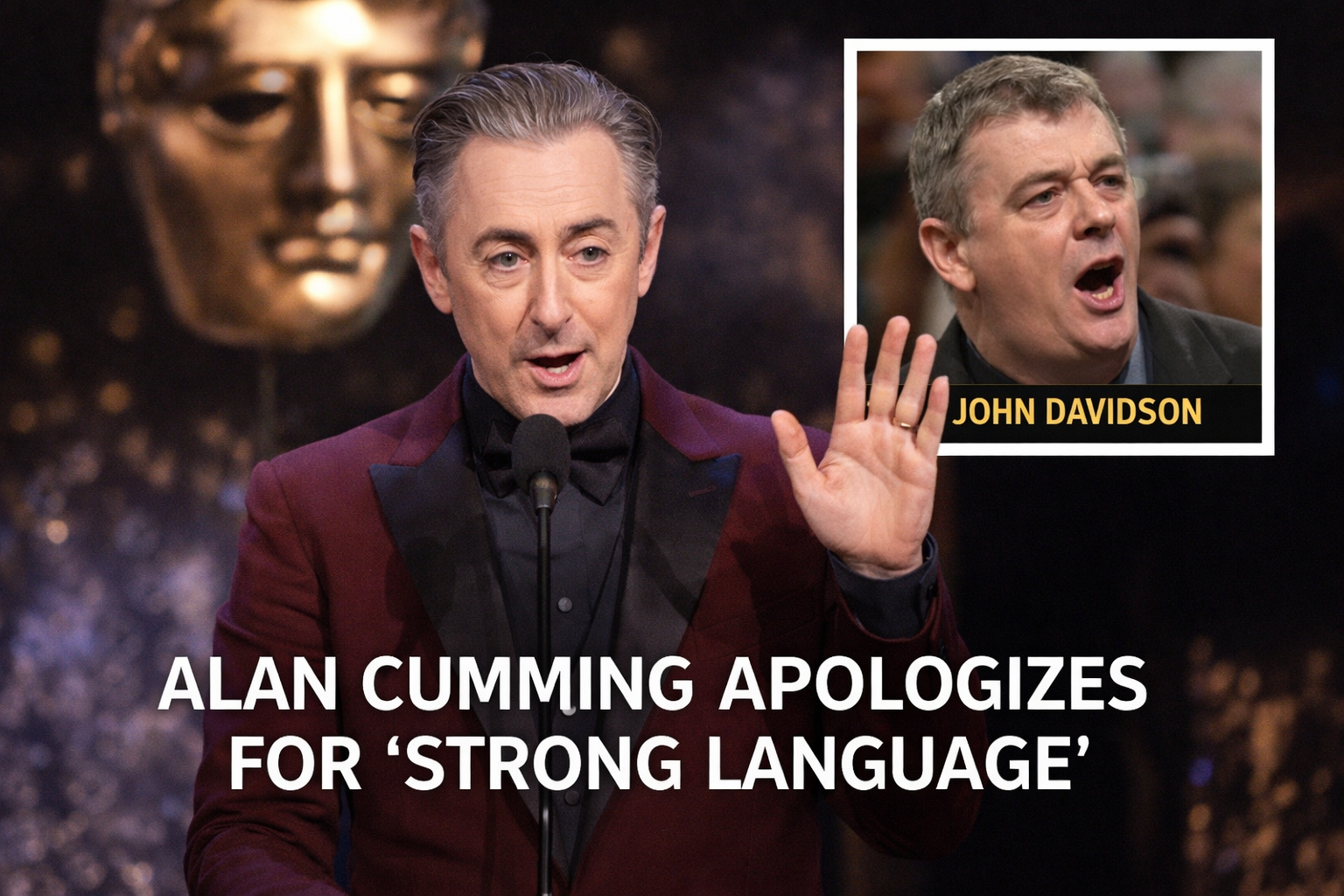
The 2026 EE BAFTA Film Awards at London’s Royal Festival Hall delivered the usual mix of glamour and major wins—alongside an unexpected, much-discussed interruption that quickly became a wider conversation about disability, live events, and broadcast standards.
During the ceremony on February 22, 2026, the audience and viewers could hear bursts of profanity and, at least once, a racial slur coming from the crowd. BAFTAs host Alan Cumming paused the program to explain what was happening, asked for understanding, and later apologized to anyone offended by the language.
According to multiple reports, the outbursts came from John Davidson, a Scottish Tourette syndrome campaigner whose life helped inspire the film I Swear, a nominee on the night.
What happened inside the ceremony
The incident unfolded in fragments rather than a single moment. Reports describe intermittent “strong language” being audibly picked up by microphones during televised segments, at times cutting across presenters and speeches.
Entertainment Weekly reports that Davidson could be heard early in the program and again later, including a moment when actors Michael B. Jordan and Delroy Lindo were on stage presenting an award, during which a racial slur was heard from the audience. (Out of respect and basic standards, this article will not repeat the slur.)
As confusion spread—especially among viewers who did not immediately know the context—Cumming addressed the room. In remarks reported by multiple outlets, he told the audience they may have noticed strong language in the background, explained that this can be part of how Tourette syndrome presents for some people, and thanked the crowd for helping keep the environment respectful.
Later, Cumming added a more formal clarification: that Tourette syndrome is a disability, that some vocal tics can be involuntary, and that he apologized to anyone offended by what they heard.
Who is John Davidson, and why was he there?
John Davidson is widely described as a Tourette syndrome campaigner and advocate, and his presence at the BAFTAs was tied to the film I Swear, which dramatizes aspects of his life and experience.
Several reports note that Davidson became publicly known as a teenager through the BBC documentary John’s Not Mad (1989), which followed him living with severe Tourette syndrome at a time when public understanding of the condition was far more limited.
In the years since, Davidson has been portrayed as someone who turned unwanted public attention into long-term advocacy—giving talks, supporting young people, and helping broaden understanding of Tourette syndrome beyond pop-culture stereotypes. Entertainment Weekly and The Independent both report he was awarded an MBE in 2019 for his activism and education work.
The Tourette syndrome context: why “strong language” can happen
Tourette syndrome is a neurological condition characterized by tics, which can be motor (movement) tics or vocal (sound/word) tics. These tics are generally involuntary, though some people can suppress them temporarily—often at a cost of discomfort, stress, or rebound later.
One of the most persistent misconceptions is that Tourette syndrome automatically means uncontrollable swearing. In reality, the symptom most people think of—coprolalia, the involuntary use of obscene or socially inappropriate words—affects only a minority of people with Tourette syndrome. The U.S. CDC summarizes this clearly: coprolalia affects about 1 in 10 people with Tourette syndrome.
The UK’s NHS similarly notes that swearing can occur but is rare compared with other vocal tics.
That distinction matters here for two reasons:
- It explains why many viewers—hearing profanity at a major awards show—initially assumed they were listening to heckling or a deliberate disruption.
- It underscores why advocates often push for accurate language: coprolalia is real, can be distressing for the person experiencing it, and can also create real-world social harm when heard by others.
Why the moment landed so awkwardly on television
Even if the room understood what was happening, the at-home audience did not necessarily get the same context at the same time.
The Independent reported that people attending the ceremony were informed about Davidson’s Tourette syndrome, but that an early explanation did not make it into the broadcast, leaving some viewers initially confused about the background interruptions.
There is also a structural broadcast factor: the BAFTAs are typically not aired fully live in the same way some other awards shows are. Entertainment Weekly reports that the BBC does not air the BAFTAs live and instead edits and condenses the show for a later broadcast window.
Separately, Vanity Fair’s winners recap notes the ceremony aired later on BBC One in the UK and as a pre-recorded special for U.S. audiences, reinforcing that many viewers’ experience of the night is shaped by editorial choices.
Put simply: an arena or theater can hold nuance in a way a clipped broadcast sometimes can’t. When viewers only hear outbursts but don’t immediately hear the explanation, the default assumption becomes “heckling,” not “symptoms.”
Why Alan Cumming apologized—and why reactions varied
Cumming’s response carried two messages at once:
- an educational framing (this is Tourette syndrome; it can present this way; thank you for understanding), and
- a social repair gesture (apologizing to anyone offended by the language).
That dual approach is common in live-event hosting: you stabilize the room and acknowledge impact without turning the moment into a spectacle.
But it also created a predictable split in reactions.
Some viewers read the apology as basic courtesy—an attempt to acknowledge that offensive language was broadcast without warning, while still protecting and contextualizing the person responsible for it involuntarily.
Others argue that apologizing can inadvertently reinforce the idea that the disabled person is “at fault,” even when the host explicitly states the tics are involuntary. This is a long-running tension in disability discourse: balancing empathy for the person experiencing symptoms with sensitivity to those harmed or triggered by what they heard, especially when the language includes slurs.
One reason this specific case drew heightened attention is the content of what was overheard. Profanity is one thing; a racial slur heard in a packed hall—particularly while Black presenters are onstage—inevitably has a different emotional weight for many viewers, regardless of medical context.
The film factor: “I Swear,” representation, and the BAFTAs spotlight
The controversy is inseparable from the film that brought Davidson into the BAFTAs orbit.
Reuters reports that actor Robert Aramayo won Best Actor for his performance as Davidson in I Swear, beating several high-profile nominees, and also won the EE Rising Star prize.
Vanity Fair’s recap also lists Aramayo as the Best Leading Actor winner and the Rising Star winner, and credits I Swear with winning Best Casting.
That awards success reframes the night’s viral moment: it wasn’t only an uncomfortable interruption; it was also a major industry validation of a performance rooted in disability experience.
Representation debates often hinge on questions like:
- Who tells the story—an insider, an outsider, or a collaboration?
- Does the project educate or exploit?
- Does it broaden public understanding or recycle stereotypes?
A film like I Swear (based on a widely documented real-life experience) can do meaningful educational work—yet it can’t fully control how the audience reacts when the real person’s symptoms show up in an arena designed for flawless presentation and controlled sound.
Coprolalia and public misunderstanding: the stereotype problem
Because “Tourette’s equals swearing” is a familiar media trope, many people who live with Tourette syndrome (including those who do not have coprolalia) spend years dealing with assumptions, jokes, or disbelief.
The Tourette Association of America explicitly addresses this misconception, stating that coprolalia affects approximately 10% of people with Tourette syndrome and is frequently exaggerated in entertainment portrayals.
The CDC makes the same point in plain terms: most people with Tourette do not blurt out obscenities, and the “Hollywood version” is not representative.
That matters for interpreting what happened at the BAFTAs:
- For some viewers, the moment was a rare “live” encounter with a symptom that is usually discussed abstractly—and the shock was real.
- For others, it felt like the public was rediscovering the condition from scratch, as if decades of education efforts had not happened.
- For advocates, it was another reminder that big cultural events still aren’t very good at explaining disability in real time without confusion or stigma.
The event-planning challenge: inclusion vs. harm reduction
Live events already plan for many risks: technical failures, stage invasions, unexpected political statements, wardrobe malfunctions. A disability-related audio disruption sits in a different category because it is not “misbehavior” to be controlled—but it can still produce consequences that organizers must consider.
In broad strokes, awards producers face competing responsibilities:
- Access and inclusion: ensuring disabled guests can attend and participate without being treated as liabilities
- Duty of care: minimizing foreseeable harm to others, including targeted groups, especially when slurs are audible
- Broadcast obligations: meeting standards for language, watershed rules, and editorial policies for television partners
There are no perfect answers, but there are better and worse approaches.
A better approach usually includes:
- proactive audience context (so “heckling” assumptions don’t spread)
- clear on-air framing if it’s audible
- avoiding sensational cutaways or “reaction shots” that turn symptoms into spectacle
- post-event communication that centers both disability understanding and audience impact
Cumming’s on-stage explanation attempted to do the first two in real time—though, as The Independent notes, broadcast edits can still undermine that goal if context is clipped or delayed.
The broadcast-editing question: what viewers get to see
Entertainment Weekly reports that the BBC edits and condenses the BAFTAs for broadcast, a structure that can protect audiences from unexpected moments but can also remove context that helps audiences interpret what happened.
From a newsroom perspective, this creates a second-order controversy:
- Was the explanation included early enough for at-home audiences?
- Were the interruptions edited out, minimized, or left in without adequate context?
- Did editorial choices make the situation seem like deliberate heckling before clarifying the disability context?
These questions matter because they influence the public narrative. When people only see confusion, they post confusion. When they later learn it involved Tourette syndrome, the conversation can swing to polar extremes—either harsh judgment or simplistic “nothing to see here.” The harder truth is that multiple perspectives can coexist without canceling each other out: involuntary tics are real, and so is the discomfort caused by hearing slurs.
Where the story goes next
In the immediate aftermath, the viral angle is likely to fade and the industry angle will remain:
- I Swear now has major awards momentum, with Aramayo’s Best Actor win and Rising Star win cementing it as one of the night’s headline stories.
- The BAFTAs have been reminded—again—that microphone placement, room audio, and broadcast editing can turn a complex human reality into a blunt online debate.
- Disability advocates will likely keep pushing the same core message: Tourette syndrome is not a punchline, coprolalia is not the whole condition, and people deserve dignity even when symptoms are socially difficult.
If there’s a constructive takeaway, it’s that the cultural institutions with the biggest megaphones—the major awards shows included—can either reinforce misconceptions or help correct them. The difference often comes down to preparation, framing, and whether they treat disability as part of the public they serve rather than a disruption to be managed.