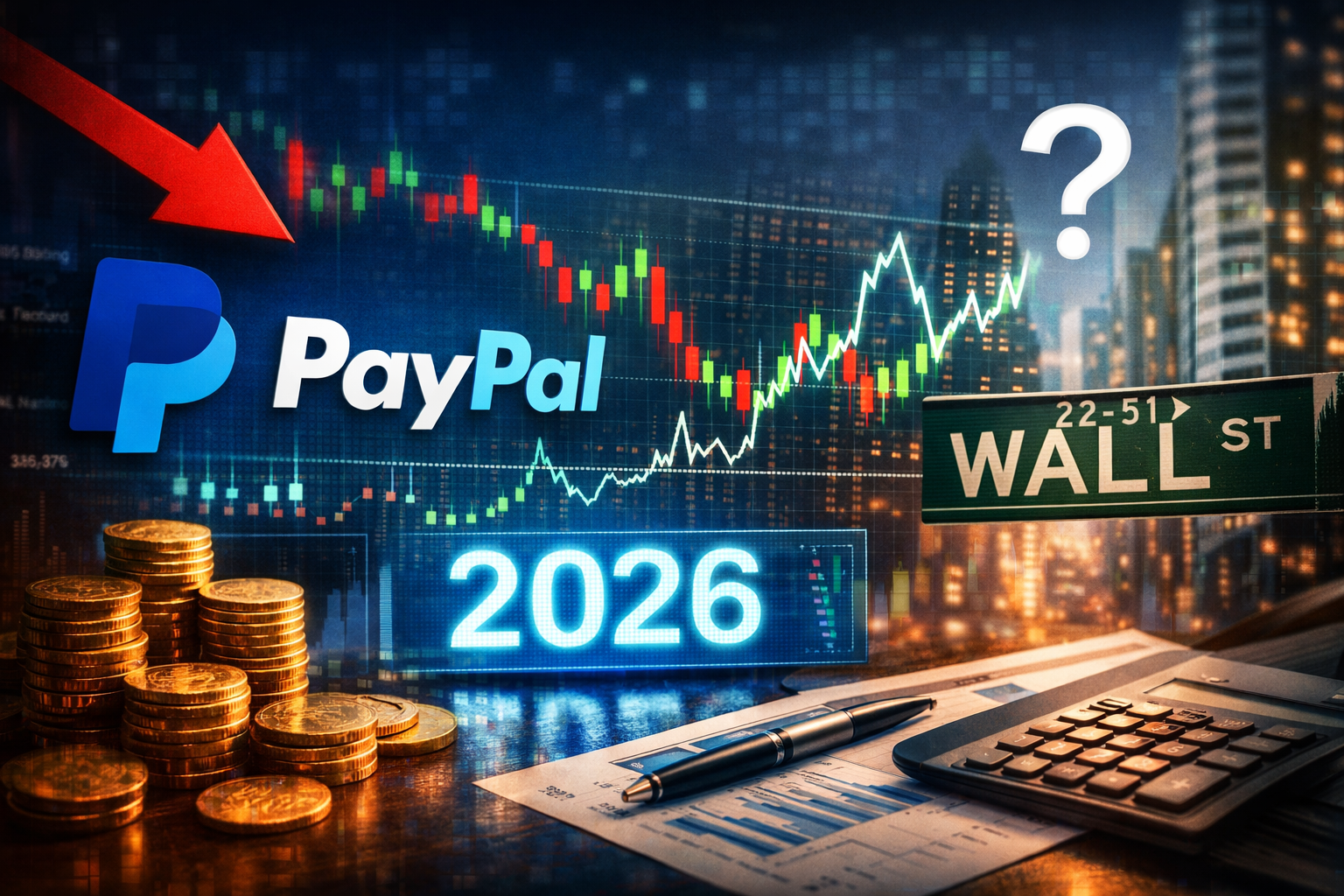
PayPal stock sits at a major decision point.
The company still processes huge payment volume. It still owns strong brands, including PayPal and Venmo. It still generates profits and cash flow at scale. But growth has slowed, competition has intensified, and leadership changes have added uncertainty. Reuters also reported fresh takeover speculation involving Stripe, which quickly moved the stock.
As of the latest quote available through the market data tool, PayPal (NASDAQ: PYPL) traded at $47.02. The tool also showed a positive daily move and a P/E ratio near 13.0, which highlights why many investors now view PayPal stock as a valuation debate, not just a growth story.
This article breaks down what matters most for PayPal stock right now: the latest results, the 2026 outlook, management changes, core business trends, risk factors, and what investors should watch next.
Why PayPal Stock Is Back in Focus
Two events pushed PayPal stock back into the spotlight.
First, PayPal reported fourth-quarter and full-year 2025 results on February 3, 2026. The company showed revenue growth, margin improvement, and higher EPS for the full year. It also posted a softer 2026 profit outlook. Reuters said that outlook came in well below Wall Street expectations, and the shares dropped sharply after the report.
Second, Reuters reported on February 24, 2026 that Stripe was considering an acquisition of PayPal or parts of PayPal, based on a Bloomberg report. Reuters also said both companies declined comment and that Reuters could not independently verify the report. PayPal shares closed nearly 7% higher that day, according to Reuters.
Those two headlines create a clear market narrative.
One side sees a mature fintech with strong assets and weak sentiment. The other side sees a company that lost momentum in its core business and now faces structural pressure.
Both views contain some truth.
What PayPal Actually Reported in the Latest Quarter
PayPal’s own earnings release gives a mixed picture.
For Q4 2025, PayPal reported:
- Net revenue of $8.676 billion, up 4% year over year
- GAAP operating income of $1.511 billion, up 5%
- GAAP operating margin of 17.4%, up 19 basis points
- GAAP EPS of $1.53, up 38%
- Non-GAAP EPS of $1.23, up 3%
- Total payment volume (TPV) of $475.1 billion, up 9%
- Active accounts of 439 million, up 1.1%
- Payment transactions per active account (TPA) down 5% to 57.7 on a trailing 12-month basis
That mix matters.
TPV grew faster than revenue. Revenue grew faster than active accounts. Active accounts barely grew. TPA declined. This pattern suggests PayPal still benefits from scale and transaction flow, but user engagement quality and product mix remain key concerns.
PayPal also flagged stronger results in some areas while admitting weaker execution in branded checkout. In the release, interim CEO Jamie Miller said PayPal grew revenue, transaction margin dollars, and EPS, but execution “has not been where it needs to be, particularly in branded checkout.”
That statement captures the whole PayPal stock debate.
Full-Year 2025 Results: Better Than the Stock Action Suggested
If you only looked at the share price reaction, you might assume PayPal posted a weak year.
The full-year numbers tell a more balanced story.
For FY 2025, PayPal reported:
- Net revenue of $33.172 billion, up 4%
- GAAP operating income of $6.065 billion, up 14%
- GAAP operating margin of 18.3%, up 154 basis points
- GAAP EPS of $5.41, up 35%
- Non-GAAP EPS of $5.31, up 14%
- TPV of $1.794 trillion, up 7%
- Free cash flow of $5.564 billion
- Adjusted free cash flow of $6.411 billion
These are not collapse numbers.
They show a profitable platform with meaningful scale and operating leverage. They also show that PayPal still converts a large amount of revenue into cash.
So why did investors react so negatively in early February?
Because markets often price the next year, not the last one.
The 2026 Guidance Problem
The biggest pressure point for PayPal stock came from the 2026 outlook.
In its February 2026 guidance, PayPal said it expected:
- Q1 2026 GAAP EPS: mid-single-digit decline versus the prior year quarter
- Q1 2026 non-GAAP EPS: mid-single-digit decline
- FY 2026 GAAP EPS: mid-single-digit decline
- FY 2026 non-GAAP EPS: low-single-digit decline to slightly positive versus FY 2025
That guidance disappointed the market.
Reuters reported that PayPal’s profit forecast for 2026 fell below expectations and that the stock dropped 19% on the day of the earnings release and CEO announcement.
This matters because PayPal stock now trades less like a high-growth fintech and more like a company under a transition plan. When a company shifts into that category, investors demand cleaner execution and better forecast credibility.
Right now, the market does not fully trust that PayPal can accelerate growth quickly.
Leadership Change and Why Investors Care
PayPal’s board made a major leadership move in February.
Reuters reported that PayPal replaced CEO Alex Chriss and appointed HP’s Enrique Lores as president and CEO, with Jamie Miller serving as interim CEO until Lores assumed the role on March 1. Reuters also reported that the board said the pace of change and execution under Chriss did not meet expectations.
Leadership changes can affect a stock in two opposite ways.
They can raise concern about instability. They can also reset expectations and create optionality for sharper strategic moves.
In PayPal’s case, the timing mattered. The board announced the CEO change alongside earnings and a weak outlook. That combination amplified investor uncertainty.
Now investors need answers to practical questions:
- Will the new leadership protect margins or chase growth?
- Will PayPal invest harder in branded checkout?
- Will PayPal simplify the portfolio?
- Will the company consider asset sales?
- Will the new dividend policy continue?
The market will judge PayPal stock on execution, not messaging.
The Core PayPal Stock Thesis: Scale vs. Competitive Pressure
PayPal remains one of the largest digital payments platforms in the world.
The company said it operates in approximately 200 markets. The 10-K and earnings release also show huge scale in TPV, active accounts, and transaction volumes.
That scale still offers advantages:
- Brand trust
- Merchant integrations
- Consumer wallet reach
- Venmo ecosystem value
- Large transaction dataset
- Cross-border and enterprise payment capabilities
But scale alone no longer guarantees premium growth.
Reuters noted long-running investor concerns that aggressive moves by Apple and Google into digital payments could erode PayPal’s share in core businesses. Reuters also noted that PayPal has struggled to maintain pandemic-era momentum despite multi-year turnaround efforts.
That pressure shows up in PayPal’s metrics.
Active accounts grew just 1% in 2025, while total payment transactions declined 4% for the year, even though TPV rose 7%. Payment transactions per active account also fell to 57.7, down 5%.
This pattern usually signals mix shifts and uneven engagement.
In simple terms, more dollars still move through the platform, but not all volume growth carries the same economics or strategic value.
What the 10-K Says About Business Mix and Momentum
PayPal’s 2025 Form 10-K adds useful detail to the earnings release.
The filing, dated February 3, 2026 for the period ended December 31, 2025, confirms the reporting timeline and gives deeper context on revenue composition and transaction trends.
On page 36 excerpts, PayPal reported:
- 439 million active accounts at year-end 2025, versus 434 million in 2024
- 25.4 billion payment transactions in 2025, versus 26.3 billion in 2024
- TPV of $1.79 trillion in 2025, versus $1.68 trillion in 2024
- Transaction revenue growth lagged TPV growth due to product mix, merchant mix, and hedging impacts
That last point matters a lot for PayPal stock.
Investors should not assume every TPV dollar creates equal revenue or margin. Mix changes can support headline volume while limiting revenue conversion.
The 10-K also notes that PayPal’s transaction revenues in 2025 were impacted by approximately $210 million of unfavorable hedging effects versus gains in 2024, based on the page 36 excerpt.
That helps explain part of the gap between volume growth and revenue growth.
Cash Flow, Buybacks, and the New Dividend Angle
PayPal stock attracts value-oriented investors because the company still generates substantial cash.
In the Q4/FY 2025 release, PayPal reported $6.416 billion in operating cash flow for FY 2025, $5.564 billion in free cash flow, and $6.411 billion in adjusted free cash flow.
It also returned significant capital.
PayPal said it repurchased about 23 million shares in Q4 2025 for $1.5 billion, and about 86 million shares on a trailing 12-month basis for $6.0 billion.
That buyback pace can support EPS, especially during slow revenue growth periods.
PayPal also announced a dividend step that many investors did not expect from the company in earlier years. The board declared a $0.14 per share cash dividend, payable on March 25, 2026, and stated an intention to pay a quarterly cash dividend going forward, subject to conditions and board approval.
This change shifts the PayPal stock story.
A recurring dividend can widen the investor base. It can also signal management confidence in cash generation. But it can also tell the market that management sees fewer near-term high-return growth uses for capital.
Investors will debate that tradeoff.
Balance Sheet Snapshot: Healthy, But Watch Capital Allocation Discipline
PayPal’s earnings release shows a solid liquidity position.
As of December 31, 2025, PayPal reported:
- $14.8 billion in cash, cash equivalents, and investments
- $11.6 billion in debt
The 10-K also provides debt detail. In one excerpt, PayPal reported $10.4 billion in fixed-rate debt principal and $450 million in floating-rate debt as of year-end 2025, plus revolving credit facilities of about $5.6 billion available.
That does not look like balance sheet stress.
The main issue for PayPal stock is not survival risk. The issue is return on strategy.
Can management use its balance sheet and cash flow to improve product competitiveness and accelerate profitable growth? Or will capital mostly support buybacks while core share losses continue?
That question drives the long-term multiple.
Why Branded Checkout Matters So Much
PayPal’s comments and Reuters coverage both point to branded checkout as a central problem area.
PayPal’s earnings release included a direct acknowledgment from interim CEO Jamie Miller that execution lagged “particularly in branded checkout.” Reuters also described pressure from large tech companies and fintech rivals in PayPal’s core business.
Branded checkout matters because it usually carries stronger economics and brand visibility than some lower-margin processing streams.
When a company relies more on volume growth in lower-yield channels, investors often lower the valuation multiple. They do that even if revenue still grows.
That helps explain why PayPal stock can look “cheap” on P/E and still fail to rally for long periods.
The market wants proof that PayPal can improve branded checkout conversion, merchant adoption, and customer relevance in a world with more wallet and checkout choices.
The Bull Case for PayPal Stock
The bullish argument for PayPal stock starts with valuation and scale.
The market data snapshot shows PayPal with a relatively modest earnings multiple compared with many fintech peers, while the company still produces billions in profit and cash flow.
Bulls also point to these facts:
PayPal processed $1.79 trillion in TPV in 2025. That scale creates network effects, data advantages, and merchant relationships that remain hard to replicate.
The company grew full-year revenue, operating income, and EPS in 2025, while improving GAAP and non-GAAP operating margins. That combination supports the case that PayPal can still drive profitable growth, not just defend share.
PayPal returned $6.0 billion to shareholders through buybacks and initiated a dividend framework. That capital return profile appeals to investors who want a cash-generating platform with upside optionality.
Leadership change can also serve as a catalyst. A new CEO may accelerate restructuring, sharpen product priorities, and reset internal accountability faster than the prior team. Reuters coverage reflects how strongly the board emphasized execution pace.
Finally, takeover or asset-sale speculation can put a floor under sentiment, even if no deal happens. Reuters reported that Stripe was considering acquiring PayPal or parts of it, while also noting the report remained unverified by Reuters.
In short, bulls see PayPal stock as a mispriced cash machine with fixable execution issues.
The Bear Case for PayPal Stock
The bearish argument focuses on structural competition and slowing quality of growth.
Bears note that PayPal’s active account growth was only 1% in 2025. They also note that annual payment transactions fell 4%, and TPA declined 5%. Those trends can signal weakening user engagement and maturing platform dynamics.
Bears also focus on the 2026 guidance.
A company with a credible turnaround usually earns patience. A company that guides to declining or flat EPS after a full-year improvement often loses that patience fast. PayPal’s 2026 outlook points to exactly that problem.
The CEO change adds another bear argument.
Boards usually replace CEOs when they want faster results. That can help later, but it often means deeper internal issues in the present. Reuters reported the board cited execution speed and transformation pace as concerns.
Bears also worry that PayPal’s strongest assets could attract more value as parts than as a single company. The latest takeover speculation reinforces that idea. If markets start pricing PayPal as a sum-of-parts story, they may also assume the core platform lacks a strong organic growth path.
In short, bears see PayPal stock as “cheap for a reason.”
What Investors Should Watch Next for PayPal Stock
If you follow PayPal stock, watch these indicators first.
1) Branded checkout execution
Management already flagged this area. Investors need evidence of better conversion, merchant traction, and profitable volume mix. Future earnings calls and presentations should show clearer progress here.
2) TPV growth quality, not just headline TPV
PayPal can grow TPV and still disappoint if mix shifts reduce monetization. The 10-K already shows that product and merchant mix affected revenue conversion in 2025.
3) Engagement trends
Watch active accounts, payment transactions, and TPA. These metrics help reveal whether PayPal’s ecosystem grows stronger or just larger in low-value areas. The 2025 trends looked mixed.
4) 2026 guidance revisions
A weak initial outlook does not lock the year. Investors will watch whether PayPal raises, holds, or cuts guidance as the year unfolds. The stock can re-rate quickly if management rebuilds confidence.
5) Capital allocation balance
Buybacks and dividends can support returns. Product investment still matters more if the company needs to restore growth in core businesses. Investors should track how management balances both goals.
6) Strategy changes under new leadership
The CEO transition could bring portfolio decisions, operating changes, or a new investment cadence. Reuters reporting suggests the board wants stronger execution discipline.
A Practical Framework for Thinking About PayPal Stock
PayPal stock now fits a “show me” category.
It no longer trades like a pure growth winner. It also does not look like a broken business. It sits in the middle.
That means investors often split into three camps.
The first camp sees a value opportunity. They focus on earnings, cash flow, buybacks, and a low multiple. They believe better leadership and execution can unlock upside.
The second camp sees a value trap. They focus on weak engagement trends, competitive pressure, and guidance softness. They believe the multiple stays low until PayPal proves stronger product traction.
The third camp stays neutral. They wait for clearer evidence after a few quarters under new leadership. They would rather buy later with better visibility than buy now on a cheap headline multiple.
All three approaches make sense, depending on risk tolerance and time horizon.
Final Take on PayPal Stock
PayPal stock offers a real investment puzzle in 2026.
The company still has major strengths. It runs at enormous scale. It generates profits. It generates cash. It repurchases shares aggressively. It has now started a dividend.
At the same time, PayPal faces real execution pressure. Its 2026 guidance disappointed. User and transaction engagement trends look mixed. Competition remains intense. The board already changed leadership to speed up execution.
That combination explains why PayPal stock can look cheap and controversial at the same time.
The next phase will depend less on broad fintech sentiment and more on company-specific execution. If PayPal improves branded checkout, stabilizes engagement trends, and restores confidence in guidance, the stock could re-rate higher. If it fails to do that, the market may keep valuing PayPal as a mature platform with shrinking strategic leverage.
For now, PayPal stock remains one of the more debated large-cap fintech names in the market.
And that usually means the next few earnings reports matter a lot.