
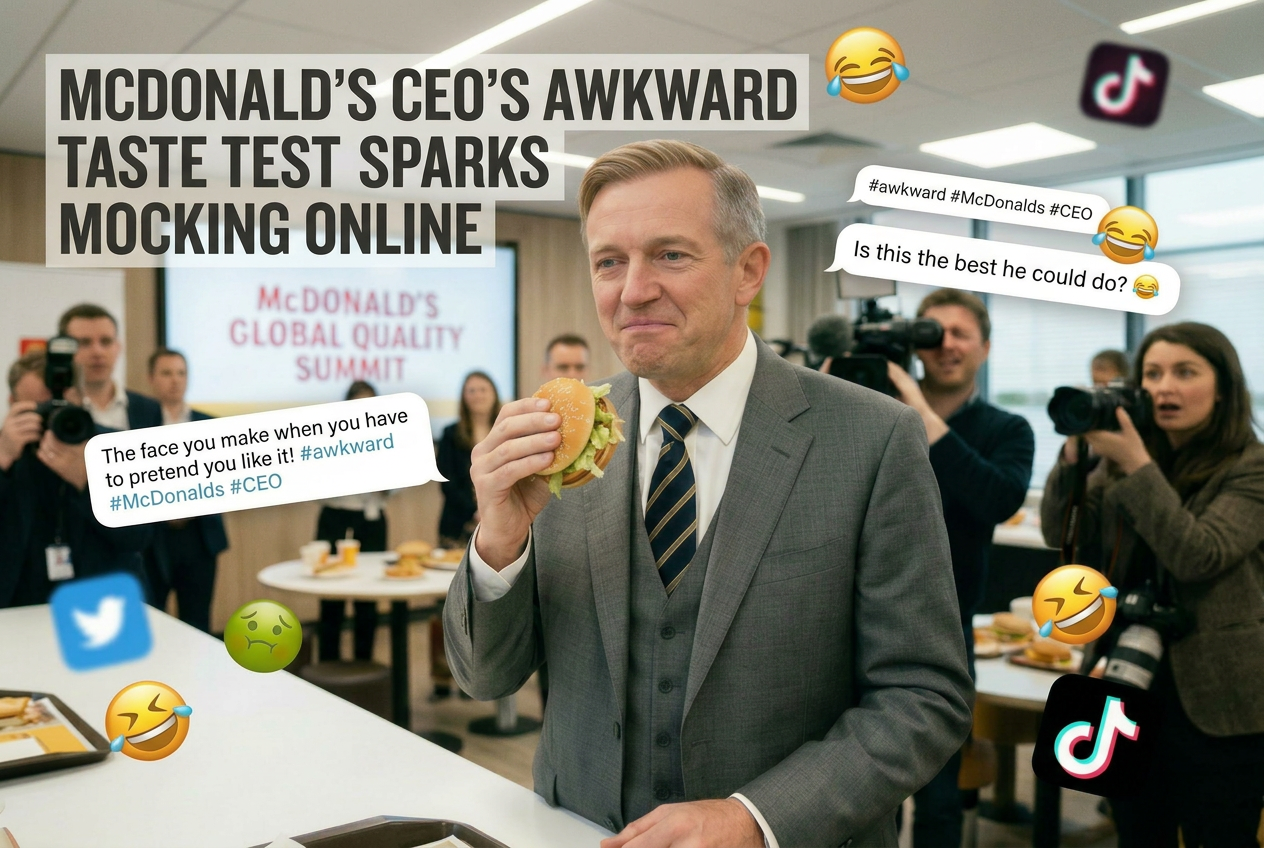
A recent attempt at creating a viral marketing video for McDonald’s ended in disaster when the CEO appeared in a taste-testing video for the Big Arch Burger that many viewed as a “stiff” or “overly corporate” moment. The CEO, Chris Kempczinski, was promoting the new Big Arch Burger, which is a large-format burger offering that features two quarter-pound beef patties, three slices of white cheddar cheese, crispy and slivered onions, pickles, lettuce, and a new Big Arch sauce. This large-format burger is a direct competitor to similar offerings from rival fast-food chains.
A Limited Time Push That Backfired
McDonald’s is using a “limited time” promotion to create buzz and to get people talking about the new Big Arch Burger. The video was intended to showcase Kempczinski eating the burger and to show his enthusiasm for the product.
However, the video did not go as planned and created a viral sensation as a result of the CEO’s stiff and overly corporate mannerisms during the taste test.
The Two Moments People Couldn’t Stop Talking About
The video featured the CEO referring to the burger as a “product,” a term that is normally associated with internal corporate meetings rather than eating a burger.
Additionally, when the CEO took a bite of the burger, it was very small compared to the size of the burger and he admitted that he was unsure of how to “attack” the burger due to the sheer amount of food on it.
These two elements combined created a comedic moment that was quickly picked-up and parodied by comedians and social media influencers across the globe.
Why The Internet Reacted So Quickly
There are many reasons why the internet reacted to the video so quickly. First, the majority of viral reactions are not based solely upon one “mistake.”
Rather, they are based on a disconnect between what the viewer expected and what they perceive they are seeing.
In today’s world of social media, particularly on platforms such as TikTok and Instagram Reels, users view a vast array of food content.
This content is generally categorized into four main areas: 1) genuinely enthusiastic, 2) deliberately critical, 3) self-aware, and 4) none of the above.
The Kempczinski video fell into the fourth category, as it had all the trappings of a casual, relatable taste-test video, but it felt staged and overly cautious.
When this occurs, many viewers tend to label the content as “inauthentic,” even though the person appearing on the video may simply be nervous, formal, or shy in front of a camera.
Once the audience perceives the content as “inauthentic,” the content is no longer viewed as a form of advertisement, but rather as a form of entertainment, and therefore subject to ridicule.
The “Product” Word Choice Problem
Another factor that contributed to the rapid spread of the video was the use of certain words that detract from the viewing experience.
Specifically, the CEO referred to the burger as a “product” several times throughout the video.
While this term is commonly used within corporations to refer to products or services, it is not commonly used by the average consumer to describe a burger.
Therefore, the use of this term pulled the viewer out of “the experience” of eating a burger and placed them back into “the corporation.”
A Classic Mismatch Between Context and Language
The use of corporate language in a social media video is a classic example of a mismatch between the language and the context in which the language is being used.
Such mismatches can create a tonal whiplash, and therefore make the viewing experience less enjoyable.
Furthermore, the visible hesitation the CEO displayed when taking his first bite of the burger was also misinterpreted by many viewers.
While the hesitation was likely caused by a fear of being seen eating a large portion of food, many viewers interpreted the hesitation as a sign of reluctance.
Reluctance is a far more damaging interpretation than simply being seen eating a large portion of food.
What The Big Arch Burger Is Supposed To Be
The Big Arch Burger, along with its marketing campaign, was created in order to provide McDonald’s with a unique and competitive edge in the market.
As previously stated, the Big Arch Burger is a large-format burger offering that provides customers with a premium-feeling option within McDonald’s flavor universe.
On McDonald’s U.S. website, the Big Arch Burger is described as a limited-time meal that includes two quarter-pound beef patties, three slices of white cheddar cheese, crispy and slivered onions, pickles, lettuce, and a new Big Arch sauce that is described as tangy and creamy with mustard, pickle, and sweet tomato flavor notes.
The meal pairing, including medium fries and a medium soft drink, is priced at 1,610 calories.
A Branded Move In The “Big Burger” Space
As stated earlier, the Big Arch Burger is designed to provide customers with a unique and competitive product in the “big burger” space that consumers normally associate with fast-food rivals and premium add-ons.
In essence, the Big Arch Burger is not only a food item, but it is a branded move by McDonald’s to signal size, indulgence, and novelty while remaining recognizable as a McDonald’s product.
The CEO-In-Social Trend And Why It’s Risky
Over the last few years, a growing number of CEOs and senior leaders have begun to appear in social content in an effort to attract talent, increase transparency, and establish themselves as more accessible to their customers.
In theory, this makes sense: a CEO can cut through the noise because they are important; their presence will signal confidence in the product; and they will create a sense of access – you’re seeing behind the curtain.
However, this type of marketing only works when the on-camera presence of the CEO feels natural.
Many executives excel in investor calls, strategy discussions, and internal communications.
However, these skills do not automatically translate to short-form video, where the audience expects quick pacing, a relaxed tone, and an almost improvisational feel.
When an executive fails to connect with the audience in a video, the backlash can be more severe than it would be for a traditional ad, since the audience believes they are reacting to a real person, not a brand concept.
When the person is the CEO, the internet views the clip as symbolic.
Viewers interpret the clip as “what the company is,” not “what this ad is.”
What People Were Really Criticizing
Ultimately, the criticism of the video centered on the perceived distance between corporate leadership and the everyday customer experience.
The criticism was not primarily directed towards the ingredients, price, or appearance of the burger.
The criticism was whether the CEO appeared to be the type of person who would eat McDonald’s casually.
This is a sensitive perception issue for any mass-market brand.
Fast food relies heavily on routine.
Customers need to believe that the product is something that normal people would choose to eat because it is satisfying, consistent, and familiar, not something that the company is “pushing.”
The Assumptions Social Media Rewards
When the CEO appears to be hesitant, customers are likely to assume: He doesn’t eat this food; He is only here because marketing told him to do it; The burger is more about corporate strategy than customer desire.
These assumptions may be unfair, however, social media rewards snap judgments, and once a narrative forms, it spreads faster than nuances.
Why “Awkward” Can Be Worse Than “Bad”
It is relatively easy to think that the biggest risk for the company is a negative review, someone saying a burger tastes terrible.
However, “awkward” can be worse than “bad” for a number of reasons.
First, awkwardness invites participation.
Users can remix awkwardness in countless ways: reaction shots, caption jokes, stitched commentary, and parody reenactments.
Second, awkwardness is safe to mock.
Users can participate without feeling like they are accusing the company of anything serious.
They are simply laughing at the awkward vibe of the video.
This is why these moments can explode so rapidly: they are low-risk engagement with high-entertainment value.
What McDonald’s Can Do Next
The company has three primary options regarding how to react to the viral nature of the video.
Option 1) Do Nothing
Option 1) Do nothing and allow the cycle to run its course.
Internet attention spans are short, and most viral moments dissipate quickly as new content emerges.
The downside of doing nothing is that the company’s failure to respond may be interpreted as a lack of confidence in the product, especially if the video continues to be referenced each time the product is discussed.
Option 2) Leverage The Meme
Option 2) Leverage the meme.
If done correctly, acknowledging the meme and demonstrating that the company is aware of the joke can convert the negativity surrounding the video into positive publicity.
However, if the company attempts to force a meme, it may exacerbate the situation and lead to further ridicule.
Option 3) Shift The Campaign To Creators And Customers
Option 3) Shift the focus of the campaign to food-centric creators, employees, or customers.
By focusing on individuals who are more closely aligned to the product and who can provide a more authentic “this is what it tastes like” experience, the company can avoid the embarrassment of the initial video.
This does not require a public apology or a significant corporate response.
It simply requires a change in the way the company presents itself to the public.
The Bigger Lesson For Brands Using Short-Form Video
Regardless of the option the company chooses to pursue, the bigger lesson learned is that short-form video is not merely another form of advertising, but rather a cultural platform.
On these platforms, viewers do not merely judge the message.
They judge the messenger.
When a CEO is the messenger, the audience judges the CEO, not merely as an advertising spokesperson, but as a representative of the company.
When a CEO is perceived as not being connected to the culture of the brand, the audience is more likely to question the legitimacy of the brand and ultimately the quality of the product.
Therefore, for companies seeking to utilize short-form video as a marketing tool, it is crucial that the format of the video aligns with the personality and characteristics of the CEO.
If the goal is to convey enthusiasm for a product, the video must appear to be casual.
If the goal is to convey a polished message, the CEO may be more effective in a longer-form video format where his natural strengths can shine, i.e., clarity, credibility, and leadership.
What The Big Arch Burger Will Be Remembered For
Ultimately, whether or not the Big Arch Burger generates a significant amount of buzz and attracts a loyal following remains to be seen.
However, the marketing efforts surrounding the Big Arch Burger, both in terms of the video and the product itself, will undoubtedly create a lasting impression on the minds of consumers.
The Big Arch Burger will either be remembered for its unique features and taste, or it will be remembered for the awkward marketing video that promoted it.
Either way, the episode serves as a reminder that the marketing efforts of a company in the modern era of social media are not only evaluated based on the quality of the product itself, but also on the image presented by the company to the public.