
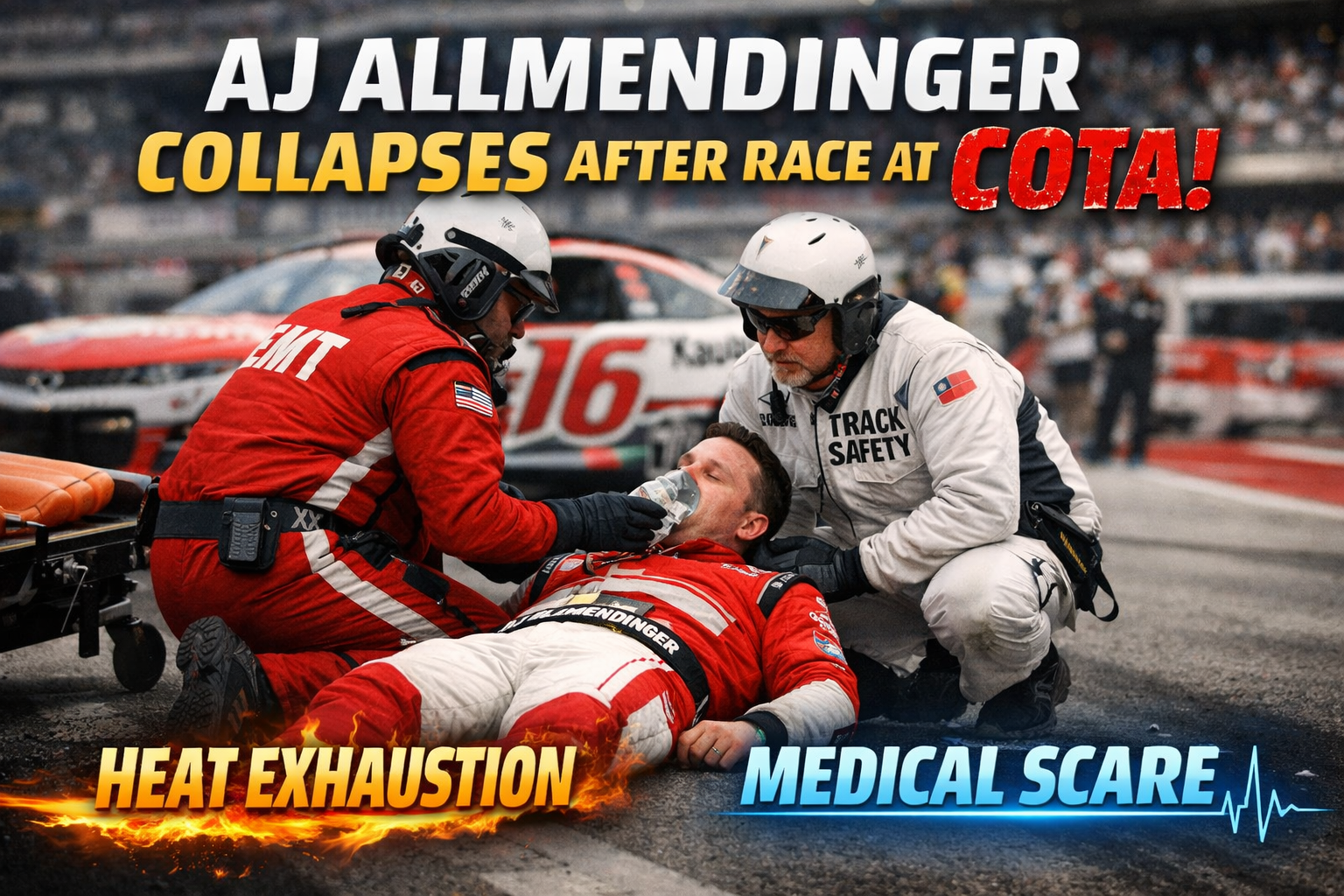
AJ Allmendinger required medical help following Sunday’s NASCAR Cup Series race at Circuit of the Americas (COTA) in Austin, Texas, having collapsed shortly after exiting his No. 16 Kaulig Racing Chevrolet. Track safety workers tending to him near pit road and taken him to the infield care center.
It happened at the conclusion of a physically-demanding road-course event that ran green for long stretches, with drivers navigating heavy braking zones, frequent changes of direction and blazing cockpit heat. Allmendinger still finished mid-pack, among the top 10, but the scene became one of the day’s troubling sights for fans and teams alike.
This is what we know so far, what might have led to it, and why the heat management aspect of a driver’s weekend remains a familiar topic of conversation whenever the Cup Series visits COTA and other warm-weather venues.
What happened after the checkered flag
There were reports trackside of Allmendinger going to the ground shortly after the finish, with safety and medical personnel gathered to help. He was taken to the infield care center, on a stretcher – a precautionary move for any driver who has shown alarming signs and needs an urgent evaluation away from the prying eyes of a pit lane full of bystanders.
Initial reports centered around some sort of cooling-system problem in the car.
One source indicated that Allmendinger’s cool suit had failed in the car, leaving the driver fighting climbing body temperatures with little recourse other than pacing and keeping hydrated. Kaulig Racing later said Allmendinger had been taken to and released from the infield care center, implying all was well but questions remained as to what happened in the first place.
The race context: a tough day at Circuit of the Americas
The Cup Series raced 95 laps on COTA’s short course, a layout that crams in a Formula 1-spec complex into a NASCAR length event—a rhythm track, big braking into Turn 1, a number of low-speed corners, long stretches with tire wear and trying to manage traffic with less of the “rest” provided by an oval’s continuation of pattern.
Sunday’s race featured long stretches between cautions and not many chances for a “natural” cool-down. That matters at road courses because the physical workload never stops: the wheel is never static, the brakes are under heavy load, and mistakes are immediately rewarded with track limits and runoff areas that can still cost time.
Tyler Reddick won, Allmendinger was ninth.
Why heat and hydration is a constant battle in stock car racing
Even on relatively mild days, the inside of a Cup car can be super hot compared to ambient air. Drivers are layering fuel-resistant fibers and gloves and a helmet, and are working the car hard for almost three hours.
When the Green Flag is staying out, it only gets worse—fewer cautions mean fewer chances to drink and refocus and let any airflow do meaningful work. It also means that any minor issue with cooling becomes a major issue, because the driver is unable to just “hang on” another couple of laps until a yellow flag comes out.
That’s why teams treat heat management as part of the performance package. It isn’t just about comfort. Overheating and dehydration can slow reaction times, lead to more cramping, and impair fine motor control just when a driver needs to be as precise as possible.
How the cool suit works and what can go wrong
Most drivers rely on a “cool suit” system where cold water is pumped through tubing in a shirt or vest worn under the fire suit. There’s usually a small pump, a reservoir (sometimes full of ice), and tubing routed to run cold water across the torso.
When it’s working, it can be the difference between a driver who has enough sharpness late in a run and one who is simply hanging on until the next pit stop. When it fails, we are down to the remainder of the human body’s tools: hydration, airflow, and pacing. Airflow is limited by car design and safety, and pacing is impossible when the driver is fighting for position.
There’s also an adrenaline component- a driver can be functional as long as the car is moving and the brain is locked in task mode, then hit a wall after the checkered flag flies when no further workload is required and the body “catches up.” That timing fits why we often see heat-related trouble look worse at the end of races than during them.
A COTA example closer to the incident illustrates how easily this can turn into a medical situation.
In 2025, Brad Keselowski was treated and released after a cool-suit failure at the same track, also being carried from pit-road on a stretcher before getting care.
Why the stretcher doesn’t mean “catastrophic”
For those on the couch, stretcher coming out means the worst has, indeed, guaranteed occurred. In reality, in motorsports medicine, it can be simply a choice to mitigate risk in eval speed.
Dizzy and weak, or overheated, or low BP? Standing on the yard of bricks and walking is a problem. Laying the driver out prone gives care teams a platform to monitor vitals, secure them, and quickly transport to a controlled environment where they can cool and be properly evaluated.
That’s where an infield care center comes into its own, simply existing to let its staff evaluate for heat stress and look for head/neck concerns, and then decide whether they need fluids, observation or a ride off-site.
Allmendinger’s day on track before the collapse
The timing of Allmendinger’s incident makes it particularly jarring as far as his day on track was going well. He qualified seventh and arrived in the weekend billed as one of the sport’s road-course specialists, even if newer road aces are getting a bit more spotlight in recent PR. If the cooling aid goes away, there’s rarely an option to “pit and fix it” that doesn’t essentially destroy that race day’s effort.
Why COTA aggravates the physical punishment
COTA is a bracing course for drivers even by road-course standards, because of how it compacts its stressors into the flow of a lap. The steep climb into turn 1, a heavy-braking tight corner where they routinely out-brake each other, comes first. The middle sector strings together changes of direction that keep the driver’s hands and core muscles racing. The final sector can be a test of traction and patience, sometimes even late in a run when tires are fading.
Then there’s the stop-start nature to the rhythm. On an oval, you can find a rhythm in how you’re driving and you can breathe on the straights. At COTA, you’re right back in a braking zone.
If that day is a warm one, it can push the body to that narrow margin where equipment reliability becomes a matter of safety. That’s one of the reasons why heat evaluations on the driver at the racetrack have become visible again across the NASCAR national series recently.
How you try to prevent heat-related stuff
At Cup level, heat preparation is treated like any other reliability item: you’ll pressure test pumps and lines, confirm the connector/quick disconnect is seated, and you make sure the driver has enough ice capacity and water capacity to go for an extended green run. The drivers pitch in, too. Many work on heat tolerance in training and are disciplined about hydration all weekend and not just on race day. The objective is to be at the green flag already “topped up,” because the car environment will often prevent recovery once the body starts to fall behind.
There is also a strategy component here. If a driver mentions a cooling issue early, at that moment a team must decide whether to pit in order to attempt to fix a problem, or adjust the strategy in order to create a short break, or keep the driver moving forward and hope/doubt it gets better. On a road course, especially if position can be everything and passing situational, that is not an easy call.
What we still don’t know
What is publicly known right now is the visible manifestation of needing assistance to leave the car, followed by a trip to the care center post-incident. What is less clear is whether it was simply a case of the cool-suit failing, something else raising cockpit and driver heat, a hydration issue, or a combination.
It is common for teams to also not share more information than the bare bones. Unless a driver goes directly to the fans to clarify, a team may only say “heat-related” or “cooling issue” while quietly toiling away to fix whatever hardware needs selecting before the next event.
The bigger picture: Heat management as a driver safety and competition issue
Heat, like other aspects, should not always be resolvable by “just tough it out.” It shows up at many parts of the car: airflow into the cockpit, ducting, the locations of driver comfort systems including cool-suits, and the trade-offs for openings to the outside world versus achieving proper aerodynamics.
There’s a team balance as well. Additional cooling systems, such as cool-suits may introduce complexity and have a chance of themselves failing, while additional ice and water weight and package issues in the car. And any trick solution to obtain airflow always has to be mindful of the level of “equalness” imposed by NASCAR rules.
There is risk there to further dial down; improved reliability standards, more uniform practices, and continuing the study of cockpit conditions with a notion toward longer green flag runs ahead—as well as where the best spots are for airflow—could help reduce things more. On the other hand, the road course trend implies a more urgent environment ahead, with turning conservative drivers into more and batter specialties with, in many cases, fewer laps where a driver can “settle in” and find rhythm.
What to watch next
The question now for Allmendinger is whether he mentions anything lingering on a personal or team or car documentation level or whether the team comments more about what component or part failed them. In 80% of the instances like this, teams will troubleshoot their equipment, double down on their checklists before the next event, and move on unless they feel this needs to be treated as something more than just a one-off.
On the competitive line, Allmendinger acted the way a man who can threaten on road courses can when he went out and finished where he needed to finish. The speed was there, too, if you will.
For the fan on the other side of the fence or the internet, what is most important for information about this is the post-race nugget: he was evaluated, cleared and released, from the incident. That and any other data he tells us on his side of the air we should probably hold on to.