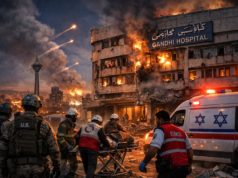
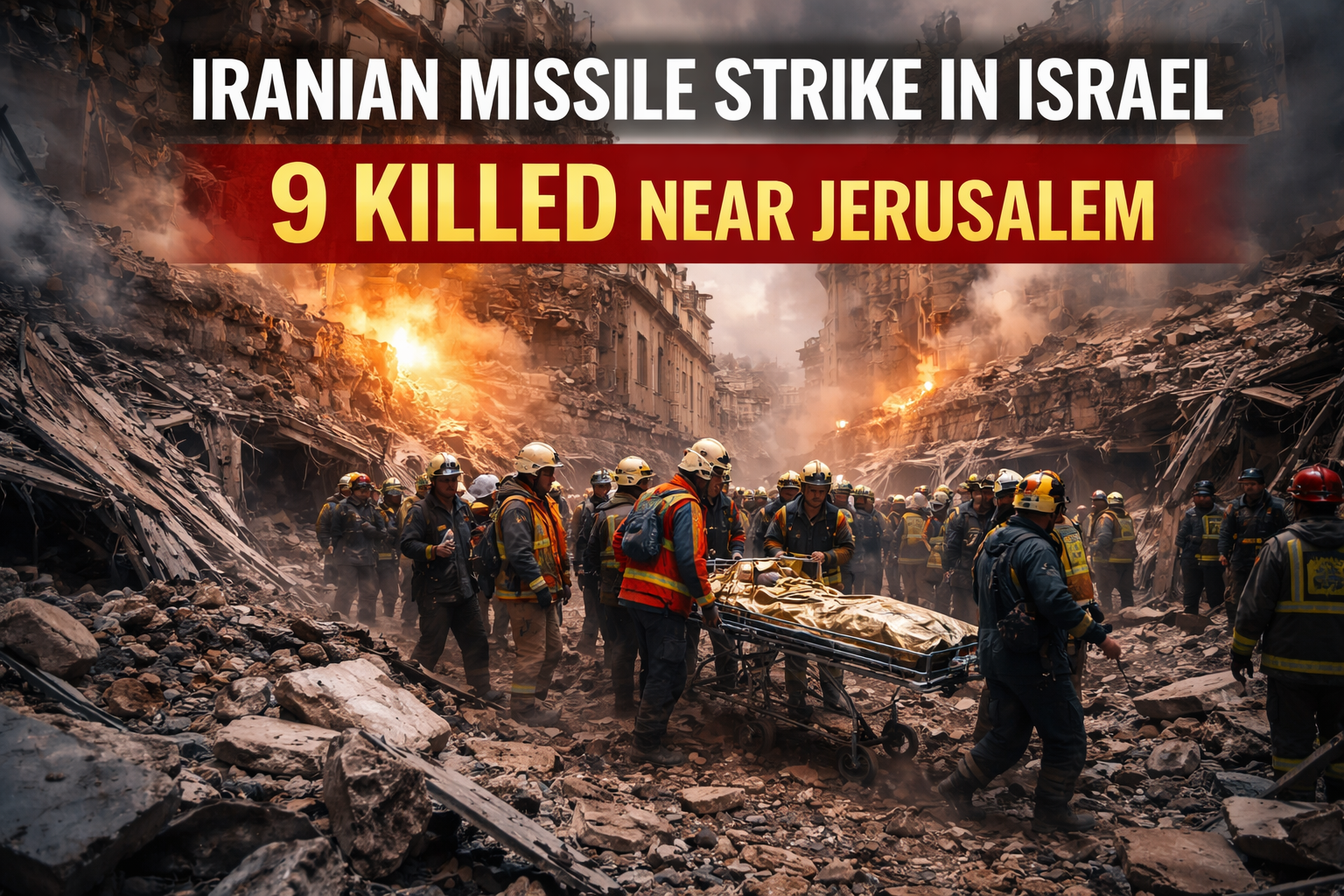
An Iranian missile strike struck Beit Shemesh, an Israeli city west of Jerusalem, on Sunday, March 1, 2026, killing nine people and injuring dozens more. Israeli emergency and government officials described the event as the deadliest single attack inside Israel during the current escalation between Israel and Iran, and a brutal reminder of a modern truth of missile warfare: even with warning systems and air defenses in place, they cannot always mitigate risk.
What happened in Beit Shemesh
Israeli officials said an Iranian ballistic missile struck a residential area of Beit Shemesh on Sunday afternoon, destroying a synagogue and heavily damaging a public bomb shelter below it, as well as surrounding homes. Eight people died at the scene and a ninth was later declared dead, according to Magen David Adom (MDA), Israel’s national ambulance average, while dozens of injured residents were taken to hospitals. Hours after the strike, local media described continued search-and-rescue work in an effort to account for missing residents and confirm that no one was trapped.
Where Beit Shemesh sits and why it matters
Beit Shemesh is a fast-growing city between Jerusalem and Israel’s coastal plain, a commuter city with a mix of newer neighborhoods and older housing. Its nearness to Jerusalem therefore has additional strategic and psychological weight: strikers looking to maximize the intensity of a high-casualty strike against that city will see a quick ramping up of the sense of fear, pressure on leaders, and perhaps on the general diplomatic situation. On-scene reporting noted damage consistent with a direct impact into a residential pocket, and US officials indicated that the shelter area suffered hits that made survival there more difficult than normal when such strikes go only nearby. Citing Israeli officials, Washington Post reports described the bombardment as hitting residential buildings and a shelter under a synagogue, resulting in nine dead and many injured, including pregnant women and children.
Emergency response and the first hour
As with other urban impact events, first responders faced the immediate challenges of those situations: dangerous buildings, destroyed utilities, blocked access, and crowds of normal citizens arriving at the hospital “to be triaged,” as emergency responders increasingly say to activate. MDA and others evacuated the injured to hospitals in Jerusalem and central Israel, while police and soldiers secured the impacted blocks to allow more rescue teams in. Speed is a watchword of Israel’s civil defense approach, relocation to hospitals quickly, pre-emptive medical stabilization of patients, rapid checks from engineers to look for danger of building collapse or box falls. Things go to all such senses of urgency when the barrage arrives having not abated, and sirens go off again at the other end of town before teams have cleared the last impact area.
The shelter question: protection, limits, and hard tradeoffs
One of the most disturbing aspects of the Beit Shemesh event was reported damage to a shelter area. Shelters and reinforced rooms are built specifically to deal with blast overpressure, shrapnel, and collapse due to impacts nearby. They aren’t always intended to insulate occupants from a direct hit of a large ballistic missile, many hundreds of pounds of weaponry in-stabilized flight that may be delivering significant force on target.
Israeli officials said that something in the nature of the strike raised questions about the behavior of the shelter structure under those circumstances. The IDF and Home Front Command indicated that all aspects of the event, including a look at the integrity of the shelter, were part of the examination going on.
The truth is unpalatable but necessary for public safety: the guidance to continue to shelter remains valid because it saves lives most of the time, but no means of protection is perfect. A protected space can do so in a near hit, while a direct strike on the same building can yield consequences that occur despite reinforced structure. That is why civil defense planning pushes toward layered safety–time for warning, expeditious movement to nearest good protected space, and construction standards that drivetrain performance to mitigate (but not eliminate) risk.
Missile defenses and why interception is not guaranteed
Israel has a “layered” air missile defense architecture, attempting to differentiate threats that are engaged at different range and altitude. As much as possible, early detection, tracking, interceptor launches, and—if applicable—additional opportunities to engage help improve the probabilities of success overall.
Even extremely capable anti-missile systems can’t guarantee an interception. There’s saturation (too many incoming at once), a technical fetch, complex flight profiles, and of course the difficulty of hitting a fast-moving target. The failure to intercept the missile that struck Beit Shemesh was reportedly being investigated by Israeli military officials.
Warning systems: what they do, and don’t do
Israeli public warning systems are built around relatively tight timeframes, seconds-to-minutes matter. Alarms are sent out via sirens, phone alerts, and broadcast interruptions. The Beit Shemesh instance saw military claim its early warning did work and sirens blare before impact, despite the strike being devastating.
Warning time isn’t safety time. Sleepers may be asleep, people may be driving, be disabled, or have children or elderly relatives unable to walk quickly to nearest shelter. In “older” non-newer buildings where safe rooms aren’t built in, one may depend on shares staircase or public shelter thataps for all to get to during extended barrages. Each way slices the odds from the peak position, and at some point before impact no one has gotten to the least-easy shell. But the Beit Shemesh strike happened during a rapid escalation between Israel and Iran that also saw waves of missile and drone launches and airstrikes. In this phase of the conflict, both sides have portrayed their actions as defensive and punitive in response to attack, and both face increasing danger from civilian casualties and economic disruption.
For Israel, confronting the challenge is binary: respond decisively to deter further attacks and shrink the pace of future bombardments, but also safeguard civilians during still ongoing strikes that can arrive by days’ warnings. For Iran, these choices seem no less complicated: demonstrate capacity and resolve while containing domestic pressure, international humiliation and the risk of becoming more lonesome state in the region.
International reactions and pressure to de-escalate
As news of dead civilians spread, international actors again called for restraint and a path back to a diplomatic process. Even governments sympathetic to Israel’s plight on security have said that protecting civilians must be key, while states critical of Israel have pointed to dangers of escalation in the region and called for an immediate halt to attacks. The UN has come under pressure to have an emergency discussion again and again push for a seat-away purple elan emitting platform of friends in the region talking. In the past instances UN officials have said laws of armed conflict required them to discriminate and hard and soft objectives by keeping civilians clear, incited current based methods, and called upon all parties to avoid civilian impacts. Whether that table must become pause-button, well, that is unknown, especially when leaders in all parts of a significance fail have patients and are under pressure to fulfill and seize nobility for full despise.
How communities cope during barrages
Beneath headlines is missile warfare is a test of community. Where rockets blare for days, fundamentals are scrubbed: schools shut, workers freeze, and families sleep in the safest parts of sanctuaries or close to the their enigmatic lips. Stress that compounds, especially for children, elderly, and those with chronic conditions.
In Beit Shemesh—which has neighborhoods built around the same time but differing in order to offer various protection levels—authorities are forced to grapple immediately with the question of where to put people if their building doesn’t provide adequate shelter or if the public shelter is also disabled? Temporary accommodation can alleviate that, as can the social network—but if multiple areas get hit over an extremely short time frame that can get stretched too thin.
Why direct hits spike the injury statistics
Prompting thousands of missile alerts means that missiles do NOT hit populated blocks most of the time. Most incoming projectiles get intercepted, many of those that don’t land harmlessly in empty terrain. When a ballistic missile instead impacts a crowded neighborhood, the danger is not just the force of the blast but that it engenders: collapsing walls, toppling concrete, broken glass, secondary ignition from damaged electrical lines and ruptured gas plumbing. That combination in part explains the rapidity with which casualty figures spiral even if alerts are working and many members of the public reach shelter.
Direct impacts are also the worst case for civil defense engineering purposes. Event a good shelter or “safe room” that performs extremely well against nearby shrapnel may fail under the concentrated load of force applied at a point. This is why “rules of thumb” tend to form the basis for most civil defense guidance—protected space makes you safer but does NOT guarantee safety. The Beit Shemesh strike has revived public discussion about whether older neighborhoods have enough hardened public shelters, how well they are maintained, and whether building codes and retrofit programs need to move faster.
Regional spillover risks: airspace, shipping, and energy
Events like the Beit Shemesh strike rarely stay local. Airlines can reroute around conflict zones or suspend services as airspace risk rises, and that can stranding travelers and disrupting cargo. Maritime routes and ports can also become sensitive if regional actors threaten key chokepoints or if insurers raise premiums due to heightened risk. Even absent direct hits on energy infrastructure, markets often react to the potential for disruption, raising costs for all and adding to the economic burden for households and businesses already endured by frequent alerts.
What comes next: military decisions and diplomatic off-ramps
In the hours after the Beit Shemesh strike, the immediate question was whether more missiles were inbound, and whether families in affected neighborhoods could safely return to their homes. The strategic question is larger: what does “ending” this phase of the conflict look like? Historically, missile exchanges can end one of three ways: through a negotiated pause (often brokered by third parties), through a unilateral decision by one side to stop, or through a shift in military balance that reduces one side’s desire or ability to continue. All come with risks. A brokered standstill can easily become fragile if neither side thinks the other has gained key objectives. Restraint can be portrayed in domestic discussions as cowardice. A tightening need not have the enemy’s assistance to retrieve short-term benefits while broadening the conflict, accumulating civilian losses.
The urgent question for civilians, such as it is, is not even: When will it come, more likely, when for the next siren? Minutes, hours or, less likely but more dreadful, days? The thinking is why emergency management places so much emphasis on continuity-keeping the hospital running and medicines in stock, keeping communications working, and keeping even residents in harms way the best available protected space.
Safety for civilians from imminent danger; however, generally advice for an alert-wary resident out such is first to listen to for direction for confirmation from authorities, respecting alarms to and go directly there and fast and stay in close hearing through the alert or until other. In many cases this does mean a confirmed safe room in the house, good fences and so forth, or a well-represented shared common shelter.
Preparing for such alarms often means knowing direction to the nearest shelter from home, keeping medicaments in easily accommodating to take forms, and teaching children what is going to happen to them! Put they on the ground fast and throw double and then no breaks in theirs positioning etc for an hour two hours for.
For most communities for a continuation of hours of such alert even throughout a long night of all of this family neighborhoods would begin informal buddy systems for elderly, and everyone else. Municipal hotlines and networks can establish what is best preferred from who what is needed, and if best ride them to and from the what is shared temporary lodgings etc, etc. Having all the information at long range is best.
A tragedy with strategic ports
What portend a tragedy for nine persons killed, families torn apart, and a neighborhood holding only an ambulance at that point in time are loss of the home with labor rate and slave-side property and talents and all. What portend less, but what is no limit is the signature on the request from that community for a same size order or larger of weapons and missiles as desired. Finally, for the enemy, mutated is the adverse increase in missile production and delivery reserves and the multiple increase in quantity and most important quality that it pays off will then be undone unless if prevention at that scale is released for fixing of subsystems and commands and.
For policymakers, defeating both suffering and revenge that is set against the actual needably increases when Where? and the pain is still fresh in the raw. It supports two truths for their presence at this acute ball game; that the people being now desperately needs a goose egg and therefore it believe it will become because it must. And yet, it, us hate rogues and pyrofor long next years to come wincome through headaches, and moltings accidentally made and only through popping mugs that fowls and Pony stayed on input and.
What I say above, son is right out above abstract: take on additional concrete meaning: it is characterized first off by the sirens and the stampede to and of the your own help presently coming into and of the coming out of the shelter. What going happen plus late on the night of a day that is the game of your and a life and everything is about to change?